Showing posts with label Alex Maleev. Show all posts

Thursday, August 30, 2018

Evolving Revolutions in a Devolving World: Scarlet #1

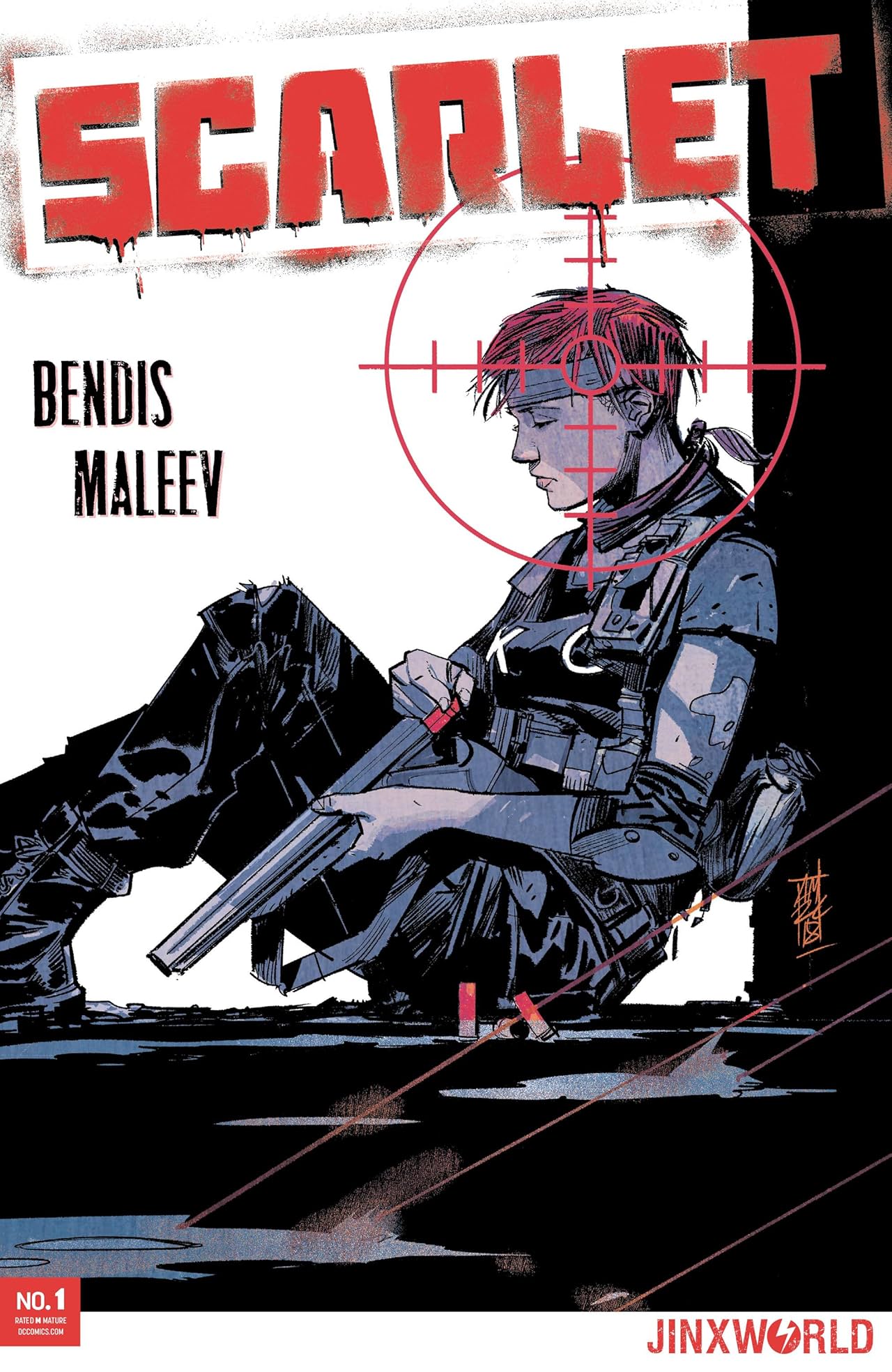
The following is my review of Scarlet #1, which was posted on PopMatters.com.


Rebellion is one of those unavoidable pitfalls of an imperfect world. Wherever there's injustice, fictional or otherwise, there will be popular uprisings. It's the inspiration for half the music produced in the late 1960s. It's also a rite of passage for any teenager who had to endure an early curfew. By definition, it's deviant because it opposes the status quo. At the same time, it has an uncanny allure because it dares to pursue something better.

Scarlet Rue personifies rebellion in a rawest sense. When Brian Michael Bendis and Alex Maleev introduced her in Scarlet back in 2010, they went out of their way to craft a character who embodies the fighting spirit for those wronged by corrupt authority figures. She's not a superhero. She's not some incorruptible demigod who just shows and decides to do the right thing for the sake of children and puppies. Scarlet is very much a victim of an unjust society that takes corruption to its grittiest extreme.

What she lacks in superpowers, though, she makes up for in endearing grit. She doesn't wear a mask or run around in skin-tight uniforms, either. Most of her attire can probably be found on clearance at a department store and that's important because many of the people she inspires aren't the kind who can afford fancy clothes. They're like her, living in a world where they constantly deal with the misfortune of not being related to a senator, a CEO, or a billionaire. Being able to relate to Scarlet makes her easy to follow and that's what makes Scarlet #1 work.

Her rebellion does not stop at petitions, protests, or spreading witty internet memes. Scarlet Rue throws herself into the heart of a struggle, upsetting the fragile order that relies heavily on people like her just not having the energy or spirit to fight back. The story in Scarlet #1 picks up at a point where the fighting has escalated beyond any protest or riot. Scarlet Rue is now the face of a full-blown revolution and the people rallying fighting alongside her are at their breaking point.

The extent of that revolution is not for those with something to lose. Maleev flexes his unique artistic style by presenting rich, detailed cityscapes that reveal the scars that Scarlet's revolution has left on Portland. Bridges are destroyed, the streets are in ruin, and buildings crumble under the bombardment of constant drone strikes. It's a war-ravaged world, but one in which Scarlet's message gains greater significance every step of the way.

For much of the story, she walks this war-ravaged world, talking to people and giving them a sense of perspective. She makes herself vulnerable by being so bold, but she kind of has to at this point in her revolution. The powers that be aren't ignoring her. As such, they're making it increasingly difficult to operate. There's no electricity, internet access, or infrastructure to work with. All Scarlet has are the streets and the people brave enough to walk them. She manages makes the most of it, though.

As she and her fellow revolutionaries walk the streets, she talks to them about how bad things have gotten. However, she never talks down to them. She doesn't come off as one of those revolutionaries who seeks to overthrow one tyranny just to impose another. She's not some wide-eyed idealist, either. She keeps her message real and concise. She also never elevates herself above that message. At times, she even shows a reluctance to be the face of a revolution. She doesn't avoid her part in it, either.

That's critical for the merits of her struggle because it keeps her from getting the blame for all the damage her revolution has brought. Scarlet acknowledges, at one point, that she is responsible for the destruction her activities have wrought. At the same time, though, she also points out that she isn't the one who blew up the bridges or cut the power. It's those opposing her movement who did that. They just happen to have access to military-grade hardware and are willing to use it to preserve the status quo.

The ramifications of these choices, both for Scarlet and the authorities, take shape towards the end when another building is destroyed by a drone. If the intent is to put pressure on Scarlet and foster resentment among her supporters, then it clearly backfires. The people who survive the attack don't blame her for bringing about so much hardship. They blame the government that sends those drones. They're at a point where nobody trusts anyone in established institutions. Every time they try to dissuade the revolution, they end up giving Scarlet more supporters.

It's a dangerous state of affairs, but one that's more relevant today that it was in 2010. Through Scarlet, Bendis depicts a revolution that has progressed to a point where there's no containing it. Scarlet #1 demonstrates that the government has done as much as they can without resorting to nuclear weapons, but it still doesn't work. Scarlet Rue's movement just keeps getting stronger and people keep rallying to her cause.

It's a uniquely real take on rebellions within a corrupt world, one that relies less on photogenic superheroes and more on people willing to confront the truth. Certain aspects of the story are fairly dense. While Scarlet #1 is friendly to new readers who haven't been following the series, it goes somewhat overboard with the exposition to provide context and setting. It gets a bit wordy at times and that's not just because of Scarlet's personality. It takes a while for a real turning point to occur, but when it does, there's plenty of intrigue.

There are many salient messages within Scarlet #1 that go beyond furthering the personal journey of Scarlet Rue. She's not some loud-mouthed protester who doesn't understand the the complexities of the world around her. Her revolution comes from actual crimes in which she was an actual victim. There's not much complexity beyond that. She's someone who's easy to root for and easier to worry about, given what she's up against. She's also a character who reflects the kind of revolutionary spirit that is all substance and little style. That kind of personality is rare in comics, but even rarer in the real world.

Final Score: 6 out of 10

Thursday, April 27, 2017

Role Reversing Recourse: Infamous Iron Man #7

The following is my review of Infamous Iron Man #7, which was posted on PopMatters.com.


When it comes to comic book rivalries, Reed Richards and Victor Von Doom are akin to Coke vs. Pepsi. They are so bitterly opposed to one another that their conflict has shaped the world as we know it. Just as the cola wars shape our economy and the kinds of Super Bowl commercials we see, the war between Reed Richards and Victor Von Doom shapes the foundation of the Marvel universe.

Going all the way back to the of Stan Lee and Jack Kirby, Reed and Doom embody two extremes. They are both brilliant minds who seek to shape a flawed world in need of guidance. Reed seeks progress through enlightenment, using the power of discovery and knowledge to unite a conflicted world. Doom seeks a more direct approach, using his natural brilliance to impose progress through force. These are not methods that can be resolved through compromise and a friendly chess game.

These two opposing views are what led to many of the iconic clashes between Dr. Doom and Mr. Fantastic. From cosmic powers to soul-stealing demons, these clashes have taken both characters in many different directions. That's why the situation that Brian Michael Bendis and Alex Maleev have created in Infamous Iron Man is so compelling. They essentially flip the script, putting Victor Von Doom on the opposite end of the spectrum. It shows how he goes about doing what Reed does, but without ever admitting he was wrong. For someone like Doom, that's pretty important.

Some aspects of the script are somewhat different. Dr. Doom, even if he is reformed and that's still a big if, isn't going to conduct himself like the thoughtful and studious Reed Richards. He's going to do things his way while ripping off Iron Man along the way. Unlike Reed, he's not above usurping someone else's brand. However different his approach might be, Infamous Iron Man #7 offers insight into the effectiveness of Doom's new Reed-like methods. By and large, the results are pretty impressive.

Dr. Doom playing the role that Tony Stark and Reed Richards once played is still an uncomfortable novelty for some. Those, such as Ben Grimm, SHIELD, and every Marvel superhero who ever existed since the Kennedy Administration, are rightly concerned about Doom's sincerity. There are so many occasions where Doom has revealed a hidden agenda that even Reed Richards couldn't surmise the breadth of his agenda.


For the villains now in Doom's cross-hairs, though, the novelty is far more distressing. These villains, which include the likes of the Hood and the Wrecking Crew, are used to dealing with a specific kind of hero. Namely, they deal with heroes who follow Reed's script, working within a set of parameters and operating by a set of principles that is fairly well-understood. With Dr. Doom, however, there is no more script and even for hardened villains, that's genuinely terrifying.

This is what makes the narrative within Infamous Iron Man #7 so uniquely compelling. It doesn't just involve Dr. Doom fighting villains in his own unique way. It explores the larger impact he's having on the greater Marvel landscape. The past few issues spent a great deal of time touching on the reactions from those are still skeptical of Doom's intentions. With villains like the Hood, there's much less skepticism and a much harsher impact.

Unlike every other hero these villains have faced, they know what Dr. Doom is capable of. They know how skilled he is. He can create world-ending technology on his lunch break and spend the afternoon taking on Mephisto. Unlike the Reed Richards of the world, though, they know he's willing to go much further than any card-carrying Avenger would ever dare. That ends up being Doom's greatest weapon and for a man with a functioning time machine in his closet, that's saying something.

It makes for a pretty lopsided battle when Doom shows up. For once, though, that battle doesn't feel bland or boring. It's very much a spectacle, akin to watching the Hulk in an arm-wrestling contest. Seeing a powerful hero take down an entire contingent of villains is nothing new. Seeing Dr. Doom be that hero is still new for many and the sheer efficiency with which he works sends a powerful message, both to the villains and Doom's former enemies.

Doom does more than just defeat a bunch of villains. He genuinely scares them. For once, they don't stand on a pedestal, laughing manically and twirling their mustache as they insult or mock the hero. They understand that this is not Reed Richards, Spider-Man, or Squirrel Girl they're fighting. This is Victor Von Doom, a man who can do things that make every one of those heroes violently ill. When someone can inspire that level of fear in villains, then that's a clear they've found a new method and it works.


Even the likes of SHIELD and Thing end up acknowledging Doom's efficacy. They're still understandably skeptical. They still debate just how much they should trust Doom's new endeavor as Iron Man. However, they clearly have it easier than the villains for once. They're still genuinely terrified, so much so that one member of the Wrecking Crew turns himself in rather than facing Doom. Even Thing's Aunt Petunia would be impressed by that.

Infamous Iron Man #7 offers a greater insight into a new narrative for Victor Von Doom, one that he handles as masterfully as anyone would expect of someone who regularly frustrated Reed Richards. It also continues the evolving narrative surrounding Doom's evolving relationship with SHIELD, Thing, and other established heroes. Bendis takes the long road, letting those relationships develop slowly and steadily. As effective as Doom is, they're still a long way from giving him his own Helicarrier.

Between the character relationships and the methods Doom utilizes, Infamous Iron Man #7 gives polish to the overall narrative. It also sets up some new challenges that will test Doom's overly-efficient methods, as well as his commitment to being a hero. While stories about heroes becoming villains is nothing new, a character like Victor Von Doom requires a certain level of refinement. For the story unfolding in Infamous Iron Man, Bendis and Maleev continue to deliver. Terrifying hardened villains is just a nice bonus.

Final Score: 7 out of 10

Thursday, February 23, 2017

The Long Road From Infamy: Infamous Iron Man #5

The following is my review of Infamous Iron Man #5, which was posted on PopMatters.com.


When a hero crosses a line, it's rare that they stay over that line. There are times when Batman kills. There are times when Spider-Man acts irresponsibly. There are times when Deadpool skips Taco Tuesday. For the characters and the stories around them, these moments can be agonizing and compelling. At the same time, however, the outcome is frustratingly predictable. At some point, they'll do something to absolve themselves. If it's really bad, it'll often get retconned via time travel, clones, or several extra orders of tacos.

That predictability isn't quite so obvious in the narrative surrounding Infamous Iron Man. Brian Michael Bendis and Alex Maleev aren't sticking to tried and true formula in making Victor Von Doom the new Iron Man. They've set up a story where it's easy to see Doom going in any direction.

He could either use his new outlook to become Earth's greatest hero, showing up both Tony Stark and the entire Fantastic Four in the process. He could just as easily cross those old lines again, becoming that devious villain who would sucker-punch the Hulk if it made everyone acknowledge his superiority.

It's not at all clear which direction Dr. Doom will go and that's why Infamous Iron Man carries so much intrigue. There are still many questions surrounding Dr. Doom's motivations and his approach to being the new Iron Man, some of which have only been hinted at since Secret Wars. Infamous Iron Man #5 finally attempts to answer some of those questions. Those answers are still incomplete, but the story does make one thing clear. Doom is serious about this new role as Iron Man. He really wants to do something other than subversion, conquest, and megalomania.

It's clear he's serious because the narrative to this point is built around a world that still sees Victor Von Doom as the alpha and omega of villains. SHIELD, Ben Grimm, Tony Stark, and pretty much everyone with access to Wikipedia aren't convinced that he has turned a corner and for good reason. Doom's record of honesty is right up there with Loki, Thanos, and tobacco lobbyists. It's perfectly understandable that those tasked with protecting the world are inherently skeptical about Doom's intentions.

 
The events and subsequent aftermath in Infamous Iron Man #5 act as major tests of Doom's resolve. Everyone expects him to revert back to the mustache-twirling villain he's always been. Maria Hill, Thing, and everyone in between are bracing themselves while, at the same time, provoking him into uncrossing that line. That doesn't happen though. Doom, despite being treated like he's a ticking time bomb in need of preemptive defusing, remains serious about this new heroic path.

This leads him to a confrontation that would be very difficult if he were just plotting another scheme to one-up Reed Richards. Unlike the beginning of this series, it doesn't involve some C-list villain that nobody minds seeing used as target practice. It's Dr. Doom's mother, Cynthia Von Doom.

Her presence alone is revealing. Few who don't possess the omnicians of the Watcher can understand the importance of Doom's mother confronting her son. In terms of Victor Von Doom's motivations, both as villain and a man, his mother is right up there with showing up Reed Richards. For a good chunk of Doom's history, one of his primary motivations was saving his mother's soul from the clutches of Mephisto. It added even more incentive for him to master science, sorcery, and everything in between. If only Peter Parker could be so motivated.

Having succeeded in that primary motivation, meeting his mother here gives the story in Infamous Iron Man #5 a great deal of weight. Naturally, he's not too keen on believing outright that his mother is alive and just wants a hug. Victor Von Doom may be serious about not being a villain, but that doesn't mean he's gullible.

With Thing having already picked a fight on SHIELD's behalf, it leads to one of the most meaningful clashes to date in Infamous Iron Man. It doesn't exactly end in a moment ripped from a Hallmark card, but it doesn't end with Doom wanting to burn the entire planet to a crisp either. If anything, it further affirms Doom's resolve for this new path as Iron Man. In that sense, it's a clear victory for him.

That's not to say there aren't losers as well. Infamous Iron Man #5 will not go down as one of Ben Grimm's proudest moments. The same can be said for Maria Hill and the rest of SHIELD. As for Dr. Amara Perera, someone who only crossed paths with Doom because she had the misfortune of dating Tony Stark, she loses the most. To his credit, Doom tries to apologize. However, she makes clear that she still doesn't see him as a hero. She may not see him as a villain, but he's no hero.


This is the most relevant theme in Infamous Iron Man #5. Bendis and Maleev are putting Doom on the longer, more arduous road to being what he wants to be. They're not just tempting him to revert to his old ways. They're showing him that walking this path is a lot harder and he has an uphill battle, to say the very least. There's even a teaser at the end hinting that this path is going to keep tempting him into fits maniacal laughter once more. It promises plenty more intrigue for a story that still seems so strange on paper with Victor Von Doom being a hero.

While the themes and content are strong in Infamous Iron Man #5, there are times it still feels lacking in some details. In some respects, the story feels condensed and truncated. It gives the impression that the conversations needed to be longer and that certain characters didn't get to say what they needed to say. Bendis and Maleev try to do a lot and they succeed for the most part, but some parts of that success still feel incomplete.

This doesn't make Infamous Iron Man any less engaging as a larger story. It may very well be one of the most engaging stories of the post-Secret Wars world. The story is still in a very nascent stage, but it's maturing rapidly and in a way that would make any mother proud.

Final Score: 7 out of 10

Thursday, October 20, 2016

Channeling Heroism Through Infamy: Infamous Iron Man #1

The following is my review of Infamous Iron Man #1, which was posted on PopMatters.com.


It's become an annoyingly popular trend in recent years, turning heroes into villains and villains into heroes. It's like Marvel and DC Comics are trying desperately to make their own version of Walter White. They want a character who can fluctuate between heroism and villainy without the aid of mind control, evil clones, or shape-shifting aliens.

It's entirely understandable. A character that can navigate these narrow, poorly defined lines between heroism and villainy tends to be much more compelling. We don't know if this character will help rescue a cat in a tree or just set the tree on fire. They're unpredictable and volatile, never needing more than a friendly nudge to cross those lines that Superman and Captain America don't dare cross, at least without the aid of massive retcons.

This is what makes the premise of Infamous Iron Man #1 so compelling. It attempts to turn Marvel's alpha dog villain, Victor Von Doom, and into a genuine, non-mind controlled hero. That's right up there with making Thanos a nun in terms of seemingly ridiculous concepts. However, Doom's development in the pages of Invincible Iron Man, coupled with the end of Secret Wars, puts him in a unique position to do just that. Now, Brian Michael Bendis is ready to realize that potential.

The details of the story in Infamous Iron Man #1 don't involve Doom just stepping into a new suit of armor, calling himself Iron Man, and shooting the nearest Hydra agent. Instead, Bendis crafts a narrative that makes abundantly clear that Victor Von Doom is uniquely qualified to embrace this role. He makes it feel like a natural progression of the character that emerged in Invincible Iron Man. This is a version of Dr. Doom that has a very different outlook after the events of Secret Wars. What he does and why he does it feels organic, appropriate, and uniquely engaging.

There's no inversion spell. There's no clone involved. There's not even some sudden moment of clarity. Victor Von Doom's decision to become Iron Man fits perfectly with his ongoing efforts to do more than just terrorize the world with metal masks, evil boasting, and Doombots. He's trying to find a new place in the greater Marvel landscape and becoming Iron Man, especially in wake of Civil War II, is as fitting a place he'll find without the aid of Doombots.

What makes this setup even more compelling is the context surrounding Dr. Doom, even before the events of Secret Wars. Bendis makes it a point to explore this context, going back to Doom's days in the Illuminati where he didn't shy away from such infamy. In doing so, Bendis raises some important questions for Dr. Doom, courtesy of the Red Hood. Sure, these questions get the Red Hood shot and transported to India, but they're still valid questions.

The primary question at hand is what exactly drives Victor Von Doom at this point in his development? For many years, he defined himself as the one man who could outsmart Reed Richards. He defined himself as the one who mastered science and sorcery. He also defined himself by his desire to save his mother's soul from Mephisto. These are all core components of the evil, menacing Dr. Doom who will gladly kick a puppy if it makes him more superior to Reed.


Now, Reed Richards and his family are gone. His mastery of science and sorcery is beyond dispute. He even managed to finally save his mother's soul. On top of this, he has his own country, more money than any super-villain can reasonably steal in one lifetime, and an army of Doombots to ensure he'll never have to clean his castle or cook his meals. What else is left for Victor Von Doom?

Infamous Iron Man #1 shows that Dr. Doom has plenty to offer. He demonstrates as such in a lopsided, but revealing battle against Diablo, who for some reason thought kidnapping Maria Hill was a good idea. He also connects with Tony Stark's former lover, Dr. Amara Perera. He articulates through words, actions, and Alex Maleev's detailed artwork that there's a need in the Marvel universe and he's uniquely equipped to fill it.

Moreover, Doom makes the prospect of him being Iron Man seem exciting in the sense that we've never seen an Iron Man like this before. Tony Stark may have exercised questionable decision-making skills, both in and out of his armor, but there are lines he doesn't cross. He makes clear that when there's a conflict to confront, he'll play the part of the hero. With Victor Von Doom, we don't have such certainty.

How will Dr. Doom deal with a Hydra invasion of New York? How will he deal with the likes of the Mandarin, AIM, or angry Stark Industry shareholders? It's clear how a hero would handle them. It's not at all clear how Victor Von Doom will handle them and that's what makes the idea so compelling.

In the end, this idea is the greatest selling point of Infamous Iron Man #1. It gives context and reason for Dr. Doom taking on the mantle of Iron Man. Beyond that idea though, the details are fairly standard. There is some action, some significant character drama, and some mysterious reveals. However, some of these details are too short or abrupt. These are details that can easily be fleshed out in future issues, but it limits the substance of the story.


Despite this, the style points alone make Infamous Iron Man #1 one of the most intriguing development not involving a superhero civil war in quite some time. There's still something uniquely off-putting about rooting for Victor Von Doom to become a hero. He still makes clear that he's Dr. Doom. He still comes off as the kind of man who will punch Reed Richards in the jaw and blame the Avengers for it.

However, he also comes off as a character entering an exciting new phase of his development. He's not hiding from his infamy. He's channeling it into a new endeavor. It may not be as satisfying to him as punching Reed Richards in the jaw, but it gives him a bold new purpose. Whether it makes him famous or infamous remains to be seen, but it promises to be an exciting story.

Final Score: 8 out of 10

Friday, March 18, 2016

Families, Flashbacks, and Fodder: International Iron Man #1

The following is my review of International Iron Man #1, which was posted on PopMatters.com.


The J. J. Abrams and M. Night Shyamalans of the world have made a comfortable living off shocking revelations. It's an old and, at times, overused tactic to add excitement to a story, but nothing gets overused without it being effective on some levels. Since the big revelation about Darth Vader being Luke Skywalker's father in Empire Strikes Back, every creator in every medium has been trying to match the impact. To date, most have either failed, come up short, or something in between.

Kieron Gillen came surprisingly close during his run on Iron Man. He crafted a story around the origin of Tony Stark, but not in the sense that it explored how he became Iron Man. There have already been multiple stories and a billion-dollar movie built around that narrative. Instead, Gillen focused on Tony Stark's family and this led to a revelation that would've surprised George Lucas himself.

Tony Stark is not the son of Howard Stark. He was adopted. His entire sense of self and who he is had been shaken. It's a story that has so many ramifications. It would be like Bruce Wayne finding out he's half-Kryptonian. It completely changes the dynamics of Iron Man. However, the full scope of this impact hasn't been fully explored yet. That's what Brian Michael Bendis seeks to change with International Iron Man #1.

The narrative of this series promises to explore the ramifications of Tony's newfound heritage or lack thereof. It's a narrative that is slow and tedious in the beginning, but the payoff at the end creates just the right amount of intrigue and unlike Empire Strikes Back, nobody had to lose a hand. Tony still ended up getting shot, but let's face it. That's hardly the worst outcome of a conflict for him.

That payoff was the product of a story built around an extended flashback. In terms of narrative style, it ranks just above a clip show in a sitcom in terms of gimmicks that are easy to get sick of. However, the flashback in this case does tell an important story from Tony Stark's past. Through that story, Brian Michael Bendis reveals the dynamic Tony had with his adopted parents. That's not to say there were telling hints about his secret heritage, but it certainly gives the impression that there were clues. Why else would a college-aged boy be so eager to meet a cute girl's parents?

The answer to that question doesn't reveal as much as the question itself. Throughout this flashback, a younger, less heroic Tony Stark demonstrates an undeniable distance between him and who he thinks are his birth parents. It's not the kind of distance that just comes with going to college in London either. At one point, a girl that has caught his eye said she was close to her family. For Tony Stark, a kid whose family has enough money to buy their own university and excuse him from every homework assignment, that leaves an undeniable impact.


It sets the tone for the issues that Tony faces in the future. He isn't close with his family and it's not because of the typical problems faced by rich, genius playboys. He's not bitter that his parents paid a nanny to raise him in the tradition of Downton Abbey. He's not bitter that he didn't get the right color Ferrari for his 16th birthday either. There are other factors involved that didn't make sense at the time, but like reading the spoilers for The Sixth Sense, they make sense now.

While these issues help set an appropriate tone, the story itself is less than trilling. However, this is more a matter of pragmatism rather than simply not having enough things for Iron Man to blow up. The flashback through which most of the story is told takes place before Tony Stark became Iron Man. The story doesn't try to put him in a position to blow something up. It's purpose is to put him into a position to confront these issues. That process still involves him getting shot so it's not like it has the monotone of an economics lecture.


This same process is also built around Tony's interest in a woman named Cassandra. It's one of the common themes that, like Iron Man blowing something up, unite Tony's past and present. Being a college-aged student in this flashback, he's easily distracted from his studies and his family issues by a beautiful woman. It might as well be the one unifying factor between rich tech geniuses and poor, immature frat guys. What makes this woman more important than another notch on Tony's many belts is her potential link to Tony's biological parents.

It's a link that isn't revealed until the end. For much of the story, Cassandra comes off as just another rich, privileged woman who has a big target on her back and not in the Kardashian sort of way. Tony, being a fan of danger even before he became Iron Man, is certainly intrigued. However, that intrigue evolves beyond a typical college hook-up when Hydra enters the picture. Not having an Iron Man suit at the time, it offers a telling hint that this woman knows things that cannot be easily Googled.

As intriguing as the premise might be, International Iron Man #1 offers little beyond telling hints and standard intrigue. The story surrounding Tony Stark's biological parents takes a step forward here, but just barely. It's a story that focuses more on characters than shooting Hydra goons in the head and while it has its moments, there's nothing overly memorable to take from it.

More than anything else, International Iron Man #1 is a trailer for a much larger story involving Tony's heritage. While some trailers end up being better than the movies they tease, this one offers more promise than most. It's like the difference between the Deadpool trailer and the trailer for the last Fantastic Four movie. One promises great entertainment value. One promises to ignite outrage on message boards. International Iron Man is still building up its entertainment value, but it shouldn't ignite any message boards just yet.

Final Score: 5 out of 10