Showing posts with label Wonder Woman comics. Show all posts

Friday, May 11, 2018

Dark Connections and Darker Divinity: Wonder Woman #46

The following is my review of Wonder Woman #46, which was posted on PopMatters.com.


When it comes to the ancient mythologies, the major themes often reflect distinctly human traits. Gods, demigods, and everything in between tend to highlight extremes and embellishments of these traits. The modern superhero genre frequently utilizes the same approach, forging heroes that embody powerful traits that reflect the best and worst of humanity. In that context, Wonder Woman reflects the best of mortals and gods alike.

Unlike the traits embodied in Superman or Batman, Wonder Woman's story is closely tied to that of the Olympian gods that she and her fellow Amazons worship. Much of her power, persona, and heritage stem from the stories of these gods that go back to ancient times. Sometimes, they empower Wonder Woman and drive her forward. Other times, they present her with adversaries and conflicts. In recent times, her struggles under James Robinson utilize a little of both.

There are a great many upheavals going on in Wonder Woman's life, both as high-profile hero in the DC Universe and on the personal front. After being reunited with her long lost twin brother, Jason, she goes through a bit of an adjustment period, having lived much of her life under the assumptions her mother, the gods, and her Amazon sisters instilled. More and more of those assumptions are now coming into question. The events of Dark Nights: Metal and her recent dealings with Grail have Wonder Woman at another crossroads that may result in more than just shocking family revelations.

While secrets and lies are a frequent catalyst in mythology, ancient and contemporary alike, Wonder Woman #46 lays the groundwork with conflict more relevant to Wonder Woman's recent personal struggles. Between discovering her long-lost brother and watching Barbara Minerva transform into Cheetah again, she's already familiar with divine melodrama, albeit on a smaller scale. James Robinson keeps the scale small at first, but it steadily escalates.

It starts with Cheetah's escape. It's sudden, violent, and brings her face-to-face with Veronica Cale, the woman most responsible for Barbara Minerva becoming Cheetah again. On the surface, it presents itself as simple revenge scheme in the mold of John Wick. That's how Wonder Woman approaches it when she enters the picture, but it gets distinctly less simple from there. That tends to happen whenever gods, new and old alike, get involved.

Parallel to Cheetah's story, Diana's twin brother, Jason, follows his own plot that reunites him with his adopted father, Glaucus. Like Cheetah's blood-soaked revenge story, his starts out simple. Rescuing his adopted father from people intent on studying the biology of immortals doesn't break much new ground. As with Diana, though, that changes once some divine details emerge.

Unlike Diana, though, Jason's story is still new and has a few lingering plot holes. Robinson doesn't overlook them, but doesn't give a full answer either. Jason's emergence within Wonder Woman is already heavily influenced by the Olympian gods. His connection with them is a bit less certain compared to his sister, if only because he's shown a tendency to be far less responsible. The hints dropped by Glaucus also indicate that they've influenced Jason more than he thinks.

This provides an ominous backdrop once the impact of Dark Nights: Metal catches up to the story. It's somewhat abrupt, hitting Diana both literally and figuratively as she tries to deal with Cheetah. Most stories involving gods and god-like beings tend to evoke powerful passions throughout the mortal masses, especially among those expected to provide worship. Anything that disrupts that worship is an attack on their very soul.

The passions, in this case, have little to do with piety. True to ancient mythologies that highlight the importance of the gods, their absence or lack of influence leaves the world of dangerous and prone to chaos. This is where Dark Nights: Metal starts spreading its influence and Wonder Woman is on the front line. Being a demigoddess, herself, it's fitting that she finds herself drawn into the chaos. An agent of that chaos even ends up being a familiar face who bears a familiar red cape and symbol on her chest, which further raises the stakes.

Wonder Woman #46 takes its time to set up a new plot involving the Old Gods, the emerging Dark Gods, and how it all effects Wonder Woman, someone's whose story involves battling divine chaos every other week. The connections between Diana's recent clashes and Dark Nights: Metal are subtle, but relevant. However, they're too subtle to generate much impact, aside from the last couple of pages. While the story is full of bloody battles and divinely-fueled chaos, it still moves too slowly to really test Wonder Woman in a meaningful way.

It still makes the necessary connections and establishes a foundation for a divine conflict that will bring new, but familiar contributors to her struggle. Whether they'll help or hinder her efforts remain to be seen. One of ancient mythology's most common themes, aside from gods impregnating mortal women, involves how determined gods are at maintaining their godly status. Those who worship them can be just as determined and if Wonder Woman #46 is any indication, she'll may end up fighting both.

Final Score: 6 out of 10

Thursday, February 15, 2018

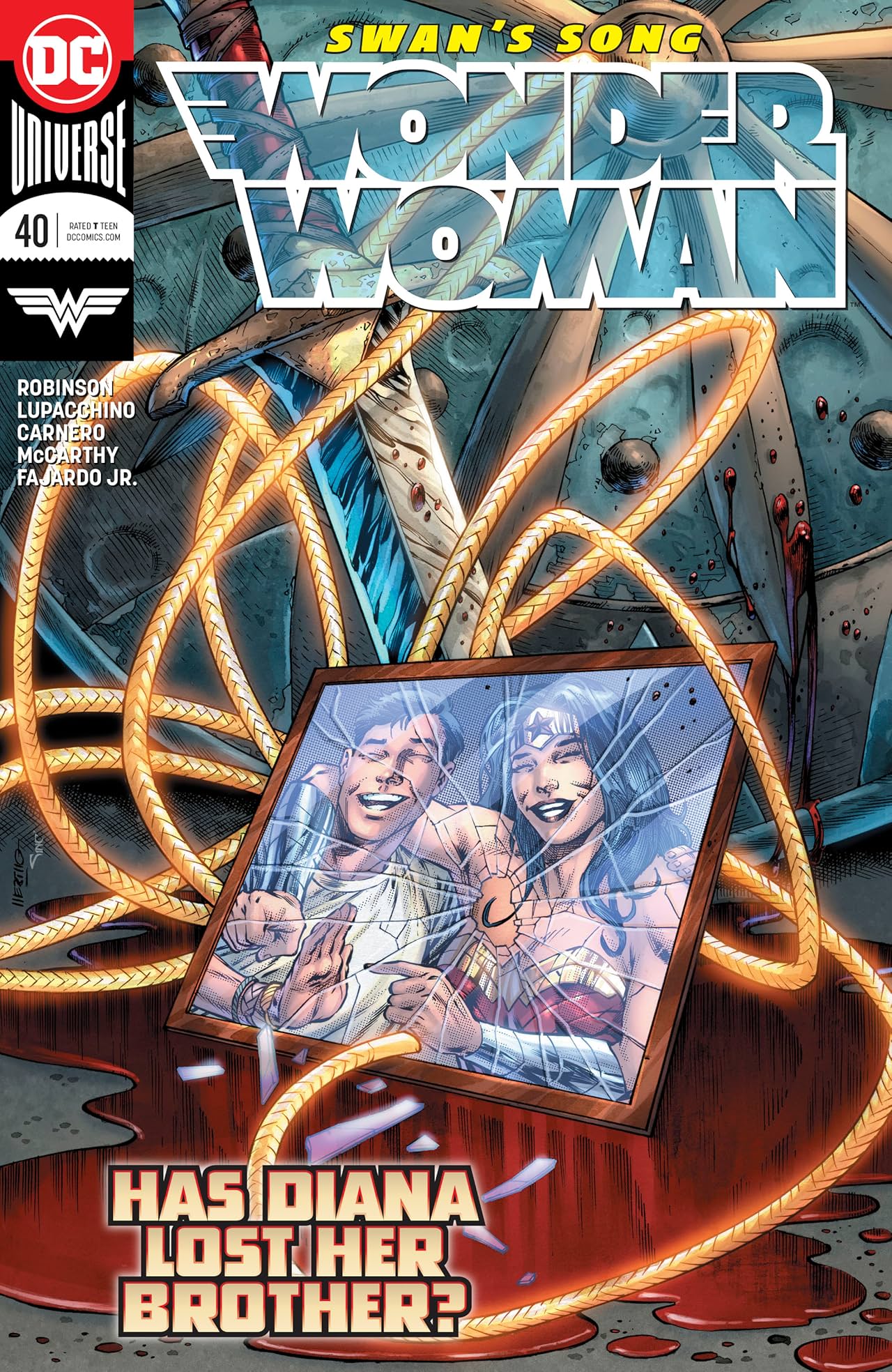
Petty Villains Makes For Shallow Conflict: Wonder Woman #40

The following is my review of Wonder Woman #40, which was posted on PopMatters.com.


There are certain villains who don't need much push to fall into that never-ending cycle of evil, resentment, and constantly seeking new henchmen. Characters like Thanos, Lex Luthor, or Darkseid rarely a lot of motivation to walk that path. They're kind of expected to because they fill a particular role. They're the kind of villains whose existence makes the struggle of the heroes necessary. They provide obstacles that often have to be fought with fists rather than words.

Then, there are the villains who need a much harder push to walk that path. These are the Walter Whites of villains, characters who tried to live an honorable life, but chose a different path when circumstances worked against them. As such, the dynamics driving these characters tend to be more complex. Sometimes, they can be downright erratic because it's not always clear whether such a character qualifies as a villain. When those dynamics are working, though, these kinds of characters can be uniquely compelling.

Most of Wonder Woman's villains don't fall into the category of a Walter White. Historically, her villains involve gods, demigods, mythical monsters, and alien tyrants. The dynamics with those kinds of characters tend to be pretty basic. That's what makes Silver Swan a breath of fresh air in James Robinson's ongoing run in Wonder Woman. She's no demigod or mythical monster, but her conflict with Wonder Woman is uniquely dramatic in that it's so personal.

The story that begins in Wonder Woman #38 takes someone who never showed an inclination towards evil and guides them down that path. Wonder Woman #40 marks the culmination of that journey. It puts Wonder Woman in a difficult position, one in which every punch and every attack she unleashes against Silver Swan is like a jab to the heart. It's one of those battles that's destined to feel like a loss, even when she wins. That kind of inner struggle and tends to bring out the best in Diana.

There are key instances in the story where Wonder Woman demonstrates that unique strength. The path that leads to her showdown with Silver Swan is pretty direct. There aren't many diversions or mysteries to solve. There's no need for Batman's detective skills or a favor from Olympus either. The path to that dramatic clash is pretty straightforward, so much so that there isn't much room for tension. Given Silver Swan's willingness to attack a hospitals and slit throats, particularly the one of the long-lost brother that Diana just reunited with, there isn't much need for it.

Much of the clash and the story around it is fairly basic. Silver Swan's motivations don't include some grand, deranged vision that involves tearing the universe asunder while using the pained cries of her enemies as background music. She just hates Wonder Woman because she feels betrayed by her. Before she becomes Silver Swan, she believes she's Wonder Woman's friend. She draws strength from that as she deals with her own personal issues. Then, when she really needs that friendship, it's not there and that pushes her over the edge.

In terms of the catalyst that turns someone from a friend to an enemy, it's pretty shallow. Silver Swan is no Lex Luthor or Joker. She's no Mole Man either. She never comes off as psychotic or broken. If anything, she comes off as petty, as though she's somehow entitled to Wonder Woman's support during her time of need. She sees her as the emotional equivalent of an Uber driver, someone she can call on to feel strong and loved again. She doesn't seem to realize that Wonder Woman, as a full-fledged member of the Justice League who has to battle alien tyrants and demigods every other week, has a lot on her plate.

This is what makes Silver Swan seem downright petty, even by villain standards. It also makes it hard to see her side things when the battle between her and Wonder Woman finally erupts. Quality villains, even the exceedingly unlikable kind like Lex Luthor and Darkseid, have some sort of grievance to bring to the table that makes their hatred of heroes seem legitimate. Silver Swan primary grievance is that Wonder Woman didn't inconvenience herself enough for her. That makes her difficult to sympathize with, let alone root for.

She still manages to come off as a highly-driven villain that hurts Wonder Woman on an emotional level. That part of the story still carries plenty of dramatic weight and that gives Wonder Woman #40 a sense of depth. However, the impact of that depth is somewhat undermined by how rushed the final battle ends up being. There isn't much time to build the tension. There's still plenty of heartfelt strain, but it ends before anyone needs to catch their breath.

That's somewhat necessary, though, because a good chunk of the story is spent on how Diana's long-lost brother, Jason, is adapting to being part of Wonder Woman's life. That's a compelling story in its own right and while it does make for some colorful moments in previous issues, it's more of a distraction in Wonder Woman #40. Despite being a demigod like Wonder Woman, Jason does more to hinder rather than help his sister's efforts against Silver Swan.

The family drama and the personal drama just don't effectively mix. Given how dramatic and convoluted things can get whenever demigods are involved, that comes off as a missed opportunity. The aftermath of the battle itself also leaves a lot of issues unresolved. While Robinson does plant the seeds of new mysteries and further complications with Jason, it doesn't make for much impact because it contributes so little to the battle against Silver Swan.

On paper, the story surrounding Silver Swan and Wonder Woman's newfound family connections has all the necessary components for a big, dramatic story full of heart, tragedy, and jokes about Zeus' various infidelities. It's an opportunity to create a new villain for Wonder Woman that tests her in ways that make iconic heroes even greater. Just being able to do that without creepy clown makeup is an accomplishment in modern comics.

Unfortunately, the story that culminates in Wonder Woman #40 doesn't make use of those components. The characters and situations are there, but connections and motivations aren't. Silver Swan isn't going to be placed in the same tier as Lex Luthor, the Joker, or even Cheetah anytime soon. Robinson does leave her story open for more development, she has a long way to go before she becomes the kind of villain that deserves Wonder Woman's tears and fists.

Final Score: 5 out of 10

Friday, October 27, 2017

Evil Wonders: Wonder Woman #33

The following is my review of Wonder Woman #33, which was posted on PopMatters.com.


No matter how dysfunctional a family is, there's usually some kind of sentiment binding it together. That sentiment isn't always healthy. Many sitcoms, good and bad alike, are built on that kind of dysfunction. Add gods, demigods, and superheroes to the mix and that dysfunction takes on a level that even the trashiest prime-time sitcom can't match. Wonder Woman's family may not have that kind of dysfunction, but whenever gods and demigods enter the mix, it usually means she'll eventually start punching something.

Wonder Woman's family already has its share of complications, thanks largely to an origins story that is still muddled between clay figurines and Zeus not being able to keep it in his pants again. The events of Darkseid Wars adds another complication in the form of Grail, who is basically the anti-Wonder Woman. As the daughter of Darkseid and a self-professed daddy's girl, she exists to spit on everything Wonder Woman stands for while looking more menacing than any illegitimate offspring that Zeus could ever sire.

Grail is one of those characters who has the potential to be a true nemesis to Wonder Woman. Superman has Lex Luthor. Batman has the Joker. Wonder Woman really doesn't have anyone on that level who isn't a renegade god or demigod. Grail, after taking down the entire Justice League in Darkseid Wars, can challenge Wonder Woman on every conceivable level. Wonder Woman #33 finally puts Grail in that position and James Robinson makes the most of it.

Darkseid War introduced Grail, but offers little insight into who she is and what motivates her. She never comes off as an overly complex character. There's no effort to craft some elaborate story about how she ends up on the path of evil. Her father is Darkseid. Evil is literally in her blood and she doesn't even try to avoid that. She embraces it. Like Lex Luthor and the Joker, she is not in conflict with who she is. She's evil and she's fine with that. That kind of self-awareness may be basic, but it's oddly refreshing in an era where too many villains try to come off as tragic figures.

That simple, streamlined persona helps move the story along. Wonder Woman #33 isn't just about establishing Grail as someone who can battle Wonder Woman without relying entirely on played out themes from Greco-Roman mythology. It's about tying her story into Wonder Woman's world, specifically the ongoing conflict with her long lost brother. Again, Wonder Woman's divine brands of family dysfunction are complicated, but that makes Grail's simplicity all the more appropriate.

Like Wonder Woman, much of Grail's story revolves around her family. She isn't just driven by her dark heritage. She actively works to protect and preserve it. The recent events surrounding Dark Knights: Metal puts Darkseid in a strange, but vulnerable position. After his defeat, he reverts to the form of an infant and it's up to Grail to play the role of mother to her father. It sounds weird, but when Greco-Roman traditions involve multiple instances of incest, infidelity, and unholy unions, it barely raises an eyebrow.


Grail still embraces this role. She never shows any hesitation or reservations about helping Darkseid return to form. She's just like him, wanting nothing more than to spread death and destruction to everything she touches. Even when aiding her father means murdering various demigods, mostly the many illegitimate children of Zeus, she does so without a second thought. She never sees it as evil or inconvenient, for that matter. She's just an evil daughter helping her evil father.

This makes for plenty of brief, but brutal moments that reinforce the extent of Grail's persona. She is evil to the core and that doesn't bother her in the slightest. While this goes a long way towards establishing her as a menacing villain for Wonder Woman, it doesn't make for too compelling a plot. Wonder Woman #33 offers a great many insights into Grail, at least with respect to her role in the ongoing story surrounding Wonder Woman's brother. Beyond that, though, there aren't many complexities or revelations.

The simplicity of Grail's character may help move the story along, but it offers little else, in terms of intrigue. She has a problem, namely her father's nascent state. She has to solve that problem by killing the many demigods that Zeus sired when he kept thinking with the wrong head. She goes about solving that problem with the kind of gratuitous violence that would make any evil father proud. There's not much more to the story beyond that.

There are some characters whose evil nature needs to be belabored every now and then. Grail established during Darkseid Wars that she is not one of them. Anyone who has Darkseid for a father doesn't need that kind of effort. While giving her a defined role in Wonder Woman's ongoing narrative is important, Grail doesn't get much depth beyond that. For her to truly become the Lex Luthor or Joker for Wonder Woman, she needs more than just a desire to help her father.

Wonder Woman #33 still succeeds in exploring Grail, demonstrating just how menacing a threat she can be to anyone she faces, demigod or not. Robinson skillfully guides her into a collision course with Wonder Woman while the artwork of Emanuela Lupacchino provides the necessary brutal imagery to that journey. More than anything else, that journey ensures that any pending clash between Grail and Wonder Woman will carry a lot of dramatic weight.

The family dynamics for both Wonder Woman and Grail, as dysfunctional and divine they may be, create a unique appeal that feels right at home in the bizzare, yet lecherous world of Greco-Roman mythology. Wonder Woman still embodies the higher values that mythos, but Grail is set to embody the worse. The fact she can do all of this without being the bitter offspring of Zeus makes that feat all the more remarkable.

Final Score: 6 out of 10

Thursday, June 29, 2017

From Rebirth To Resolve: Wonder Woman #25

The following is my review of Wonder Woman #25, which was posted on PopMatters.com.


By every measure, Wonder Woman is having a great year. For the first time in her history, it's not unreasonable to say that hers is the brightest star in the DC trinity. Superman and Batman can have their epic battles and bitter disputes, but only Wonder Woman can say she raised her profile while maintaining the heart that makes her so endearing. She's conquered both the box office and the critics on Rotten Tomatoes, something that Batman and Superman's epic clash cannot claim.

Wonder Woman's star is burning so brightly at the moment that it's easy to forget that part of that flame has been regularly stoked by Greg Rucka and Liam Sharp in her comics. After the events of DC Rebirth, Wonder Woman goes through a sobering process of sorts. The world she thought she knew is shrouded with lies that she didn't know were plaguing her. The life she thought she had lived has gaping holes in it that she cannot ignore. For a woman used to extracting truth with her lasso and her charm, that's an unfamiliar feelings.

Like many other DC Rebirth titles, the narrative in Wonder Woman is crafted in a way that builds and escalates. At times, it tends to drag. On top of that, Rucka and Sharp explore some of the gaps that emerged while the DC universe underwent its messy rebirthing process. They end up having to retell, reshape, and update Wonder Woman's story, often while trying to tell a parallel story in the present. It's easy to lose track of the story, but it can make for a uniquely satisfying payoff.

Wonder Woman #25 marks the end of Rucka's run on the series. It also marks the epilogue of sorts of all the various plots within Wonder Woman's rebirth-induced history. It's no easy feat, revamping and retelling Wonder Woman's entire history in just 25 issues while a major Hollywood movie is making headlines in the background. Rucka rises to the challenge, providing a capstone of sorts to a journey that balances the hardened warrior, the loving spirit, and the feminine ideal that she embodies.

It's an important balancing act for Wonder Woman. Throughout her history, multiple writers approach her from various angles. For some, she's only that hardened warrior. For others, she's only that loving spirit and feminine ideal. As iconic a character she is, the stories about her tend to segment her character. All too often, only parts of her personality are explored. Rucka dares to use every one of them in Wonder Woman #25 and in many ways, it completes her rebirth process.

The story itself is built around the aftermath of a lengthy arc that jumps between time periods, exploring Wonder Woman's initial arrival into man's world and her latest clash with a couple menacing gods. Along the way, she faces an identity crisis that makes a rebirth all too necessary. She faces a painful, soul-crushing revelation. For someone who's used to getting the truth out of everyone with ease, that's an accomplishment, even for gods.

Entire chunks of Wonder Woman's life are called into question. Her faith in the gods, her heritage, and herself become subject to major doubt. At the same time, she's still trying to help her friends and still be a full-time member of the Justice League. It's stressful, to say the least. It sends the message that if someone like Wonder Woman can crack under the strain at times, then what hope does anyone have?

That hope doesn't stay lost for long, though. Early on, Rucka shows that Wonder Woman can still be Wonder Woman in the midst of so much upheaval. She can arrive on the scene with the Justice League, fight giant monsters, and hardly break a sweat in taking it down. The hardened warrior aspect of her character is rightly preserved. However, that's not the sole focus of the story or Wonder Woman's journey over the course of the past 25 issues. It's never more than a secondary focus because Wonder Woman embodies more than just a fighting spirit.

Much more of Wonder Woman #25 focuses on her heart, which is heavy and wounded. She spent a great deal of her recent journey trying to save Dr. Barbara Minerva from the clutches of Cheetah, but circumstances beyond her control make that impossible. That's pretty heart-wrenching because when something is impossible for Wonder Woman, who regularly deals with gods, monsters, and Batman, that makes clear that some things are just beyond anyone's control.

She still makes an effort to help her former friend. She also makes a desperate plea for help from the last person who would want to help her. Even with all her love and heart, it isn't enough. It shows in the way she fights. Even her fellow friends on the Justice League sense it. When she finally gets around to confronting it, she has to essentially accept what she can't control. The truth may hurt, but that doesn't make it any less important. There are people who go their entire lives avoiding that. Wonder Woman confronts it, even when she's angry and wounded. Given her immortal heritage, that's quite an accomplishment.


Rucka goes heavy on the symbolism, giving Wonder Woman a love/hate relationship with her magic lasso at a time when the truth can hurt even an immortal warrior woman. Sharp's colorful artwork keeps the tone of the story from getting too bleak or dire. In the end, her willingness to take back her lasso and accept the harsh truth for what it is highlights the end of a journey that Wonder Woman needed to take. It's a journey that strengthens every part of her character, as well as those around her.

As fitting an end as Wonder Woman #25 is to that journey, it does gloss over a few issues and rushes a few others. There's never a clear resolution with Cheetah and Wonder Woman's acceptance of the truth feels somewhat rushed. The fact she only needs a pep talk before taking back her lasso feels somewhat unremarkable, if not contrived. There are a lot of arguments she could've and probably should've had with the gods that deceived her. However, those conversations are essentially shrugged off in favor of some sexy time with Steve Trevor. On some levels, though, that's a fair trade-off.

Overall, Rucka's run on Wonder Woman is a remarkable accomplishment. At a time when Gal Gadot, Chris Pine, and Patty Jenkins are elevating Wonder Woman's star to new heights, her DC: Rebirth journey finds a way to make that star burn a little brighter. Wonder Woman is tough, compassionate, loving, loyal, and beautiful on every level. It's not something that most people need to be reminded of, but some reminders are still worth having.

Final Score: 8 out of 10

Monday, November 14, 2016

The Wonder of What Wonder Woman Embodies: Wonder Woman #10

The following is my review of Wonder Woman #10, which was posted on PopMatters.com.


There are some origin stories that don't need to be retold again. The story of how Bruce Wayne lost his parents or how Clark Kent lost his home planet are so overplayed that there's really not much new to add to the narrative. We, the audience, get the message. We know why Bruce Wayne is Batman. We know why Clark Kent is Superman.

With Wonder Woman, however, the situation is different. Despite being the third pillar of DC's mighty trinity, her origin story is one of the few that DC Comics doesn't overly belabor. The setup is already established. Wonder Woman's basic history of growing up on an island of immortal women and rubbing elbows with Greek gods is easy to grasp. Anyone with access to Wikipedia can glean those details.

What Greg Rucka and Nicola Scott are doing with Wonder Woman in DC Rebirth takes it a step further. Conflicts in the present are used to explore elements of Wonder Woman's past. One issue covers the past. One covers the present. It sounds disorganized on paper, but in the grand scheme of things, it fits together into a fairly cohesive narrative.

It's not a re-imagining. It's not a reboot or a retcon either. In many respects, it's an overdue dose of depth. Despite 75 years of history, the Wonder Woman mythos is sufficiently vague to permit a certain level of refinement. Wonder Woman #10 takes advantage of that opportunity and adds a level of refinement that brings out the best in Wonder Woman.

There are no vindictive gods, shape-shifting monsters, or invading aliens in this narrative. In fact, Wonder Woman does surprisingly little fighting in this issue, but given how she seems to fight a new god, alien, or monster every other day, it's a refreshing and overdue change of pace. Instead, the story gives us a glimpse into Wonder Woman's past, focusing on her early exploration of man's world in its simplest form, namely by taking a trip to a local strip mall.

Granted, this a strip mall in America is hardly the most comprehensive insight into man's world, but it's fitting in that it doesn't make a terrible impression. Sure, there's excessive noise, rampant consumerism, and gaudy advertising displays, but there's nothing so horrifying that it would inspire an island of warrior women to purge the world of testosterone. Steve Trevor and Eta Candy even introduce her to margaritas. That's as good an impression man's world could make without something deep fried and dipped in chocolate.


This helps create a uniquely balanced tone for Wonder Woman #10. Rucka doesn't attempt to make Wonder Woman's impression of man's world too extreme. There's no emphasis on violence, rampant gender inequalities, and oppressive patriarchy. The world in which Wonder Woman explores never comes off as a beer commercial or a bad sitcom from the late 1950s. It actually makes the case that man's world is worth exploring and protecting.

It fits nicely with the overall tone of DC Rebirth in that the narrative isn't overly focused on dark and dire themes. There's still room for hope, understanding, and justice. Those are all among the highest qualities that Wonder Woman embodies. She's not just this tough warrior woman in a tiara who fights aliens and renegade gods alongside Superman and Batman. She stands for her own set of values, embodies them to the utmost, and looks great while doing it.

She eagerly interacts with total strangers, embracing them regardless of their age, gender, or ethnicity. She's not at all put off by the sight of men interacting with women, children making unfiltered comments about her attire, or the woefully impractical shoes that some women wear. Wonder Woman has any number of opportunities to be offended or appalled, but doing so would require her to be overly petty.

Such pettiness is the antithesis of what Wonder Woman values. She loves and embraces everybody. She's willing to give others a chance and she's not going to be politically correct about it. These are all powerful values that Wonder Woman has always embodied to some degree, but there have been too few stories that explore how she shaped these values upon coming to man's world. It's still a story not nearly as familiar as Kryton exploding, but it's a story worth exploring.

Wonder Woman is less a warrior and more an ambassador in this issue, but that's not to say the hard-nosed warrior in her is completely muted in Wonder Woman #10. She does get a chance to fight. She does get a chance to protect the innocent. Granted, it's not against rampaging titan or an agent of Darkseid, but she still gets to be the wonderful hero she is at heart. It's not exactly an epic battle in which the outcome is in question. This is Wonder Woman fighting in a crowded strip mall after drinking a margarita. It can only be so epic in that context.


Despite the limited scale of the fighting, there's still some meaning and depth to the conflict. This isn't just some random attack meant to fill Wonder Woman's hard-nose warrior quota. It's an attack that has ties, albeit vaguely, to the events taking place in the present. In terms of tying Wonder Woman #10 into the larger narrative that has been unfolding since the DC Rebirth relaunch, this issue does succeed, albeit barely.

The ties to a larger narrative may be limited, but Wonder Woman #10 still succeeds in its most important task. It highlights a period in Wonder Woman's story that is poorly developed and in need of greater depth. This issue gives us that without belaboring the parts we already know.

Greg Rucka and Nicola Scott are crafting a large, ambitious story that jumps around multiple time periods, puts a modern spin on a classic superhero mythos, and highlights the core values of an iconic character. It still feels like something that's too convoluted on paper, but they somehow find a way to make it work. That is a wonder, in and of itself.

Final Score: 8 out of 10

Tuesday, August 25, 2015

Meddling Progress: Wonder Woman #43

The following is my review of Wonder Woman #43, which was posted on PopMatters.com.


If there’s one thing that the success of HGTV has taught us, it’s that society has a weakness for reclamation projects. In the same way certain women can’t help but fall for the bad boys in hope of saving them, there’s a kind of broken character that draws us in. Like Pamela Anderson at a hair band reunion tour, we can’t help but embrace these characters. As it stands, Donna Troy is the comic book equivalent of a burned out 80s rock star that just got out of rehab.

Her introduction to the post-Flashpoint era might as well have come with a bad handicap and adamantium shackles. She entered the world as a pawn, which is somehow worse than being another illegitimate offspring of Zeus. Her first act was the textbook definition of a war crime. Even the ancient Mongols would’ve raised an eyebrow at slaughtering an entire population of men that happened to be brothers of the Amazons. While she wasn’t completely control of her faculties at the time, she still has to live with that burden the same way Hallie Berry has to live with her role in the Catwoman movie.

The aftermath of this atrocity has served as the foundation of a new era for Wonder Woman. She’s now the acting God of War, Queen of the Amazons, and an active member of the Justice League. Even Hillary Clinton would call her an overachiever at this point. But while she’s trying to shoulder the burden of all these responsibilities, she still hasn’t come up with a way to deal with Donna Troy. It’s a story that has been set up and teased. Now, in Wonder Woman #43, that story finally starts to unfold.

It’s a story that follows many of the same themes that Wonder Woman has been exploring since the New 52 reboot. It has mischievous gods whose idea of entertainment is tormenting mortals and frustrating Wonder Woman. It has colorful characters with god-like powers who are essentially parodies of classic mythology, but not in the Weird Al tradition. And Wonder Woman is expected to manage this chaos while fighting the injustices of a patriarchal world. The demands on her couldn’t be more unreasonable without asking her to coach the Oakland Raiders.


Yet for all her power and responsibilities, Wonder Woman is largely powerless to help Donna Troy in this story. While Wonder Woman spends most of her time just looking for her, Donna’s story is an ongoing tragedy. However, that’s still an upgrade over being the catalyst for an outright war crime. What makes that tragedy compelling is that she understands the scope and scale of her crimes. She doesn’t try to hide from it. She doesn’t try to justify it. She actually tries to deal with it, which is more than most war criminals ever try to do. And none of these criminals can claim they were being controlled by black magic, except for maybe Kim Jong Ill.

It’s here where we’re also reminded that in addition to being guilty of an atrocity, Donna Troy is still a child. She’s basically an infant in a teenage girl’s body. She has no life experiences, let alone emotional maturity. A teenage mind is barely equipped to cope with calculus exams. This girl has to cope with being guilty of a war crime. It might be the first time a teenage girl’s melodramatic lamentation is completely warranted.

And being so emotionally immature, Donna’s first inclination is to seek an immature solution. She tries to end her life. Being an Amazon, she can’t exactly use Kurt Cobain’s approach. So she seeks out the mythological Sisters of Fate. However, they claim they can’t give her what she wants and not because suicidal teenagers have a tendency to not think things through. Despite being god-like beings, they can’t end her life because her fate isn’t set.

In some respects, it’s an appropriate metaphor for any teenager not guilty of war crimes. They may think that their life will always be defined by one bad day at high school, one day at work, or one bad relationship. That’s not how life works. The universe’s attention span isn’t as big as we make it out to be, especially for those whose experiences are so limited. And for Donna, her experiences couldn’t possibly be more limited without having been born in the lower decks of the Titanic.

Her frustration and self-hatred is the greatest strength of this story. It helps make her character endearing, notwithstanding the war crimes she’s still quite guilty of. The problem is her story is somewhat truncated. Another critical part of this story involves Wonder Woman searching for Donna. This leads to a few ambiguous twists involving someone attacking the Sisters of Fate and a surprise attack by Aegeus. It’s presented as a mystery, but ambiguity makes it come off as bland movie trailer.

Beyond the conflict, Wonder Woman doesn’t give the impression she has a plan for Donna. She doesn’t even indicate she can help her in any way other than bringing her back to Olympus, a place where gods torment mortals whenever they get bored. She still talks about helping Donna forgive herself and accept the weight of her crimes. That’s all well and good from a Dr. Phil perspective, but it’s insufficient for a character whose only life experiences involve being a pawn to war atrocities.

There is still some intrigue to this mystery, but its lacking in substance. It makes the overall narrative in Wonder Woman #43 uneven. It’s worth following to see the story of Donna Troy evolve beyond the grim circumstances of her creation. Beyond that, it’s mostly a generic conflict among gods with too much power, too much free time, and no Netflix.

There is still hope for Donna Troy as a character. Her journey is one that has the potential to be something unique and intriguing. She just has to find out how to circumvent self-hatred and meddling gods. If she can do that, she can be an inspiration for melodramatic teenagers everywhere. And in this day and age, there can never be too many of those.

Final Score: 6 out of 10

Monday, June 8, 2015

Hollow Redemption: Wonder Woman Annual #1

The following is my review of Wonder Woman Annual #1, which was posted on PopMatters.com.


Having the moral high ground is a lot like having Monopoly money. It's value is mostly symbolic and rarely, if ever, pragmatic in a meaningful way. For many years, the Amazons could claim without question that they had the moral high ground. They were warriors that embodied the highest values. They fought in the name of love, compassion, and justice. They're the kinds of values that only tyrants and internet trolls could oppose. Even if those values were symbolic, it made them more noble.

That nobility helped mask the fine print of the Amazons' principles for many years. That fine print contains clauses like the provisions in an Apple user agreement that specifies how all the love and compassion is not applicable to men. They'll love and cherish one another as sisters. They'll fight the good fight against aliens, gods, and Lex Luthor. But when it comes to the male population as a whole, they come off as more petty than young Madonna.

That caveat was easy to overlook in some respects because the history of the Amazons was tied to the atrocities they suffered in the past. What gave them the moral high ground in the first place was their ability to rise above these atrocities as a society. Then, the New 52 brought about some inglorious details that highlighted other parts of that fine print.

They already lost a big part of the moral high ground when it was revealed how they slaughtered men after seducing them to produce more Amazons. They did manage to keep a sliver of it when they chose not to go full-on Spartan with discarding male babies. But with the creation of Donna Troy, the Amazons let it get even more inglorious. And if there's any moral high ground left to retain, it has to be salvaged in Wonder Woman Annual #1. In the end, however, they only managed to salvage a portion.

The culmination of the conflict between Wonder Woman and Donna Troy had been hyped up like a title fight over the course of multiple issues. And Wonder Woman had to go into this fight somewhat handicapped because she had been dealing with another conflict that unfolded from the fallout of her battle with the First Born. Both of these conflicts were pretty disconnected, so much so that Wonder Woman is essentially a victim of circumstance. And no matter how powerful a man or woman might be, circumstance will find a way to screw them over.


Wonder Woman really couldn't do anything about Donna Troy because she was caught up in something else. It comes off as underhanded in some respects, her having to be distracted for this conflict within the Amazons to manifest. It's like Wonder Woman is being punished for trying to do too much. However, the conflict involving the fallout from the First Born actually establishes something important for the struggle against Donna Troy. Even if she is trying to do too much, Wonder Woman's heart is always in the right place. Not many people since the death of Mr. Rogers can say that.

By resolving the conflict with the trapped aliens who had been awakened by the First Born's defeat, Wonder Woman made an important statement. First, she showed the value of not resorting to the Dick Cheney approach to dealing with problems, finding a peaceful resolution first. Second, she maintained her claim on the moral high ground. That made her battle against Donna Troy more meaningful because it makes clear that she's the only remaining Amazon who can claim the moral high ground. And unlike Mr. Rogers, she's willing to fight to maintain that claim.

When the battle against Wonder Woman and Donna Troy finally unfolds, all the right emotions are in place. The artistic detail provided by David Finch highlights all the visceral details of this title fight between two Amazon heavyweights. And unlike the Mayweather/Pacquiao fight, it's much more satisfying. It's also much cheaper than an overpriced pay-per-view package. But even if it is more satisfying, the aftermath is somewhat mixed.

At the very least, nobody can complain they got ripped off. However, the impact of Wonder Woman's fellow Amazons feels a bit too muted. Under Donna Troy, they committed an atrocity that's as much a war crime in the 21st century as it was in the 1st century. They just stormed a village full of innocent, unarmed men and slaughtered them without mercy or provocation. On top of that, these men were their brothers and they had fought beside them in the battle against the First Born. It's the kind of family treachery that would disgust even Game of Thrones fans.

However, Donna Troy's defeat doesn't really deal with this crime in a satisfying way. Sure, Donna is deposed and the Amazons involved are punished, but the lack of impact on the Amazons as a whole is troubling. They really don't seem to mourn the loss of their Amazon brothers. They react the same way most people react when they find out that they overpaid for a Prius. Wonder Woman is the only one who sheds a tear. Sure, one of her sisters is nice enough to kill the old woman who pulled the strings from behind the scenes. But the rest don't even apologize for doing absolutely squat when they had a chance.


The Amazons haven't just lost the moral high ground. They crumpled it up, threw it on the ground, and spit on it. Now only Wonder Woman still has this symbolic claim. The problem is it really doesn't seem to matter much to her sisters. She can do the right thing all she wants. She can be the paragon of Amazon values until the end of time. Her sisters aren't going to apologize for the glaring inconsistencies in their philosophy. Like debating creationists on a message board, Wonder Woman is dooming herself to frustration by trying to inspire her sisters to be better.

This incomplete resolution makes Wonder Woman Annual #1 feel disheartening in too many ways. The Amazons still come off as thugs more than warriors. Other than Wonder Woman herself, the emotions in this story might as well have come from Kristen Stewart. The Amazons are in need of redemption. But by all accounts, they're a long ways from getting it and their efforts in achieving it are haphazard at best. And for the tribe that birthed Wonder Woman, they deserve better.

Final Score: 6 out of 10

Wednesday, January 28, 2015

A Royal Struggle: Wonder Woman #38

The following is my review of Wonder Woman #38, which was posted on PopMatters.com.


There's a reason why the royal family is regular fodder for British tabloids. It's the same reason the Kim Kardashians and Donald Trumps of the world are fodder for American tabloids. There's this eerie fascination with high society, be it royal or rich. These people live in a world so different and so detached from reality that, like the wreckage of a derailed freight train, we just can't look away. It's not something most people are proud of, but it's an industry that still has a fertile market.

If Wonder Woman and Themyscira existed in real life, she would certainly have her share of tabloid headlines. These are the same publications that regularly report that aliens have placed chips in the brains of every President since Lincoln. But when real gods and goddesses are involved, it has a special level of intrigue. So much so that the affairs of Wonder Woman's world would probably require its own TV network. If Oprah has one, then Wonder Woman could certainly manage.

It's this world that has become so chaotic and so disorganized that it's several steps beyond a train wreck. And Wonder Woman, the feminine ideal who is supposed to be able to have it all in that classic feminist mentality, has been struggling to manage it. She's the God of War, the Queen of Themyscira, a member of the Justice League, and Superman's lover. That's a lot of responsibilities to juggle, even for a demigod. And in Wonder Woman #38, even the embodiment of feminine strength struggles with it.

The core of this part of Wonder Woman's story isn't built around one major struggle. It's a series of smaller struggles that are overwhelming her. It's death by a thousand paper-cuts rather than death by guillotine. Granted, a smaller struggle by her standard still involves being a god and dealing with infighting on an island of immortal warriors, but these struggles still come off as real and genuine. Her fears and insecurities manifest in a very real, albeit not entirely literal, way that makes her relatable in a way usually reserved for shows that rip-off Dawson's Creek.

It's jarring in some ways. Wonder Woman isn't supposed to be vulnerable. This is the same woman who can battle the entire Olympian pantheon on Monday and still have enough strength to fight off an invasion by Darkseid on Thursday. However, Wonder Woman really doesn't do much battling in this story. In fact, she does next to none. On paper, that sounds like it shouldn't make for a good Wonder Woman story. But in practice, it's still a story worth telling in the sense that it's probably the easiest story to overlook.

For Wonder Woman and the many characters like her, male and female, there plenty of stories about them fighting epic battles and winning with varying degrees of style. But there aren't quite as many stories about how they manage their lives in between battles. Wonder Woman battles the First Born, becomes both the God of War and Queen of the Amazons in the process, and somehow finds time to be a member of the Justice League in between. How does she cope with that? This story offers some insight into that question. In terms of an answer, at best it leaves room for improvement.

Wonder Woman confides in her insecurities, but she's not crippled by them. She's still Wonder Woman. She's not going to curl up into a fetal position and whine about it. She understands that being the God of War and being the Queen of the Amazons carries with it some heavy responsibilities. To her credit, she attempts to imbue her own values of compassion and understanding to these tasks. But in the same mold as "Mr. Smith Goes To Washington," these ideal values clash with the same fodder that keep tabloids in business.


The gods of Olympus still plot against her. The Amazons she's supposed to rule don't care for all these new changes, as kind as they might be. Compassion and understanding just aren't enough in a world where people need to get upset about something and trolling message boards just aren't enough. Wonder Woman can do all the right things for all the right reasons, but it's still a struggle and that's what makes her story so compelling.

But as compelling as it is, the story itself moves along at a painfully slow place. In addition to not doing much fighting, the other ongoing plots surrounding the newly-introduced Donna Troy and the the Justice League don't make much progress. There is some, but it comes off more as a movie trailer at times. It helps that there is still plenty of character depth to compensate for this lack of progress. It's just not as balanced as it could be.

If this part of the story were a tabloid story, then it probably wouldn't get many people worked up. There aren't any scandalous affairs. There are no hookers or drugs involved. There aren't even any embarrassing photos of bad hangovers or botched botox. But there is a power struggle in both Themyscira and among the Olympians. Power struggles may not get the same headlines as scandalous affairs, but they do feed into the public's fascination. Even if the details are mostly teasers, there's still a story worth following in Wonder Woman #38.

Wonder Woman's humanity and vulnerabilities take center stage in this story, but there are still conflicts unfolding all around her. And if the ending is any hint, she'll have to share that stage with Donna Troy. The pressure is building for Wonder Woman. There's only so much that even the world's strongest woman can handle. At some point, she has to confront her limits. That doesn't make her less a feminine ideal. It just makes her someone who can keep fighting, despite tabloid-level scrutiny.

Final Score: 7 out of 10

Monday, November 3, 2014

Godhood, Womanhood, and Humanity: Wonder Woman #35

The following is my review of Wonder Woman #35, which was posted on PopMatters.com.


What does it mean to be a goddess? What does it mean to be a warrior? What does it mean to be a mother, daughter, or woman? These are all some of the profound questions that Brian Azzarello has been exploring since his run on Wonder Woman began at the onset of the New 52 relaunch. These questions have been the main driving force in the battles that Wonder Woman has fought. While she hasn't had many clear answers, she has confronted many challenges that have made it very difficult to be the Wonder Woman that inspires feminists and perverse male fantasies alike. And despite plenty of complications and allies/enemies/frenemies, she has always risen to the occasion.

This ability to keep fighting, even in the face of gods and the deranged offspring they sire, is part of what makes Wonder Woman who she is. Since this series began, she has been in a constant fight against an endless horde of gods, demigods, and monsters attempting to ascend to the throne of Olympus. At times, it has been like Game of Thrones, but with less full-frontal nudity.  

Wonder Woman #35 is supposed to be the end of that fight. However, it does not unfold like a heavyweight title fight that people overpay to see on pay-per-view. It's a fight that highlights everything that makes Wonder Woman more than just a woman and a warrior. Essentially, it exposes what makes her so wonderful.

This fight began when Wonder Woman crossed paths with Zola, a young woman who became the latest in the Jerry Springer style affairs of Mount Olympus found out she was pregnant. The fight can only end when the First Born, who claims to be the true heir to Olympus in Zeus' absence, is defeated. In this sense it doesn't just parallel Game of Thrones. It parallels the struggles that have plagued royalty since kings foolishly believed that power struggles wouldn't complicate family affairs. It also sets the stage for a bitter struggle that forces Wonder Woman to fight with more than just her fists.

That said, most of the story is built around the same format as that final boss battles in a Street Fighter game. Wonder Woman gets pretty roughed up by the First Born. Even Poseidon gets involved since no Greco-Roman god misses out on a chance to usurp the power of a family member. It's a struggle where Wonder Woman is badly overmatched in many respects. But instead of following the same formula that every bad sports movie has followed since the Karate Kid, Wonder Woman rises to the occasion in a different way.

While Wonder Woman is a warrior capable of going toe-to-toe with gods, aliens, and the Lex Luthors of the world, she is also capable of great compassion and empathy. In many ways, this acts as one of her greatest warriors as a weapon. And what makes the struggle in Wonder Woman #35 so satisfying is that she uses this weapon to great effect. Her capacity for mercy and compassion help change the tone of the battle at one point. It acts as a reminder that there are more ways to win a battle than just carrying a bigger sword or relying on the infidelities of the gods.

This helps set Wonder Woman apart from the other gods and demigods that surround her. She has a chance at numerous points in the battle to kill. And unlike Batman, she has no issues with killing. She's even pointed out at times that the reason she doesn't have rogues gallery that requires numerous spin-offs and sequels is because she "takes care of them" as she once described it. However, that doesn't always mean slitting throats or snapping necks. As the God of War, she is in a position to kill the First Born, but she doesn't. That alone says a lot about her because the First Born gave her plenty of reasons to be "taken care of."


In many respects, the First Born is the opposite of Wonder Woman. He will not show mercy or compassion. Even when Wonder Woman gives him a chance, he literally throws it away. She even points out his inability to understand these concepts, but in a manner far more effective and painful than therapy or counseling. That's not to say she's exceedingly kind in how she defeats the First Born. She's still a warrior. She can't be too understanding in the same way the Amish can't be too tech savvy. But she gives context to her actions, expressing faith in the ability of even the First Born to learn compassion.

It isn't just the First Born that Wonder Woman tries to beat with compassion either. She needs that same compassion to deal with a striking (and somewhat contrived) revelation about Zola and her son, Zeke. It's another situation that deals in old school royal conflicts that usually don't have peaceful resolutions. But Wonder Woman is able to inspire compassion, even among gods who aren't in a position to make use of it. That inspiration is among her greatest strengths, at least among those who haven't earned her wrath.

But as inspiring as Wonder Woman is, the characters that benefit are lacking in the same depth. The final revelations about Zola and her son are among the weakest parts of this struggle. These revelations are akin to someone being stranded on a desert island for three years only to find out there was a luxury resort with a yacht and a helicopter pad on the other side of the island. It takes away some of the humanity that has helped make Wonder Woman's struggle so compelling. While it does address some plot holes as only depraved Greco-Roman Mythology could, it feels incomplete.

That feeling of incompleteness doesn't detract from Wonder Woman's strengths, but it does detract from the story. Wonder Woman #35 is presented as a culmination of so many plots and conflicts. While it does address the major plots, it negates many of the smaller sub-plots. It still finishes the story, but only to the extent that it took the express lane in lieu of the more enjoyable scenic route. It's a story that has required Wonder Woman to utilize all her strengths for all the right reasons. For her, it's a testament to what makes her one of the most iconic characters in comics, female or otherwise.

Final Score: 7 out of 10

Monday, September 22, 2014

War, Peace, and Hope: Wonder Woman: Futures End #1

The following is my review of Wonder Woman: Futures End #1, which was posted on PopMatters.com.


The cynical, overly progressive hipsters of the world would have us believe that it doesn't take much to get people to fight in a war. Those who frequent message boards and 4chan certainly give the impression that it doesn't take much to rally an army. One overblown incident or one petty insult could be all it takes to trigger a flame war. So it would follow logically that if it's that easy to start a flame war, then it should be that easy to start a war that involves actual flames. Since message boards and cynics aren't known for their use of logic, it shouldn't be that surprising to anyone that war is a lot more complicated than Call of Duty and Game of Thrones would have us believe.

The most complicated part of any war, despite what the John McCains of the world claim, is that it's really hard to get people to fight one. It takes someone with the charisma of William Wallace, the tactical brilliance of Sun Tzu, and the bravado of Charlie Sheen to inspire a strong army. By that standard, Wonder Woman is the valedictorian of war harbingers because she has all the necessary traits to lead an army, minus the personal problems of Charlie Sheen.

Even though she clearly has the skills, she has rarely used them to instigate a war. She has always been one to fight for peace and look obscenely beautiful while doing it. But in Wonder Woman: Futures End #1, she is thrust into this role in a way that brings out all the qualities that make her someone any army would willingly follow to the gates of Hell. The world described in the various incarnations of Futures End has had many dark corners, but Wonder Woman finds a way to make this future feel a bit less apocalyptic. And at a time when apocalyptic futures are a dime a dozen, it makes for a refreshing story.

There's nothing too complicated about the war Wonder Woman's fighting. It's not some vague border conflict in the Middle East or some petty infighting among nobles in Game of Thrones. It's a very simple good vs. evil kind of war between the forces of Nemesis and the forces Wonder Woman has assembled. The circumstances come right from the pages of the Lord of the Rings trilogy. Nemesis' forces are vast and overwhelming. Wonder Woman's forces are limited and poorly equipped. Yet it still feels like a fair fight because Wonder Woman is the one leading the charge.

It's a conflict that forces Wonder Woman to embrace her role as the God of War. It's a role she's been putting off since the death of Ares and against the overwhelming armies of Nemesis, she shows she can carry out that role very well and look way sexier than Ares ever could in the process. But style points aside, Wonder Woman doesn't shy away from the brutality of her role. There are a number of battles she fights that would warrant more than a PG-13 rating if this were a movie, but it's never done in a way that gives the impression it's just trying to upset One Million Moms.

By embracing this role, it takes a toll on Wonder Woman. She sustains the kinds of injuries and wounds that everyone sustains in a prolonged war. She's less a warrior princess and more a hardened soldier, having fought for so long that it's difficult to imagine doing anything else. It's a perspective that Wonder Woman has rarely shown over her history. She's always walked a fine line between being a champion of justice and being a proud warrior. There's no line in this conflict. It's war at its most basic and brutal.


She struggles with this conflict ways that make for some pretty brutal struggles, but at the same time she makes clear that she's not fighting for the sake of fighting, as any God of War is prone to do. She still tries to fight for hope and that's what really resonates with the people fighting for her. When she tries to take on Nemesis forces single-handedly, they refuse to let her do it alone. That's the mark of a great leader, inspiring others to fight against overwhelming odds. Some use it to become overpaid motivation speakers. Wonder Woman uses it to fight a war that they can't afford to lose. Whether she's the God of War or a hardened soldier, she never loses sight of what makes her Wonder Woman.

Even though the story has some fairly bleak themes, Wonder Woman: Futures End #1 provides an inspiring, uplifting narrative that captures many of the traits that make Wonder Woman a compelling character and a great leader. She's willing to endure and struggle in a way that would inspire any army against any foe. Even as the future around her has become more depressing than one of Sarah McLachlan's ads for the ASPCA, she keeps fighting for hope when that's usually the first thing that's lost in war.

Over the course of Futures End, numerous characters have been strained or distorted by the circumstances of this future. It's not entirely dystopian, but it's no hippie dreamscape either. Some have lost their way completely. Some have disappeared altogether for reasons not fully explained. That's why Wonder Woman's story in Wonder Woman: Futures End #1 is so refreshing. It shows a Wonder Woman that has been affected by this future, but not in a way that deviates from the core of her character. She's still a beacon of hope and love. And for a God of War, that's saying something.

Final Score: 9 out of 10