Showing posts with label Kieron Gillen. Show all posts

Thursday, November 9, 2017

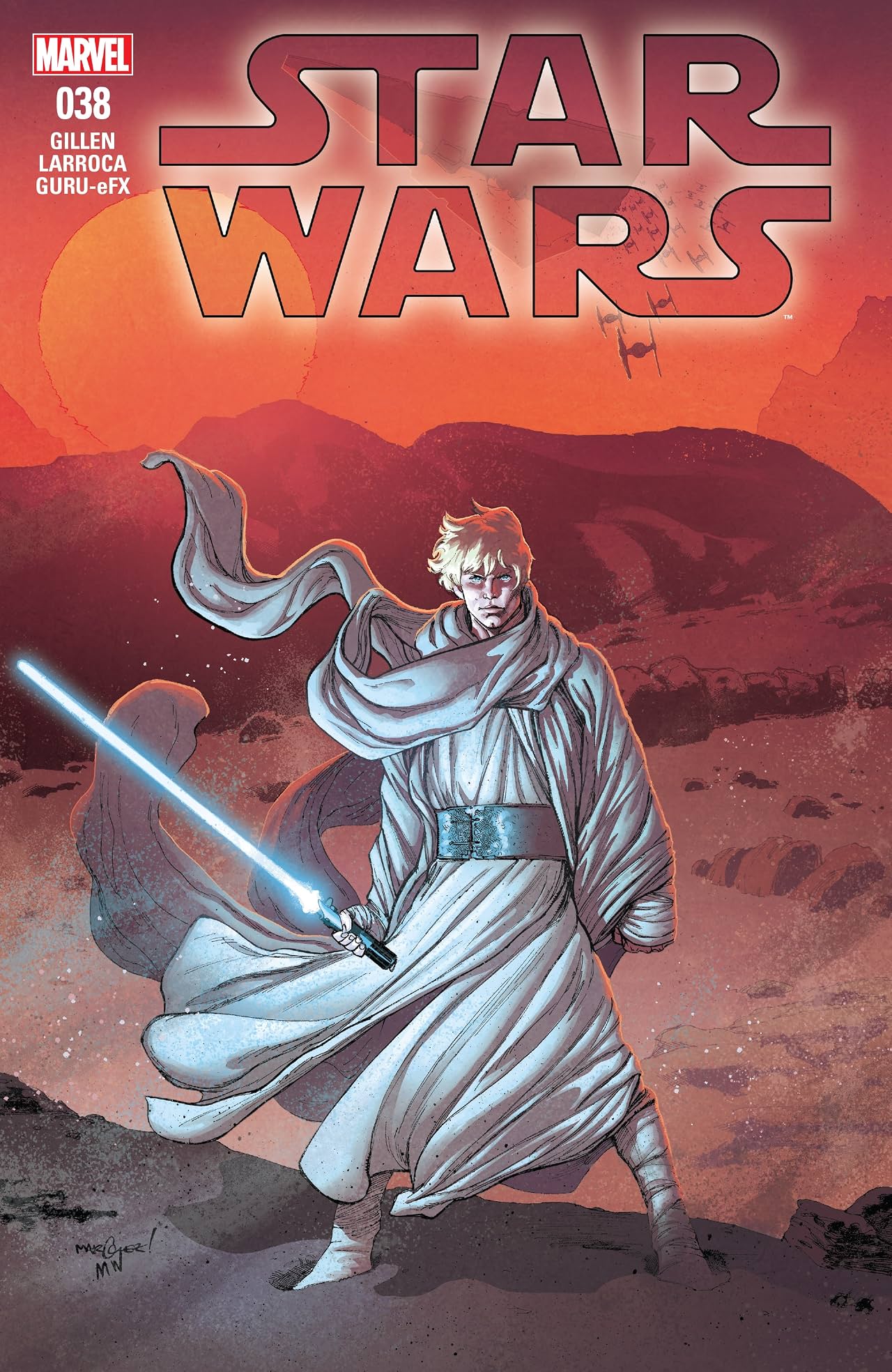
Empires, Ambitions, and Atrocities: Star Wars #38

The following is my review of Star Wars #38, which was posted on PopMatters.com.


When it comes to evil empires, Star Wars sets the bar high and the scope even higher. It's one thing to subjugate a kingdom, continent, or planet. It's quite another to conquer an entire galaxy. Even someone as bad as King Joffrey from Game of Thrones can only inflict so much evil. It says a lot about Darth Vader, Emperor Palpatine, and the Empire, as a whole, when that evil is so far-reaching that blowing up a planet is no more ambitious than Joffrey cutting out someone's tongue.

At times, however, the evil of the Empire becomes an afterthought in order to focus on the story surrounding Luke Skywalker, Han Solo, and Princess Leia. While the original trilogy and the much-maligned prequels do plenty to explore the cruel nature of the Empire, few outside the ruins of Alderan can appreciate how bad it can get for those living under its thumb. It's important for the overall Star Wars mythos to belabor why the Empire is evil in the first place. That makes seeing the Death Star blow up all the more satisfying.

This is where Kieron Gillen and Salvador Larroca come in. Having made various contributions to Marvel's line of Star Wars comics, they enter a mythos far, far away that is rarely short of drama, dread, and droids. At times, the narrative lacks direction, but Gillen and Larroca have already made numerous contributions through Darth Vader and Dr. Aphra. Star Wars #38 offers them a chance to contribute to the bigger picture and leave a more indelible mark on the galaxy. Having to do that without the aid of another Death Star is always a challenge.

The Force is on Gillen's side, though, because the Empire's atrocities don't stop at just blowing up planets. Like many other evil empires, it also goes out of its way to plunder the places they've destroyed. While there are many real-world parallels of evil empires that plunder, going back to the days of the pyramids, not even the most blood-thirsty ruler could do so on the scale of the Empire.

That's what brings Luke, Han, Chewy, and Princess Leia to Jedha, a planet that the Empire partially destroyed, but not out of mercy. The planet happens to be a rich source of kyber crystals, a mineral that the Empire values. That means they can only partially destroy it, but that still means blowing a huge chunk of the planet away. For the Empire, that's the most mercy it'll ever show. This says a lot about how they operate and why blowing up multiple incarnations of the Death Star is so cathartic.

There's nothing that big for the Rebels to destroy in Star Wars #38, but there's still a chance to frustrate the Empire. That's an opportunity that Luke and his friends rarely pass up. That also involves teaming up with the residents of Jedha, which include someone named Chulco Gi, a name that sounds custom-made for the world of Star Wars. His story and the way it ties into that of the Rebels further expands on the evil of the Empire because that can never be too belabored.


It isn't enough that the Empire partially destroyed Jedha, just to get its resources. It also isn't enough that it displaced a huge chunk of its population and did so with the kind of overkill that's akin to swatting a fly with a bazooka. The people of Jedha have their own culture, customs, and religion. Gi is a pious adherent of that religion. However, the Empire just blows that up like they do everything else that gets in their way. Whether it's a planet, a people, or a culture, they deal with it by destroying it. When they have weapons that blow up planets, it's just easier than diplomacy.

This sort of callous approach leaves plenty of scars, even on Gi. He, like Luke to some extent, believes that all the suffering and loss has a greater destiny in mind. So much of the Star Wars mythos is built around fulfilling or fighting destiny. The atrocities of the Empire just raise the stakes even more, which helps give greater weight to the struggle in Star Wars #38.

That struggle has more moving parts than simply sending Storm Troopers and Imperial Droids to shoot things. Gillen also takes some time to explore the logistics of plundering a planet with the Empire. It doesn't just involve shooting giant lasers or Darth Vader force choking subordinates. Gillen actually taps some characters from the pages of the Darth Vader comic, namely Shu-Torun. While the Empire makes few allies that aren't easy to blow up, they tend to be pragmatic when it comes to allegiances. That shows that the Empire isn't just evil. It's competent, which only makes it scarier.

That added fear factor helps make Star Wars #38 feel like part of a larger picture, one that is actually impacted by events in other Star Wars comics. That's something many of the Star Wars comics have been missing since the Vader Down event, which Gillen also helped right. The fact that a story with those connections unfolds without creating a new Death Star makes the story that much more impressive.

It's still a story that only gets so much time to develop. Star Wars #38 does plenty to establish that the situation on Jedha is dire and its people are suffering. It also establishes the personal stakes for characters like Gi, who have more reason than most to fight the Empire. What isn't clear, at least from the outset, is the larger plan the Rebels have. When there's no Death Star to blow up or plans to steal, their tactics tend to be more subtle. They also tend to be vague, which makes it hard to evoke the same drama that comes with watching Luke hit a thermal exhaust port only two meters wide with nothing but the Force.

There are a number of blanks that need to be filled. Star Wars #38 creates a story that feels part of a larger narrative, but that story isn't quite as concise in terms of purpose and intent. It still marks an overdue improvement, of sorts, with Marvel's Star Wars comics. It's not just trying to fill the sizable gaps between iconic movies. It's trying to build bigger worlds in a story where worlds regularly get blown up. It's still a challenge, as is often the case with Evil Empires, but the payoff is worth its weight in destroyed Death Stars.

Final Score: 7 out of 10

Thursday, July 13, 2017

Convergence of Character and Chaos: Dr. Aphra #9

The following is my review of Dr. Aphra #9, which was posted on PopMatters.com.


Every now and then, a character comes along that fills a need that nobody even knows is there until it's shoved in their face. It's like there are all these blind spots in the world of popular culture and nobody bothers to look until something jumps out and surprises everyone for the best possible reasons. For a mythos like Star Wars, where endless debates rage over whether Han Solo or Greedo shot first, it's hard to imagine there are any blind spots left. Then, Dr. Aphra and her two homicidal droids, Triple-0 and BT, come along and suddenly everyone has a reason to forget about Greedo.

Ever since her debut in Darth Vader #3, Dr. Aphra keeps finding ways to be the most compelling character in Marvel's evolving Star Wars universe. She's part Indiana Jones, part Han Solo, part Lara Croft, and part Catwoman. For such a new character, relative to a mythos that has been around since the disco era, that's an eclectic mixture, to say the least. However, Kieron Gillen finds a way to make Dr. Aphra work brilliantly. She's a character Star Wars didn't know it needed, but it's that much better because of her.

What helps set Dr. Aphra apart from Luke, Han, Leia, and Jar Jar Binks is her ability to play both sides. She's neither on the side of the Empire nor the Rebel Alliance. She's very much on her own side, as seen in arcs like Vader Down and Screaming Citadel. She has no qualms with changing her allegiance on a whim whenever it suits her. She's downright Machiavellian in her tactics, but somehow finds a way to be lovable.

These tactics are on full display within Dr. Aphra #9. While fans of all things noble and true in the galaxy may have a hard time rooting for her, it's hard to deny her ambitious. Dr. Aphra is the personification of Mos Eisley in that she surrounds herself with the worst thieves, thugs, and deviants in the galaxy. Unlike Luke Skywalker, she's exceedingly comfortable in their company. She gives the impression that she prefers it. For her, the scum of the galaxy are preferable to Jedi or Sith, if only because they have deeper pockets.

That's another aspect of her character that sets her apart. Like Han Solo, Dr. Aphra is more concerned with paying off old debts and turning a profit rather than bringing balance to the Force. Unlike Han Solo, though, she's not as inclined to step up and play the hero when the chips are down. If it means losing a payday or a valuable asset, she'll generally brush it off. She'll even screw over anyone who tries to nudge her in a certain direction. More than anything else, Dr. Aphra prefers to serve her own agenda and will employ any number of murder drones and renegade wookies to achieve it.

The agenda in Dr. Aphra #9 isn't that complex, but the setup is pretty elaborate. For the past several issues, she's been trying to make use of an ancient Jedi artifact that dates back to the Old Republic. Beyond satisfying her scientific curiosity as a renegade archeologist, she also understands that all things Jedi have greater value in a galaxy where most were wiped out. She may be a deviant, even by Sith standards, but she understands market forces.

Knowing the Empire is more prone to blow up planets rather than bargain, she invites some of the galaxy's most accomplished thieves and criminals to bid on it. She even turns it into a party of sorts, one in which puts Dr. Aphra's charisma and cunning on full display. She's not some inexperienced farm boy. She's not even some privileged princess. She's very much in a category all her own. In a galaxy full of Death Stars, smugglers, droids, and Lando Calrissians, she finds a way to stand out.

That's not to say Dr. Aphra is that efficient at pursuing her agenda. In fact, a good chunk of her nascent history is full of ambitious plans blowing up in her face, going all the way back to when Darth Vader first enlisted her help. It's one of the reasons she finds herself in so much debt in the first place. She's great at forging these elaborate schemes to acquire resources. She's just not that good at adapting those schemes when something goes horribly wrong, which tends to happen a lot in a galaxy where even Death Stars are prone to blowing up.

In a sense, she's very much the anti-Rey. Nobody can read Dr. Aphra #9 and claim she's a Mary Sue type character. Dr. Aphra is ambitious and skilled, but she doesn't exactly endear herself to everyone around her. It's also painfully obvious by the end that at least part of her plan is doomed to fail again. Unlike Han Solo and Princess Leia, she can't expect to rely on the love of friends and allies to save her.

Dr. Aphra isn't that kind of person. For her, friends and allies are expensive and potentially distracting. Granted, that puts her in many difficult positions, especially when her schemes go awry, but that's what provides so much of the entertainment value in Dr. Aphra #9 and her story as a whole. She is very much a deviant and a renegade, but she's no Jabba the Hut. She's not cruel or vindictive. She's not the kind of person who will Force choke anyone who disagrees with her. However, she is willing to leave dead bodies and broken droids in her wake.

Those who've grown fond of Dr. Aphra since her introduction in Darth Vader #3 will find plenty to enjoy in Dr. Aphra #9. In a sense, Dr. Aphra #9 highlights all of the traits that make her story compelling and her character endearing. Those who haven't been following her exploits since Screaming Citadel may be lost, though. Dr. Aprha's story is difficult to just pick up and follow. There are also times when the flaws in her schemes seem a bit too obvious. Those hoping for a big revelation on par with The Empire Strikes Back will be disappointed. That's not how Dr. Aphra works. It's the little revelations that make her story so engaging.

That doesn't prevent Dr. Aphra's character from being any less endearing. She's still someone that's easy to root for. At the same time, she's also someone that can slip up and not upset too many people. Gillen's development of her character continues to be strong and Andrea Broccardo's art adds visual appeal with that distinct Star Wars style. Dr. Aphra may not care much for the Force since it can't pay her debts, but she doesn't even need it to be a great character. Debts or not, the galaxy is inherently richer because of her presence.

Final Score: 8 out of 10

Thursday, December 8, 2016

Uber-Brutal Alternative History: Uber Invasion #1

The following is my review of Uber Invasion #1, which was posted on PopMatters.com.


The concept of alternative history is a cottage industry of sorts that has a unique, albeit contentious appeal. It's often presented in the form of a compelling, potentially plausible "What If" scenario that paints our current history as series of miraculous events that are never more than a casual whim from deviation.

By far, the most popular scenarios of alternative history narratives take place in World War II. It is to alternative history what orphaned princesses are to Disney movies. Most of these narratives boil down to the idea that if Hitler had done this or that, then the Nazis would've won the war and the entire western world would begin its day with a mandatory salute to the Nazi flag. These narratives are extremely simplistic, often taken extreme liberties with known historical fact.

This is exactly why Kieron Gillen's narrative in Uber is so compelling, but in a very different way compared to traditional alternate history stories. Gillen does not try to twist or contort historical facts to fit a scenario. He doesn't try to make an argument that history needed a few tweaks to become radically different. Instead, he crafts vast, refined scenario built around the premise of Nazi's creating superpowered soldiers.

It's a scenario that we've seen before in multiple Captain America movies, but Gillen takes it in a very different direction. There's no Captain America. There's no Red Skull either. Instead, there's a complete re-imagining of World War II, but with the added theatrics of superpowers. Those powers completely reshape the narrative at the end of the war in 1945 in the first Uber series. Now, with Uber Invasion #1, Kieron Gillen raises the stakes and the payoff is both astonishing and ominous.

The situation, as described by Henry Stimson to President Harry Truman, is pretty grim. The Nazis have a new arsenal of superpowered soldiers capable of burning cities to the ground, annihilating entire armies, and spreading the kind of brutality that would make any dedicated Nazi smile. The American arsenal, as vast and resourceful it is, has nothing like this and that puts them at an extreme disadvantage. It's a situation that America is not used to being in, even today.


Gillen doesn't change the logistics of World War II, something Captain America movies and Call of Duty video games tend to do to an excessive degree. America is still an economic powerhouse that produces enough planes to blot out the sun over Axis-occupied countries. However, Gillen doesn't obscure the situation with the kind of ideals that dominate every 1940s-era newsreel. True to Uber's legacy, there's a powerful emphasis on the brutality and devastation of war.

This gives Uber Invasion #1's its greatest strength as a narrative. The brutality and devastation is not sanitized, censored, or twisted. The blood, the destruction, and the terror all unfolds in graphic detail, benefiting considerably from Daniel Gete's art. It creates a powerful impact, one that is very different from other narratives surrounding World War II. This is not the kind of impact that evokes patriotism or parades. It's the kind that exposes the horror and brutality of war.

That impact doesn't just focus on the American side of things either. The Uber narrative never takes a side. There's never a sense that this is a story from the perspective of the Allies or the Axis. Both get a chance to assess the events, respond to them, and form a strategy for the future. No side is overly glorified as the hero and no side is overly vilified as the villain. In a story about real-life Nazis, that in and of itself is an accomplishment.

This isn't an underdog story. There aren't any inspiring speeches by General Patton or evil gloating from Adolf Hitler. Uber Invasion #1 is a story about the brutality of war. That brutality is only amplified, intensified, and expanded with the aid of superpowered soldiers. In some respects, the use of superpowers is secondary, but it is still very much the catalyst for the added brutality.

This brutal, visceral brand of alternative history began immediately in Uber #1 when superpowered Nazi soldiers entered the picture. Uber Invasion #1 reflects the inevitable progression of that history, taking the brutality to the shores of America. Gillen dedicates the bulk of the first round of Uber to crafting a narrative around how superpowered Nazi soldiers change, decimate, and destroy the history we know in Europe. In the second round, he enters a period point in history that goes beyond anything old newsreels and documentaries ever explored.

One of the many defining circumstances of World War II is how America avoids much of the destruction unleashed upon Europe. The impact of this circumstance is hard to overstate and Uber Invasion #1 goes out of its way to highlight that. In this conflict, America never feels the brutality and destruction that Europe suffers. It never experiences the true horror of war on its own soil. Gillen and Gete bring that experience to America in this story and gives it just the right impact.


The true extent of that impact manifests in a very brutal, albeit very theatrical way in the end. For all the exposition that helps establish the situation in Uber Invasion #1, it still finds a way to inject the brutality in just the right places in just the right ways. There are any number of stories where America gets invaded by Nazis, aliens, and crap monsters. This invasion, however, feels different. Again, there's no Captain America or Chuck Norris to save the day. There's just the harsh brutality of war.

Uber Invasion #1 stands out in so many ways, both in terms of impact and narrative. At times, it tries too hard to be a jumping-on point for those who didn't read the first series. The amount of exposition does start to drag in some areas, but it never derails the story or takes away from the impact.

In the end, Uber Invasion #1 is a different kind of alternative history. It's a different kind of World War II story. It's different for all the right reasons and those reasons manifest in all the right ways. This is not a story that anyone, be they Nazi or American, would dare use as war propaganda. In many respects, though, that makes the impact all the more profound.

Final Score: 9 out of 10

Thursday, October 13, 2016

The Polish of the Dark Side: Darth Vader #25

The following is my review of Darth Vader #25, which was posted on PopMatters.com.


In the post-Breaking Bad era of popular culture, it's not enough for our villains to just be villainous anymore. The qualities of overtly evil characters like Lex Luthor, Thanos, and every James Bond villain that ever existed are no longer sufficient. These characters deserve layers, personalities, and development every bit as much as the heroes. It seems like an unwarranted consideration for villains, but it's one that helps craft more compelling narratives.

In this respect, Darth Vader is a character that was ahead of his time. When he shows up in Star Wars Episode IV: A New Hope, he carries himself as a traditional bad-to-the-bone villain who will blow up a planet full of sick puppies in order to crush the rebels. Then, by the end of Star Wars: Episode VI: Return of the Jedi and the maligned prequels that followed, he becomes a more complex villain who does what he does for reasons beyond just enjoying the cries of dead Alderaneans.

Kieron Gillen takes this complexity and hits the ground running full speed when his Darth Vader series begins. He succeeds where three prequels with production budgets north of $100 million failed, building new layers to Darth Vader as a character and as a villain. Gillen never tries to make Vader an anti-hero. He doesn't try to make him sympathetic either. He just uses this series Darth Vader a more compelling character. As such, Darth Vader #25 acts as the cherry on top of a very delicious cake.

Make no mistake. Darth Vader does nothing remotely heroic in this issue. Darth Vader #25 still occurs within the context of the period before Star Wars Episode V: The Empire Strikes Back. This means he's not remotely close to the character who sacrifices himself to save his son. He's still on that path, but he's going to dig himself into a deeper hole before he gets there.

For much of this series, Gillen has Darth Vader focus on a different goal, but one that's more relevant for this particular part of the Star Wars mythos. It begins with him acknowledging that he failed to prevent the destruction of the Death Star. He gives Emperor Palpatine a valid reason beyond mustache-curling evil to question the competence of his apprentice. It's Darth Vader's job to prove himself again and, true to his devious legacy, he goes the extra parsec.


It doesn't just involve Darth Vader confronting and defeating the Emperor's efforts to defeat Cylo, who the Emperor taps as a possible replacement. It also involves Vader himself going behind the back of his Emperor, carrying out missions that undermine his blind obedience to his master. This is what led him to cross paths with Dr. Aphra, Triple-0, and BT, three characters that frequently steal the show in this series. There's just something inherently charming about a murderous version of C-3P0.

These subversive efforts, alongside his efforts at redeeming himself, give extra weight to Darth Vader's villainous legacy. It's a legacy that doesn't really need to be refined, especially in wake of the ill-fated, Gungan-filled prequels. However, this extra layer of complexity acts like the extra layer of frosting on a cake. It makes everything sweeter in the end.

The battle against Cylo comes to an end, one that involves a creative yet destructive use of the Jedi mind trick. Darth Vader's dealings with Dr. Aphra come to a head as well. All the secrets and plotting create such a unique dynamic between Darth Vader and Dr. Aphra, making for a confrontation with the Emperor that carries a significant amount of dramatic weight.


Anyone hoping for Darth Vader to show mercy for Dr. Aphra after all she's done for him will be disappointed. Within the context of this stage of the Star Wars mythos, nobody should be surprised either. Darth Vader at this stage of development is willing to encase Han Solo in carbonite and cut his son's hand off. He's more than willing to toss a loyal ally like Dr. Aphra out of an airlock. If anything, that's as merciful as he can possibly be at this point.

While not surprising, this moment carries weight because Gillen puts time and effort into crafting a unique relationship between Darth Vader and Dr. Aphra. Those efforts help give the moments in Darth Vader #25 the dramatic weight it needs to have an impact. It feels much more meaningful than Darth Vader just force choking an entire legion of Gungans, but is every bit as satisfying.

There's no question that Darth Vader is still bad to the cybernetic bone at this stage in the Star Wars mythos. His battle against Cylo and his confrontation with Dr. Aphra prove that beyond any doubt. However, Gillen does offer some hints that the Darth Vader who goes onto sacrifice himself to save his son is starting to emerge.

These hints are somewhat subtle, sometimes excessively so. They show mostly through the crisp artwork of Salvador Larroca. It's not as overt in Darth Vader #25 as it is in previous issues of this series, but the subtext is there. It doesn't add much to the dramatic weight of the story, which does skew the balance more to the Dark Side. However, given the context of the story, it's still appropriate.

Kieron Gillen didn't set out to remake or redefine Darth Vader with this series. More than anything else, he works to reinforce the devious, villainous part of the character that the prequels tried too hard to circumvent. There's still an internal struggle here that will manifest in the final minutes of Star Wars Episode VI: Return of the Jedi, but the tone of the narrative in Darth Vader #25 is clear. This narrative embraces the dark side and the results are impressive. Most impressive.

Final Score: 9 out of 10

Tuesday, February 17, 2015

The Dark Side of Empires: Darth Vader #1

The following is my review of Darth Vader #1, which was posted on PopMatters.com.


When the Star Wars prequels were originally announced, the main appeal was that it would provide a context for how Anakin Skywalker became Darth Vader. That is a story that's worth telling and one that helps cast the events of the later movies in a new light. However, the story failed make that new context all that compelling. Darth Vader really didn't become more interesting as a result of the prequels. Those movies just made Anakin Skywalker out to be a whiny, overly gullible kid with poor impulse control.

There's much more appeal in seeing Darth Vader as the sinister, intimidating villain he was when introduced. Darth Vader is a freshly mixed batch of ice cream while Anakin Skywalker is just the ingredients. There's little appeal in the ingredients on their own, but the ice cream that is Darth Vader has plenty of appeal.

He's a powerful Sith Lord who, unlike the far less imposing Emperor, is willing to get his hands dirty. He's not like Dr. Doom, who prefers letting his Doombots do the fighting. He's not even like Lex Luthor, who wastes time belittling and berating his enemies with his brilliance. Darth Vader speaks only as much as he needs to and in the most intimidating way possible. And when that's not enough, he'll finish the job no matter how many Stormtoopers or Death Stars it costs.

This is the version of Darth Vader we're given in Darth Vader #1. There's no elaborate effort to make him a more sympathetic character. There's no shocking revelations about who might be who's father. This is just Darth Vader, fresh off a humiliating defeat on the Death Star, looking to get back at those responsible. The end result is much more engaging than the prequels ever were. The lack of Jar Jar Binks is only a bonus.

The structure of the story is heavy with exposition and that's not necessarily a bad thing. The loss of a resource as big as the Death Star should definitely have some major ramifications and since Darth Vader was tasked with defending it, he should face some level of scrutiny. He's not some renegade official who took one too many bribes or got drunk at one too many office parties. He lost the Empire's greatest weapon. It would be like someone misplacing an atomic bomb during World War II. There should be some fallout.

The fallout in this story revolves around Emperor Palpatine holding Darth Vader personally responsible for the destruction of the Death Star. It's the kind of fallout that has genuine impact because the Emperor is one of the few characters who can berate Vader and live to tell about it. He provides a context for what the loss of the Death Star means. It's a context that was never explored in the movies, but it's one worth exploring because it portrays the Empire as something more complex than a standard GI Joe villain.

The Emperor lays out the plan that Darth Vader failed to uphold. The Death Star was just the culmination of 20 years of solidifying the Empire's rule. Losing it means the Empire is vulnerable in a way that'll make any Emperor feel uncomfortable. The consequence of that discomfort means Darth Vader gets a brief demotion and a new task that involves dealing with criminals like Jabba the Hut. In terms of a demotion, it's not quite the same as being given janitorial work, but it still sends a message.

That message brings out the tough, ruthless, force choking side of Darth Vader that Hayden Christensen never properly portrayed. When he visits Jabba the Hut, there's no elaborate deception or struggle. Nobody ends up in a chain bikini either. Darth Vader just tells Jabba what he wants and what he'll do to him if he doesn't give it to him. It's the kind of negotiation tactics that would make the John McClanes of the world smile.

It gives Darth Vader a chance to show off why he's much more interesting as a dark lord than he ever was a pod racing kid. Jabba still attempts to use the same tactics that will eventually get him killed in Return of the Jedi. Darth Vader easily fights them off. He doesn't end up fighting a Rankor or a Sarlac, but he gets his point across. It's the best action in the story and that might be somewhat of a problem.

There's never a real sense of struggle. Even the cave-dwellers who never saw Empire Strikes Back or Return of the Jedi would never get the impression that there was any real struggle between Darth Vader and Jabba's thugs. The battle was extremely one-sided. If it were a football game, it would not be a game the NFL scheduled for prime time. It attempts to inject a little intensity into a story that's so heavy on exposition. It just doesn't succeed nearly enough. A Rankor would've helped, but even that wouldn't be a fair fight against Darth Vader.


In many ways, that's the challenge of a story like this. Darth Vader is so powerful and ruthless that it's hard to give him a challenge. Unless it involves protecting moon-sized battle stations, he makes it look easy. The real appeal in Darth Vader #1 involves putting his character in a difficult position where he has to regain his credibility with the Emperor. The added context of his failure to protect the Death Star and the challenges he now faces in making up for it make this story compelling. It'll appeal to fans of the West Wing, but not fans of Die Hard movies.

This story is deeper than Darth Vader being ruthless and that's one of its greatest strengths. However, the overall narrative has a few holes in it and won't put anybody on the edge of their seat. It still puts Darth Vader front and center in a story that explores his character in a way the prequels failed to do. And if it can do this without Gungans and pod racers, then it's definitely a story worth telling.

Final Score: 7 out of 10

Monday, December 8, 2014

Heavenly Beginnings: Angela: Asgard's Assassin #1

The following is my review of Angela: Asgard’s Assassin #1, which was posted on PopMatters.com.


In this era of reboots, recons, and remakes, it often feels as though the bar for success is exceedingly low. These days, most fans will consider any remake that doesn’t dump burning napalm on their childhoods a success. It’s like every remake is a plane that’s always about to crash. It can only work if those involved can walk away alive. Even the successes, such as J. J. Abramas’ Star Trek, feel like flukes rather than accomplishments. Failures such as Michael Bay’s Teenage Mutant Ninja Turtles tend to be the norm.

These are the circumstances in which Marvel had to remake Angela, a character who is not at all native to their universe. She was an established character in Spawn. She had her own history and her own place in that world. But thanks to negotiations with Todd MacFarlane’s lawyers, which may or may not have included a deal with Mephisto, Marvel gained the right and the opportunity to incorporate her into the Marvel Universe. It has taken them a while to make good on that opportunity. At times, it has taken too long. But now Angela has a place in the Marvel Universe and Angela: Asgard’s Assassin #1 makes it akin to the hot new club in town.

Make no mistake. This Angela is not the same Angela from Spawn. She has the same name. She has the same look. She has the same knack for slaying unholy monsters in ways befitting of any Angel of Death. But she is a different character. This issue attempts to build on what was established with Angela from the aftermath of Age of Ultron and Original Sin. While the results probably won’t satisfy those who enjoyed following her in Spawn, it does plenty to make her worthy of being in a universe where she can arm-wrestle Thanos and Dr. Doom.

The development of her character has been somewhat slow since Age of Ultron. It wasn’t until Original Sin that Angela established a more definitive place in the Marvel Universe, being the lost sister of Thor and raised in the Tenth Realm of Heven. This issue does build on the aftermath of this revelation. It even explores the personal impact it has on Angela. However, that impact is secondary. No matter what universe she’s in, she’s still Angela. She’ll find a way to be a badass, monster-slaying Angel of Death in any universe.

This is what brings her remote backwater portion of the universe reminiscent of Mos Eisley on Tatooine. She’s fresh off the disturbing revelations of her heritage and looking to take it out on someone. She puts herself in a perfect position to do so. She arrives with a stolen baby in her arms and plenty of angry monsters chasing after her and not the kind from Child Protective Services either. They attempt to attack her. Angela makes them wish they hadn’t. There’s absolutely nothing about her actions that’s out of character. This may even be her way of coping with the revelations of her Asgardian heritage. It’s not exactly the healthiest kind of therapy, but it works for her.

Angela’s ability and prowess in battle ends up being the central theme to the story. She does not fight the same way as She-Hulk, Black Widow, Catwoman, or Wonder Woman. She’s not some overly sexualized vixen who hides the impracticality of fighting in stiletto heels. She’s not overtly masculinized and she’s not completely devoid of sex appeal either. Angela fights with a style all her own. It’s a style that’s visceral, focused, and right at home in a universe where giant green monsters and killer robots are the norm.

This unique style helps give the story some flavor. It’s not just another case of a beautiful woman beating up monsters like a superpowered slasher movie. It gives Angela a unique appeal among male and female characters alike. And in a market flushed with powerful female characters like Storm and Captain Marvel, that in and of itself is an accomplishment. However, it isn’t just her fighting that makes Angela appealing. It’s her motivations that help her stand out and not necessarily in a heroic sort of way.

While Angela is fighting, her friend, Sera, gives a brief anecdote about why she does what she does. She may be Asgardian now, but she still sees herself as an angel. And angels in the Marvel Universe are anything by heavenly. They’re more like loan sharks and debt collectors for the mob. Angela’s motto is, “Nothing is for nothing.” Every act, including something as basic as saving a baby from a crashed spaceship, incurs a debt. And anyone who ever took out a student loan understands the dangers of debt


It sounds like the way Tony Soprano would operate and not an angel, but Angela still comes off as much more likable. Sure, she’s okay with wacking those who can’t pay, but she won’t take pleasure in it. She won’t be unreasonable about it. She’ll give others multiple chances. If they choose not to take them, then she will dish out Columbian Neckties with her sword. It’s not as cruel as it sounds, but it’s every bit as unheroic as it sounds.

This overview of how Angela operates provides great insight into her character. However, the insight does cause the story to drag considerably. Given how long and tedious it has been to get Angela to this point, it certainly tempers the impact. However, there is a major payoff in the end when it’s revealed whose baby she took and why monsters are coming after her. It leads right into a conflict that feels like a natural outgrowth from Original Sin. It feels like an investment that has finally paid off and without the need for insider trading.

There are many ways Angela can contribute to the Marvel universe. She’s shown she can be part of a team. She’s also shown she can fit into the overly convoluted history of the Marvel Universe. Now, Angela: Asgard’s Assassin #1 shows that she can hold her own and do things her way. There will still be Spawn fans that refuse to accept that, but that’s their problem. It isn’t the perfect template on which to recast an established character. At the very least, it’s a blueprint for actually making it good and not just avoiding a horrible crash.

Final Score: 8 out of 10

Wednesday, December 3, 2014

Scanned Thoughts: Angela Asgards Assassin #1


Beautiful redheaded women in the Marvel universe are like big-breasted blondes to Hugh Hefner. There can never be enough of them. Between Jean Grey, Black Widow, and Mary Jane Watson, I think every heterosexual man with a functioning penis would agree. So when Marvel’s lawyers pulled off a miracle with Todd MacFarlane (which I’m convinced involved someone getting blown more than once) to get the rights to Angela, I was all for it. Since she arrived at the end of Age of Ultron, her character and her whole story is being reimagined. Some have bitched and moaned about it, as they are prone to do about damn near everything.

But Marvel has found a way to incorporate Angela into their world while maintaining everything that makes her awesome. She’s a killer, badass angel of vengeance who likes to show off her washboard stomach and snap necks, often in that order. She also happens to be the sister of Thor from a previously-unknown tenth realm, but that’s beside the point. Angela is now part of the Marvel universe. Deal with it. Now she has her own series to help her find a place in that universe. Angela Asgard’s Assassin #1 is the first step in that process. After Original Sin, it’s probably not going to make her any more comfortable. However, I’m sure plenty of readers will find a reason to bitch and moan about it anyways.

As for Angela herself, she has way more legitimate reasons to complain. She just found out that she’s an Asgardian, who just happen to be the sworn enemies of angels. Now the angels who raised her hate her guts and she did plenty to make Asgardians hate her as well during Original Sin. I’m not going to say she’s completely blameless, but she certainly went out of her way to piss a lot of very powerful beings off. Maybe that’s just how she rolls. Not going to say it’s worthy of a rap video, but she’s definitely taking the hard road.

Now that shoe knows who and what she is, she’s basically off on her own. Heven hates her. Asgard hates her. So what does she do? Go out drinking with Dracula and arm wrestle the Hulk? Maybe that’s on her to-do list, but she still has shit to do. This leads her to some stereotypical mystical land that looks like a lost level in World of Warcraft. She’s carrying what looks like a baby, but it could be baby dragon for all we know. There’s some nice narration to recap what she’s gone through and how rough she’s had it lately. But this doesn’t stop her from walking right into another shit storm.


When she arrives, she’s greeted by an army of orcs that look like leftovers from Lord of the Rings. They welcome her to the Un-Town, which sounds like a bad Disney ride. She makes it clear she’s not interested in rides or waiting in line for the last Hobbit movie. She’s here looking for a friend. After all the bridges she burned and spat on in Original Sin, it’s hard to believe Angela has any friends. But she does. This one’s name is Sera. She’s like her in that she loves wearing badass armor and beating up those who think they’re stronger than her. It’s not entirely clear why Angela wanted to find her. I don’t get the impression they’re planning a spa day or something. But there is a reason for it and it’s usually safe to assume it involves something or someone that needs to be killed.


Low and behold, that’s exactly what happens. Angela reveals that she didn’t stumble across this fucked up version of an old western town on acid by accident. She was actually running from something and it wasn’t child protective services. It was actually scarier, but not as scary as the IRS. It was a horde of horse-riding demonic creatures that must have also been rejects from World of Warcraft. They apparently didn’t like Angela holding that baby and they’re not going to wait until she gets her own episode of Hardcopy to make her pay. There’s still not much in terms of details regarding this baby or why these creatures want to fight Angela. I’m assuming they don’t have a death wish, but I try to be careful with my assumptions. One accidental encounter with a transvestite hooker taught me that lesson.


Whatever their reasons, these creatures also learn the hard way it’s not smart to piss off Angela. They try to fight her and she fights back, albeit much more effectively. It’s brutal, visceral, and nicely detailed. It’s not overly bloody. It’s not overly gratuitous. It’s not even overly sexy, but it’s just sexy enough to put a smile on my face and a boner in my pants. It’s the perfect balance in that it shows the kind of fighter Angela is and what she’s capable of. She’s not the Hulk. She’s not Black Widow. She’s fucking Angela and she kicks ass her way.


As much fun as it is to see her kick ass, there are still plenty of blanks that need to be filled in here. Anybody who skipped Original Sin or is too drunk to remember it might be confused, but would probably be content to just follow one long story of her eviscerating orcs. However, this isn’t how the story unfolds. There actually is an effort to explain why Angela is doing this and it might even explain where that baby came from. For all we know, it’s still a dragon or the last discounted iPad from a Black Friday sale.

This is where Sera starts to narrate, which makes sense because Angela is busy decapitating orcs. She explains that Angela was out troving the galaxy, looking for work. I imagine she was trying to stay busy, as many often do after they’ve had a real shitty couple of days, like finding out she was the daughter of Odin. This led her to a crashed transport on some backwater alien planet that looks nothing like Tattoine. In the wreckage, she found an infant had survived. She saved it, but along the way Sera makes clear that she doesn’t do this out of the goodness of her heart. She still considers herself and angel and angels in the Marvel Universe are less about salvation and more about making the kinds of deals the mafia likes to make. Saving this child puts it in debt to her and like Joe Pesci in Casino, she intends to collect and she’s not afraid to use a baseball bat if necessary. “Nothing is for nothing,” is her motto. I’m pretty sure that’s also the motto for Goldman Sachs too.


To be fair, she demonstrates a lot more ethics than Goldman Sachs or the mafia ever does. She finds the infant a home on this world. She even tells its adopted parents who she is and makes clear that this kid is to know who she is. She just found out how much it sucks keeping secrets about an infant’s heritage. She’s going to spare this kid that torment. Like I said, she isn’t without ethics. She’s not the fucking DEA.

But eventually, a day comes when she returns to collect her debt. Angela returns to this world when she finds out her friend Sera has been taken prisoner. The infant she saved has since grown into a king. He’s not exactly a Game of Thrones caliber king and his throne is really shitty by comparison. But he comes off as fair and reasonable when he argues that Sera is guilty of crimes against his people. So even though Angela offers to forgive his debt by letting her go, he refuses. Angela begs with him. She asks him nicely multiple times. He still refuses. At that point, Angela channels her inner Joe Pesci and collects on the debt and her sword is way more effective than a baseball bat.

It’s cruel and not very heroic. But that’s part of what makes this moment so powerful. It shows that Angela does have a code of honor, but that code isn’t very honorable by some standards. She will kill those she has compassion for. She will be brutal when she has to. She’s not a big believer in altruism either. She’ll either balance out the debts or she’ll spill enough blood until the universe balances it for her. She doesn’t take sadistic pleasure in it though. She actually provided funds and resources to the kingdom to help maintain stability after the king’s death. At this point, they know to accept Angela’s terms. She is not someone they want to piss off.


Sera makes clear that this is the core of who Angela is and why she does what she does. She collects debts. She balances out imbalances. And from time to time, she shows a sense of loyalty to her friends. She’s not going to get emotional about it. She’s only ever going to get pissed when someone or something gets in their way. It’s makes her unique in how she operates. She’s not a villain. She’s not all that heroic either. Then again, the Avengers still have the Hulk on their team. So maybe the standards for heroics should be graded on a curve here.

After Sera is done recounting her history with Angela and why she does what she does, we finally get back to more immediate concerns. At this point, those concerns seem secondary. The whole flashback was like an extended halftime show of sorts. It was fun, but it kind of fucked up the rest of the football game. By now, Angela has finished maiming all the orcs. That really shouldn’t surprise anyone. Then Sera reminds her that if she was followed to the Un-Town, she’s probably being watched and not in the creepy gym-teacher-in-the-girls-locker-room sort of way.


Whoever or whatever was watching her figures out quickly that sending orcs after her ain’t going to get the job done. So instead, she gets a visit from another menacing threat. This time it’s from Thor, Sif, and the Warriors Three. That’s like going from Hydra drones to Dr. Doom’s A-team. It promises to make for a much messier and more epic battle. To this point, the story was starting to drag, having spent so much time just establishing Angela as a character. But the arrival of the Asgardians, especially after the shit storm in Original Sin, definitely gets things back on track in a way rivaled only a line of top quality blow.


But that’s not the only thing that gets the story back on track in the most awesome way possible. Remember that baby and/or dragon Angela was carrying? Well it turns out, it was actually a baby. If that sounds like a letdown, take another bong hit. That baby happens to be the new heir to Asgard. When and how this new baby was born is not explained, but that’s really not the main concern here. More than anything else, it gives Thor and all of Asgard another very good reason to battle Angela. It’s the kind of family conflict that would impress Jerry Springer himself. It couldn’t be more awesome without midget strippers being involved.


This issue, more than anything else, establishes the method to Angela’s badassery in the Marvel universe. She’s not exactly an angel. She’s not exactly an Asgardian either. She’s more like a cross between She-Hulk, Jean Grey, and Tony Soprano. She’s strong enough to take on an army of monsters and beat the everloving shit out of them with only her fists and a lousy mood. She’s loyal and compassionate to those she considers friends. But at the end of the day, she’s all about business. Owe her something and she will collect. Deny her and she will kill and she won’t hesitate. She’s not some Catwoman-level femme fatal who thinks latex and stiletto heels function as a combat uniform. She’s not some butch, barely feminine agent of destruction who appeals only to lesbians and feminazis. She does have sex appeal, but it’s not the overly overt kind found in every Victoria’s Secret catalog ever made.

Angela is very much her own character. She’s not quite a hero. She’s not quite a villain. She’s in a category all her own and that makes her both sympathetic, but just enough of a bitch to be badass. It took a while to establish this persona and this comic moved way too damn slowly at times to make readers give a damn. But in the end, it still worked. That’s why I give Angela: Asgard’s Assassin #1 an 8 out of 10. There will be some Spawn fans are still going to be pissed off. There will be some Marvel fans are going to be pissed off. But short of a gallon of morphine and extensive electro-shock therapy, I doubt these fans would ever be satisfied so fuck them. Nuff said!

Tuesday, December 31, 2013

Scanned Thoughts: Origins II #1


I know I give Wolverine a hard time on this blog. Sometimes it seems like I take an extra bong hit and jerk off every time Wolverine makes an ass of himself or gets upstaged by Cyclops in the comics, but that's not the case. I take an extra bong hit and jerk off for whatever the fuck reason I want, thank you very much. But lately, a lot of Wolverine's story has been tied up in his work with the Jean Grey Institute, his constant bickering with Cyclops, and a supremely shitty movie that basically turned him into Edward Cullen without the sparkling. It's easy to forget that Wolverine is still one of the most awesome comic book characters ever. I certainly haven't forgotten and given all the brain cells I've killed over the years, nobody has any excuse. So I did even more extra bong hits when I heard that Kieron Gillen was returning to the X-books to write a sequel to Wolverine Origins, a mini-series by Paul Jenkins that any self-respecting Wolverine fan needs to own. It basically goes back to the very shit that made Wolverine so awesome in the first place. For that and many other reasons, reading and reviewing Origins II #1 was a reminder that awesome still exists in an era where Bryan Singer has fucked Wolverine up for a generation of comic book fans.

At this point in his life, James Howlett, the man who would become the Wolverine that Hugh Jackman would use to soak the panties of female X-men fans, has ditched a typical human life. Wolverine has just killed Rose, the woman who established the precedent for him falling in love with pretty redheads that didn't love him back. It also set the precedent for him stabbing pretty redheads, but that's not the point here. Her death basically drove him batshit with guilt because at this point in his life, he hadn't gotten used to killing people. Just wait until he tears through hoards of Weapon X soldiers and Hydra agents. He'll learn to kill with a goddamn smile and a boner, but he's just not there yet. It follows closely after the events of the first Origins, which may be jarring to some since that shit came out over a decade ago. But it's not Marvel's fault that many people have attention spans only as long as Miley Cyrus's last music video.

Now in the wild and wiping his ass with leaves, he spends his day hunting down other weaker animals for food in the wild Canadian wilderness. And he even does it while wearing nothing but a fucking loin cloth. At temperatures that would cause most peoples' nuts to fall off, he's as comfortable as Pamela Anderson at a fake tits convention. He's not Weapon X yet. He's not an X-men yet. He's not even Wolverine yet. He's living as an animal, ruled by instinct and survival. He's basically a proto-Wolverine and yet he's still as awesome as the man he later becomes.


But the story isn't just pre-Wolverine hunting for food in his underwear. That would be a pretty boring ass story, except for women who are tired of masturbating to Tarzan wannabes. Throughout this issue, there's sort of an over-arching narration. It's not Wolverine's thoughts. It's not clear who the fuck it is, but it doesn't have to be anyone. It helps explain a situation that would otherwise be just a guy hanging out with a pack of wolves. This isn't the fucking Jungle Book. This is Wolverine and his story with these wolves would not make the cut in a crappy Disney G-rated movie.

These wolves are basically Wolverine's new family. Having reverted to his most primal instincts, he now gets along quite nicely with equally primal animals, like wolves. The wolf even has a name, Grey Scar. It sounds like the name of a heavy metal band, shady pharmaceutical company, or a fucked up scar that Jackie Chan probably had at some point in his career. But it's still a badass name for a wolf. And this wolf is basically the head of a pack that has adopted Wolverine as one of its own. So yes, it is a lot like the Jungle Book, but the Jungle Book never showed anyone gutting a dear and gorging on its blood. That shit is just too PG-13 for Disney's tastes, but it gets the point across. Wolverine has built a new life with a new family. That life is still violent and bloody, but it's awesomely fitting.


Everything seems to be going well. It's a simple life devoid of redheads incessantly cock-teasing him, asshole adopted fathers, and shitty adopted brothers like Dog Logan making his life miserable. It's one of those "back to nature" moments that's meant to make us long for a simpler existence that doesn't require us to pay taxes, work in cubicles, or stand in line at the DMV. It sounds good on paper, but it sucks for everyone who doesn't have Wolverine's ability to heal and his ability to be a badass hunter.

However, in the same way he tends to give the finger to Cyclops, Captain America, and anyone else who tries to give him orders, he goes against the sentiment of his pack when they come across a large white bear. His pack leaves it while Wolverine decides to investigate. Considering a bear is big and strong enough to maul three normal men and six adult wolves, its a clear sign of human stupidity that would make Charles Darwin himself bang his head against the wall. Wolverine just has to tempt natural selection and look into this mysterious bear. It's clear what's so fucking special about this bear. The narration is a big vague and nobody even says a fucking word in this comic. So it's a story that has to be processed with a sober mind sadly.


As Wolverine stalks the bear, he makes Charles Darwin bang his head against the wall for another set of reasons. He finds out that the bear isn't exactly Winnie the Pooh or a disgruntled circus bear for that matter. It's just hungry as fuck and apparently a really shitty hunter. Natural selection is already poised to send this bear to the same place it sent a T-Rex, but Wolverine took pity on it in a way a pack of hungry wolves never would. He tried to help it by leaving it fruit, but he might as well have tried to serve light beer to Ozzy Osborne. It just wasn't going to do the trick. He eventually gives up and returns to his pack, but it shows that he's still more man than wolf, albeit with some of the stupider tendencies in men.

I don't know if this is a metaphor for how shitty human beings are at fending for themselves in the wild or if this is just a sign of Wolverine's capacity for making shitty mistakes because of his instincts. This is where not having any fucking dialog sort of makes the story confusing. The message is still clear and it's still much more compelling than a typical story of Wolverine decapitating several Hydra henchmen. It's just too vague, especially for those of us who don't read comics sober. And I'm pretty sure that counts as discrimination in some states.


Whatever the message, the story continues to play out through the eyes of a wolf pack. A few days go by. All is happy with Wolverine and his wolf family. They cuddle, lick each other's hair, maul unsuspecting prey, and mark their territory with their piss. I imagine Led Zepplin used to do the same thing with their groupies. But then one day they're out in the forest hunting when one of the wolves howls out a distress call. Remember that bear that Wolverine took pity on? Well that bear didn't have much pity for him or his family. Once that bear found their den, he helped himself to all the sweet, succulent meat of the other wolves.

It's bloody, it's tragic, and it's definitely the kind of shit that would never make the cut in the Jungle Book. It's one of those things that shouldn't have an impact. I'm sure there are bears out there right now mauling entire packs of wolf cubs, but this has an impact because so much time has been spent making readers give a damn about Wolverine and his wolf family. And it fucking worked. Anyone who saw Bambi as a kid might have painful flashbacks, but that's nothing a few extra bong hits can't help.


Needless to say, Wolverine is pretty pissed off. He just got done killing a pretty girl he really cares about and who may or may not eventually let him touch her boobs. Now this new family that he cares about just got mauled by some douche-bag creature that he actually tried to help. It's as if karma took the form of a hooker and an IRS agent and proceeded to fuck Wolverine over in the worst possible ways. It leads to some much more visceral action that we're supposed to all associate with Wolverine. It's still the kind of bloody shit that Animal Planet goes to great lengths to water down, but it highlights a basic primal reaction from a guy who runs on basic primal action like I run on whiskey. It seems a little too basic, but it works because this is still a man in the process of becoming Wolverine.


That process gets sped up pretty damn quickly. This isn't as simple as just pouncing on a deer, slitting its throat, and gorging on the bloody flesh that comes off the bone. This is a fucking bear that just got its fill of baby wolves. It's like fighting Mike Tyson after he has done six lines of blow. And this is a Wolverine that doesn't have adamantium bones or any significant combat training. So it's not as fair a fight as it would be if it took place on one of Wolverine's off-days from pissing off Cyclops and Captain America. He gets more bloodied than Rocky after 10 rounds with Ivan Drago. It's bloody, but it's pretty fucking awesome. It goes on for multiple pages with some very graphic and very very well-drawn carnage. Again, it's basic and detailed to the point of being excessive. There's no words or narration. It's just Wolverine fighting a bear. That's pretty damn awesome in and of itself, but it's not going to soak anyone's panties.


When the fighting eventually ends, there are no winners. It's like getting Rick James and Chris Brown high on crack and unleashing them in a Tijuana whore house. Nothing good could possibly come of it. The bear is dead. Wolverine is more bloodied than the entire cast of Saving Private Ryan at the end. And his wolf family is still dead. Maybe this is another metaphor for Wolverine's life. He fights and bloodies everyone that fucks with him, but in the end it doesn't undo how badly he is fucked over or bring back the loved ones he has lost. It's pretty fucking depressing in the grand scheme of things. Then again, Wolverine has had a pretty depressing life and this isn't even top 10. But it still gets the point across. It's a little esoteric for those just wanting to read a story about Wolverine fighting and killing things. Those are the same people that give Michael Bay no incentive to include some actual fucking story in his movies. So fuck those people.


It is depressing, but it still feels satisfying. While Wolverine is lying bloodied and battered, the lone wolf that had been stalking his family's den earlier dropped by to scavenge on the corpses. He stabs the little shit in the head before he can get the satisfaction. That lone wolf is probably the least sympathetic character in the entire story, but one that might as well be Wolverine in the future. Given all the lone wolfing he's done, he is setting himself up to really hate himself. It ends in the same way the previous Origins ended, with him surrounded in a pool of blood from his loved ones. It's the all too tragic story of Wolverine's life and while it's hard to feel too bad for a guy who grows up to bone Mystique and Storm, it's a story that should remind people why Wolverine is so awesome in the first place.


So there was no talking in this comic. There was only the kind of narration that came off as a mix between Morgan Freeman and Martin Sheen. But that's okay because this issue was a massive exercise in action speaking louder than words. I know everybody hears that shit from their boss, their girlfriend, their parents, or their parole officer. More often than not, it's just a polite way of calling someone a lazy dipshit. However, in this instance, it conveyed a special kind of insight into the twisted psyche that is Wolverine. At his heart, he is an animal. He functions like an animal and this was a period in his life where he ditched the human world completely and embraced the animal. And in many ways, being an animal offered many parallels to being human. I don't know if that's just a hidden message that humans are a pack of blood-thirsty wolves at the end of the day, but it makes for a great story and one that has a touch of heart. PETA lovers may cry and vomit. Wolverine fans may cry and cheer. For that reason, I give Origins II #1 a 7 out of 10. It doesn't do much or do anything for Wolverine's character that hasn't been done before, but it does make him awesome again. It's like reminding someone it's still possible to jerk off to old episodes of Charlie's Angels. It's not just nostalgia. It just shows that some shit never stops being awesome. Nuff said!

Wednesday, October 31, 2012

Avengers vs. X-men Consequences #4 - Villainous Badass Awesome


There are some world class drunks out there (like yours truly) that don't need a whole lot of excuses to get wasted. But some of those excuses are pretty fucking stupid in the grand scheme of things. When a guy gets fired from his job after his house is foreclosed upon because he spent too much money on a Brazilian stripper named Coochie Mocha, he's more than justified in getting shit faced. But when your name is Tony Stark, you have billions to your name, and you can build an army of robot Pamela Andersons to cater to your every perverse fantasy, you have no excuse. There was actually a time when Iron Man was a world class drunk in Marvel comics. He's not the first comic book character to struggle with real world addiction, but he was by far the least believable.

Iron Man's movies may be as awesome as Scarlett Johansen's rack, but in the comics he's about as sympathetic as Mitt Romney pleading for food stamps. He may claim to be sober, but I refuse to believe that some of the shit he did in Avengers vs. X-men wasn't the result of some mind-altering substance that just doesn't show up in piss tests. Only a drunk could determine that the best way to deal with the looming threat of the Phoenix Force was to shoot it with a big ass gun. And only a drunk would pretend that he was too fucked up to take any level of responsibility for shit that he caused. But Iron Man has faced absolutely zero scrutiny for his role in Avengers vs. X-men, just as he faces zero scrutiny for the shit he did in Civil War (thanks to a bullshit retcon). As such, I scorn him on behalf of all us honest drunks.

In both Avengers vs. X-men and the ongoing Consequences mini, Iron Man is still walking around as if he played no part in the bullshit surrounding the Phoenix. He didn't seem to give a damn when Cyclops was thrown in jail and he didn't get any shit from Captain America for his gizmos being responsible. He also pretends to have a new appreciation for the mystical aspects of life. There's a term for that as well. It's called being fucked up out of your mind, leaving no doubt that he was smoking something in Avengers vs. X-men. But I doubt Marvel will ever admit to it.

Whatever shit Iron Man is on, there's no indication he's sobered up. Cyclops, who we found out in the previous issue was working a plan with Magneto on the outside, is still taking all the accountability for what happened with the Phoenix even though he's only partially responsible at best. Avengers vs. X-men Consequences #4 continues by having Tony Stark pay a visit and not for a conjugal visit in the women's prison either. He's still high from his Joseph Smith style religious experience, but unlike Joseph Smith it isn't a complete fraud. He expresses a desire to understand the Phoenix while still deflecting responsibility for his role in fucking it up and having Cyclops take the blame. Whether out of boredom or pity, Cyclops humors his curiosity. There's really no indication here as to what Tony hopes to gain or why the fuck he's not taking responsibility like a good recovering alcoholic should. Either he's drinking again or he gave the finger to Alcoholics Anonymous. Either way, he's still a dick.


Whereas Iron Man's latest non-alcoholic obsession does nothing for the story other than remind readers of what a dick he is, there are other parts of the story that help actually move things forward. In the first issue of this mini, Captain America said he suspected that someone with a lot of access and too much free time was helping the Extinction Team. Unlike the CIA's suspicions about Iraq, this actually proves accurate because someone who definitely has that kind of access is Agent Brand of SWORD. She worked closely with the Extinction Team in the pages of Uncanny X-men. So it makes such perfect sense that she would be the one to help them that you feel like you were lobotomized in your sleep for not thinking of it. Apparently, she's been coordinating with Magneto because she's of the opinion that the Avengers and the X-men intent on sucking their dicks for approval aren't going to do what needs to be done for this new influx of mutants. Since she admits she's also a mutant, she decides to roll the dice with the Extinction Team. While she may be fucking Beast at the moment, her willingness to give the finger to both the Avengers and the X-men earns her plenty of points in my book.


So by now, we've caught up with every member of the Extinction Team except one. Of all the members that were forgotten faster than Vanilla Ice's movie career, Namor definitely got shafted the most. After he laid waste to Wakanda and set the stage for the glorious breakup of Storm and Black Panther, he was barely mentioned and never even seen. Well now that he's on the collective shit list for both Wakanda and the Avengers, he's been lying low. That's understandable, but still a dick move. Apparently, he's been hanging out in the old ruins of Utopia, which have since been shot to shit. This happens to be where Hope, everyone's least favorite rip-off bratty bitch, decides to travel to track down Cable. It makes about as much sense as the rest of the bullshit she's done outside of betraying the X-men. But I guess I've come to expect that from her.

But despite Hope's annoying presence and incessent intent on making everyone hate her, there's a nice moment to be enjoyed here. Hope goes out of her way to ask Namor what the fuck he was thinking when he laid waste to Wakanda. I imagine it's akin to asking someone what the fuck they were thinking when they fought that transvestite hooker over a half-eaten hot dog on a cocaine bender. But Namor basically describes how the Phoenix fucked him up and showed that being the king of Atlantis with access to all the hot mermaid pussy he wanted just didn't amount to jack shit in the grand scheme of things. Nothing else really comes of this other than Hope being an annoying bitch and Namor discussing why he took his sexual frustrations over Emma Frost out on Wakanda. But at least we finally get to see what the fuck he's been doing since the Avengers vs. X-men shit hit the fan.


Namor's handling of the events of Avengers vs. X-men is at least twenty seven times more mature than Colossus. In this series, he's developed the kind of hatred for his sibling that couldn't be matched outside the Baldwin family. Now free from the Cytorakk influence and made to feel like an ass for helping his sister, he's basically become one of those creepy hermits who lives in a cave, minus the occasionally spying on children at playgrounds. Storm, who received a message about Colossus's location courtesy of Magik in the last issue, paid him a visit. Since she's nowhere near the asshole that the Avenger strive to be, she doesn't turn him in. She just tries to talk to him. Colossus only tells her to fuck off and leave him alone in the most polite way possible. Of all the members of the Extinction Team, you gotta feel sorry for him the most. He went out of his way to save his sister and all along she was just fucking with him. That's like a homeless man finding out that the stray dog he's been taking care of was a stuffed animal all along. It's tough shit.


But Colossus isn't the only one Storm visits. After she's done chatting, she encounters Magneto. Now in nearly every other era of X-men, when Storm is on the same page as Magneto it's usually accompanied with a violent battle that involves magnetism and F5 tornadoes. But for a time, these two actually worked side-by-side during their days on the Extinction Team. I admit it always felt awkward, like having a pot head manage your stock portfolio. You know it couldn't last, but it was fun while it did and made work a shit ton more interesting. Storm and Magneto have what may be their last civil conversation. Storm tries to convince him that he can still be a good guy, but Magneto makes it clear that good guys don't make progress in this world. To get shit done, you need to be a little bit of an asshole of a villainous kind and that's something that he's willing to do that the Avengers are too chicken shit to try.


There's tension everywhere it seems. Siblings now want to kill each other and former allies are too fucked up to do anything. But some elements of Avengers vs. X-men Consequences have taken an approach that probably wouldn't make an episode of Jerry Springer. In the last issue, Cyclops met up with a fellow prisoner named Jake who happened to be a mutant. He was no Magneto. He was a dipshit burglar who happened to be among those who got mutant powers after the events of Avengers vs. X-men. Rather than whine about how he's going to be hated and feared, he actually made friends with Cyclops and expressed a desire to make his life better. Hell, he even got an X-men tattoo. He sounds like the kind of guy you want to have your back in prison and not in a way that will lead to severe rectal trauma.

Unfortunately, Cyclops doesn't get the chance to become prison buddies with this guy. In the previous issue, a bunch of other prisoners with poor impulse control and no fresh anuses to sodomize tried to shank Jake and Cyclops. They failed miserably. But this time, they succeeded in attacking Jake. Cyclops tries to help him, but the guards don't let him this time. Instead, they just subtly laugh their asses off and use his collar to shock him so he can't save the guy. It's a sad end to the most lovable prisoner since Tony Montana. But it has a strong impact and one that sends a message that goes beyond why you shouldn't give prisoners tooth brushes and nothing better to do with their time.


While Cyclops is left reeling by this latest injustice on top of the massive amounts of shit already piled on top of him, Wolverine pays another visit. To this point the only things his visits have accomplishes is making him an even bigger asshole than before. Maybe he's had time to sober up or maybe he's finally stopped drinking shitty light beer, but he actually comes off as decent this time. He finally tells Cyclops that he believes that he didn't mean to kill the Professor when he was fucked up on the Phoenix Force. He also has a very nice bromance moment where he tells him that while he may hate his guts for what he did in Avengers vs. X-men and for having access to Jean Grey's pussy, he still respects him and still thinks he can be the better man. Whether he's trying to dissuade him from this stupid martyr gig or trying to dissuade him from getting back at the prisoners who killed Jake, he sends a clear message.


However, I don't think Wolverine expected Cyclops to respond to that message by secretly contacting Magneto. In the previous issue, he revealed that he had been keeping in touch with him as part of some sort of plan. At the time, the plan didn't involve him being busted out of jail. Well after seeing how the world is treating new mutants like Jake and how few fucks people like the Avengers seem to give, he changes that plan. He's prepared to give a big middle finger to the justice system and allow Magneto to break his ass out. On behalf of everyone who has ever gotten a bullshit parking ticket, I say fuck yes!


The word badass and villain is thrown around a lot like herpes on the Jersey Shore. Marvel has done a great deal to blur those lines over the years, whether it's with their stories or with their characters. It's an inescapable fact of comics. If most of these characters existed in real life, we would think they were complete assholes. Tony Stark flies around in an Iron Man suit and doesn't share that shit with anyone. Wolverine is a drunken, sex-crazed dick with anger management issues. Fuck, if I want that I'll visit my cousin in Texas (if he hasn't broken parole). But every now and then, Marvel walks that fine line in a way that even if a character existed in real life you would be inclined to say, "Fuck yeah! Someone get this guy a beer and a hooker!" The end scene with Cyclops accomplished this feat in the best possible way.

This issue helped tie up a few more loose ends that were not addressed in the previous issue. With only one issue left, the mysteries are falling to the wayside in favor of setting the stage for All New X-men and all the rest of Marvel's overhyped relaunch that they'll never admit to being overhyped. We already knew Cyclops was going to bust out of jail, if for no other reason than to ensure the sanctity of his anus for mutant kind. But this issue actually presented an even better reason for him bust out if his asshole wasn't good enough. The death of that prisoner mutant, Jake, effectively conveyed the message that rotting in a prison cell isn't going to solve the problems mutants now face in the post Avengers vs. X-men world. And since the Avengers and his fellow X-men can't be bothered to deal with it, Cyclops needs to flex his nuts again. You couldn't give the man better motivation without serving it on Emma Frost's tits and Jean Grey's pussy.

Nearly everything in this issue fit together nicely. However, it did drag a bit at times. The whole notion of Iron Man wanting to understand the Phoenix seemed about as pointless as Mitt Romney's position on welfare reform. And while every scene involving Hope Summers is akin to smearing horse diarrhea on the page, her conversation with Namor amounted to less than Donald Trump's prenup. While there's definitely the potential for these scenes to expand in the final issue, they didn't really give much reasons for the reader to give half a shit about them.

Avengers vs. X-men Consequences is largely a transition series meant to bridge the gap between Avengers vs. X-men and Marvel NOW! As such, it has to wade through the river of shit carved by Avengers vs. X-men and somehow mask the stench. The first few issues did an admirable job, but the past two have taken it to some badly needed levels of awesome. While Avengers vs. X-men will always suck, the way in which Marvel is moving forward from it doesn't have to. I give Avengers vs. X-men Consequences #4 a 4 out of 5. Now if I can get serious for a moment, let's all have a moment of silence for Jake, the imprisoned dip-shit burglar who didn't stand a chance. Rest in Peace, Jake! May your last breath be accompanied by an intact asshole. Nuff said!

Wednesday, October 24, 2012

Avengers vs. X-men Consequences #3 - Rehabilitating Awesome


I've been accused of being pretty damn arrogant in the past. I've also been accused of being forgetful. Every now and then I'll black out at a bar, wake up on the floor of my kitchen with my pants around my ankles and mustard smeared on my anus, and get a call from some random woman that claims I shaved her dog and drew dicks all over him with permanent marker. But at least when that woman shows me her dog with a giant dong drawn right over the tail, I admit that I was fucked up and someone was stupid enough to let me borrow their electric razor and a permanent marker. I don't just ignore that shit and claim it was someone who just looked as drunk as I do. I've come across one too many state troopers to know that excuse is bullshit. I make no exceptions for comic book characters either. Sure, they're fictional. But it doesn't give them an excuse to be arrogant assholes.

Anyone who saw the first Iron Man movie would never claim that Tony Stark is Mother Theresa. Hell, if arrogance was a disease, this guy would be fucking quarantined on his own moon. But he's usually pretty good at about shrugging his shoulders when he fucks up. Recovering alcoholics at least try to do that in between withdraw symptoms and insomnia. But in Avengers vs. X-men, Iron Man's arrogance took on a Freudian level of bullshit. This guy actually thought that it was a good idea to deal with a cosmic force by shooting it with a big ass gun. That would be like me saying at a bar, "Too many shots of tequila may kill me? Fuck, someone get tank! That ought to fix this shit!" Anyone who has any experience with tequila (may Galactus have mercy on your soul) knows why that shit is a bad idea.

Iron Man's so-called solution for the Phoenix Force was a bad idea for the exact same reason. Yet has anyone called him out on his shit? Fuck no! He's never even acknowledged that maybe he fucked up in causing the Phoenix Five fiasco in the first place. No one, Avengers or X-men, has even tenderized his ass for basically preventing something that ended up being the right thing after all. Hell, even he reached that conclusion in Avengers vs. X-men #12 when he conceded that the Phoenix needed to merge with Hope. But at no point did he admit he was wrong or full of shit or take any responsibility for what happened.

In the end, all that shit was lumped on Cyclops and he came out smelling the worst. Yet he was right. Avengers vs. X-men Consequences #2 nicely articulated this when he pretty much gave Wolverine the finger and proclaimed that he did the right thing while Wolverine came dangerously close to fucking everything up. He accepts responsibility for what happened to Xavier and for all the destruction. But he doesn't regret it. And why should he? He saved a whole fucking species and created a worldwide utopia. Some shit you need to apologize for. You take a piss on your buddy's boot, you fess up. But saving a species and creating a utopia? Fuck, you deserve a free blowjob from all the hookers in Vegas for that.

Avengers vs. X-men Consequences has only slightly explored these details that Avengers vs. X-men shrugged off in the same way George W. Bush shrugs off illegal torture. Avengers vs. X-men Consequences #3 continues that exploration with Tony Stark as he lends a hand in rebuilding K'un L'un. But does he mention at all that it was his alcoholic ass that split the Phoenix, led to the Phoenix Five, and the destruction that followed? Fuck no! He just talks about how awesome it was to finally walk that fine line between science and magic. Because like a creationist, science is hard. It's just easier to believe in crazy shit. It helps distract you from the bullshit your guilty of that everyone else seems to have forgotten. It's a pretty worthless scene that only amounts to Iron Man saying goodbye to K'un L'un and returning to rebuild the world that he indirectly helped fuck up yet isn't in jail for.


Iron Man has it easy. All he had to do was just believe crazy magical shit. For Cyclops, all the crazy beliefs in Texas wouldn't save his ass. At the end of the previous issue, he found himself at the business end of an improvised shank made by a guy twice his size who looks only slightly less menacing than Wolverine when he's hung-over. Anyone else in that situation would probably be able to forge a diamond out of coal from their clenched asshole, but Cyclops isn't just anyone. He's fucking Cyclops! His skills go far beyond controlling his optic blasts and giving multiple orgasms to the likes of Jean Grey and Emma Frost. He can also fight. He can fight well enough to beat the shit out of a bunch of prison thugs with too much free time, no women, and poor impulse control. I'm not sure if this counts as another instance of him giving the finger to Wolverine and the Avengers, but fuck standards! I'm counting it anyways!


But Cyclops isn't the only one in jail because of the shit storm that was Avengers vs. X-men. It's barely been mentioned in a few passing speech bubbles, but Emma Frost ended up behind bars as well. Because apparently it's a crime to have cosmic power, make the world a global utopia, and look inhumanly sexy. But her situation as well as her relationships with the rest of the team have been completely ignored. Hell, she hasn't even talked to anybody with her usual wit and lurid subtext for much of the Avengers vs. X-men aftermath. Well we finally get to hear from her and I'm proud to say that one thing I learned from prison porn turned out to be true. You can masturbate to a woman in prison garb.

Being in prison still hasn't hurt Emma Frost's edge. She engages in a brief conversation with Kitty Pryde. Unfortunately, it doesn't vindicate some of my other beliefs about prison porn, but if you close your eyes and use your imagination I figure you can still masturbate to it. As expected, Emma has no remorse for what she did. She just tells Kitty, who only shows a tiny hint of sympathy, that she regrets that new mutants won't be able to learn from her. Because somehow young mutants can only learn from someone with the capacity and willingness to use her boobs as often as her mind. I'm not going to argue with it. I'll just say it's a great scene that adds some long overdue context to Emma's assessment of her situation. Some issues remain clear. The status of her relationship with Cyclops wasn't addressed, but there was a hint that she may not be inclined to let him see her naked anymore. Then again, if I had a nickle for every woman that called me stupid, I would own every cocaine factory in Columbia by now.


Her sensual grit aside, Emma Frost did bring up one important issue. There's a whole new generation of mutants emerging because of what happened in Avengers vs. X-men. We actually met one of those mutants in the previous issue. Cyclops's cell mate, whose powers manifested while he was still in prison for planning a burglary as well as Todd Akin prepares for a gynecological exam, happens to be a mutant. After seeing Cyclops beat the shit out of a bunch of prisoners with his asshole intact, he's understandably intrigued. Cyclops actually talks to him about doing something with his powers. He even refers him to Wolverine's school. Again, I'm counting that as another middle finger to Wolverine. But moreover, he further explains why he has no regrets. It's because new mutants are emerging once again that guys like this failed criminal have a chance to be something more, be it a hero or a guy who ends up going batshit and killing his mentor. It adds a greater insight into how Cyclops is coping with this new world. And it makes him all the more awesome yet he didn't have to bone Emma Frost to do it. Need I say more?


Cyclops's awesome may be undeniable, but SHIELD and the Avengers are struggling with logistics like every other government agency that ever existed. Wolverine returns from his visit with Cyclops to report that not only did he get no information from Cyclops, but he got the size of his balls reduced by more than two thirds. The Avengers and SHIELD are basically stuck at a dead end. They know someone is helping Cyclops and the Extinction Team, but they have no fucking clue how to find out. It leads Maria Hill and Captain America to question whether Wolverine really knows how loyal his team is. Being a drunk womanizer with a tendency to juggle multiple superhero teams, it's not too crazy to think that maybe someone is pulling some shit behinds his back. It's a disturbing possibility for them, but an awesome possibility for the reader.


That possibility may or may not manifest with Magik, who finally pissed her brother off enough to make him want to snap her neck if they're ever in the same time zone. There's a memory of how much I pissed off one of my old teachers by posting pictures of his gay porn career in the school cafeteria, but I'll save that for another review. After prettying must cutting ties with her brother, Magik has clearly found some other means of occupying her time. She appears to Storm at the Jean Grey Institute telling her she knows where Colossus is. Does this mean she's the one operating behind the scenes? Or does it mean Storm is? SHIELD wants to arrest Colossus as well. Yet Storm doesn't seem to be in too great a hurry. It's vague, but it's a scene that has so many possibilities and I'm not just talking about the femslash fanfiction I know some fans are going to write for this scene.


Unfortunately, there are far fewer possibilities for the little redheaded rip-off character that Avengers vs. X-men turned into the most annoyingly bratty pissant since Honey Boo Boo. Yes, I'm talking about Hope fucking Summers. I know I've given her a lot of shit on this blog, but I maintain that I don't even give her a fraction of what she deserves. Because of her Mitt Romney-style flip-flopping, the events of Avengers vs. X-men were both royally fucked up and her likability fell apart faster than downtown Detroit. This little bitch has no redeeming qualities. Yet after the events of Avengers vs. X-men where she betrayed the people who sacrificed everything for her and shrugged her shoulders when others were sent to jail for that shit, all she wanted to do was live a normal life. Yeah, well after I was found naked in ball pit, I would love to go back to a McDonald's with a play house but that shit ain't happening.

In one of the least coherent scenes of this issue, we find out that somehow Hope managed to enroll in some fancy private school that isn't the Jean Grey Institute. She's basically a school girl in a Harry Potter-like uniform pretending to be a normal girl that fucks over anyone who sacrifices for her. She muses about how much school sucks and how much fitting in sucks. Well here's a news flash you little shit, you don't need to survive an apocalyptic future to figure that out! She's whined about damn near everything else so it's no surprise when she whines about this. Unfortunately, she's not going to be a character that Marvel just sweeps under the rug like a pile of dog shit on your grandmother's living room floor. She wants to find Cable, who apparently got sick of her bratty ass and ditched her in an earlier issue. But being the little rip-off character, she can't take a fucking hint and decides to go looking for him. With any luck, she'll get shot or contract an incurable rectal itch. I'm sorry if I'm harsh, but there was no fucking explanation for how she joined this fancy school and since she's already back to defying the wishes of everyone who cares about her it felt like a pretty pointless scene.


There's much more mystery surrounding the shit Cyclops is doing while behind bars. To this point, he hasn't shown that he plans to do anything in prison other than take responsibility for his crimes and protect the integrity of his asshole. But this is Cyclops we're talking about. Not only can he beat the shit out of a bunch of prison thugs, but he can formulate a plan under any circumstance. So we find out here that Captain America was actually right for the first time since Avengers vs. X-men began in that he did know something. Using some fancy looking powder that probably isn't the kind you buy from a guy in a Grateful Dead T-shirt on a street corner, he communicates with some unknown person in the form of powder messages. Is it Magik? Is it Storm? We don't know, but Cyclops makes it clear that he doesn't want to be broken out of jail...yet. He's more valuable as a political prisoner than he is a fugitive. So he decides to stick around. Score another middle finger against Wolverine!


Whereas most of the previous issue took place entirely in a prison cell and consisted mostly of Cyclops informing Wolverine that he acted like a complete douche during Avengers vs. X-men, this issue takes a slightly broader view. It not only continues the story of Cyclops in jail, but it finally catches up with some of the other stories that were established in the first issue while addressing others that have slipped through the cracks, namely the fate of Emma Frost. It also finds a way to deepen the mystery surrounding the so-called sympathizer that's helping the Extinction Team. Cyclops may be rotting in jail, but the man always has a plan and we finally found out what he's been secretly laughing about behind everyone's back. He clearly knows more than he told Wolverine, which I guess counts as yet another instance where he upstaged that wife-seducing furball. It also indicates that the Extinction Team is still active, as Magik's little visit to Storm showed. What does it all mean? Shit if I know. I'll need to do a few bong hits to come up with a sufficiently crazy idea. Or I can wait until the next issue, whichever comes first.

But what really sets this issue apart from the previous issue is that it finally felt like the story was moving behind all the characters pissing themselves as they tried to process all the shit that happened in Avengers vs. X-men. Ever since Avengers vs. X-men #12, it seems like the only thing anybody is doing is whining about how much the world is fucked up and blaming it all on Cyclops. Some manage better than others. Then you've got a shitty rip-off bitch in Hope Summers suddenly playing the part of the cute school girl that always gets tentacle raped in anime porn. Not all of it is coherent, but it all makes sense in a way that is very refreshing.

After reading the last few issues of Avengers vs. X-men, I was starting to worry that a Marvel comic would never make sense again. I'm glad I was at least partially wrong. This issue made a clear effort to move the Marvel universe forward while still exploring the aftermath. It worked for some, but not others. In that since it's like tequila. Some people can enjoy the brain-melting power of that shit and some can't even say the word without dry heaving.

Avengers vs. X-men Consequences has had to claw its way out of a pretty deep hole. It's success is basically akin to the chances the Cleveland Browns have at going to the Superbowl this year. It's not just an uphill battle. It's pretty much impossible. But after two solid issues and this issue on top of it, I can finally say that the Marvel universe is on its way to becoming coherent again. It's like that guy who goes on a week-long cocaine bender in Columbia and only finally starts remembering how many dicks he's had to suck along the way. It's incredibly disturbing, but it opens the door to rebuilding a new era of awesome. This issue did a great job in most areas in rebuilding that awesome while maintaining that fragile balance that every aftermath issue must deal with. It has some skid marks in its underwear, but it's nothing that'll get you kicked out of a public pool. For that I give Avengers vs. X-men Consequences #3 a 4 out of 5. Cyclops has a plan. Hope Summers is an annoying little brat. Wolverine is a douche. And Magik enjoys fucking with people. Take a deep breath, Marvel fans. Shit is finally getting back to normal! Nuff said!