Showing posts with label Fantastic Four comics. Show all posts

Thursday, August 9, 2018

Unforgettably Unforgotten: Fantastic Four #1

The following is my review of Fantastic Four #1, which was posted on PopMatters.com.


What is the Marvel universe without the Fantastic Four? That's a difficult question that many fans have had to answer since the conclusion of Secret Wars in 2015. Since then, Marvel's First Family has been absent, scattered, or a solemn combination of both. The reasons for their limited status are many and prone to speculation, ranging from bitter disputes over movie rights to simply not having a place in Marvel's ever-evolving landscape. Whatever the reason, there's one inescapable truth. The Marvel universe just isn't whole without the Fantastic Four.

Their absence is a glaring flaw in a world that was built on a foundation that Reed, Sue, Johnny, and Ben helped forge during the golden age of the Stan Lee/Jack Kirby partnership. While many other Marvel heroes have seen their star rise, the Fantastic Four only ever seem to decline. Regardless of which hot new superhero emerges or who gets an overdue overhaul, it's never a matter of whether the First Family will ascend once more. It's just a matter of time, opportunity, and vision.

With Fantastic Four #1, that moment is here. Dan Slott and Sara Pichelli are poised to reaffirm the Fantastic Four's importance to the Marvel universe. Overall, they succeed in almost every meaningful way. The most important thing they do is demonstrate how much the Richards family is still missed. It's not just Ben and Johnny who miss them, either. Many of their close associates, including Medusa, Crystal, and Luke Cage, all get a chance to say how they feel about a world without the Fantastic Four. They don't need Reed's vast vocabulary to make clear how much that world is lacking.


That sentiment starts as simple longing on Ben and Johnny's part. There's this underlying sense of solemn, but uplifting kind nostalgia. They both handle it very differently, though. Throughout the story, Ben is more resigned to the idea that Reed, Sue, and their kids are gone for good. It still hurts, but he's trying to move forward with his life. He even has a chance to make an important life decision with Alicia. From Ben's perspective, the best way to deal with the lost of his old family is to build a new one.

That's not Johnny's approach, though. In fact, he's downright offended by Ben's methods. Johnny, being the literal and figurative hot-head of the bunch, isn't inclined to move forward. He resists any inclination to just accept that the Fantastic Four are gone for good. He clings to the idea that Reed and Sue will find a way, as they often do. Considering that these two can outwit Galactus, navigate the negative zone, and resist Namor's efforts to undermine their marriage, his faith in them is not entirely misguided.

That doesn't make it any less frustrating for him, though. To some extent, Johnny's anger towards anyone who accepts that Reed, Sue, and their kids are never coming back reflects that of every other Marvel fan who misses them. It goes beyond the comics themselves. The marginalization of the Fantastic Four is hard to miss, even for those who don't follow news about mismanaged movie rights. Given their importance to the history of Marvel and the way the landscape of Marvel has unfolded without them, a little frustration is more than warranted.

It culminates in a powerful moment where Slott captures that feeling perfectly through Johnny. Rather than celebrate the progress Ben makes in his personal life, he lashes out at the stars where he and the First Family got their powers. He says what so many others have thought, felt, and articulated in fan mail. Reed Richards is one of the smartest beings in the Marvel universe. No secret war, incursion, or Disney lawyer can keep him and the Fantastic Four apart. He shouldn't need a reminder, but Johnny gives him one anyways.

He does it in a way that almost makes you want to shout with him. This isn't just another superhero team that can form, dissolve, and join a super-powered civil war within the same week. The Fantastic Four are a family. No matter how many planet eaters there are, family finds one another. That's something that no Avenger, X-men, or Champion can match. In the end, both Johnny and those who share his frustration get a welcome and overdue answer. It's both a sign and a gesture of reassurance. The Richards family is coming home. The Fantastic Four will be whole once more.

That sentiment, built around the affirmation that the First Family is coming together again, is Slott and Pichelli's most important achievement with Fantastic Four #1. This isn't just a team reforming after a dramatic schism. This is a family finding itself after being torn apart by forces that literally ripped apart the multiverse. Regardless of how much or how little you missed the Fantastic Four during their prolonged absence, it's easy to appreciate that longing these characters feel to be whole once more.

Slott and Pichelli evoke the right emotions throughout Fantastic Four #1, but the story isn't without shortcomings. As a whole, it comes off as more of a prelude rather than the first issue of a larger story. Even though Reed and Sue make an appearance, there are times when the story feels more like a movie trailer than the start of a new chapter for the First Family. The inclusion of a flashback sequence didn't seem to contribute much to the plot, either.

That doesn't make the emotional weight of Fantastic Four #1 any less impactful. It still sends the message that Fantastic Four fans have been waiting to hear for years. The First Family of the Marvel universe is coming back and they've been sorely missed. While they probably won't solve every lingering problem with superhero civil wars and pushes for diversity, they'll still be together. For any family, that's the most important part of any challenge.

Final Score: 7 out of 10

Monday, December 25, 2017

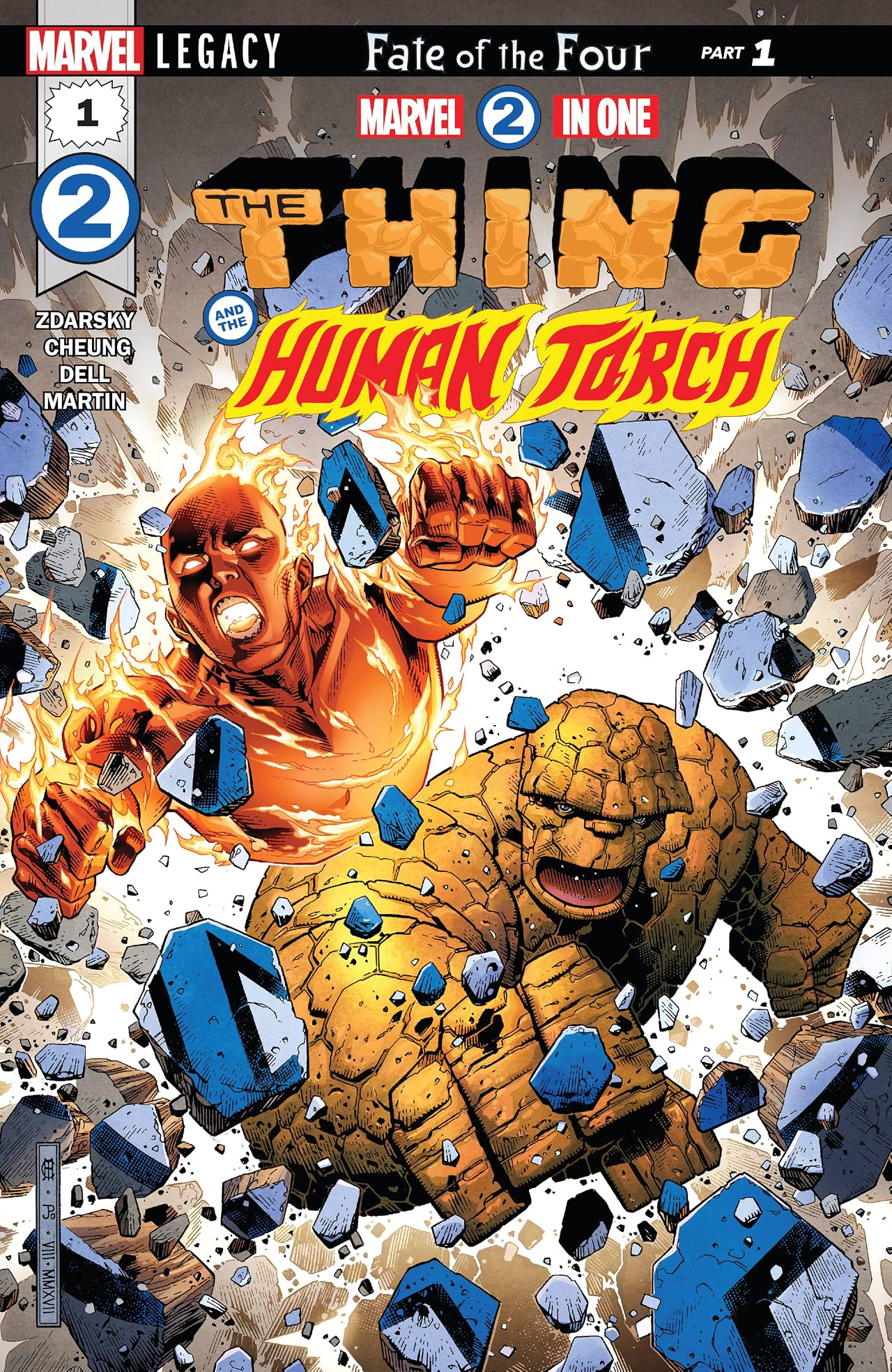
Half-Fantastic and Full Heart: Marvel Two-In-One #1

The following is my review of Marvel Two-In-One #1, which was posted on PopMatters.com.


Like most ordinary people, every superhero has bad days. Some of those bad days are worse than others. Some of those bad days make for iconic stories, as well. Events like The Phoenix Saga, Secret Wars, Civil War, and House of M often start with a particularly bad day that spirals out of control, sometimes leading to retcons, wars, and clone armies. Short of being trapped in a cage with Deadpool and an unlimited supply of tacos, a bad day for a superhero often becomes the cornerstone for a major upheaval in Marvel's over-arching mythos.

While every major superhero and their assorted teams have bad days, few have had more or worse days than the members of the Fantastic Four. No matter how much Peter Parker complains about not catching a break or how much the X-men complain about people hating mutants, they can't deny that the Fantastic Four have it much worse.

It's not just that they've been victimized by horrible movies, so much so that Pixar's The Incredibles is often cited as the best Fantastic Four movie. Despite being Marvel's first family and one of the most pivotal creations of Stan Lee and Jack Kirby, the influence and prestige of the Fantastic Four has never been lower.

The events of Secret Wars effectively shoved a wedge the size of an entire multiverse between the team. Reed, Sue, and their children are no longer playing an active role in the Marvel universe. Ben and Johnny, conversely, find themselves relegated to weak supporting roles in books like Inhumans and Guardians of the Galaxy. Their struggles are often a punchline within Marvel, but Chip Zdarsky and Jim Cheung look to get serious with what remains of the Fantastic Four in Marvel Two-In-One #1. While Marvel's first family may still be split, Ben and Johnny keep the spirit alive in a story that's as compelling as it is heart-felt.

This is one of those stories that reflects a particular sentiment at a particular time in the history of a franchise. It's not unreasonable to say that, in wake of the failure of Josh Trank's Fantastic Four movie and the subsequent cancellation of the Fantastic Four comics in 2015, these are the darkest of times for Marvel's first family. Reed, Sue, and their children are gone. The Baxter Building is gone. On top of all that, Dr. Doom isn't even acting like Dr. Doom anymore. It's as though everything that makes the Fantastic Four endearing has been lost.

Marvel Two-In-One #1 acts as the first beacon of light within the darkness that has shrouded Fantastic Four for years. The first family is still not whole, but Zdarsky and Cheung make it a point to show that the heart and soul of the Fantastic Four is still there. Not only that, they make the case that there's still a place for them in the Marvel universe and by nearly every measure, they make that case well.

The foundation of the story is basically the remnants of the first family being at rock bottom. Neither is in a particularly good place with Johnny being especially broken. Ben, true to his rocky nature, acts as the last remaining anchor of the team. He carries himself as the only one with the strength and fortitude to carry on the legacy that the Richards family left behind. He doesn't have much to begin with, but he gains a lot over the course of the story.


What he gains and how he gains it doesn't feel cheap or contrived. In fact, it makes for one of the most heart-felt moments the Fantastic Four have had since the events of Secret Wars. Zdarsky and Cheung don't discount the events that tore the first family apart, nor do they make light of just how much those events hurt Johnny and Ben.

Part of what makes the Fantastic Four so compelling is that they're not just heroes. They're family. When one of them is lost or gone, it hurts. That pain in Marvel Two-In-One #1 is undeniable. By the end, though, there's a sense that the time for healing has arrived. Even though the memories of bad movie adaptations still linger, the darkest hours of the Fantastic Four are behind them. Now, they're ready to move forward.

Moving forward, however, still means confronting the less-than-ideal situation in the present. That involves Johnny revealing a distressing secret about his powers and Ben having a productive, but messy conversation with Dr. Doom. It's dramatic and overdue, but the fact they're finally confronting the situation is probably the biggest sign of progress that Marvel Two-In-One #1 can have. Overdue or not, it's still refreshing.

More than anything else, Marvel Two-In-One #1 is a clear, yet poignant reminder of what the Fantastic Four stand for. They're not just a family with superpowers. They're not just heroes either. They look beyond the horizon and dare to go farther. They seek to explore, learn, and grow together. That's how they often end up encountering beings who ride cosmic surf boards, giant world-eating beings, and shape-shifting aliens. The heroics are often secondary, but still just as important.

There's a lot to be said about the current state of the Fantastic Four, how they got there, and why they've struggled to remain relevant at a time when every superhero seems to reinvent/reboot themselves every other week. There are still plenty of ongoing issues with that state that can't be easily resolved over the course of a single issue, let alone several. However, Zdarsky and Cheung take the biggest, and arguably most important, step in that process.

Marvel Two-In-One #1 is one of those books that will give a certain segment of fans a genuine emotional uplift. It's as though someone finally comes to their front door, gives them a reassuring hug, and lets them know they haven't forgotten about the Fantastic Four and everything they stand for. It may have taken a while. It may not undo all the damage that the first family have suffered over the past several years. It's still a first step, but one that feels like a giant leap in the right direction.


Final Score: 9 out of 10