Showing posts with label All-New X-men. Show all posts

Thursday, August 16, 2018

Tenuous Temporal Deconstruction: Extermination #1

The following is my review of Extermination #1, which was posted on PopMatters.com.


There comes a point in every time travel story where the damage to the timeline become untenable. Sometimes, it takes too long to get to that point and when functional time machines are involved, that's saying something. It's debatable whether the original five X-men that, as ripped from the earliest issues of Uncanny X-men, have gotten to that point, but the circumstances surrounding Extermination #1 make a pretty convincing case that their time has come.

The details are unavoidable. The reasons why the time-displaced X-men came to the future and stayed there are obsolete. Cyclops never causes a mutant genocide. Jean Grey doesn't stay dead. Angel doesn't permanently lose his mind. Iceman doesn't stay in the closet. Everything that once horrified them about the future no longer applies. It makes their continued presence both superfluous and confusing. Ed Brisson and Pepe Larraz promise to resolve that with Extermination.

That necessarily requires more time travel and all the timeline-twisting machinations that come with it. As Back to the Future so eloquently demonstrates in 1985, the source of the temporal disruption must also be the solution to some extent. The events of Extermination #1 just add more urgency, as well as a new threat that promises to step up the time tables, literally and figuratively.


The nature of that threat is vague, but it involves familiar names. Things happen fast and suddenly. Big messy battles unfold, giving Larraz plenty of chances to create stunning visuals. There are also multiple casualties, each of which have weighty implications. However, since casualties in a time travel story are often tenuous at best, the drama is limited. Despite this temporal barrier, Brisson and Larraz find plenty of ways to inject it into the plot.

The stakes go beyond the integrity of the timeline. They get personal very quickly and hit the time-displaced X-men right in the proverbial heart. Some get hit harder than others and the emotions from characters like Cyclops and Jean Grey are palpable. For a time travel story, which often relies heavily on sub-plots laden with sci-fi technobabble, this kind of heartfelt anguish is refreshing. It makes Extermination #1 feel like something other than a time travel story, of which the X-men have many.

However, some of that melodrama comes off as forced. In between the destructive battles, the personal dimensions of the conflict emerge from outstanding side-plots that have been unfolding among the time-displaced X-men in recent years. The overall structure of Extermination #1 doesn't rely too heavily on it, but it doesn't complement it, either. There are even moments that don't entirely mesh with recent developments in the books that precede it.


The moments between Teen Cyclops and Bloodstorm don't really match with what has been going on with them in X-men Blue. There's an implied connection between them, but one that comes off as contrived for the sake of increasing the impact. The moments between Teen Jean, Rachel, and Cable also assume a lot about the relationship they have. While past issues of All-New X-men and X-men Gold establish that they are aware of one another, there's little indication that they've fleshed it out to any meaningful extent.

This doesn't make the events in Extermination #1 less coherent, but for anyone who has been following the journey of the time-displaced X-men, it feels disconnected from their over-arching story. To some extent, this keeps the story from getting bogged down by continuity. At the same time, it also overlooks the larger implications of the original five X-men's presence in the future. 

That's not a requirement to making the plot work, though. The time-displaced X-men don't need to have a deep, well-developed relationship with every character involved. Just knowing who Rachel and Cable are is enough to understand why the events that unfold are a big deal, both for original five X-men and the integrity timeline. It effectively shoves the cold, hard truth in their face in a way they can no longer ignore. Their presence in the future cannot continue. This is the end of the line for them and there's no scenario in which they can stay without incurring greater losses.

That's the underlying message of the story and Brisson effectively belabors that. Some characters, namely Teen Cyclops, openly acknowledge that they have to go back to their own time at some point. They even understand that has to happen soon, but there are a lot of factors keeping them in the future, including the unpleasant fact that one of their future selves is still dead. Like any approaching time paradox, though, they don't get much say in the matter.

When the past, present, and future finally catches up to the time-displaced X-men, it feels abrupt, yet necessary. There's a sense that there has to be consequences to them being in the future for as long as they have. Some characters suffer more than others and it weighs heavily on the time-displaced X-men. It also sets the stage for a much bigger, much more personal confrontation with two familiar characters who have a tendency to show up in dystopian futures.

Even with all these personal and temporal connections, there isn't a sense that what happens in Extermination #1 is a culmination of everything the time-displaced X-men have done. There's no critical mistake that puts them past the point of no return. Forces they neither control nor know about simply catch up to them and make them pay for daring to have personal attachments in the future. It's a common consequence of time travelers, but one that has just enough depth to work.

Extermination #1 certainly succeeds in firing the first shots in the conflict that will ultimately send the original five X-men back to the past. There's little mystery as to who is behind it. Brisson doesn't drag anything out and still leaves room for plenty of intrigue. The situation is dire, but it isn't hopeless and since the X-men are always one misstep away from creating another dystopian future, that counts for a lot.

Final Score: 6 out of 10

Monday, November 6, 2017

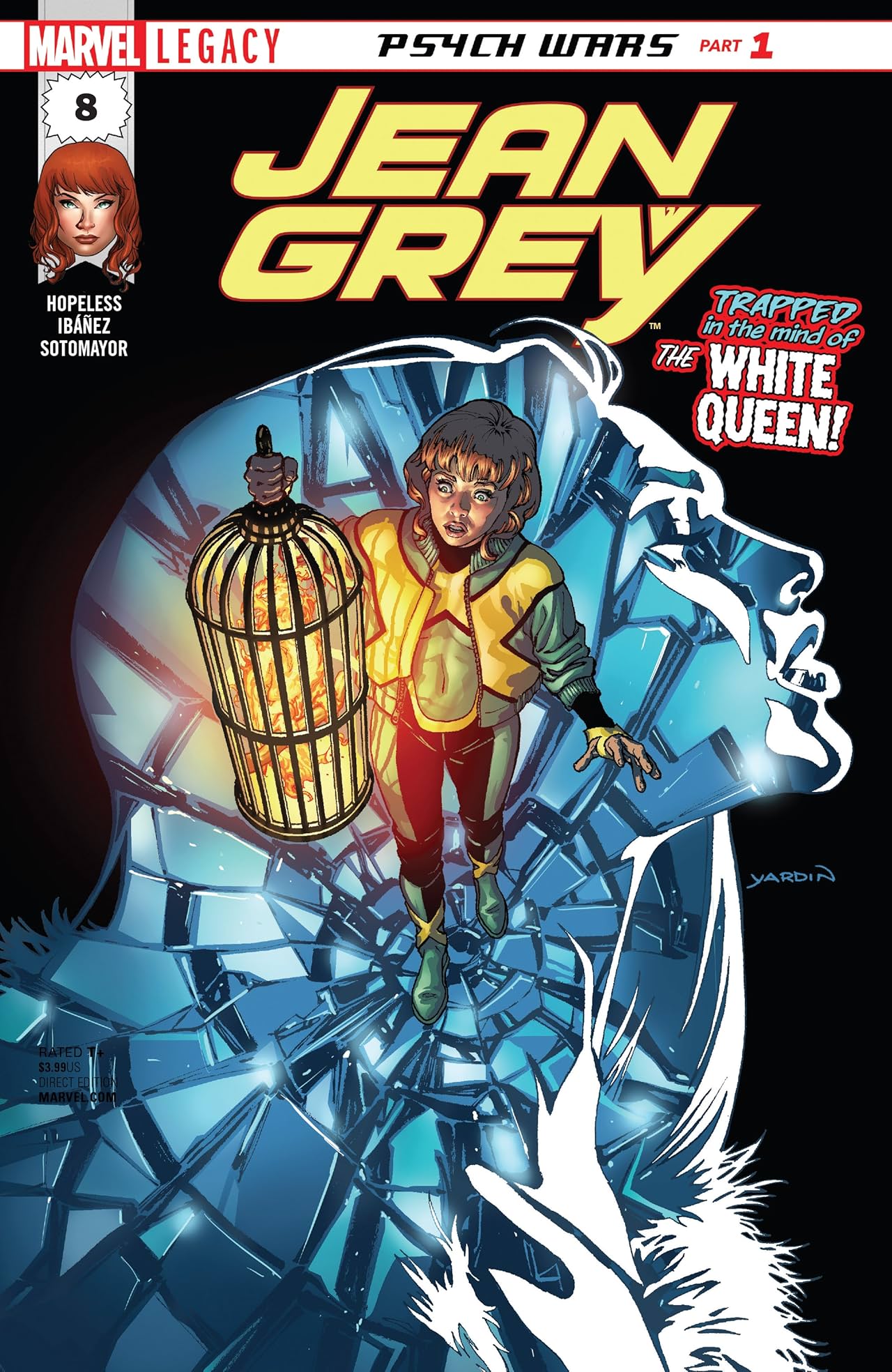
Wars of Hearts, Minds, and Psychics: Jean Grey #8

The following is my review of Jean Grey #8, which was posted on PopMatters.com.


In a perfect world, a friendly rivalry brings out the best and worst of two characters. Since no world is perfect, especially one that has Loki and shape-shifting aliens in it, that kind of friendliness is next to impossible. In the Marvel universe, rivalries between heroes and villains are widespread, common, and a vital part of its mythos. There isn't too much complexity in the sense that the dynamics are fairly clear-cut. The two characters are on opposing sides. They hate each other and want their side to triumph. Anyone who watches professional wrestling can understand that.

It's only when two heroes develop a rivalry that the narrative gains a layer of dynamics that can't be fleshed out by seeing Captain America fight the Red Skull for the billionth time. These rivalries often pit two characters who are on the same side against each other, sometime to the point where they undermine their own heroic efforts. For Jean Grey and Emma Frost, that point is far behind them and they've long since entered uncharted territory of bitterness.

These aren't just two characters who occasionally disagree with how to conduct themselves as superheroes. These are two characters who have actually hurt each other, physically and emotionally, on multiple levels. Going back to the early days of the Phoenix Saga during Chris Claremont's run on Uncanny X-men to Grant Morrison's run on New X-men, these two have a long and varied list of reasons to hate each other.

Even though Jean Grey ends up dead, there's a sense that these two are destined to clash again. With Jean Grey #8, the beginning of the Psych War arc, the wait is finally over. Dennis Hopeless pits a teenage, time-displaced Jean Grey against Emma Frost at a time when she shows little hesitation in sparking wars between the X-men and Inhumans. It may not involve the same dramatic elements that Morrison or Claremont utilized, but the stakes feel every bit as high.

From the beginning, Jean Grey #8 follows similar themes that Hopeless has established in previous issues. The time-displaced Jean Grey, in her effort to prepare for the Phoenix Force, finds herself in a situation she's completely unprepared to handle. Her being a teenager gives her a pass to some extent, but that only goes so far when the stakes are cosmic and the egos involved include Emma Frost. There's really no amount of preparation that can prepare anyone for that kind of struggle, regardless of how much time travel is involved.

In a sense, Jean is in a unique position to offer commentary on the events that led to her most recent death. Her venture into the mind of Emma Frost, her future rival, sends her on an abridged journey through those moments, eventually culminating in a direct encounter with the former White Queen during a lurid, yet familiar situation. It's the context of that encounter, though, that establishes the stakes and the drama for the Psyche War arc.

It's a rare, but increasingly common theme throughout her solo series. The time-displaced Jean ventures into a world that's destined to kill her, but with a different set of perceptions, compared to her older self. While being an immature teenager does plenty to skew anyone's perceptions, it still has the advantage of lacking the baggage of the older Jean Grey that perished. That's an important factor for the Morrison-era X-men because that same baggage played a significant role in causing her death.

Hopeless doesn't ignore those factors as the time-displaced Jean traverses Emma's mind and the memorable moments from the world of New X-men. In a sense, that baggage takes form and substance with the ghost of the older Jean Grey. The previous issue establishes her presence with the teenage Jean and not in a very friendly way either. The two Jean Greys from two different eras are constantly at odds, arguing and yelling at one another in various moments that would strain anyone's mental health.

That constant clash, which becomes a lot more heated as they fight through Emma Frost's mind, establishes an important distinction for Psyche War and for Jean Grey's ongoing story, as a whole. The Jean Grey of the past is still very much at odds with the Jean Grey of the future and not just because she ends up dead. Even though both Jean Greys share the same goal in avoiding the fate of the Phoenix Force, they're not on the same page in terms of methods. If anything, they trip over one another in their conflicting efforts.


It raises the stakes in the ongoing struggle while also revealing how ill-prepared Jean Grey is for the challenge before her. It gives the impression that she has never had a true grasp of the Phoenix, despite her being its most iconic host, going back to the Claremont era. It also makes the role Emma Frost plays feel more personal, especially as it sets the stage for a more heated battle that won't just involve psychic attacks.

The situation, context, and tensions are all there for Jean Grey and Emma Frost. The journey to their clash never gets derailed or subverted. However, even with so many critical ingredients, the lack of heated drama leaves the overall story in Jean Grey #8 feeling muted. While it doesn't try to fight the entire battle between these intensely passionate characters all at once, it stops short of probing the open wounds between them.

They never berate each other over past failures. There's no heated exchange on how Emma affected Jean's marriage to Cyclops. There are all sorts of emotional sub-plots that didn't find their way into the conflict. While the door is left open for these sub-plots, the story still lacks the connecting emotions that give all its potent ingredients the necessary impact.

Psych War still has plenty of potential to make this latest clash between Jean Grey and Emma Frost as dramatic as it deserves to be. Jean Grey #8 is just the first step in that effort. These are two of the most powerful psychics in the Marvel universe and they just happen to have a long list of reasons to resent each other. Anything less than an omega-level clash just won't cut it.

Final Score: 6 out of 10

Thursday, October 12, 2017

Shaping A Sibling Rivalry: All-New Wolverine #25

The following is my review of All-New Wolverine #25, which was posted on PopMatters.com.


In many superhero comics, sibling rivalries are right up there with love triangles in terms of shallow plots that bring out the worst in certain characters. It's one thing for families to bicker. That's the premise of almost every sitcom, Simpsons rip-off, and Fantastic Four comic. Rivalries, however, often act like open scars that never truly scab over. They come to define certain characters, so much so that it that it undermines their ability to evolve on their own.

X-23 and Daken have a major advantage, in some respects, because much of their development occurs independently of one another. The story of Laura Kinney and Daken Akihiro unfolds in vastly different circumstances and go in very different directions. Whereas Laura eventually ascends to take on her father's mantel, Daken falls to the wayside for a while. Even after the Death of Wolverine, his story essentially stagnates while Laura's accelerates.

That's what makes the premise behind All-New Wolverine #25 so risky, yet so intriguing. Tom Taylor is taking a chance on tying Daken's story with Laura's once more. While they had clashed in the past during Marjorie Liu's run on X-23, these two characters don't ever establish a functional relationship. They don't forge a bitter rivalry either, but the tension is there. It has the potential to either expose their worst traits or forge new ones. The difference between the two is as thin as a simple swipe of the claws.


Taylor puts both characters on a collision course, of sorts, and it's one that doesn't just involve more slashing and stabbing. It builds on the events of the previous arc, which first see Laura and Daken reunite under dire, yet amicable circumstances. They never get a chance to catch up, fight each other, or address any of the past instances where they try to kill each other. A lot is left up in the air, but All-New Wolverine #25 offers new opportunities for Laura and Daken to connect. Doing it in a series that also includes a pet wolverine named Jonathan is just a nice bonus.

Taylor keeps the continuity of the series tight, having the events in this issue play off those of previous issues. Recent events don't play too big a part in the chaos that unfolds, though. After those connections are made, the fighting begins and it's not a fair fight, even for Daken. While he's a long way from deserving the same sympathy as Laura, the battle he faces sets a specific tone, one that feels unique to Wolverine's overly burdened offspring.

Part of being tied to Wolverine in any capacity involves attracting the kinds of enemies that require more than an adamantium claw to the face. His violent, illustrious life is full of super-powered samurai, killer robots, undead ninjas, and married women he can't stop attracting. With the exception of married women, Laura and Daken attract those same dangers. However, the specifics of that danger are only teased in All-New Wolverine #25, but not in the same overtly ominous ways that just promise more stabbing.

This is where the Orphans of X come in, which is both the title of the arc and the name of the danger. They establish early on that they know how to hurt both Daken and Laura. Daken is somewhat easy to hurt, given his crass attitude and utter apathy for regular heroics. It's Laura who requires a more elaborate approach. Having recently fought Brood armies and spent time in the stomach of Fing Fang Foom, her threshold for pain is much higher.

They still find a way to test it by taking Laura back to her roots. That means returning to the pages of X-23: Innocence Lost, the tragic origins that have come to define Laura since her arrival to the X-men comics. Despite all her abilities, including those that allow her to survive the stomach of Fing Fang Foom without permanent physiological scarring, the details of her tortured origins still haunt her.

More than any other threat she faces throughout her relatively brief history, it's one of the few things that really hurt her. The fact that the Orphans of X use that against her shows that they've done their homework on her. The use of a few flashbacks, which evoke just the right impact thanks to Juann Cabal's art, help belabor just how much these memories hurt Laura. They're so troubling that she risks upsetting both Gabby and her pet wolverine by striking out on her own. Given Gabby's capacity for frustrating Laura and looking adorable while doing it, that's a not a trivial risk.

It's not initially clear how much that risk pays off because, even though Laura's recourse is directly tied to what happens with Daken, the narrative stalls somewhat once it ventures into that the bloodier parts of her past. While belaboring a painful past is an important ingredient in any Wolverine story, it can be overdone. Instead of learning why the Orphans of X think it's wise to torment two characters with a history of poor anger management, much of the story unfolds as a mystery with too few clues to follow.

There's still plenty of melodrama, which is true to the spirit that Taylor has established with All-New Wolverine. There's never a sense that either Laura or Daken are just angry, vengeful brutes who are just eager to stab something. All-New Wolverine #25 establishes deep, personal stakes. However, it doesn't do much to establish who is making such risky bets against them.

The ending sets the stage for a lot more melodrama and heartache. The connections that will eventually require Laura and Daken to team up again are there. Given the high standards that Taylor has set with All-New Wolverine, though, the impact of the conflict isn't felt yet. Too much of it relies on old scars that Laura has been carrying with her since her days as an extra in the X-men Evolution cartoon. While those scars are sure to deepen, the Orphans of X will need to hit much harder to leave a lasting impact on Laura and Daken.

Final Score: 6 out of 10

Thursday, June 8, 2017

A Real (And Relevant) Coolness: Iceman #1

The following is my review of Iceman #1, which was posted on PopMatters.com.


No character ever becomes iconic without doing something to set themselves apart. For years, going all the way back to the Lee/Kirby era of Uncanny X-men, Iceman never gets that chance. Despite being a member of the iconic Original Five X-men, he never gets his own Phoenix Saga. He never undergoes a transformation like Angel or Beast. He never even goes through the twisted melodrama of marrying a clone or have a time-displaced child. In a sense, Iceman is like a capable backup quarterback on a team of pro bowl players. He can hold his own. He just never gets a chance to show his skill.

That all changed after the events of All-New X-men #40. In what is, without a doubt, the biggest upheaval in Iceman's 50-plus year history, Jean reveals that he's gay. Now, there's a lot that can be said about how his outing was handled. Jean's somewhat callous approach to the situation, as well as the circumstances in which it occurred, are somewhat troubling. There's also the issue of Iceman's past entanglements with women. Some of them even count as serious. One of them, namely Mystique, almost got him killed.

However, that only makes the reveal more powerful because it reflects the real-life conflicts that many homosexuals deal with. Sometimes, they spend decades of their lives pretending to be something their not. Adding this on top of the underlying themes of the X-men, which is somewhat analogous to LGBT issues, it puts Iceman's story in a whole new context. It does more than set him apart from the rest of the Original Five X-men, who've already done plenty to distinguish themselves. It puts Iceman in a position to forge a unique path, one that few characters of his status have ever attempted.

Iceman #1 isn't entirely structured around Bobby Drake's homosexuality or how he deals with it. It's not built around him just going on solo adventures either. He's not Wolverine, Iron Man, or even Squirrel Girl. His path has the potential to be both unique and revealing. Sina Grace doesn't try to fit Bobby into another Phoenix Saga, a Dark Angel Saga, or any kind of saga. More than anything else, Grace tries to focus on Bobby's very human struggles while still giving him a chance to be Iceman.


In setting up the story, Grace establishes a distinct difference between Iceman and his time-displaced counterpart. Whether due to recklessness or immaturity, the teenage Iceman does a much better job of accepting his sexuality. He even has a male love interest that he's been exploring in other X-men comics. Ironically, the older, adult Iceman is behind the curve of his teenage self. He's admitted that he's gay, but he hasn't done anything with it yet. He's still more focused on being Iceman rather than Bobby Drake.

Iceman #1 puts him in a position where he has to be both. He doesn't face a cosmic entity or a killer robot. Instead, he faces a very real, very relevant issue with his parents. Unlike the rest of the X-men, they don't know that he's gay. His mother even asks about whether or not he has any girlfriends. It establishes that while Iceman may be out as a gay character, he's not quite out with the world at large.

It's the kind of situation that real homosexuals with real families deal with, not knowing how to talk to their parents about their sexuality. Bobby's parents make it even harder because they're not necessarily proud of his mutant status either. They give the impression that they'd much rather see him holding down a steady job as a garbage man rather than regularly saving the planet from Apocalypse. It's not so much that they have unreasonable standards as much as it is they want a "normal" son.

It's a concept that resonates with both mutants and the LGBT community, the idea of being so not normal that it undermines friends, family, and everything in between. In Bobby's case, he's got a double dose of non-normalcy. He's a minority within a minority, a homosexual man and a mutant. That means he can expect double the hate from every racist bigot, of which there are plenty in both the real world and the Marvel universe.

Fittingly enough, the main conflict in Iceman #1 isn't a killer robot or invading aliens. It's a wannabe Purifier, who are basically Marvel's that anti-mutant version of the KKK. While they don't make their position on homosexuality known, it's hard to imagine that would make them any less hostile to someone like Bobby.

It gives Bobby a chance to be a hero and, strangely enough, that's the most normal thing he does. When he's fighting a rogue Purfier, he's the same Iceman that people have known and loved since the Kennedy Administration. It's only when he has to be Bobby Drake that he faces an insurmountable conflict, of sorts. His parents don't accept him. The world, as a whole, doesn't accept him. Even other mutants seem more "normal" by comparison.


It's a powerful message that makes for a story that feels real and relevant. That's the greatest strength of Iceman #1. Grace tells a story that real people can relate to and Alessandro Vitti's artwork makes it visually appealing. Anyone who is LGBT, an outcast, or just not "normal" in a classic sort of way will find something to appreciate.

While the story may feel real, it also lacks the kind of dramatic impact or emotional upheaval that so many other major X-men characters have enjoyed in their 50-year plus history. That may be too much to hope for in one issue of a solo series for a character who hasn't had one before, but while the plot feels real and relevant, the substance is somewhat lacking. It's a competent, cohesive story that delivers a powerful message. It just doesn't go much further than that.

What gives this series promise, though, is the way Grace and Vitti frame Bobby's story at this point in his history. He's a minority within a minority, still trying to be a hero while trying to find his place. Being a hero is the easy part for him. Trying to find his place is a far greater challenge, one that he's very uncertain about. It's easy to be certain when there are killer robots to smash and evil mutant racists to fight. It's much harder to live a distinctly non-normal life that still feels normal. For mutants and LGBT individuals alike, it's an important story to tell.

Final Score: 7 out of 10

Thursday, May 11, 2017

Before The Ashes: Jean Grey #1

The following is my review of Jean Grey #1, which was posted on PopMatters.com.


When she's not dying, coming back from the dead, or being on the wrong end of a love triangle, Jean Grey is one of those characters whose story often gets defined by others. This is understandable because in many respects, she's the heart and soul of the X-men. She embodies the hope, drive, and passion that guides them. She makes such strong connections to those around her, be they teammates or rivals, that it's hard for her to exist in isolation. From the famous Phoenix Saga to her most recent death in Planet X, she serves as an emotional catalyst for the X-men as a whole.

While this benefits the X-men, it also means she rarely gets a chance to grow on her own. Her story is often too tied to those of her teammates that she just can't forge her own path. Even after she and the original five X-men come to the future in All-New X-men, she continues to follow the path of her team.

It almost seems like a gross oversight that Jean Grey has never gotten her own solo series. Other characters such as Doop, Pixie, and even her arch-rival Emma Frost got a solo series at one point. Overdue or not, Dennis Hopeless and Victor Ibanez use Jean Grey #1 to finally give her a chance to tell her own story.

It's a story that emerges out of unfamiliar circumstances for Jean. She isn't just a teammate and guiding force anymore. She's the leader of a team that's taking guidance from Magneto, of all people. By X-men standards, these circumstances couldn't be more unfamiliar without the influence of the Cosmic Cube.

Even so, Jean's personal agenda is the same as it was in the early issues of All-New X-men. She seeks to avoid a future where she ends up dead, resurrected, dead again, and a topic of awkward conversation between Wolverine and Cyclops. Hopeless makes the story personal by exploring Jean's mentality and personal sentiments. There have been plenty of scenes with Jean lamenting, fighting, and complaining about her situation. The idea of her just taking a moment to process feels both novel and overdue.


That's not to say she's able to process everything. She's still a time-displaced teenage girl who learns that she dies multiple times, may or may not have destroyed a planet, and has at least one evil clone. Not even the mental fortitude of Reed Richards can process something like that, but that helps mold the overall tone of the story. Jean Grey, despite all her overwhelming burdens, is all too human when it comes to matters of life, death, rebirth, and evil clones.

From the beginning, Jean Grey #1 emphasizes Jean's humanity. Those not familiar with her humanity or the many obstacles, cosmic and non-cosmic alike, that strain it get a few major highlights of her story. The ones that stick out most for Jean, as a character, are those surrounding her multiple deaths and various resurrections. This is where Hopeless establishes a critical theme for her and the series, as a whole.

Jean Grey doesn't just want to avoid becoming the woman who ends up dying multiple times and inspiring multiple retcons. She actively hates that person. She doesn't see her future self as someone she aspires to be. She sees her as a painful reminder, one that actually gives her nightmares. Granted, it is a bit melodramatic in that it overlooks a lot of the good her future self did, but she's a brooding teenager so it's perfectly appropriate.

On top of these musings and dreads, Jean gets a chance to be a typical hero. Whether by coincidence or cosmic karma, she's having lunch in Kyoto, Japan just as the Wrecking Crew is doing a heist. It's admittedly contrived. Even those involved admit that. It also gives Jean a chance to show just how powerful she has become. It emphasizes that, despite how much she hates her future self, she's still a hero at heart.

The perspective and style in Jean Grey #1 feels very personal. Even if the action is predictable, Ibanez's art makes it flashy. It also sets the stage for the over-arching narrative that puts Jean on a collision course with the Phoenix Force. Given the status of the Phoenix Saga as one of the greatest X-men stories ever told, it raises both the stakes and the risks.

It's an unfortunate byproduct of such a dramatic and iconic story. Any effort to expand or explore that story tends to undermine, complicate, or convolute it to some degree. Sometimes it's for the better, as Chris Claremont proved with Inferno. Sometimes, it just comes off feeling too forced, as proven in Avengers vs. X-men. However, in the case of Jean Grey, it's a story that cannot and should not be avoided.


The foundation is already in place. The events of The Trial of Jean Grey proved that what the Phoenix did and what it can potentially do is still relevant. Jean, despite her best efforts, cannot avoid this part of her past and future. During the battle with the Wrecking Crew, she gets a harsh, but overdue reminder that her story and that of the Phoenix Force is inextricably linked.

While some details of the narrative in Jean Grey #1 are still contrived, the underlying themes and overall tones remain strong. They carry the necessary dramatic weight that is so critical to any story involving Jean Grey and the Phoenix Force. Hopeless crafts a story that makes it easy to sympathize with Jean. He makes it easy to root for her. For a character who is often the victim of so many dramatic tragedies and insipid love triangles, it's a welcome and overdue change.

The series still has a lot to prove. The prospect of more complications with the Phoenix Force and even more teenage melodrama ensures Jean Grey has many opportunities to falter. Whether or not Hopeless and Ibanez can avoid that cosmic trap remains to be seen, but they still succeed in reminding everyone why Jean Grey is the heart of the X-men.

Final Score: 7 out of 10

Thursday, March 30, 2017

Priming A New Future: X-men Prime #1

The following is my review of X-men Prime #1, which was posted on PopMatters.com.


Victory in every conflict comes at a price, but sometimes the price is secondary to the situation. For the X-men, the situation tends to be convoluted in detail, but simple in substance. Either they achieve victory or they go extinct. There's very little gray area in between. Those are the stakes that play out in Inhumans vs. X-men. Those are the stakes that drive the X-men's overall narrative as a series.

Now, with the conclusion of Inhumans vs. X-men, the situation is ready to evolve. The X-men once again have a chance to do more than just fight for their right to exist, which has been at the heart of nearly every major conflict since House of M. It's a chance they can't afford to squander. Stories involving sterilization and extinction are rapidly losing their ability to generate dramatic weight. More than any other ongoing series, the X-men need a new conflict with new stakes.

That's exactly what X-men Prime #1 sets out to do. Under the pen of Marc Guggenheim, Greg Pak, and Cullen Bunn, and a couple other top-tier artists, the X-men's story finally moves forward from yet another extinction/sterilization plot. It is, effectively, a bridge from one era to another. It helps settle the dust of one conflict while preparing the X-men for another.

The conflict itself is still secondary compared to the situation. Compared to the X-men's situation after Secret Wars, it doesn't take much to improve their predicament. In essence, this is one situation where over-achievement is necessary to elicit the necessary impact. It's a challenge and not just because impacting the X-men usually requires killer robots. He is tasked with essentially molding a new situation for the X-men to navigate. What he ends up crafting is as polished as it is compelling.

There are no killer robots. There are no poison gas clouds, time-traveling assassins, or clone army. X-men Prime #1 isn't structured for those kinds of fireworks. It's very much an epilogue and a prelude for the X-men as a whole. It unfolds primarily through the eyes of Kitty Pryde, who was lucky enough to have avoided the whole sterilization/poison gas cloud/war with the Inhumans. In many respects, that makes her uniquely qualified to take in this new status quo.


Kitty, having spent much of her time guarding the galaxy with her ex-fiance and a talking raccoon, returns to the world of X-men that wants to change. From Storm to the time-displaced X-men, Guggenheim, Pak, and Bunn create this prevailing sentiment that the way they're doing things has to change. Their current way put them at war with the Inhumans and forced them to live in a demon-infested realm. With or without mutant powers, any system that puts anyone into close proximity with demons is definitely a system in need of revision.

This makes for some very personal moments between Kitty Pryde and several characters who have been deeply affected by recent events, some of which don't even involve demons. Most of those moments involve Storm, who presents herself as a relic of the old system, in a sense.

She accepts responsibility for the decisions that led to the X-men's war with the Inhumans. She makes clear and gives some fairly understandable reasons why she doesn't feel inclined to lead anymore. Again, the X-men ended up living in a demon-infested realm under her leadership. She realizes on some levels that there's room for improvement.

Not every moment is as personal, though. Kitty does get a chance to meet up with Colossus, which is understandably awkward, but promptly avoided. She also gets a chance to meet up with the time-displaced X-men, albeit indirectly. These moments aren't quite as dramatic, but they do serve a purpose in that they show how portions of the X-men are going in different directions. Kitty can only do so much to influence them, but she's in a position to do more for the X-men than most. At this point, any direction that doesn't involve close proximity to demons counts as an upgrade.

X-men Prime #1 doesn't just succeed in using these personal moments with Kitty to move the X-men forward. It succeeds in making it feel dramatic and sincere. Being able to do this without killer robots or sterilization plots counts as an accomplishment these days. Through Kitty Pryde, he's able to convey a sense of hope and determination, two of the most important elements in any era of X-men.


As good as these moments are, there are a few that don't feel quite as dramatic. Kitty's interaction with Colossus is relatively minor and doesn't get too personal. A side-plot involving Lady Deathstrike and Weapon X feels disconnected and unnecessary to the overall story. While the moment with the time-displaced X-men offers a nice twist, it doesn't have many specifics. Some elements are left a bit vague, but it never feels too convoluted. In a series with clones and time-displaced characters, that still counts for something.

In terms of setting the stage for a new era of X-men, X-men Prime #1 checks nearly every box. Guggenheim, Pak, and Bunn establish a direction for the team. He takes the X-men out of the demon-infested and into a more promising situation. Considering how grim and dire the X-men's condition has been since the conclusion of Secret Wars, it's downright refreshing.

Sure, there are bound to be more attacks by killer robots. Sure, it's very likely that more clones and time travelers will enter the mix and frustrate the X-men. Like Wolverine and beer, certain elements are inescapably linked. The challenge is making the narrative behind these links compelling. In that sense, X-men Prime #1 rises to the challenge. For now, there's hope for the world of the X-men and, provided nobody ends up sterilized, that hope holds a great deal of promise and potential.

Final Score: 8 out of 10

Thursday, March 23, 2017

Capping Off A (Somewhat) Extraordinary Journey: Extraordinary X-men #20

The following is my review of Extraordinary X-men #20, which was posted on PopMatters.com.


For certain eras, there are characters who become symbolic of the conflicts. Sometimes they are the catalyst for the conflict. Sometimes they are the reaction to it. In either case, these characters embody a certain mentality and perspective of a period in time. When the history is written about the post-Secret Wars, pre-Inhumans vs. X-men era of the X-men comics, no one character will be singled out as the sole symbol of the conflict. However, Storm and the time-displaced Jean Grey are likely  in the top five.

When Extraordinary X-men began under Jeff Lemire, Storm went out of her way to identify Jean Grey as the heart of the X-men. That alone says a lot about the state of the X-men, singling out a time-displaced version of a character that has been dead for over a decade. Oddly enough, it's entirely warranted. Jean Grey is very much an embodiment of the X-men's highest ideals, if only because time travel allows her to skip the many eras of setbacks, retcons, and evil clones.

When the story of Extraordinary X-men begins, both Storm and Jean Grey are reluctant, if not downright hostile, to the idea that they're now the greatest hope for the X-men. Jean is a time-displaced teenager. She has enough on her plate as it stands and not just because of acne. Storm is a reluctant leader who ended up in her role because the world believed, thanks to Emma Frost, that Cyclops is the worst thing to happen to the world since poor wi-fi.

Then, as Extraordinary X-men progresses, they both settle into their roles. They confront the challenges that come with being an inspiration for every generation of X-men. Now, in wake of Inhumans vs. X-men, Storm, Jean Grey, and the rest of their teammates faces a whole new challenge and a whole new era for the X-men as a whole.


Extraordinary X-men #20 acts as a bridge between these eras. The Inhumans/X-men war is over. The entire mutant race doesn't need to hide in a demon-infested realm anymore. Naturally, most in X-Haven are eager to leave for a home where killer robots are more likely than demon attacks. For Storm, however, there's a lingering sense of uncertainty that bothers her. Having lived in a demon realm, being bothered by anything is quite an accomplishment.

It's through Storm's point of view that the uncertainty unfolds. It's through a time-displaced Jean Grey that the X-men confront it. In many ways, it's fitting that that these two characters are the ones tasked with tying up the loose ends of Extraordinary X-men. They are still the main catalyst for the story. They bore most of the burdens throughout the series. Lemire acknowledges the extent of those burdens. However, the story itself doesn't do much to give them greater weight.

The primary plot in Extraordinary X-men #20 actually deals with some unresolved aftermath from Inhumans vs. X-men. In a sense, Lemire addresses a practical issues regarding Emma Frost's hidden agenda, which most of the X-men only recently uncovered. In world where magic and time travel are often used to cover plot holes, this is somewhat refreshing.

It also makes use of some lingering side-plots that have fallen to the wayside in Extraordinary X-men, namely those involving Cerebra and No Girl. Again, these are usually the kinds of side-plots that are first to get overlooked. Lemire's efforts to address them give the story an attention to detail that the X-men comics have lacked, due largely to the constant doom and gloom caused by other characters whose movie rights aren't owned by a rival studio.

Between Jean's efforts and Storm's inner musings, the story in Extraordinary X-men #20 helps make this transition from one era of X-men comics to another feel personal. It tries to do more than just shove the X-men into the next extinction-level plot. It tries to step back and take in the situation. In some respects, they don't step back far enough because they end up fighting killer robots. However, compared to demons, Inhumans, and sterilization, it still counts as an improvement of sorts.

It still makes for a very simple, very basic kind of story. The X-men fighting a host of killer robots, be they Sentinels or discarded Sentinel prototypes, is as classic a plot as any extinction story. This one isn't all that memorable or epic, nor does it try to be. However, it's not the kind of battle that is there just to give the X-men something to blow up. There is a purpose do it. It's a minor purpose, but a purpose none-the-less.

The battle in Extraordinary X-men #20 may be somewhat forgettable, but it doesn't change the underlying situation facing the X-men. They don't have to hide in a demon realm anymore. They're not facing imminent extinction anymore. Given how rare these moments are for the X-men these days, it's an important situation to take in. Storm offers the perspective. Jean Grey offers the catalyst. In the grand scheme of things, it uses all the right ingredients, even if there's not enough of them to make a cake.


What makes the outcome of Extraordinary X-men #20 most satisfying is that, while it does attempt to tie up loose ends, it tries to give the series closure without dropping one too many ominous hints about the next extinction plot the X-men will face. Lemire makes a genuine effort to end the series on an upbeat note. For a series that began with off-panel deaths, sterilization, mutant-hunting death squads, that's quite an undertaking.

Taken as a whole, the end of Extraordinary X-men #20 doesn't give the sense of a complete, satisfying journey. Given the exceedingly bleak circumstances of its beginning, it's hard to go from one extreme to another. To go from the brink of extinction to a friendly baseball game is a journey that requires a lot more than 20 issues and a crossover event. Even if details are lacking, the primary spirit of the X-men narrative is still there. The fact that a series like Extraordinary X-men can end in a friendly baseball game is a testament to the strength of that spirit.

Final Score: 7 out of 10

Thursday, March 16, 2017

The Enemy Within (And Beyond): All-New Wolverine #18

The following is my review of All-New Wolverine #18, which was posted on PopMatters.com.


There are some stories that just can't be remade in a convincing, compelling fashion. The producers of the now-infamous Ghostbusters remake found this out the hard way. However, it is possible to retell a story in a way that doesn't feel like a new layer of paint on an old car that shouldn't be on the road anymore. Those stories are rare and even then, a retelling of those stories involves a lot of moving parts that need to work together without collapsing into a chaotic mess

The classic Wolverine story, Enemy of the State, may not be nearly as iconic as Ghostbusters, but it captures so much of what makes Wolverine a great character. It effectively jams rusty nails into Wolverine's deepest scars, let's them fester, and builds a story around it. It's a key conflict for Wolverine that gives him much of his depth. He struggles with being a man and a former meat puppet of Weapon X. It's a powerful struggle that his daughter and inheritor of his title, Laura Kinney, has inherited.

As X-23, Laura knows just as much about being a tormented meat puppet as Logan. On top of that, she deals with this on top of being a teenage girl. This makes her uniquely qualified to handle the narrative surrounding Enemy of the State II. Tom Taylor gives her that chance, putting her in a situation where Laura has to confront the meat puppet within her that once made her a living weapon.

He sets high stakes. After apparently killing nearly three dozen innocent people, she finds herself at the top of SHIELD's most wanted list, right up there with cloned Spider-Man villains. She also has to confront old enemies like Kimura, who are intent on reminding her that she's a failed science experiment and not a person. In her mind, she's several layers below a trained pitbull.

These are the moving parts that forge the narrative for Enemy of the State II and All-New Wolverine #18 caps off that narrative with a potent mix of drama, action, plot twists, and exploding bean cans. It's every bit as entertaining as it sounds. Beyond the entertainment value, though, Taylor goes out of his way to capture the most important element of Enemy of the State, which is heart. Those who've seen the Logan movie and wiped away their tears will appreciate what Taylor accomplishes here.


To get to this point, X-23 must overcome some personal demons that have plagued her since her early origin stories in X-23: Innocence Lost. This is perfectly appropriate for the context and grand scheme of the story. Overcoming personal demons for Wolverine is right up there with drinking beer, stabbing Sabretooth, and chasing married women. For X-23, a teenage girl who isn't old enough to drink, it's a much higher priority and one that ensures All-New Wolverine #18 hits with just the right amount of drama.

The biggest demon for X-23 has both a face and a potent weapon. Kimura is to her what Sabretooth is to Logan. She embodies the anchor that keeps her tied to her bloody past. She represents the pain, burdens, and rage that fills her with such dread and anger. Fighting her means much more than just fighting a run-of-the-mill Sentinel. Taylor has this fight involve more than just stabbing though.

The stakes of the battle are already high because Kimura is armed with the trigger scent, the weapon that turns X-23 into the heartless killer who murdered her own mother. It is a burden and a fear that has plagued X-23 since her earliest days in the X-men comics. It's a big part of what drives the narrative throughout Enemy of the State II, having X-23 go on the run and do everything she can to avoid becoming what Kimura wants her to be. This convergence of past fears and present conflicts helps craft a perfectly balanced, deeply satisfying conclusion.

It's also a conclusion that requires X-23 to do things Logan wasn't very good at. He may have been the best at what he did, but coordinating with others was never one of those things and not just because of his propensity to flirt with married women. X-23 shows a greater willingness to work with others, let them in, and share her burdens. It gives a supporting cast like Gabby, Jean Grey, Gambit, Angel, and Tyger Tiger a chance to shine. She's still not the greatest teammate, but compared to Logan, she's a pro.

X-23's supporting cast gives her the resources she needs to overcome the trigger scent and attack Kimura. However, she's still the one who delivers the final blow. Like her predecessor, she makes it very personal and very brutal. Unlike previous battles, though, Kimura can't use the trigger scent as her trump card. She has to face X-23 head on. They have to fight as equals. It makes for a battle that feels organic, brutal, and dramatic.


The added drama also helps ensure the plot twist that emerge in the final conclusion work. As a result, it doesn't feel forced. It doesn't feel like a cop-out. It feels like a genuine, realistic recourse for the narrative. For a story that involves so much running around, stabbing, and snarling, that's a critical ingredient that separates decent stories from savory deserts.

The original Enemy of the State may not be as iconic as other major Wolverine stories like Old Man Logan, if only because it hasn't been the basis for a major movie yet. However, it is an important story that embodies what it means to be Wolverine. All-New X-men #18 and Enemy of the State II embodies that same spirit.

X-23 even goes out of her way to make that clear. She loudly proclaims that she's not just a weapon. She's Laura Kinny. She has a mother, a father, and the title. She is, by every meaningful criteria, Wolverine. Taylor does everything necessary to make this abundantly clear. If anyone has any doubts at this point that Laura is worthy of that title, then they're just being petty.

Final Score: 9 out of 10

Thursday, February 2, 2017

The Truth Hurts (and Astonishes): All-New X-men #18

The following is my review of All-New X-men #18, which was posted on PopMatters.com.


The truth is supposed to hurt. The truth is supposed to set us free. Lies are supposed to be cockroaches that run into the cracks of the wall the second a light is exposed. That's the narrative the real world tries to convey, if only to convince children not to lie when they've taken one too many cookies from the cookie jar. It's not an entirely false narrative, but it is incomplete.

Lies can be every bit as harsh as the truth and the X-men comics have been demonstrating this since the conclusion of Secret Wars. So much of the narrative surrounding the X-men and their struggles against the Terrigen Mists is built around certain assumptions that helped give the story weight. Those assumptions included the understanding that Cyclops committed this horrible, heinous atrocity that made mutants more hated than whoever came up with Deadpool's mouthless design in Wolverine Origins.

Both the X-men and the readers share in these assumptions for most of the X-men's narrative after Secret Wars. Then, Death of X comes along and reveals the truth that these assumptions are inaccurate. The so-called crimes committed by Cyclops aren't his crimes. They aren't even his idea. They are an elaborate ruse, one only known to a select few individuals. It's not a conspiracy theory on the same level as Captain America being a Hydra agent, but it still has major implications.

Now, as Inhumans vs. X-men unfolds, this effects of this ruse are getting harder to conceal. All-New X-men #18, which directly ties into the events of Inhumans vs. X-men, sets the stage for undoing this ruse. Dennis Hopeless has a chance to explore the breadth of teen Cyclops' torment, being reviled for what his older self did and stuck in a future where every horrible thing anybody does exists forever on social media. Hopeless doesn't squander that chance and crafts one of the most dramatic issues of All-New X-men since Secret Wars.


It's not just that the truth finally comes out. Teen Cyclops does learn about the elaborate ruse surrounding the events of Death of X. That's actually the simplest part of the story. It's how Hopeless sets it up that gives it so much dramatic weight. The fact that this drama has nothing to do with Jean Grey, clones of Jean Grey, or a Shi'ar sneak attack makes this all the more remarkable.

Most of the story takes place in between the panels of the main Inhumans vs. X-men series. Teen Cyclops is part of the main attack on New Attilan. However, he doesn't contribute too much to this attack. The fact that he's an inexperienced teenager who has yet to become the man who will one day hook up with both Jean Grey and Emma Frost certainly shows. This is actually important to the structure of the story.

Hopeless makes it a point to show just how unpolished this version of Cyclops is. He's not the master tactician who fights Sentinels for breakfast and takes down Apocalypse before brunch. He's still a kid who's struggling with the legacy his older self left behind. That legacy, however skewed it may be, torments him in ways that have guided his story since the conclusion of Secret Wars. To this point, it's a burden he carries and one he thinks he can never escape. This helps make the Death of X spoilers all the more powerful.

It's not one of those reveals that's akin to Morpheus offering a teenage Cyclops the red pill. If anything, the reveal is a byproduct of another plot unfolding between the panels of Inhumans vs. X-men. Specifically, this plot involves Mosaic, the Inhuman who can possess other bodies. This ability is key to balancing the scales of the conflict, which to this point has played out in the X-men's favor. Part of this process involves him possessing teen Cyclops. While it's not entirely clear why this needs to be part of Mosaic's plan, it does have an important impact, even if it's unintended.

Mosaic's actions may very well be critical to advancing the main plot of Inhumans vs. X-men, even if the particulars are unclear, but what he does in All-New X-men #18 may end up having much bigger implications for Cyclops and the rest of the time-displaced X-men. Unintended or not, he helps teen Cyclops uncover the truth about what happened to his older self. More importantly, he finds out who is really behind the burdens, the self-loathing, and the angry flame wars on message boards.

This knowledge threatens the X-men's plans and motivations in Inhumans vs. X-men. Emma Frost is a major driving force in these plans and only a select few know of her role in Death of X. Now teenage Cyclops knows and is in a position to react with a level of extreme melodrama that only a teenager can appreciate. It doesn't just create a major turning point in teen Cyclops' overall narrative. It may very well change the entire outlook that he and his fellow time-displaced X-men have on navigating the future.


This dramatic shift is the biggest selling point of All-New X-men #18. Hopeless doesn't get too bogged down in the various nuances of the Inhumans vs. X-men conflict and, given the various flaws surrounding this conflict, this helps keep the story concise. However, some of those flaws do manifest at times. The whole concept of Cyclops being a war criminal for attacking a cloud still feels exceedingly contrived. It makes some of teen Cyclops' various musings seem forced, even by the lofty standards of teenage melodrama.

It leads to some parts being choppy and chaotic, but it doesn't take away from the impact of the main plot in All-New X-men #18. Mark Bagley's colorful renderings of the various moments helps to move things along as well. Whatever flaws there may be in the over-arching narrative of Inhumans vs. X-men, it doesn't undermine the big reveal that gives this issue so much weight.

It's not just another tie-in where a teenage character mopes and whines at being so overwhelmed. This story digs deeper, achieving an impact that goes beyond an ongoing crossover. For a tie-in that focuses on an anxious teenager, that's quite an accomplishment.

Final Score: 7 out of 10

Tuesday, November 29, 2016

Incomplete Moments With Shallow Revelations: Death of X #4

The following is my review of Death of X #4, which was posted on PopMatters.com.


If a fight is rigged and rigged well, then it's usually hard to tell which side has the advantage. Those fights can be quite entertaining, as the success of WWE wrestling routinely demonstrates.  When the rigging is too obvious though, the entertainment value suffers. It's just not very fun or interesting when it's easy to tell who is getting an extra shot of Hulk blood on the side.

This is the biggest flaw in the Death of X narrative. It isn't a passionate disagreement between Iron Man and Captain America over methods for administering justice. It's a cage match between one side that has the unconditional backing of Disney's lawyers and another that remains under the boot of a rival company. The X-men and the Inhumans are not on a level playing field and haven't been since Marvel Studios began churning out billion-dollar blockbusters on a regular basis.

This means there's little to no suspense in the outcome of Death of X #4. It's a foregone conclusion that the X-men will lose, the Inhumans will come out on top, and the lawyers negotiating movie rights will keep getting billed by the hour. It gives Charles Soule and Jeff Lemire a poor foundation to build on, but it's a foundation that can still fill in some unresolved issues. They just have to build carefully because they don't want to give the X-men more reasons to resort to clones and time travel.

There's a genuine effort to extract every ounce of drama from this final issue, but there's not much worth extracting here. There's a distinct absence of detail and polish to the overall story. It does not complete the narrative that began in the first issue, nor does it fill in the blanks left by the various X-men titles that spun out of Secret Wars. There is some intrigue. There are some heated, passionate moments. It doesn't fall flat, but it does feel distinctly incomplete.

If there is a defining moment in Death of X #4, it manifests during the confrontation between Cyclops and the Inhumans royal family. This moment feels very much like a trailer of sorts, complete with ominous warnings and angry pleas. The trailer may lack the star power of Hugh Jackman or Sir Patrick Stewart, but it effectively ensures that there will be a war between the Inhumans and the X-men. It's not just inevitable at this point. It's overdue.


While this moment is vital in giving Death of X #4 the necessary impact, it's pretty much the only moment that's memorable or impactful in any way. Every other moment throughout the narrative is either lacking in substance or devoid of style. There's little else in terms of drama. None of that drama feels like an emotional gut punch either. For a comic where a major character dies, that's pretty telling.

It's also the most frustrating aspect about Death of X #4 and the X-men comics as a whole since Secret Wars. The lack of drama and the lack of details ensures this story adds little context to the overall narrative surrounding the X-men. Much of that narrative is crafted around this idea that Cyclops did something so horrific and so despicable that it would make James Marsden violently ill if someone said it out loud. That idea, however, becomes exceedingly complicated here.

It's not just because Soule and Lemire try to throw in a twist at the end that effectively ensures that Cyclops can die with some credibility intact. It's also because the sequence of events that unfold throughout Death of X do little to warrant such an idea. There's no overt atrocity here. Cyclops doesn't suddenly become Thanos, Victor Von Doom, or whoever canceled the last X-men cartoon. He does what he and the X-men always do and tries to protect innocent mutants.

Now this does draw the ire of the Inhuman royal family for reasons that are understandable, albeit petty. However, it's worth emphasizing here that what Cyclops does, be it overt or indirect, can't qualify as an atrocity. He doesn't kill anyone. He doesn't destroy anything. He doesn't even make a joke about Medusa's hair. There really is nothing here that warrants the hatred and disdain that is so prominent in the current X-men comics.

If there are any unforeseen consequences to Cyclops' actions, they aren't revealed. They aren't even hinted at. What Cyclops does simply prevents a cloud of Terrigen Mist from descending upon a populated area and killing every innocent mutant in its path. No human or Inhuman dies as a result. In fact, only one other person dies and that person dies willingly in a heroic sacrifice that the Inhuman royal family tried to prevent.


In terms of a balanced, albeit rigged, conflict, the entertainment value really suffers here. Death of X does little to create even the illusion of balance between mutants and Inhumans. If anything, it only shows that the Inhuman royal family is disturbingly comfortable letting an entire minority suffer horribly so their race can propagate. While Cyclops did make clear to them that he was just as comfortable letting the Inhumans stagnate, there's little effort to have a passionate, balanced discussion.

In terms of the bigger picture surrounding the X-men/Inhuman conflict, Death of X #4 has too many blanks to fill and not nearly enough ink to make a concerted effort. It does what it can, but not much else. There is a sense of rhythm and flow to the narrative. It never becomes too chaotic and it avoids completely denigrating certain characters, although there will likely be a certain segment of fans that will passionately disagree on message boards. There is a sense that this story is part of a much larger narrative that has yet to unfold.

Death of X #4 doesn't read like the end of an event so it's not going to check every box before the final page. While it manages to be coherent and revealing in some respects, it still comes off as woefully incomplete. If it were a school project, it couldn't be adequately graded because it doesn't present a finished product. This may be okay for a movie trailer, but for a complete story that kills off one of the most iconic X-men in history, it's not even close to being enough.

Final Score: 4 out of 10

Wednesday, November 23, 2016

Death of X #4: Nuff Said!

Well, it's here. The (unofficial) final review of nuff said. I've been looking at it the same way a cow looks at an oncoming train. I know it's coming. I know it's close. I'm just too bloated with hormones, illegal chemicals, and fatty foods to give enough shits. I want to say it's fitting that a series called Death of X is the final review for nuff said. However, with a title like Death of X, it's only fitting in the same way that a colonoscopy is a fitting way to end taco eating contest.

This is it. This is where we find out what the fuck Cyclops did that made him more hated than Chuck Austin, Brett Ratner, and the assholes that canceled Wolverine and the X-men after just one season. We know he's trying to stop the big green fart cloud that the Racist Xenophobic Slave-Owners refuse to do jack shit about. We know he's trying to save his species from extinction and sterilization yet again after having already gone through that shit before. At this point, who can blame him for losing his fucking mind and going evil?

It's still a big fucking blank to fill into just one issue. Death of X #4 has a fuckton of questions to answer if the events of Extraordinary X-men, Uncanny X-men, and All-New X-men are to make half a piece of dog shit worth of sense. I'm skeptical that it can do this in a way that won't piss off X-men fans, Cyclops fans, and fans of anything that actually makes sense. This being my last review for nuff said, I'll either have to be extra drunk or extra sober to get through it.


I get the feeling that Storm could use a few shots of bourbon on her end because she now has to contend with a determined and pissed off Magneto. She, and everyone else in the entire fucking Marvel universe, should know by now that he's not a fan of genocide by toxic gas. That shit is kind of a sensitive issue for him. Even those on the alt-right wouldn't push his buttons when there's a big green mutant-killing cloud on the loose.

He effectively ends the little spat between the X-men and the Racist Xenophobic Slave-Owners in Madrid. He doesn't kill or maim anyone, which for Magneto requires a level of self-restraint that would allow a guy like me to walk through a whiskey distillery and come out sober. Crystal and her genocide-enabling people better fucking count their blessings. The fact they have intact assholes in this situation should make them want to go out and buy an extra lotto ticket.


With Crystal's crew of Racist Xenophobic Slave-Owners neutralized, Cyclops and his team go to work stopping the big green cloud of death that's going to maim countless innocent mutants. Yet somehow, he's going to become the monster? No, it still doesn't make sense and spoiler alert, it's not going to no matter how much weed you smoke. If you have some though, fill your bong because you're going to need it.

Cyclops' plan doesn't involve genocide, bloodshed, or anything that may make Wolverine horny. It involves using Alchemy, the nerdy D-list mutant he recruited in the last issue, to turn the big green fart cloud into something that won't horribly maim innocent mutants. For some reason, the Racist Xenophobic Slave-Owners don't like the idea of their big green fart cloud NOT killing innocent mutants so they shoot him right out of the sky before he can read the cloud. Yes, a team of super-powered racist, xenophobic, slave-owners is pro-genocide and Marvel wants to give them a fucking TV show. Even the most bigoted neo-Nazi skin-head would be paralyzed by the WTF on display here.


However, an attack by a group of racist, xenophobic slave-owners who are okay with the idea of gassing an entire minority to death has never stopped the X-men before. Cyclops manages to find Alchemy, who now has a broken arm and no whiskey to dull the pain. He then gives him the kind of pep talk that would make high school football coaches envious, which helps Alchemy's balls grow ten times bigger so he can get another shot at giving a big middle finger to the Racist Xenophobic Slave-Owners. If I were a woman, I'd have jumped Alchemy's bone on the spot.

The Racist Xenophobic Slave-Owners are decidedly less horny. They somehow think in their racist, xenophobic, slave-owning minds that they've won. They've saved their big green fart cloud of mutant-killing death. They're fucking wrong. With Sunfire's help, Alchemy gets another shot. I assume he gave them all the finger somewhere along the way.


With help from Magik and the Stepford Cuckoos, the royal family of Racist Xenophobic Slave-Owners remains distracted. They can't take Alchemy down this time. Instead, he makes it into the big green fart cloud and uses his powers to turn it into a big red fart cloud, but it's a cloud that doesn't kill or maim anyone. To the rest of the non-racist, xenophobic, slave-owning population of the planet, that's a good thing. To the Racist Xenophobic Slave-Owners, it may as well be one big kick in the dick. Now I'd definitely jump Alchemy's bone, even if I'm not a woman.


Unfortunately, Alchemy isn't very bonable after this stunt. After turning the big green fart cloud into a harmless red fart cloud, he returns just in time to find out he's now dying of M-pox. That means he sacrificed himself to stop a big cloud of mutant-killing death. That's objectively awesome on every level. Again, this a D-list X-men character who hasn't been relevant since the Regan administration and he just gave the finger to the Racist Xenophobic Slave-Owners.

This issue is to Alchemy what the Dark Phoenix Saga is to Jean Grey. He sacrifices himself to save countless innocents. Alchemy, you are a true hero. May the next life be filled with endless pools of whiskey and endless hordes of naked Emma Frost clones. You've earned it.


It's a true hero's end for Alchemy. For Cyclops, however, it's not so noble, but it's every bit as heroic. He calls out the Racist Xenophobic Slave-Owners and the royal family responds. They're still shocked and appalled that someone would stop their big green fart cloud from maiming innocent mutants. I guess genocide and the suffering of minorities is important to the culture of the Racist Xenophobic Slave-Owners. Even the most ardent Bernie Sanders supporter would call bullshit on this and so does Cyclops.

The Racist Xenophobic Slave-Owners do and say nothing to justify their bullshit. They still act all appalled and offended that someone would dare to stop their big green fart cloud from killing innocent mutants. Cyclops boldly confronts them, flexes his nuts, presumably makes the red-headed Medusa extremely horny, and tells the royal family to fuck off. He makes clear that he's going to keep fighting these big green fart clouds of mutant-killing mayhem and if they don't like it, then they and their shitty movie rights can just go fuck themselves.

Naturally, the Racist Xenophobic Slave-Owners' first instinct is to just kill him. Yes, that's how Racist Xenophobic Slave-Owners solve problems. They kill those who want to stop an ongoing genocide. Hell, even racist skin-heads have the decency to just beat the shit out of minorities and say shitty things on message boards. For the Racist Xenophobic Slave-Owners, they don't even try to see things from Cyclops' side. They just let Black Bolt kill Cyclops so their big green fart clouds can continue maiming mutants.

Cyclops doesn't do anything to fight back. He just lets it happen. He doesn't really need to do anything. He claims that he's not just a leader now. He's an idea. He's an idea that inspires mutants and makes beautiful telepathic women horny. That idea can't die, no matter how much Black Bolt whines about it. It's one last epic middle finger that should make all the telpepaths, blondes, and redheads both proud and horny. It may be a somewhat inglorious way for Cyclops to die, but he dies giving the finger to Racist Xenophobic Slave-Owners. That means he dies with a hell of a boner.


A week later, the shit storm is settled. The big green mutant-killing fart clouds are still out there and the X-men bury their leader. There's a small ceremony on Muir Island. They even have the decency to give Cyclops a gravestone. Nobody spits on that gravestone though. Nobody shows any of the vehement Cyclops hatred we've seen in the post-Secret Wars X-men comics. It's almost like Cyclops didn't do anything that shitty. He just tried to destroy a mutant-killing gas cloud. So how the fuck is he now the most hated mutant that didn't appear in the Wolverine Origins movie?

That's not just a drunken remark. That's an honest fucking question and it's a question that doesn't get answered. That's a big fucking deal too because that means all this Cyclops-hatred that fueled so many shit storms still makes no fucking sense. It also means that everybody just agreed to let the Racist Xenophobic Slave-Owners keep their mutant-killing gas cloud. They're all suddenly okay with mutant genocide and yet Cyclops is the asshole? Seriously, what the everloving fuck?


Still confused? Well sit back and tuck your nuts in people because it's about to get even more fucked up. Remember all the nut-flexing and bravado that Cyclops had been demonstrating for the past few issues? Well, it turns out that Cyclops isn't the one doing the flexing. In fact, he was never even in a position to. Instead, that shit was all an illusion. I'm not talking about a David Blain/David Copperfield type of illusion that makes people pay several hundred bucks for a glorified stage show. I'm talking about a real actual mass delusion the likes of which would give British tabloids multiple orgasms.

Emma Frost, right after Cyclops' funeral no less, meets up with Havok, who was apparently too busy to participate in stopping mutant genocide. She reveals that Cyclops did pretty much none of the shit that has transpired in this series. He actually died in the first issue the second he entered Muir Island. There was no epic sacrifice. There was no final message from Jean Grey. He just took a whiff of the big Inhuman fart cloud and died. That's it. It's as inglorious and unfitting as it sounds.


Naturally, Emma Frost had a big fucking problem with this. She let this man see her naked without paying, damn it. He deserves better than that. So with the help of the Stepford Cuckoos, she projected a psychic image of Cyclops and that image is the one that did all the crazy shit that everyone in the world hates him for, even though there's no fucking reason given for that hatred. Even if there was, it still wouldn't be warranted because Cyclops still didn't do anything. He just went to Muir Island looking to help mutants and died, all because the Racist Xenophobic Slave-Owners didn't know their big fucking fart cloud maimed innocent mutants.

It's a big fucking blow to Emma Frost. Even though they broke up, she still makes clear that she cares about Cyclops more than she does most men who see her naked. The idea that an ex-lover of her's dies and it has nothing to do with her being pissed off and vindictive really fucks with her. She knows better than most that Cyclops is the only X-man with the balls to lead mutants against pro-genocide racist xenophobic slave-owners. Hell, she's probably licked them so she knows their power. Now, he's dead and she has to have the biggest balls in the X-men from now on. I guess she accepts that challenge.


It still makes for an unsatisfying, callous end for Cyclops. He doesn't die fighting to save his people. He dies because of some big green fart cloud. It's the kind of end that seriously fucks with Emma Frost's head because now she's intent on carrying on this idea she's created. She makes clear that without Cyclops, someone needs to have the balls to take on the Racist Xenophobic Slave-Owners and their big green fart cloud. It might as well be her. She knows how to bust balls. Now, she gets to flex them. In that sense, the Racist Xenophobic Slave-Owners are truly fucked in the long run. It's one thing to kill Cyclops and protect mutant-killing fart clouds. It's quite another to piss off Emma Frost.


So...is it awesome?

Short answer? Not really. Shorter answer. Not fucking close. Is it terrible? Well, that actually requires a longer answer because I can't just spit out my whiskey and say fuck yes. Even at my most drunk, that wouldn't recognize the full context of the story here. I can't say Death of X #4 is fucking awful because it isn't. It doesn't horribly butcher Cyclops' character like it promised. Hell, it makes him a victim of shitty luck, which is kind of appropriate for the guy who was lucky enough to see Emma Frost and Jean Grey naked in his lifetime.

Even if Cyclops doesn't go down in history as the worst thing to happen to the X-men since Chuck Austin and Brett Ratner, Death of X #4 is still an incomplete issue at best. It does set the stage for a future clash between the X-men and the Racist Xenophobic Slave-Owners. It even raises the personal stakes of that clash. It just doesn't fill in enough blanks in a satisfying way. Like a porn star using a dildo that's too small and doesn't vibrate, it just doesn't get the job done.

It doesn't shit all over the job and light it on fire either. These days, that's the best the X-men can hope for. Death of X #4's biggest shortcoming is that it doesn't give a damn good reason for why Cyclops is so hated. He didn't kill anybody. He did cause panic, but he didn't kill anyone. Hell, he wasn't even in a position to kill anyone. None of his fellow X-men came out and spit on his grave. Nobody was so disgusted by what he did that they wanted to vomit violently into the nearest trash can. All he did was turn a big green fart cloud into this creepy red mist. The worst he did was make it too easy to film a shitty horror movie.

Death of X #4 isn't going to traumatize X-men fans, but it's not going to get anyone's heart racing like the death of Jean Grey, the death of Charles Xavier, or the realization that X3 is officially retconned now. It is going to confuse the fuck out of many of them. It's also going to annoy the fuck out of Emma Frost fans and make the Cyclops-hating shit show that emerged after Secret Wars all the more confusing. Then again, if that's the worst that X-men fans have to endure these days, then that in and of itself is a win.

Final Score: 4 out of 10

PS: I really wish I could make my last profanity-laced, drunken rant of a review more uplifting. At the very least, it's not overly depressing, but I still feel like this is a good way to cap this off. I've enjoyed writing these reviews and I hope you've all enjoyed reading them, hopefully while both drunk and sober. Thanks again to everybody who supported my drunken ramblings. From the bottom of my failing heart, I thank you. Nuff said!

Wednesday, November 2, 2016

Death of X #3: Nuff Said!

I'm of the firm belief that anyone is capable of becoming a total asshole. I don't care if you're a pacifist nun who nurses sick animals back to health. Get stuck in traffic for three hours, get overcharged by your cable company, or get the wrong order from Starbucks and your inner asshole is going to emerge. You may not be the kind of asshole that takes a baseball bat to a window, but you'll still show you have it in you.

Cyclops has been an asshole at many stages of his life. Nobody is really shocked by that shit anymore. They haven't been since he got shit for marrying a clone. However, the key to being a true asshole is to take it out on those who don't deserve your assholery. In that sense, it's debatable how much of an asshole Cyclops is in Death of X because he's taking it out on the Racist Xenophobic Slave-Owners. These are a team of unapologetic assholes who never did shit for anyone until it became too much of an inconvenience, but thanks to movie rights bullshit, they're treated as though their shit doesn't stink.

I say all of this because Marvel is making a concerted effort to turn Cyclops into the ultimate asshole. That shouldn't be too hard because he's been an asshole before, but against the Racist Xenophobic Slave-Owners, Marvel is really pissing into the wind. They start going for broke in Death of X #3 and let's just say I'm not standing downwind of them in anticipation.


Just as in the last two issues, you can really tell which group has their movie rights with Marvel and which has their rights held hostage by a bunch of crack-addicted Fox lawyers. The Racist Xenophobic Slave-Owners decided it's too damn inconvenient to just go to Madrid, work with the X-men in containing the riots that Cyclops helped trigger, and do actual hero work. Instead, they used the powers of their newest recruits to knock every single mutant and human out cold in Madrid. On top of that, they did it with a goddamn smile as though they just brought a sick puppy back to life.


Crystal and her team of fellow Racist Xenophobic Slave-Owners stand over a messy, decimated city full of unconscious people and smiles. She and her buddies just shrug this shit off, thinking they just succeeded because they didn't have to unnecessarily inconvenience themselves. This is what passes as heroic for these guys. Never mind that they knocked all these people out without asking and didn't even warn the X-men, who were actually trying to get their hands dirty in saving lives. You know, like actual heroes.

I guess that concept is retarded Latin for them. Instead of actually getting their asses in gear, looking to mitigate the damage they caused by knocking everyone unconscious, they focus more on giving their new recruit a fucking code-name. Seriously, that's a higher priority for the Racist Xenophobic Slave-Owners in this situation. Even so, we're still supposed to think these asshats are the heroes. I don't think there's enough whiskey or weed to make sense of that.

If nothing else, it continues the same theme that Death of X #1 established. It's basically an unspoken rule that the shit of Racist Xenophobic Slave-Owners doesn't stink. In fact, they don't even fart. They cough breath mints and spit imported vodka. Nothing they do is bad, but nothing they do is all that heroic either. Never-the-less, the X-men are supposed to work with them to fix this problem. I may be a drunk, but even I know when some relationships are just doomed to fail.


Storm and her team of X-men can keep trusting that a team of Racist Xenophobic Slave-Owners will go out of their way to help a vulnerable minority. Hell, she can trust that Lindsey Lohan won't fail another drug test. That still does mutants a disservice. Emma Frost understands this. That's why she's trying a different approach. That approach probably doesn't require her to be damn sexy every step of the way, but that's never stopped her before.

She and Cyclops are already hatching a plan and she's even recruiting Magneto to help them. It's not a complicated plan. It just involves Magneto keeping the Racist Xenophobic Slave-Owners in Madrid so they can do what they need to do. Given Magneto's history with other groups that have a legacy of racism, xenophobia, and genocide, it's safe to say he'll be plenty motivated. Emma doesn't even need to flash him her tits.


Another part of this elaborate plan involves the Stepford Cuckoos recruiting the services of another mutant. This takes them to England, home of Dr. Who, James Bond, and countless James Bond rip-offs. There, they meet up with Thomas Jones, also known as Alchemy. He's a mutant. He's not the kind of mutant who jumps at the chance to wear skin-tight spandex uniforms, but he's in a position to help. He also doesn't need to have to be knocked out or psychically manipulated to help a situation. That alone makes him more likable than every Racist Xenophobic Slave-Owners not named Kamala Khan.


As this plan goes into motion, the rest of the X-men in Madrid wake up and realize that there may be some risks to working with Racist Xenophobic Slave-Owners who don't like being inconvenienced. Considering they got knocked out in a city that's supposed to be ground zero for a big green mutant-killing fart cloud, that's bound to make some of them anxious. Storm certainly understands that. Having been the one to reach out to the Racist Xenophobic Slave-Owners, I imagine she's a little pissed, especially when Iceman points out that everybody got knocked out except Crystal and her Racist Xenophobic Slave-Owner buddies.

If we didn't already know how badly this shit would play out for the X-men and the entire mutant race, this scene might have had more impact. Sadly, we do know how it plays out. We do know that the Racist Xenophobic Slave-Owners come out of this smelling like Jennifer Lawrence's panties while the X-men come out smelling like Johnny Depp's last three movies. It does at least sew the seeds of doubt in the heads of the X-men that maybe the Racist Xenophobic Slave-Owners aren't going to do shit to help them when their species is going extinct. They may not know this now, but it does set them up to learn the hard way down the line.


After wasting plenty of time fawning over the code name of their newest recruit, Crystal and her fellow Racist Xenophobic Slave-Owners finally feel inclined to get their asses in gear and help out all the people they knocked out without permission. Storm and her team of X-men decide to confront them first, if only to point out that what they did was an omega level dick move.

Crystal acts as though it's not a big deal. They knock out a bunch of innocent people and accomplished heroes without permission. She treats it like she just overcharged them for a burrito at Taco Bell. Apparently, Racist Xenophobic Slave-Owners don't understand that knocking out innocent people is a bad thing. Does it really take a lecture from Captain America to teach these assholes what constitutes a dick move?


Naturally, things get more tense than one of Tom Cruise's divorce settlements. The Racist Xenophobic Slave-Owners, still averse to being inconvenienced in any way, decide the best way to deal with the X-men is to knock them out again. If anyone still has any sympathy for the Racist Xenophobic Slave-Owners, then I can't help you and neither can my weed dealer. Just stick to watching reruns of Duck Dynasty.

This time, however, the Racist Xenophobic Slave-Owners don't get to do things the easy way. This comes courtesy of Magik, who drops by and snatches up the Racist Xenophobic Slave-Owner who knocked everybody out. This confuses both sides, but at least it makes things more balanced. The Racist Xenophobic Slave-Owners probably aren't used to that shit so that's fitting. It says a lot about them that a demon-loving teenage girl is more likable than they are. She makes this conflict feel balanced for once, which can't sit well with the Racist Xenophobic Slave-Owners. It's the first time where they can't carry themselves like their shit doesn't stink.


The situation gets unbalanced again, but this time in the X-men's favor. Seeing as how they got knocked out against their will when they went out of their way to work with the Racist Xenophobic Slave-Owners, I'd say this makes them even. However, this imbalance comes courtesy of Magneto so we have to grade this situation on a curve.

He comes packing plenty of Magneto-level heat. He also brings backup like Colossus, Wolfsbane, Rockslide, and Warpath. These are X-men who can do way more than just inconvenience the Racist Xenophobic Slave-Owners. He makes clear that they're not going to do shit at this point. They just proved that they like to solve problems by knocking people out and treating it as though they just cured a sick baby. He even keeps Storm's team from interfering because they already lost their credibility by thinking they could trust the Racist Xenophobic Slave-Owners. It's often hard to take Magneto's side when he's got a rage boner, but in this case, I don't even need to be high to sympathize with him.


With the rest of the X-men and the Racist Xenophobic Slave-Owners restrained, Cyclops and his people put their plan into motion. They arrive outside of Madrid, staring down a massive green fart cloud that's on its way to maim innocent mutants while strengthening Racist Xenophobic Slave-Owners. It's the kind of sight that would make a lawyer at Disney squee with joy, but for mutants, it's the kind of pants-shitting terror that hasn't been seen since Brett Ratner.

Before it hits, Cyclops has a word with Alchemy. In doing so, he actually sounds like the Cyclops we know and love from the past several years. He doesn't come off as someone whose about to commit the worst atrocity since Joel Shumacher. He comes off as someone who just wants to save his people. He doesn't even force Alchemy to help them. That alone makes him much more credible than the Racist Xenophobic Slave-Owners, who jump at the chance to knock innocent people out cold when the situation becomes too hard.

It still feels hallow though. We know how this is going to end. We know Cyclops is still going to become the most hated person in Marvel comics who isn't a secret Hydra agent. At the very least, we're getting one last glimpse into who Cyclops is. He's not out to commit atrocities. He's out to save his people. If that's going to make him a monster, then so be it. He'll still be more likable than any Racist Xenophobic Slave-Owner not named Kamala Khan.


So...is it awesome?

The story is coherent. Things move forward, tensions rise, and nobody is more an asshole than they need to be. Given that the bar is so damn low with the Racist Xenophobic Slave-Owners, that's probably the best we can hope for these days. At the very least, the rest of the X-men start to recognize that the Racist Xenophobic Slave-Owners can be assholes who will only ever do what is least inconvenient to them, even if it means knocking people out against their will.

If Death of X #3 accomplishes anything, it lays the foundation for future conflicts, namely Racist Xenophobic Slave-Owners vs. X-men. It also provides a greater hint for what sort of horrifically evil shit Cyclops will end up doing that makes him so hated. It's still overly vague, but at the very lease, his motivations are the same as they've always been. He wants to save the mutant race from yet another extinction. After the last one killed Charles Xavier, his reputation, and his relationship with Emma Frost, I'm pretty sure he's extremely motivated to avoid another shit storm like that.

There are still a lot of problems with the setup, characterization, and context of this story. We know how it ends. We know mutants get an omega-level screw job thanks to Cyclops. Death of X has a chance to provide context to it all. For now, all it's doing is showing that the Racist Xenophobic Slave-Owners can be assholes and nobody gives a shit. That, more than anything, sums up the current state of the X-men.

It's like watching a football game where you know the Patriots are cheating, but nobody does shit about it. Even Roger Goodell would see the issues with this setup and you wouldn't have to bribe him. This makes for a hallow story, but at least Death of X #3 tries to be more coherent and balanced than previous issues. It still fails, but it doesn't fail miserably and that's as close to a win as the X-men can get these days.

Final Score: 5 out of 10