Showing posts with label Cyclops. Show all posts

Thursday, September 13, 2018

Time (Inevitably) Runs Out: X-men Blue #35

The following is my review of X-men Blue #35, which was posted on PopMatters.com.


Certain time-displaced, alternate universe, or cloned characters never wear out their welcome. Time paradoxes aside, someone like Cable is here to stay. Josh Brolin's role in Deadpool 2 and Dafne Keen's role in Logan effectively cements that. Those are rare exceptions, though. For the most part, characters derived from others or a byproduct time travel have an expiration date. It's arguable when that date was for the original five X-men who first came to the future in All-New X-men, but most agree that date has long since passed.

Pretty much every circumstance that kept the time-displaced X-men in the future is moot at this point. Jean Grey is no longer dead. Cyclops never causes a mutant genocide. Iceman doesn't stay in the closet. Angel never loses his wings. At one point, there are legitimate barriers keeping them in the future, which play out in X-men: Battle of the Atom. However, most of those barriers crumble throughout Cullen Bunn's run on X-men Blue. They're now at a point where they not only have the ability to go back. They accept that they must go back.


While the logistics of that story play out in Extermination, there's room for reflections and reconciliations. X-men Blue #35 doesn't act as a prelude to Extermination as much as it does an epilogue to the journey that Brian Michael Bendis began in All-New X-men. These characters, despite the many myriad of complications incurred by time travel, are in a very different place than they were when they first arrived. Some improve their situations. Some see it become much worse. In any case, they're all painfully aware of the headaches generated by time travel.

No matter their status, these iconic characters are no longer the wide-eyed idealists that they were when Charles Xavier began training them. They've seen a future where ideals get tainted at every turn and spirits get broken almost as often. In doing so, these characters diverge considerably from the path they were on before. The structure of X-men Blue #35 is built around each member of the time-displaced X-men confronting their future selves, but affirming that they're not the same person.

The problem is they can't be the person they've become anymore. Beast makes clear that in order to avoid any further pitfalls relating to time travel, he and his fellow time-displaced X-men have to forget everything they've experienced during their time in the future. Going back with the knowledge they have, from who wins in every superhero civil war to who plays in every Super Bowl, has serious implications for the overall continuity of the Marvel universe. Given the many convolutions of that continuity, as it stands, the timeline just can't handle that.

This makes for a strange, but intriguing tension between the characters. In each conversation they have with their future selves, they try to affirm they're their own person. However, they also acknowledge that they can't separate themselves from who they're destined to become. If they do, they break reality and after the events of Secret Wars, the timeline just can't handle that.


Each member of the time-displaced X-men deals with their own existential crisis, of sorts. Jean comes off as having a full-blown identity crisis, lamenting at how she feels false in the presence of her older self. To some extent, she's right. She and her teammates aren't the "true" version of the original five X-men at this point in the timeline. They're anomalies that have to disappear completely in order to keep reality intact. To them, though, going back to their own time doesn't mean resolving a long-standing time travel plot. It means erasing themselves from existence.

It's actually Bobby who seems to understand this more than the others. For him, going back in time means going back to being closeted and that bothers him. It's one of those ideas that would bother anyone identifying as LGBT, having to go back to that isolated place and live a lie. Even though his older self is in a much better place in terms of accepting his identity, it doesn't make the underlying notion less distressing.

That's the overall sentiment of each time-displaced character in X-men Blue #35. They agonize over the idea that everything they've done in the present will only serve those in the present. They still have to go back and endure all the hardships, heartaches, and losses. Despite accepting that they must return to their own time, they establish that their preference is to stay. Existing is just inherently more appealing to oblivion.

While it's easy to sympathize with those feelings, Bunn belabors the consequences of following those feelings. Parallel to the interactions between the time-displaced X-men and their counterparts, there are brief flash-forwards that depict the future that unfolds if they don't go back. This side-story doesn't just link X-men Blue #35 with the events of Extermination. It reveals the extent of the existential crisis the X-men face.


Even if going back to their own time is overdue, there are still a lot of problems that these characters want to resolve. Angel is still going to lose his mind and become a horseman of Apocalypse. Cyclops is still going to end up dead and vilified for all the wrong reasons. Beast is still going to end up a blue, furry ape man who plays fast and loose with time machines. Despite the many harsh realizations they've endured, they still retain that youthful idealism that defines the original five X-men.

If that's the primary goal in X-men Blue #35, it definitely succeeds. In terms of furthering the various other plots that have been unfolding since X-men Blue began, it doesn't fail, but it comes up short. There's a lot of lamentation and frustration, but not much else. This being the penultimate issue of the series, there isn't time to tie up every loose end. However, that's the appeal/irony of time travel stories. If everything were resolved, then time travel wouldn't be necessary in the first place.

Final Score: 7 out of 10

Thursday, August 16, 2018

Tenuous Temporal Deconstruction: Extermination #1

The following is my review of Extermination #1, which was posted on PopMatters.com.


There comes a point in every time travel story where the damage to the timeline become untenable. Sometimes, it takes too long to get to that point and when functional time machines are involved, that's saying something. It's debatable whether the original five X-men that, as ripped from the earliest issues of Uncanny X-men, have gotten to that point, but the circumstances surrounding Extermination #1 make a pretty convincing case that their time has come.

The details are unavoidable. The reasons why the time-displaced X-men came to the future and stayed there are obsolete. Cyclops never causes a mutant genocide. Jean Grey doesn't stay dead. Angel doesn't permanently lose his mind. Iceman doesn't stay in the closet. Everything that once horrified them about the future no longer applies. It makes their continued presence both superfluous and confusing. Ed Brisson and Pepe Larraz promise to resolve that with Extermination.

That necessarily requires more time travel and all the timeline-twisting machinations that come with it. As Back to the Future so eloquently demonstrates in 1985, the source of the temporal disruption must also be the solution to some extent. The events of Extermination #1 just add more urgency, as well as a new threat that promises to step up the time tables, literally and figuratively.


The nature of that threat is vague, but it involves familiar names. Things happen fast and suddenly. Big messy battles unfold, giving Larraz plenty of chances to create stunning visuals. There are also multiple casualties, each of which have weighty implications. However, since casualties in a time travel story are often tenuous at best, the drama is limited. Despite this temporal barrier, Brisson and Larraz find plenty of ways to inject it into the plot.

The stakes go beyond the integrity of the timeline. They get personal very quickly and hit the time-displaced X-men right in the proverbial heart. Some get hit harder than others and the emotions from characters like Cyclops and Jean Grey are palpable. For a time travel story, which often relies heavily on sub-plots laden with sci-fi technobabble, this kind of heartfelt anguish is refreshing. It makes Extermination #1 feel like something other than a time travel story, of which the X-men have many.

However, some of that melodrama comes off as forced. In between the destructive battles, the personal dimensions of the conflict emerge from outstanding side-plots that have been unfolding among the time-displaced X-men in recent years. The overall structure of Extermination #1 doesn't rely too heavily on it, but it doesn't complement it, either. There are even moments that don't entirely mesh with recent developments in the books that precede it.


The moments between Teen Cyclops and Bloodstorm don't really match with what has been going on with them in X-men Blue. There's an implied connection between them, but one that comes off as contrived for the sake of increasing the impact. The moments between Teen Jean, Rachel, and Cable also assume a lot about the relationship they have. While past issues of All-New X-men and X-men Gold establish that they are aware of one another, there's little indication that they've fleshed it out to any meaningful extent.

This doesn't make the events in Extermination #1 less coherent, but for anyone who has been following the journey of the time-displaced X-men, it feels disconnected from their over-arching story. To some extent, this keeps the story from getting bogged down by continuity. At the same time, it also overlooks the larger implications of the original five X-men's presence in the future. 

That's not a requirement to making the plot work, though. The time-displaced X-men don't need to have a deep, well-developed relationship with every character involved. Just knowing who Rachel and Cable are is enough to understand why the events that unfold are a big deal, both for original five X-men and the integrity timeline. It effectively shoves the cold, hard truth in their face in a way they can no longer ignore. Their presence in the future cannot continue. This is the end of the line for them and there's no scenario in which they can stay without incurring greater losses.

That's the underlying message of the story and Brisson effectively belabors that. Some characters, namely Teen Cyclops, openly acknowledge that they have to go back to their own time at some point. They even understand that has to happen soon, but there are a lot of factors keeping them in the future, including the unpleasant fact that one of their future selves is still dead. Like any approaching time paradox, though, they don't get much say in the matter.

When the past, present, and future finally catches up to the time-displaced X-men, it feels abrupt, yet necessary. There's a sense that there has to be consequences to them being in the future for as long as they have. Some characters suffer more than others and it weighs heavily on the time-displaced X-men. It also sets the stage for a much bigger, much more personal confrontation with two familiar characters who have a tendency to show up in dystopian futures.

Even with all these personal and temporal connections, there isn't a sense that what happens in Extermination #1 is a culmination of everything the time-displaced X-men have done. There's no critical mistake that puts them past the point of no return. Forces they neither control nor know about simply catch up to them and make them pay for daring to have personal attachments in the future. It's a common consequence of time travelers, but one that has just enough depth to work.

Extermination #1 certainly succeeds in firing the first shots in the conflict that will ultimately send the original five X-men back to the past. There's little mystery as to who is behind it. Brisson doesn't drag anything out and still leaves room for plenty of intrigue. The situation is dire, but it isn't hopeless and since the X-men are always one misstep away from creating another dystopian future, that counts for a lot.

Final Score: 6 out of 10

Friday, June 1, 2018

Overdue Resurrections and Heartfelt Reflections: X-men Red Annual #1

The following is my review of X-men Red Annual #1, which was posted on PopMatters.com.


When death and resurrection are so common that it becomes indistinguishable from an extended hiatus, it’s difficult for either to have much impact. Even if the death remains a powerful moment within a larger narrative and the resurrection finds a evoke the necessary drama, it’s not always possible to explore the more personal effect it has on a character. That’s why the resurrection of a non-time traveler, non-alternate universe Jean Grey presents such a rare opportunity.

Her return in the pages of Phoenix Resurrection succeeds in ways few resurrection stories achieve in an era of never-ending death and rebirth. It doesn’t just bring back a character whose death had a far-reaching impact and whose rebirth has equally profound implications. It takes a character who hasn’t experienced or influenced the course of the X-men or Marvel universe for over a decade and puts her in a setting that may as well be an alternate universe. In the world she knew, Spider-Man is still married, the Maximoff twins are mutants, and Nick Fury looks more like David Hasselhoff instead of Samuel L. Jackson.

A character that dies and comes back after just a few years is bound to experience some culture shock, but it’s rarely jarring to the point where clones start to make sense. For Jean Grey, so many world-changing events have transpired, including the deaths of some loved ones and the resurrection of others, that she may as well be in another universe. It’s not possible or even in character for her to just brush off how much the world has changed, especially for those close to her.

X-men Red Annual #1 gives her some time to take in this world. It also gives Tom Taylor and Pascal Alice a chance explore the emotional depth of a character whose passions have a long reach. In doing so, they capture some of the most important elements of Jean Grey's character, a few of which may have been overlooked or forgotten during her prolong absence. However, the story that unfolds is much more than a refresher course on a beloved X-woman.

The narrative pics up almost exactly where Phoenix Resurrection left off. Jean Grey is alive again, having severed ties with the Phoenix Force and had a heart-wrenching goodbye with her dead husband, Cyclops. She's surrounded by the friends, family, and teammates who mourned her for so much over the years. It's one of those situations that can be either intensely emotional or incredibly awkward, but Taylor pursues the former over the latter. For Jean Grey, who is defined by her passions and the predicaments in which she expresses them, it's very fitting.

Naturally, Jean has a lot to catch up on. Being dead for a couple years is hard enough. Alien invasions, Hydra-led uprisings, and deaths of other characters can occur within that time and still have room for holiday specials. Being dead for nearly two decades means Jean has to catch up on schisms, extinction plots, and even an upcoming wedding between Kitty Pryde and Colossus. There's a lot to take in, if not too much for a cohesive story.

Taylor isn't tedious with all these revelations, but he doesn't gloss over them either. There isn't a word-for-word retelling of major events, which would've made the plot as interesting as a physics lecture by Reed Richards. Instead, the primary focus is on Jean's inner musings. Her thoughts and feelings emerge through a series of well-designed thought-bubbles, a feature that Chris Claremont utilized to give characters like Jean Grey so much depth in the past. It proves just as effective in this instance and helps set Jean on a new course for the future.

This also helps provide some connections to her role in X-men Red, another one of Taylor's books. However, X-men Red Annual #1 doesn't attempt to be a prequel. It's not an extended epilogue of Phoenix Resurrection either. More than anything else, it bridges the gap between the past that Jean missed and the future she hopes to build now that she's back. In doing so, it also provides some needed closure to one of the most jarring details of Jean's return.

That has to do with Cyclops, namely the adult non-time traveling version, being dead due to the events of Death of X. It's something that evokes an especially powerful reaction in Jean, one that prompts her to confront Black Bolt and the Inhumans, who are indirectly responsible for his death. It helps inject some conflict and action into an otherwise emotional journey. It's one of those situations where it could easily devolve into another Punisher-style vengeance plot. However, that just isn't Jean Grey's style.

At her core, Jean is a woman of great power and compassion. She has the power to make those who hurt others suffer for their transgressions, more so than Ghost Rider or all the Batman rip-offs ever made. That's not her preferred recourse, though. True to the teachings of Charles Xavier, which she has championed since the Kennedy Administration, Jean opts for understanding and forgiveness. If someone is willing to apologize, then Jean Grey is willing to forgive.

At a time when heroes and villains alike define themselves by seeking revenge, Jean brings something different to the table. The rift between mutants and the Inhumans after the events of Inhumans vs. X-men cannot be understated. This conflict is what kills the man who held Jean in his arms when she last died. For her to confront those responsible and not seek retribution doesn't just establish the breadth of Jean's heart. It shows that is possible to mend these wounds.

It also indirectly establishes just how much the world needs Jean Grey. At a time when Captain America can be a secret Hydra agent and Spider-Man can have his mind swapped with his greatest enemy, there needs to be a voice that conveys a message of forgiveness. Since Jean's voice carries more weight than most, the impact of her return feels that much more relevant.

X-men Red Annual #1 has Jean do plenty more besides reminding others that it's okay to accept a heartfelt apology every now and then. She gets to spend time with characters who've missed her dearly. She also gets to meet others who she have a chance to interact with before she died. These moments are brief and leave plenty to be desired. The issue itself is extra long, but Taylor and Alice could've made it several hundred pages and it still wouldn't have been enough to fully explore every aspect of Jean Grey's resurrection.

As such, the plot does come off as rushed in a few areas. There are plenty of other characters with which Jean could've had a moment. There are also other unresolved details surrounding her death and absence, namely those involving Emma Frost and Magneto, that are never addressed either. Even with these oversights, Taylor gets the underlying message across. Jean Grey is back. The world didn't just miss her. It missed everything she stood for.

Final Score: 8 out of 10

Thursday, April 5, 2018

Poison and Perils Within Symbiotic Plots: Venomized #1

The following is my review of Venomized #1, which was posted on PopMatters.com.


Alien life has an uncanny ability to fascinate because it is, by definition, alien. Humans have amazing imaginations, but no matter how creative or elaborate it gets, it's still limited by the amount of gray matter within the human brain. Alien creatures like the symbiotes, whose function is both radically different and somewhat disturbing in the context of the non-comic book world, push those perceptions even further.

As a character, Venom checks all the right boxes for a menacing creature operating with an alien mindset. It's not just some monstrous glob with a biological imperative to hate Spider-Man. A part of that hatred comes directly from its alien persona. It's part of a race whose survival depends on more than just finding a host. It must also improve that host, something that puts it far beyond any tapeworm or tick.

Venom, and symbiotes in general, take on the best and worst of a host, turning the volume on their most defining traits up to the max and beyond. For someone like Eddie Brock, it takes almost any story to extremes. Whether it's trying to kill Spider-Man or a cosmic journey with time-displaced X-men, every element takes on an a more intense context. Whereas hating Spider-Man is a fairly common narrative that has played out any number of ways since the Reagan Administration, Cullen Bunn crafts a different story with Venom in Venomized.

Spinning right out of the events of X-men Blue, another series Bunn writes, Venomized builds directly on top of those events that brought Venom into conflict with the Poisons. That story establishes that, like all forms of life, there's competition for resources, as well as diseases. For symbiotes, Poisons are both. Bunn establishes that these creatures are to symbiotes what mosquitoes and malaria are to humans.

In Venomized #1, the Poisons grow even bolder. Whereas Poison X in X-men Blue focused primarily on the time-displaced X-men, this story expands that conflict to the wider Marvel universe. The X-men, the Avengers, SHIELD, Spider-Man, and even the villains who fight them get involved. The symbiotes don't discriminate. When it comes to hosts, they're more egalitarian than most humans can hope to be.

Much of the story revolves around corrupted symbiotes attacking and infecting other heroes. It makes for plenty of colorful sequences involving major characters like Thor, Hercules, Storm, and Iron Heart getting infected. It's not the kind of epic struggle that often plays out with Spider-Man every time he encounters a symbiote, nor does it try to be. Turning heroes into hosts is just part of a larger agenda that unfolds quickly and chaotically.

It's an agenda that's more ambitious than anything Venom has attempted before. With and without a host, be it Peter Parker or Eddie Brock, Venom is a highly individualistic character. Sometimes it's downright greedy, which is part of what leads it to clashing with Spider-Man so often. It makes for an unusual dichotomy, having that sense of individualism while still needing a host to survive. That's part of what gives Venom his character. It's also part of how it influences its hosts.

By contrast, the Poisons work to subvert the individualism in symbiotes like Venom. They're not content with simply improving a host, which is as far as any symbiote will go. They'll completely consume it and use the body of that host to empower a larger collective. It's like communism mixed with parasitism mixed with cannibalism. Even by symbiote standards, it's pretty gruesome.

The elements of a larger symbiote war are in place. However, Venom and the time-displaced X-men are behind the curve for most of the story in Venomized #1. They don't arrive on the scene until after the Poisons have landed and started attacking the heroes. Even when they do arrive, they aren't able to do much to slow the Poisons down. Their already several steps ahead of them. While this does add more urgency to the story, it also hinders it in some ways.

Things don't just happen quickly. There's a lot that apparently happens off-panel. Even if the agenda of the Poisons is fairly clear, the details are somewhat lost in the spectacle. That's to be expected, to some extent, for a story that covers so much ground with so many characters. However, those lack of details creates the impression that there's so much more going on behind the scenes and too little of it unfolds in the actual narrative.

While this helps create many symbiote-fueled battles throughout Venomized #1, there isn't much in terms of drama. Compared to the Poisons X arc that played out in X-men Blue, there aren't a whole lot of emotions to explore beyond Thor and Hercules drunkenly stumbling out of a bar. Even when Spider-Man gets involved, a character whose history with symbiotes is full of drama, the drama falls fairly flat.

The potential for drama is still there and hints of it even emerge towards the end once Carnage enters the picture. It's still somewhat limited in terms of impact. The story has plenty of structure to build around, going back to the Edge of the Venomverse. It's only lacking the dramatic weight that gives greater purpose to all the symbiote-fueled fighting.

Even without that weight though, Venomized #1 still has plenty to offer. It's very much in keeping with the spirit of symbiotes and extremes. It puts heroes and villains alike in a position where they have to take part in a war that spans the both the multiverse and Venom's own personal ego. In terms of scope, it's hard to get more extreme than that.

Final Score: 6 out of 10

Friday, March 16, 2018

Sexy Side-Project Announcement: The Red Queen Chronicles: The Leader is LIVE!


There are certain characters who just inherently attract respect, ridicule, admiration, disdain, and sexy women all at once. These are remarkable characters in their own right. They're also great characters for my sexy side-projects. That's exactly why I'm so excited about this latest project, which gives Cyclops a chance to channel his attraction in the sexy world of "The Red Queen Chronicles."

With so many sexy female characters in this series like Mary Jane Watson, Jean Grey, and Emma Frost, it's easy to forget that men can have sex appeal too. Granted, they don't always look as good in a thong, but their sex appeal is still plenty deserving of respect. There's a reason why the X-men comics often have Cyclops attract so many beautiful women. Sure, he can be a boy scout, but he can also be one of those guys who just drives the ladies wild.

It's not just the fact that he's tall, fit, and handsome. It also has nothing to do with how awesome he looks in shades. Cyclops is, at his core, a leader and a fighter. He won't just stand at the front lines of a conflict. He'll make others want to stand by his side, even as killer robots bear down on him. No man has that kind of leadership skill without attracting a few beautiful women.

Jean Grey may be the love of his life, but the fact that Cyclops has been involved in more than one love triangle throughout his history says a lot about his sex appeal. The comics are often subtle with that appeal, even when Emma Frost is involved. However, this sexy side-project will not be that subtle, among other things.

Since joining the Hellfire Club in "The Red Queen Chronicles: The Phoenix," Cyclops has had his share of sexy action. While Spider-Man and the rest of the sexy supporting cast have had more, he has yet to utilize the new opportunities before him. That's exactly what he'll do here and more than one woman will benefit from that effort. If you're a Cyclops fan and just love seeing him be awesome, then this is the story for you.


I hope you enjoy it. As always, I strongly encourage everyone to take the time to post feedback. I do have other side-projects planned. I'll announce them in due time. For now, I hope this will build on the sexy foundation I've created.

Friday, February 23, 2018

Sexy Side-Project Announcement: A Red Queen One-Shot Featuring Cyclops!


There are some sexy side-projects that are inspired in unexpected ways, often by unexpected events. If you've been following the X-men comics lately and you're a fan of any character other than Cyclops, then you're probably pretty excited about the future of the X-men. Jean Grey is back from the dead. Charles Xavier is back from the dead. Logan is also coming back as part of a big event involving the Infinity Stones. This, combined with Marvel's announcements at another "fresh start" in may, should have every Marvel fan excited.

Again, this is all great unless you're a Cyclops fan. Sadly, he's still dead, having died one of the most unceremonious deaths in the history of comics. Hell, it's right up there with the shitty send-off he got in X-men: The Last Stand, but without undermining James Marsden's career. There's so much hope to go around for so many X-men characters. Unfortunately, Cyclops remains dead and there's no hint that he'll be coming back anytime soon.

It's for that very reason that I have even more incentive to make my next sexy side-project even sexier. I've bounced around a bit with my Red Queen series, taking it to places like Asgard and throwing surprise birthday parties. While I've given Cyclops a few opportunities to indulge in ways the comics would never allow, he hasn't had much room to grow as the new Black King. That changes with this story.

Three weeks from today, I'm giving Cyclops the opportunity he'll probably never get in the comics. He's not just going to use his newfound position and sex appeal to make his mark on the world of the Red Queen. He's going to do so with the kind of poise and leadership that make him such an endearing character in the first place. If you're a Cyclops fan, you won't want to miss this.

I don't know how long it'll be until Cyclops returns to the X-men comics. Other than his role in the upcoming X-men: Dark Phoenix movie, we may not get anything other than his time-displaced self for the foreseeable future. I'm not saying this sexy side-project will completely fill the hole, but I hope it can tide Cyclops fans over during the arduous wait. Nuff said!

Thursday, January 25, 2018

Transcending Time-Tested Tropes: X-men Blue #20

The following is my review of X-men Blue #20, which was posted on PopMatters.com.


Time travel stories are kind of like those needlessly loud stereo systems that some people put in their cars. From a purely functional standpoint, there's not much to gain by having the ability to project music at volumes that make most peoples' ears bleed. However, the functionality of such a system is hardly reflective of its value. There are other, less tangible reasons why someone would want those systems in their cars. More than anything else, such elaborate systems create equally elaborate spectacles.

Time travel plots are similar in that they rarely function as a means to simplify or clarify a story. Most of the time, they create additional complications that only get more complicated when time paradoxes enter the picture. Such stories may not be simple, but they can work even in light of those paradoxes, as multiple Back to the Future movies have proven. The X-men also have a better track record than most when it comes to compelling time travel stories, going all the way back to Days of Future Past from the Chris Claremont era. Cullen Bunn and R.B. Silva are making a concerted effort to channel Claremont's skills with Cross Time Capers in X-men Blue.

In some respects, this is a story that had to happen sooner or later. Going all the way back to the early days of All-New X-men, when the original five X-men first ventured into the future, those inescapable complications that come with time travel continue plaguing the young X-men. They can't avoid the fact that their presence in the future and their absence in the past is bound to have serious ramifications. Some of those ramifications play out over the course of their story, particularly in events like X-men: Battle of the Atom.

With Cross Time Capers, though, Bunn puts the time-displaced X-men in a position to confront the consequences of their time-traveling shenanigans. It may have taken longer for them to feel those consequences, but they finally get a sense of perspective throughout the arc. It's only in the concluding conflicts in X-men Blue #20 that they gain a better understanding of how they're affecting the space-time continuum.

If there's any lesson the original five X-men should learn from this, it's that when there's a gaping hole in the timeline, someone or something will come along to exploit it. Biff Tannen did it in Back to the Future. The future Brotherhood of Mutants, led by Charles Xavier Jr. and his omega-level daddy issues, do the same. While they're not quite as ambitious as Biff Tannen, they are every bit as devious. What they do to exploit the time-displaced X-men's absence is neither subtle nor minor. It leaves an impact, one that goes beyond the usual lessons learned by messing with time travel.

Bunn closely follows the traditions of Chris Claremont in that respect in that the sci-fi elements associated with time travel are secondary to the dramatic elements. The story is less about the original five X-men traveling through time to fix the past than it is about them confronting the consequences of their actions. Their continued presence in the future has consequences and these are the kinds of consequences that literally fight back.


It's that element of drama that helps subvert the usual complications and confusion often associated with time travel. Classic stories like Days of Future Past show that this is an effective way to give time travel stories a genuine impact without making every other conversation an existential crisis on time paradoxes. Those conversations still happen in X-men Blue #20, but the assorted techno-babble is kept to a minimum.

Instead, Bunn relies on converging the various elements seeded throughout the journey that unfolds in Cross Time Capers, throwing a many of them as possible in the final battle. It's a battle that Silva effectively turns into a colorful, vibrant spectacle that feels epic in both size and scope. While it unfolds quickly, it hits on all the necessary dramatic elements, from confronting Xavier Jr. to the original five X-men reuniting with their mentor. Each moment carries weight and without incurring more time paradoxes.

That's not to say the time travel elements don't also carry weight in this story. Given the circumstances and context of the original five X-men's time displacement, those aspects of the conflict are unavoidable. The story clearly establishes that their decisions in the future have an impact on the past. It also provides some ominous, albeit not too surprising, foreboding about the decisions they'll have to make at some point.

Like Battle of the Atom before it, Cross Time Capers makes clear that what the original five X-men are doing still has an impact on the overall timeline. The choices they make, the battles they fight, and the impact they have on the past and future all matter. It also puts the team in an awkward position because to some extent, they already know what they'll end up having to do. It's like reading an unwanted spoiler in that they can't unread it.

This is where X-men #20 stumbles a bit into the inevitable complications of time travel stories. Even with the drama, there are some details that don't get fleshed. There are moments that have the potential to become very emotional and impactful, but some of that potential is lost for the sake of keeping the story going. Certain elements from the early parts of the story don't really play a role in the final battle, but they aren't rendered meaningless by the final conclusion.

In terms of the most critical elements, X-men Blue #20 handles those very well. There's reason and purpose behind every decision. The motivations and emotions of each character is clear. The events of previous issues influence the outcome of the final battle. Even with the complications of time travel and the erratic pacing of that final battle, the end result is a concise, cohesive story that satisfies as much as any time travel story can without getting too caught up in paradoxes.

That's not just an accomplishment that honors the standards set by Chris Claremont. It's a testament to the unique challenges of time travel stories. They have so many moving parts and so many potential complications that may or may not result in someone like Biff Tannen messing up the timeline. Being able to tell that story and not lose track of all the frustrating time travel tropes that derail so many stories is quite a feat. While Cross Time Capers may not be in the same league as Back to the Future, it certainly makes the case that those stories are still worth telling.

Final Score: 8 out of 10

Thursday, January 18, 2018

Strength In Numbers With Youthful Idealism: Champions #16

The following is my review of Champions #16, which was posted on PopMatters.com.


Any gambler not named Remy Lebeau knows there's a time to fold, a time to double down, and a time to re-evaluate one's bluffing skills. So long as they're not down to their last penny, it's usually wise to know when the odds just aren't favorable anymore. Young superheroes, especially those still in their teenage years, face greater odds than most. At the same time, however, they have the benefit of not being too jaded to throw away their ideals the same way Peter Parker claims to give up being Spider-Man every now and then.

Youth may inspire the kind of wide-eyed optimism that makes most jaded adults roll their eyes. However, that's exactly what makes teams like Champions so endearing. They live in a world where adult superhero teams have waged a civil war on one another twice. They regularly see established heroes like Captain America fall prey to sinister influences like Hydra while villains like Magneto somehow manage to operate with some semblance of credibility. These are some pretty mixed messages, especially for impressionable youth.

Mark Waid and Hamberto Ramos don't shield the members of the Champions from those messages. In fact, confronting those heroic inconsistencies of the modern Marvel universe is a major theme of Champions, as well as a major appeal. This cast of younger, less jaded heroes want to cling to those superhero ideals that seemed to go out of style since the Frank Miller era. The world around them isn't making that easy. If anything, that world keeps upping its bets and skewing the odds.  

Champions #16 has these idealistic young heroes respond by having them go on a recruitment run. Considering the events of previous issues, which included crossovers and clashes with the far less idealistic adult Avengers, it comes off as strange, if not too soon. From the perspective of young, teenage heroes who cling ardently to their idealism, though, it makes perfect sense. Tragedy and drama may hit adults and teenagers equally hard, but teenagers will often find more creative ways of dealing with it. Those ways aren't always healthy or rational, but that's exactly what makes them endearing.

The tragedy and drama in this case has to do with the recent upheavals surrounding Viv Vision. Even by advanced android standards, she's in a strange position. After the Champions and Avengers' recent clash with the High Evolutionary, there are now two versions of her, one human and one android. It's an identity crisis that's unprecedented, even in a world full of clones and shape-shifting aliens. Neither version is able to make sense of the situation. Viv's teammates don't fare much better.

There's now a sense in Champions that the team is more vulnerable than it was when it began. It's not just because one of their members is a time traveler who could trigger a paradox with one bad decision. The events surrounding Viv painfully demonstrate that there are times when the team becomes fractured. There are moments when personal dramas hinder the team's ability to function. It's a problem adults face too, but adults are more inclined to stick with what works and preserve the past. Teenagers, not having much of a past to begin with, look to the future.


That's the underlying theme of the narrative that Waid crafts in Champions #16 and Ramos' colorful visuals make it feel optimistic, despite the dramatic circumstances. Despite the seriousness of these circumstances, Waid preserves the light-hearted, upbeat tone that gives Champions much of its appeal. Throughout the story, the fact that these are still teenagers never becomes lost. They see what happens to their friend. They don't make light of it, but they still move forward.

That part of the story works to the extent that it lays the foundation for more interactions between the Champions and other young heroes. While Viv heals, their recruiting run leads them to cross paths with the likes of Moon Girl, Red Locust, Iron Heart, and Patriot. Some of these characters have crossed paths with the Champions before. Like the Champions, though, they respond to the message because they too lack the jaded mentality that plagues older heroes.

It's a golden opportunity for young heroes to come together and remind older heroes that there's still room for the kind of wide-eyed idealism that most superheroes lose in their first year. Unfortunately, little of that opportunity is realized in Champions #16. The recruitment run does get off to a good start, but there's not much depth beyond just interacting with other young heroes. Some, like those with Moon Girl, fit the spirit and character of the story. Others, like the moments with Iron Heart, don't really contribute much.

That lack of depth is partially due to the unfolding side-plot surrounding Viv. In many respects, this plot carries with it much heavier drama. Viv's identity crisis and sense of self are in flux. There's a lot of internal conflict that plays out in between interactions with her android self and Vision. Some of it still echoes with the kind of teenage melodrama that is so distinct of Champions. Most of it, though, comes off as detached narration.

The intent is clear throughout the story, both with Viv Vision and the Champions' recruitment drive. It's the execution that leaves much to be desired. Both elements of the story have the right dynamics, but both end up feeling incomplete. It gives the impression that the story needed to be at least twice as longer for the necessary elements to play out. It makes Champions #16 feel somewhat truncated, even if the potential is still there.

The idealism and appeal of Champions never wanes, even in light of major upheavals, both personal and circumstantial. That remains one of the greatest strengths of the series. It's realizing the potential of the various plots and sub-plots that keep it from having the kind of impact that teenagers and adults alike can appreciate. Even if both are destined to end up jaded, the appeal of the idealism espoused by young heroes remains as strong as ever.

Final Score: 5 out of 10

Thursday, November 30, 2017

Doubling (And Tripling) Down On Time Travel: X-men Blue #16

The following is my review of X-men Blue #16, which was posted on PopMatters.com.


There's a certain point in a narrative where a certain subplot either needs to be abandoned or shoved back into the spotlight. It's like that point in a poker game where pushing all the chips to the center of the table is the only sound tactic left. It's a major risk and one that potentially undermines the entire foundation of a story, but the payoff is significant. For the time-displaced X-men in X-men Blue, the time is right for that kind of gamble.

There's no getting around it. Since arriving from the past in the pages of All-New X-men, the mission of the original five X-men seems to change every other week. One week, they're trying to stop Cyclops from ushering in a full-blown mutant genocide. The next, they're joining Cyclops to become mutant revolutionaries. The week after that, they're working with Magneto, the same guy who tried to kill them on their first mission. While it's not uncommon for teenagers to have erratic priorities, time travel seems to exacerbate the situation for the time-displaced X-men.

Beyond these varying missions and allegiances, though, there remains one common, unresolved thread. These time-displaced X-men are, for reasons not yet explained, cannot go back to the future. The events of X-men: Battle of the Atom establish that there is something keeping these time traveling teenagers stuck in the future. The nature of that mechanism is vague and rarely hinted it. For the most part, it's like Spider-Man's marriage in that it's overtly ignored for the most part.

In X-men Blue #16, Cullen Bunn and Thony Silas finally revisit this issue in a way that requires them to push those proverbial chips to the center of the table. It all happens quickly and under the backdrop of some typical teenage melodrama that always seems to find its way into the pages of X-men Blue. The mixture and transitions aren't always seamless, but few things involving teenage melodrama are.

That melodrama is only a small part of a much more serious conflict that has roots that extent back to X-men: Battle of the Atom and beyond. Anyone who has seen Back To The Future more than once understands the erratic and chaotic nature of time travel. Mess with the timeline too much and eventually, it'll get impatient. Whatever patience kept the original five X-men intact in the future seems to have run out, albeit quite suddenly.


There's little build-up or foundation to the sudden fracturing of time. It just starts happening, forcing the time-displaced X-men to react on the spot. Part of that reaction involves them engaging in more time travel. On the surface, that seems like fighting fire with napalm. In this rare instance, though, it makes sense and it addresses an important issue that has remained vague since X-men: Battle of the Atom.

Even those who haven't seen Back To The Future understand on some levels that time travel, especially one that involves changing the past, tends to incur an unpredictable impact on the present. For the most part, the impact of the original five X-men being in the future hasn't been that significant. The final few issues of Dennis Hopeless' run on All-New X-men even imply that their presence may not affect the timeline at all, which undermines the entire premise of a time travel story to begin with.

Like the events of X-men: Battle of the Atom, the temporal details remain vague. However, X-men Blue #16 ditches much of those subtleties and makes one thing very clear. The original five X-men's presence is indeed having an impact on the timeline. They aren't just a bunch of clones or alternate versions of themselves from a dystopian future, of which the Marvel universe already has plenty. They are from the same timeline and what they do does effect the present. That reaction may have been delayed, but it's happening.

It's an important facet that Bunn and Silas belabor, which helps establish the premise and the stakes of the Cross Time Capers arc that begins in X-men Blue #16. It's an overdue dose of clarity for an issue that many recent stories involving the time-displaced X-men go out of their way to ignore. It's both refreshing and profound in that sense that it gives the story genuine stakes, but still doesn't forget that those involved are teenagers. That means that no matter how serious the story may be, there's going to be some entertaining awkwardness along the way.

There is some of that in X-men Blue #16, but not nearly enough. Much of the melodrama involves ongoing emotional entanglements between Cyclops and Jean Grey. While those kinds of entanglements are a major part of X-men drama, regardless of timeline, they seem somewhat forced. It's as though these two always have to have the same kind of drama thrown in, as though that's the only drama they know. Being teenagers, that's less believable than anyone shooting lasers from their eyes.

Even if the melodrama is forced and the pace is quick, the sheer intensity of X-men Blue #16 make it a solid beginning to what promises to be a chaotic arc involving time travel. Given how X-men Blue is coming off an event that involved Mojo, that's saying something. Bunn's concise storytelling and Silas' colorful lay a solid foundation that has the potential to incur more significant implications than anything the time-displaced X-men have experienced to date. Like Marty McFly though, they will likely have to learn about those implications the hard way.

Final Score 6 out of 10

Monday, November 6, 2017

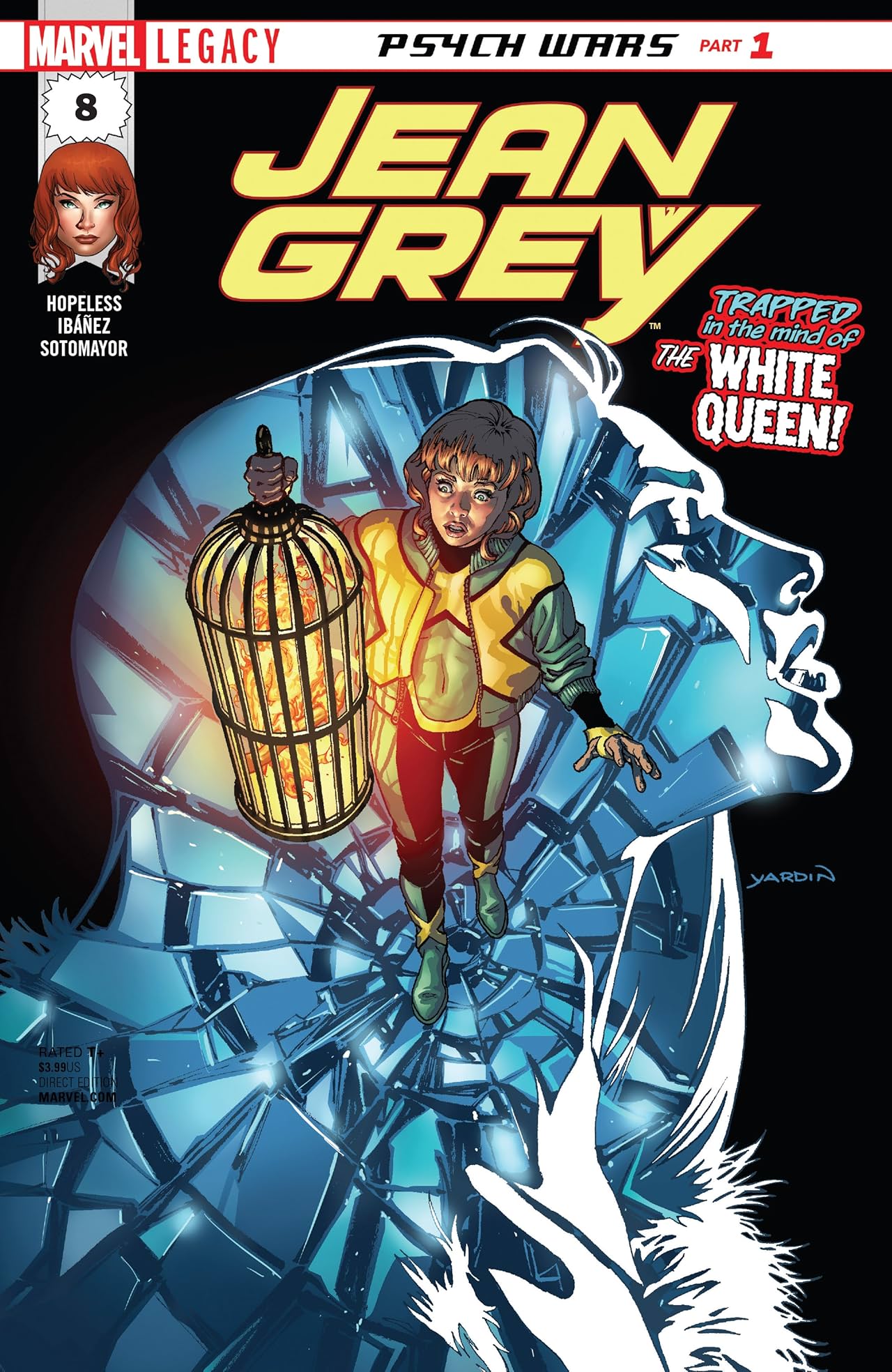
Wars of Hearts, Minds, and Psychics: Jean Grey #8

The following is my review of Jean Grey #8, which was posted on PopMatters.com.


In a perfect world, a friendly rivalry brings out the best and worst of two characters. Since no world is perfect, especially one that has Loki and shape-shifting aliens in it, that kind of friendliness is next to impossible. In the Marvel universe, rivalries between heroes and villains are widespread, common, and a vital part of its mythos. There isn't too much complexity in the sense that the dynamics are fairly clear-cut. The two characters are on opposing sides. They hate each other and want their side to triumph. Anyone who watches professional wrestling can understand that.

It's only when two heroes develop a rivalry that the narrative gains a layer of dynamics that can't be fleshed out by seeing Captain America fight the Red Skull for the billionth time. These rivalries often pit two characters who are on the same side against each other, sometime to the point where they undermine their own heroic efforts. For Jean Grey and Emma Frost, that point is far behind them and they've long since entered uncharted territory of bitterness.

These aren't just two characters who occasionally disagree with how to conduct themselves as superheroes. These are two characters who have actually hurt each other, physically and emotionally, on multiple levels. Going back to the early days of the Phoenix Saga during Chris Claremont's run on Uncanny X-men to Grant Morrison's run on New X-men, these two have a long and varied list of reasons to hate each other.

Even though Jean Grey ends up dead, there's a sense that these two are destined to clash again. With Jean Grey #8, the beginning of the Psych War arc, the wait is finally over. Dennis Hopeless pits a teenage, time-displaced Jean Grey against Emma Frost at a time when she shows little hesitation in sparking wars between the X-men and Inhumans. It may not involve the same dramatic elements that Morrison or Claremont utilized, but the stakes feel every bit as high.

From the beginning, Jean Grey #8 follows similar themes that Hopeless has established in previous issues. The time-displaced Jean Grey, in her effort to prepare for the Phoenix Force, finds herself in a situation she's completely unprepared to handle. Her being a teenager gives her a pass to some extent, but that only goes so far when the stakes are cosmic and the egos involved include Emma Frost. There's really no amount of preparation that can prepare anyone for that kind of struggle, regardless of how much time travel is involved.

In a sense, Jean is in a unique position to offer commentary on the events that led to her most recent death. Her venture into the mind of Emma Frost, her future rival, sends her on an abridged journey through those moments, eventually culminating in a direct encounter with the former White Queen during a lurid, yet familiar situation. It's the context of that encounter, though, that establishes the stakes and the drama for the Psyche War arc.

It's a rare, but increasingly common theme throughout her solo series. The time-displaced Jean ventures into a world that's destined to kill her, but with a different set of perceptions, compared to her older self. While being an immature teenager does plenty to skew anyone's perceptions, it still has the advantage of lacking the baggage of the older Jean Grey that perished. That's an important factor for the Morrison-era X-men because that same baggage played a significant role in causing her death.

Hopeless doesn't ignore those factors as the time-displaced Jean traverses Emma's mind and the memorable moments from the world of New X-men. In a sense, that baggage takes form and substance with the ghost of the older Jean Grey. The previous issue establishes her presence with the teenage Jean and not in a very friendly way either. The two Jean Greys from two different eras are constantly at odds, arguing and yelling at one another in various moments that would strain anyone's mental health.

That constant clash, which becomes a lot more heated as they fight through Emma Frost's mind, establishes an important distinction for Psyche War and for Jean Grey's ongoing story, as a whole. The Jean Grey of the past is still very much at odds with the Jean Grey of the future and not just because she ends up dead. Even though both Jean Greys share the same goal in avoiding the fate of the Phoenix Force, they're not on the same page in terms of methods. If anything, they trip over one another in their conflicting efforts.


It raises the stakes in the ongoing struggle while also revealing how ill-prepared Jean Grey is for the challenge before her. It gives the impression that she has never had a true grasp of the Phoenix, despite her being its most iconic host, going back to the Claremont era. It also makes the role Emma Frost plays feel more personal, especially as it sets the stage for a more heated battle that won't just involve psychic attacks.

The situation, context, and tensions are all there for Jean Grey and Emma Frost. The journey to their clash never gets derailed or subverted. However, even with so many critical ingredients, the lack of heated drama leaves the overall story in Jean Grey #8 feeling muted. While it doesn't try to fight the entire battle between these intensely passionate characters all at once, it stops short of probing the open wounds between them.

They never berate each other over past failures. There's no heated exchange on how Emma affected Jean's marriage to Cyclops. There are all sorts of emotional sub-plots that didn't find their way into the conflict. While the door is left open for these sub-plots, the story still lacks the connecting emotions that give all its potent ingredients the necessary impact.

Psych War still has plenty of potential to make this latest clash between Jean Grey and Emma Frost as dramatic as it deserves to be. Jean Grey #8 is just the first step in that effort. These are two of the most powerful psychics in the Marvel universe and they just happen to have a long list of reasons to resent each other. Anything less than an omega-level clash just won't cut it.

Final Score: 6 out of 10

Thursday, August 10, 2017

Rising Ashes From Two Eras: Generations: Phoenix & Jean Grey #1

The following is my review of Generations: Phoenix and Jean Grey #1, which was posted on PopMatters.com.


It's usually a sign when a certain character becomes best known for dying, not staying dead, and having large chunks of their history retconned and rewritten. It's rarely a good sign, but a select few can manage more balanced results. Jean Grey functions better than most with that kind of legacy. She dies, comes back to life, dies again, gets cloned, travels through time, and somehow finds a way to deal with a cosmic force. That may very well be another sign, but one that speaks to the strength of her character.

In a sense, Jean Grey is one of those characters who's always torn between two opposing forces. Sometimes it involves her being on the wrong end of a love triangle. Other times, it involves wanting to forge her own path while still confronting the many conflicts in her history. She knows she ends up dead, an icon to some and a walking resurrection joke to others. Since her arrival from the past in All-New X-men, Jean's story seems to fluctuate from one conflicting force to another.

One day, she's trying everything she can to avoid the same obstacles that doomed her adult self. The next, she's determined to face them. Given that she's a teenager and teenagers are known to have erratic methods in dealing with problems, this is understandable. It also makes Jean Grey's story somewhat chaotic. There's not a clear understanding of what she hopes to accomplish, so long as she's stuck in the future with the rest of the time-displaced X-men. Unlike her teammates, though, she can't reach out to her older self for guidance.

Now, thanks to space-time machinations for Marvel Generations, a teenage Jean Grey finally gets the chance to interact with her older self and learn from the icon herself. What plays out in Marvel Generations: Phoenix and Jean Grey #1 is not an illusion. It's not some twisted memory either. This is the real Jean Grey of X-men lore who goes onto devour a star, cheat death, get clones, and inspire any number of fights between Cyclops and Wolverine. It's as big a moment as a teenage girl can ever face outside her prom night.


Cullen Bunn and RB Silva don't just rip a teenage Jean Grey out of the present and stick her into some contrived point in the ever-changing, constantly-reconnected timeline of the X-men. Bunn shows that he's done his homework by putting the young Jean Grey in a specific moment within the original Phoenix Saga between that ran between Uncanny X-men #101 and Uncanny X-men #138. It's the kind of attention to detail that Chris Claremont himself would be proud of.

In a sense, it's the most optimal moment Jean and her older self could've chosen for their respective stories. Within the context of the original Phoenix Saga, it's that brief period where Jean had control over the Phoenix Force. She isn't corrupted, twisted, or devouring entire star systems just to see what it feels like. She's still very human in her perspective, but vulnerable to the corruption that comes with the god-like power of the Phoenix Force.

It's a narrow window for her teenage self to explore, but one that's vital within the context of her own story. It provides a clear and effective link between the conflict unfolding in Jean's solo series and the events unfolding in Marvel Generations. Once again, Jean faces the prospect of dealing with the Phoenix Force again.

She knows as well as anyone who tries to follow convoluted timelines and never-ending death/rebirth plots that it's bound to cause cosmic headaches for everyone. In order to deal with it, she needs to learn about it. She'll find no better source than this particular version of herself at this particular point in her history. Even a cosmic version of Wikipedia can't provide information that comprehensive.

As a result, Marvel Generations: Phoenix and Jean Grey #1 takes on a very personal undertone. Bunn dedicates significant parts of the narrative to exploring the inner conflict within the teenage Jean Grey. She recognizes from the beginning that this is an important opportunity, one that she can't afford to pass up. She needs to learn everything she can about the Phoenix Force. On top of that, she has spoilers to the tragedy that lies just ahead for her adult counterpart.


Despite all the implications this meeting has for both characters, Bunn resists the urge to turn teenage Jean Grey into Marty McFly from Back to the Future in that she doesn't mindlessly mess with the timeline. She actually establishes a personal connection with her older self. She doesn't attempt to deceive her or impede her. She presents herself as a friend and ally. It may seem redundant since they're the same person, but it serves an important purpose.

By becoming an ally, teen Jean gets a chance to learn about her older self outside the tragedy, heartache, and retcons that exist only in the memories of her fellow X-men. She sees that, like her, the older Jean Grey is also struggling to make sense of this cosmic power. However, her older self clearly has a different perspective of that power, which she eagerly demonstrates in ways that maximizes the visual appeal of Silva's art.

It leads to a cosmic clash between the Phoenix and Galactus. It's the kind of clash that's inherently epic on paper, but easy to mess up in a story. Bunn achieves a fitting balance of sorts, giving Jean and her adult counterpart a chance to shine and learn from each other. In doing so, it sets up a unique moment between two characters from different periods in a vast mythos. That moment carries with it a dramatic impact that maximizes the opportunity that Marvel Generations creates.

It's a moment that Marty McFly botched in Back to the Future. For Jean Grey, it's a moment of clarity that takes place at the best possible time. That's not just an outside observation either. The Watcher himself shows up to let her know just how important her decision is in the grand scheme of the never-ending chaos that is the Marvel universe. She has a chance to make the easy decision that will most definitely incur all sorts of complications and consequences. She ends up making a different choice. The fact she makes that choice as a teenager, whose natural inclinations gravitate towards easy solutions bereft of consequence, speaks to the strength of her character.

Marvel Generations: Phoenix and Jean Grey #1 is in a position to literally rewrite the history of one of the X-men's most iconic stories. It's also in a position to add even greater complications to a story that has had more than its share since the 1980s. Bunn doesn't draw the ire of Chris Claremont, nor does he completely nullify the potential of the moment. The Jean Grey from the past and the Jean Grey from the present both get something out of their encounter. It's not the same as a retcon or a time paradox, but it has a genuine impact and that impact feels relevant to both characters.

There's still a sense that teenage Jean didn't do as much as she could've. It could be argued that she didn't do as much as she should've either. However, what she ends up doing is probably the most responsible decision she could've made in that situation. For a teenager constantly looking for ways to avoid the destiny that fate has laid out for her, it speaks volumes to the strength of her character. Even if the circumstances of Marvel Generations are unclear and the overall impact is uncertain, Jean Grey shows why, no matter which era she's in, she's still the heart of the X-men.

Final Score: 9 out of 10

Friday, June 16, 2017

The Red Queen Chronicles: Phoenix Part 3 is LIVE!


It's the beginning of summer. It's hotter than Emma Frost's panties as a diamond exchange. It's the time of sun, beaches, and bikinis. In other words, it's the perfect time of year for my sexy side-projects.

Since the unexpected success I got with "Spider-Man and the Prostitute," I've had plenty of projects to keep me busy. I've since expanded that world with "The New Red Queen" and the various spin-offs I've done from that. With someone as sexy as Mary Jane Watson running the show at the Hellfire Club, of all places, the potential for sexiness is virtually unlimited. There are so many sexy ideas to explore and I'm about to cap off another.


In the latest round of the Red Queen Chronicles, I've had Mary Jane and Emma Frost recruit Cyclops and Jean Grey to their ranks. So far, the process has been a bit messy, but sexy as hell for reasons that should be obvious to anyone who read the first two chapters. The final chapter should help cap things off in the most fitting, sexy way possible. Whether you're a Cyclops/Jean fan or just fans of sexy stuff like this, you'll find plenty to enjoy.


Again, I appreciate the strong response I've gotten with this and all my recent Red Queen stories. The more support I get, the more motivation I have to keep this sexy series going. I will announce right now that I do have another spin-off in the works. After that, though, nothing is set in stone. It depends on the response I get to this story and the next one. If there's still sufficient demand, I'll keep at it. Like I said, the potential for sexiness when it comes to Mary Jane Watson is unlimited. Nuff said!

Friday, June 9, 2017

X-men Supreme Issue 152: Volatility Sensibility Part 2 is LIVE!


There’s a difference between the right decision and the prudent decision. That’s something the X-men deal with all the time in the comics, movies, and cartoons. The X-men Supreme fanfiction series is no different. Whether they’re caught in the middle of a war with the Shi’ar or trying to save the lost city of Nova Roma, the X-men have had to made more than a few hard decisions. In every occasion, their guiding principles came from Charles Xavier’s dream of peace and understanding. Now, in the evolving conflicts of X-men Supreme Volume 7: United and Divided, those principles have become obscured.

It’s a critical and tenuous moment for this fanfiction series. The X-men are divided, but the world still needs them to make these hard decisions. Charles Xavier is trying to pursue a different dream with the Mutant Monitoring Initiative. Cyclops and X-Force are trying to preserve what remains of Xavier’s old dream. They cannot and will not compromise their principles. Now, in the events of Volatility Sensibility, they won’t have a choice.

X-men Supreme Volume 7: United and Divided is in the midst of its first arc. It’s also the first major conflict since the X-men split in the events of X-men Supreme Issue 148: New Divide. A young mutant named Nitro find himself at ground zero of a potentially explosive situation, both literally and figuratively. A combination of bad luck and poor decisions on his part have made him a target of both the Mutant Monitoring Initiative and a group of petty criminals to which he is indebted. It’s up to the X-men and X-Force to try and resolve this situation before it literally blows up in their face.

In previous volumes of X-men Supreme, the decision would be relatively easy. Helping distressed mutants is what the X-men do. Whether it’s someone struggling with their powers, like Rogue did when hers first manifested, or helping a mutant like Gambit, who found himself in a tricky situation back home, the X-men make it a point to protect mutants. Under the Mutant Monitoring Initiative, complete with the constant scrutiny of President Kelly and General Grimshaw, it’s not so easy anymore. Helping Nitro might also mean turning him over to the government or sending him to prison. That puts the X-men in a tough position while giving X-Force an opportunity to intervene.

Who is right and who is wrong in this instance? Will Xavier’s new methods win out? Will Cyclops and X-Force prove him wrong? It’s the first major test for the X-men and X-Force in X-men Supreme Volume 7: United and Divided, but it will certainly not be the last. It is, however, as explosive as it gets. Whether they want to save Nitro or the innocent people he may hurt with his powers, they’ll have to make those hard decisions soon. What they do and don’t do will set the tone for the future of this fanfiction series. Make no mistake. Volatility Sensibility will have significant implications and it starts with this issue.

X-men Supreme Issue 152: Volatility Sensibility Part 2

There’s plenty more to come with X-men Supreme. This first arc of X-men Supreme Volume 7: United and Divided is meant to set the tone for the kind of conflict you’ll see between the X-men and X-Force. Now, I’ve followed the X-men comics as closely as most other X-men fans and I know that divided X-men has become somewhat taboo in recent years. I hope to go at it from a different perspective here in X-men Supreme.

As such, it’s very important that I continue to get feedback from readers on this fanfiction series. I especially want to hear from those fans who were as disappointed as I was with how the whole schism issue was handled with the X-men comics. I want to handle it better here in X-men Supreme and I need feedback to ensure I’m succeeding. Either post your comment directly in the issue or contact me directly. Either way is fine and I’m always happy to chat X-men. Until next time, take care and best wishes. Xcelsior!

Jack

Friday, June 2, 2017

X-men Supreme Issue 152: Volatility Sensibility Part 2 PREVIEW!

Image result for Charles Xavier

In the world of X-men Supreme, it doesn’t take much to turn a difficult situation into a crisis. It happened with Impossible. It happened with Prison Break. It happened with Proactive Regression. These situations weren’t like Overlord or the Phoenix Saga, two events that started off as crises from the beginning. They started small and devolved quickly, eventually becoming pivotal turning points for this fanfiction series. In their current divided state, the X-men are vulnerable to a crisis in any situation.

The events that culminated at the end of X-men Supreme Volume 6: Liberation Decimation are still reverberating for many. Charles Xavier is still working tirelessly to make the Mutant Monitoring Initiative work. He has the strong, yet tepid support of General Grimshaw and President Kelly. He’s even managed to forge some significant progress, as shown in X-men Supreme Issue 149: Law Abiding Bind. This new form of X-men has done plenty of good, but they’ve done that good without having to deal with a difficult situation. That all changed in the first issue of Volatility Sensibility.

The X-men Supreme fanfiction series is about to give Charles Xavier and his new brand X-men a familiar challenge with a different set of complications. Dealing with a mutant who’s struggling with volatile powers is nothing new. The X-men have handled situations like this on my occasions, going back to Rogue’s initial recruitment in X-men Supreme Issue 6: Rogue Recruit and Jean Grey’s encounter with the Phoenix Force in the Phoenix Saga. In each case, the X-men were able to deal overcome the challenge. Now, they have to do so under the intense scrutiny of General Grimshaw and Captain Freeman.

The X-men have always prided themselves on being heroes, working within the system and sometimes outside it when necessary. Part of Xavier’s dream was to show that mutants could work together to help each other and mankind. More importantly, they could do this without a government sanctioning or supporting them. Now, they don’t have the option of working outside a system. They have to play by whatever rules that General Grimshaw and President Kelly prescribe. Can those rules work? Can they save lives when they can’t be the heroes they’ve always been?

Charles Xavier is willing to take that chance. Cyclops and his renegade brand of X-men, which he calls X-Force, is not. Whoever ends up being vindicated will likely shape the course for mutants moving forward in this fanfiction series. At the center of it all is a young mutant with a bad streak of luck named Nitro. He not only finds himself being born with mutant powers that literally make him a walking time bomb. He’s also a target of some very bad people that he managed to piss off, even before he found out he was a mutant.

Nitro’s fate is very much the fate of the X-men and X-Force. His fate will act as a major catalyst for the X-men Supreme fanfiction series moving forward. However it plays out, there will be consequences. There will be challenges. There’s more than Charles Xavier’s dream on the line now. It’s a volatile time for the X-men at every level and it’s going to get worse before it gets better. As always, I’ve prepared a preview of the next issue of Volatility Sensibility and all the chaos that's just starting to unfold.

“Will you quit driving like a pussy and step on it already?” shouted one of Boss’s body guards, “That light show behind us is getting too flashy for my tastes.”

“I’m going as fast as I can,” replied the driver, “This van wasn’t built for shitty back roads.”

“Forget about damaging the rims. Just gun it already!”

“Both of you, pipe down!” said Boss firmly, “Bickering will not make us go any faster.”

The two body guards and the driver fell silent, fearing Boss’s wrath almost as much as the explosion. He earned his title by taking big chances. Having a walking bomb on their side would have been a potent weapon and a lucrative resource. It was too bad Nitro had to be so stubborn with them. However, Boss was not deterred.

The mood inside the van remained tense as they neared the front gates of the mine. The light behind them continued growing, but from the looks of it they were going to outrun it. As the van picked up speed, Boss was already contemplating ways to make this work for them.

“This was risky venture for all of us. It turned out to be riskier than expected, but the potential is still there,” mused Boss, “We missed out today. Our friend, Nitro, is clearly going through some growing pains.”

“Those pains may turn our boys back there to bird chow,” commented his body guard.

“Well it’s their own fault for not being efficient enough. They should have handled Nitro more carefully. They don’t understand that he’s an immature child. Like any immature child, he’ll grow out of it. Then we’ll be able to make another offer.”

“You think he’ll change his mind?” asked his second body guard.

“I doubt it, but I’m sure we’ll find a way to convince him,” said Boss wryly, “He’s a mutant and mutants are the future, my friends. It’s an untapped market that’s ripe for the picking. I plan on getting in at the ground floor. Once the dust settles from this incident, we’ll be ready to…”

Suddenly, the van was brought to a screeching halt. Boss was thrown from his seat in mid-sentence and so were his body guards. It was like they just ran into steel column.

“Ungh! What the hell just happened?” barked one of the body guards, now rubbing his head.

“Uh…we just hit something, Boss,” said the driver in a daze.

“Then drive over it already!”

“That’s…going to be a problem,” he replied, his voice filled with dread.

From the front seat, the driver was staring at an obstacle that was not going to let him through. That obstacle was Warpath. Just as the van was about to reach the main entrance, the Native American mutant jumped out in front of them and dug his feet into the ground.

The van had no chance when it hit him. Now he had his hands firmly dug into the hood. If that show of strength wasn’t intimidating enough, the anger in his eyes only added to the driver’s fear.

“Your boys just shot my girlfriend. So I’m taking my anger out on you!” barked Warpath as he rocked the van with his strength.

“Ahhhhhh! What the hell are you talking about?” the driver exclaimed.

“I think he means to say we’re making our escape on foot!” said the Boss from the back.

Despite the shaking, Boss only had minor injuries and was able to open the side door. One of his body guards had a concussion and was in no condition to follow. Since the glowing light in the distance was getting worse, he was in no condition to aid him. So as soon as Boss was out of the van, he prepared to run.

“We’re really going to try and outrun this thing?” exclaimed the other body guard that wasn’t concussed.

“Unless you want to take that chance, you’re welcome to keep up!” said Boss.

With his eyes set on the main entrance, Boss took his first step. It ended up being his last because another obstacle literally fell from the sky in the form of large metal shards. They struck within mere inches of his feet. They were sharp as well, cutting his oversized trench coat in the process. It was enough to make him fall back towards the van.

“Oh no you don’t, Don Corleone! You’re going to stick around for the show and the after party,” said the menacing voice of Angel from above.

“By after party, he means your arrest or the cleanup of what’s left of you.” said Warpath, still gripping the van.

“More mutants…figures,” groaned Boss, “Surely ,we can be reasonable about this?”

“Save your reasons. Unless I need to remind you that these wings aren’t made of feathers,” said Angel.

The winged mutant flexed his techno-organic wings, forming dozens of sharp tips and arching them so that they were pointed right at Boss. He got the message and slowly inched back towards his van. His body guards stayed put, not testing Angel’s patience. Angel made sure they didn’t try and take the cowards way out. He kept his wings pointed at them, ensuring they would be here to face the consequences of what they instigated.

With each thug secure, Warpath smashed through the front of the van to take out the engine. It further stifled their escape while giving him a means to vent his anger. Moments ago, Emma Frost gave them a telepathic update on what was happening with Nitro. It wasn’t pretty. He was poised to explode again thanks to Boss’s thugs. The X-men showed up as well and Storm had been shot. It left him with plenty of reasons to be enraged in addition to facing another massive explosion.

“I’ll let Cyclops know we’ve secured our wannbe Godfathers,” said Angel.

“Any idea if he plans on preventing this mine from becoming a crater?” asked Warpth.

“He’ll figure something out. He always does,” assured Angel.

“If by chance he doesn’t, at least let me break some bones with these guys,” said the Native American, cracking his knuckles as he stared down Boss, “They deserve a little discomfort just for what they did to Storm. Never mind the whole putting an entire town at risk.”

“I can appreciate your feelings for assholes like this, but we’re not here to break bones. We have a mission and it hasn’t blown up in our faces yet.”

“But it’s about to,” quipped Warpath, “Mission or no mission, somebody back there better do something. This kid blowing up is gonna suck for both X-Force and the X-men!”


I still find it somewhat ironic how things in the X-men Supreme fanfiction series are so divided while the X-men comics are going in the opposite direction. At the moment, the X-men comics are returning to a more familiar state. Divisions, rivalries, and schisms are ending. The X-men, as fans have known them, are taking shape once more. Meanwhile, the X-men Supreme fanfiction series is throwing all sorts of divisions and complications into the mix. It’s a tough situation, one that I didn’t plan, but am trying to flesh out none-the-less.

I get that a lot of X-men fans are tired of the divisions, extinctions, and time travel plots. Granted, this fanfiction series has yet to use time travel or alternate universes to further a plot and I don’t plan to. I’m still plenty determined to make sure that X-men Supreme is as awesome as it can possibly be. That’s why it’s so important that people continue to provide feedback. Either post your comments directly in the issue or contact me directly. Either way is fine and I’m always happy to chat X-men. Until next time, take care and best wishes. Xcelsior!

Jack

Thursday, June 1, 2017

Timely Traditions: Cable #1

The following is my review of Cable #1, which was posted on PopMatters.com.


When it comes to time travel, there aren't many superheroes these days that can do it without making fans roll their eyes. As a concept, time travel is overdone, burned out, and utterly devoid of shock value. The days of "Back To The Future" and the lovable eccentricities of Doc Brown are long gone. Stories that involve time travel are about as inane as a stories that involve Superman telling kids to eat their vegetables.

However, there is still one character who can build their story around time travel and make it work. It's not Doc Brown either. It's Cable. He's part Terminator, part Marty McFly, and part Rocky Balboa. He's also friends with Deadpool and willingly works with him on a regular basis. That alone is a testament to his grit and determination.

With a major role in the next Deadpool movie, as well as the star power of Josh Brolin, the time traveling mutant has a lot going for him. With Cable #1, another title in Marvel's ongoing RessurXion effort, James Robinson and Carlos Pacheco try to put Cable on the same wave that Deadpool rode to a wave of popularity. He may never inspire as many Funko figures or cos-play costumes, but he still has so many factors going for him.

The story in Cable #1 takes the core of his character and runs with it. There's no elaborate exposition. There's no major build-up to the plot. It just puts Cable in the middle of a time travel plot and lets him do his thing. Anyone who knows anything about Cable won't be too surprised. They won't be disappointed either. There's time travel, there's big guns, and there's large-scale violence both on and off-panel. By every measure, this is a typical Tuesday for Cable.


In terms of getting back to the core of a particular character, Cable #1 checks the necessary boxes. It doesn't check every box, but it checks the ones that are most important to the core of Cable's character. Robinson doesn't try to reinvent Cable or twist his story in some elaborate way. He sticks to the basics of time travel and big guns, which are the meat and potatoes of every great Cable story.

In terms of the contents of that story, it itself doesn't try to be too iconic. It has Cable doing some time-hopping to find someone who has been sharing futuristic weapons with people and time periods that haven't even mastered indoor plumbing. Anyone who deals with Marvel's twisted timeline is right to be concerned about that sort of thing. Given the absence of the Fantastic Four and the ineptitude of those such as Hank McCoy, Cable is the only one qualified to handle this issue. The substance is there. It's only the portion size that's lacking.

The core concept is there in Cable #1. There's someone screwing with the timeline by giving high-tech guns and swords to cowboys and samurai. That makes for plenty of gun-fights and gratuitous violence, as only Cable can inspire, but there's little context to the story. There's no real clue as to who Cable is after. The only detail revealed is that they think giving people who still see bathing as a luxury is a good idea. Beyond that, there's little else to go on.

That doesn't make Cable's battles any less entertaining. Compared to the plots of a typical Terminator movie, Cable #1 is refreshingly straightforward. There's just too little drama and too little setup to intrigue those who aren't already fans of Cable's time-hopping narratives. Robinson doesn't try to push the envelope and that's understandable. At a time when many other X-men characters are returning to their roots in wake of Inhumans vs. X-men, his efforts in Cable #1 fit the larger narrative. It just doesn't try to push it any further.

For those who don't know much about Cable or his convoluted backstory, complete with clones and techno-organic viruses, they won't see anything too overwhelming. They won't see anything too shocking either. They'll just see a character that specializes in traveling through time, shooting big guns, and getting into big fights. That alone has plenty of entertainment value. However, in a world that still has Deadpool and multiple Wolverine knock-offs, that only goes so far.

There aren't many details of the story in Cable #1 that are clear from the beginning or even the end, for that matter. That's not to say the story is messy or convoluted, though. It is the beginning of a larger story. The ending teases a much larger conflict at hand, one that will require more time travel and more big guns.

That has plenty of appeal to long-time Cable fans, but new readers won't find anything that they can't find in other comics that deal with big guns and gratuitous violence. Given the number of characters that rely on big guns and gratuitous violence, Cable #1 doesn't do much to set itself apart. However, there is still something to be said about a story that can involve cowboys and samurais in the same story.


In the end, the greatest success of Cable #1 is how sticks to the basics and doesn't complicate the narrative. In any story that involves time travel, that in and of itself is an accomplishment. Robinson maintains the core of Cable's character and Pacheco's art ensures that it's visually appealing. The story has the necessary foundation on which to build upon Cable's story. There's nothing in that story that precludes a narrative that becomes an iconic moment in his history. It's a long way towards achieving that level of quality, but it's on the right path.

With a promising future in Deadpool 2, courtesy of Josh Brolin, Cable is one of those characters whose profile is on the rise. Cable #1 puts him at the front of the batting order and shows off the potential of what he can bring to the table. With big guns, a bad attitude, and a blatant disregard for time paradoxes, he has all the tools he needs to be a major player for the X-men. At a time when Hugh Jackman has retired and Deadpool is the new adamantium standard, the timing couldn't be better.

Final Score: 6 out of 10