Showing posts with label Matthew Rosenberg. Show all posts

Thursday, September 6, 2018

Heroes, Criminals, and Heroes Operating As Criminals: Astonishing X-men #15

The following is my review of Astonishing X-men #15, which was posted on PopMatters.com.


In principle, being a superhero is simple. You find criminals, you fight them, and you defeat them. If you can cooperate with the authorities along the way, then that's a nice bonus. When heroes have to operate as criminals, though, things aren't as simple. That doesn't just apply to vigilantes like Batman and the Punisher, who overtly operate outside the law. Sometimes, a superhero has to function in an environment where they're branded a criminal for the wrong reasons.

That is Alex Summers' situation in Astonishing X-men. Now that he's not inverted anymore from the events of AXIS, he's attempting to rebuild his superhero credibility. His timing is actually really good, in some respects. With both his brother, Cyclops, and Captain America also having to salvage their reputations due to events like Secret Empire and Avengers vs. X-men, he's following ongoing trend among heroes. With the way things play out, however, he's going in the wrong direction and it's not entirely his fault.

Matthew Rosenberg and Greg Land give Havok plenty of opportunities to channel his brother's leadership skills. He manages to assemble a new team of X-men to carry out heroics on their own terms. It's not exactly a team of A-list heavy hitters, though. Between Warpath's attitude in Weapon X and Colossus still recovering from his failed wedding in X-men Gold #30, Havok needs more than just leadership to get them on the same page.

The underlying plot of Astonishing X-men #15 starts off simple. The Reavers are on the loose again and the X-men usually don't have many qualms about fighting Reavers. However, some major complications emerge that would hinder Captain America on his best day. These aren't the traditional, mutant-hunting Reavers the X-men are used to. They're now directly sponsored by the government and operating under the guise of law enforcement. Given the government's tenuous history with policing mutants, it's only shocking that they didn't resort to killer cyborgs sooner.


This immediately puts Havok and his new team are already behind the curve. Their confrontation with these state-sanctioned Reavers goes so badly that even Kitty Pryde has dissociated the X-men from Alex's team. Logistically speaking, they can't even call themselves X-men. In the eyes of both the law and their friends, they're not superheroes operating as criminals. They're just criminals.

This isn't just bad press like the kind Spider-Man deals with every other day. Officially, Havok's team fight and evade government agents. That's both frustrating and jarring because it subverts the X-men's traditional approach to battles. Like Sentinels or evil clones crafted by Sinister, the Reavers are the kinds of enemies that X-men usually battle without a second thought. It's almost like a reflex akin to Captain America saluting the flag or Deadpool making a dirty joke.

The difference this time is that the Reavers are sanctioned by the government. It's not entirely a mutual partnership. The Reavers, led by Donald Pierce, make it abundantly clear that this partnership was imposed. They didn't cooperate with the government out of civic duty. They were essentially drafted into serving and Havok doesn't find that out until it's too late.


This creates an unusual, but interesting backdrop to the conflict. There's no mind control or inverted personalities at work here. The only alteration to the X-men/Reaver clash is that the Reavers are now operating under the whim of the authorities. Even if they do it unwillingly, they're still technically government operatives and Havok's team fought them. From a legal perspective, they assaulted agents of law enforcement. That's not what heroes do. That's what criminals do.

It's less about the ethics of heroism and more about the bureaucracy surrounding it. Any team of heroes, be they X-men or Avengers, can take down all the cyborg assassins they want. Both the public and those in government will gladly cheer them on. However, as soon as those same cyborg assassins start operating with the government's seal of approval, those cheers turned to outrage.

It puts Havok in an unusual predicament. He wants to redeem himself. Instead, he and his new team find themselves on the wrong end of the law and public opinion. The media doesn't frame the story as the X-men heroically defeating the Reavers before they can harm innocent mutants. They report it as a group of rogue mutant terrorists battling government forces.

Technically, that's not some misleading headline on the front page of the Daily Bugle. That actually happens, forcing Havok and his new team to lay low. That doesn't work either, though. The Reavers still find them, which means they have to defend themselves. Doing so means fighting back, but that only compounds the problem because they're still fighting government officials.

It's a no-win situation for Havok. Unlike his older brother, he doesn't have a boy scout reputation to fall back on. People may question a news story that claims Captain America sucker-punched a police officer, but they're less inclined to doubt that Cyclops' less capable brother did something awful, especially after being inverted for so long. He even acknowledges how bad it gets, escaping to a bar frequented by other colorful criminals. It seems every conceivable force is working against Havok's efforts to redeem himself and for once, that's not just brooding.


It's not completely hopeless. Rosenberg never lets the tone of the story get too bleak. Havok still gets a chance to do his brother proud, hatching a plan towards the end that requires him to embrace his new criminal connotations to some extent. It's bold, but fitting approach. Given how the plot is almost framed, it feels necessary.

That also feels like a flaw, of sorts, because neither Havok nor his team really have much choice along the way. There's never a sense that they have any agency in how they impact the plot. The same goes for the Reavers, as well. Having that government label really limits their agenda to serving whoever has the right emblems on their uniform.

Even with those limits, Astonishing X-men #15 succeeds in presenting Havok with a daunting, yet novel challenge on his path to redemption. Just forming a new team of X-men and following his brother's example isn't enough. He has to operate as a criminal in order to become the hero he wants to be. His brother would be proud, but probably just as frustrated.

Final Score: 7 out of 10

Thursday, March 15, 2018

Heart, Soul, and Zombies: New Mutants Dead Souls #1

The following is my review of New Mutants Dead Souls #1, which was posted on PopMatters.com.


From a purely pragmatic standpoint, teenagers are uniquely qualified to take on paranormal threats. Most adults, be they ordinary people or iconic superheroes, have a certain level of life experience to forge what they see as a sense of normal. It's part of the basic maturation process. As kids grow into adults, they refine their perspectives into what they consider rational, balanced, and proper.

That may serve them well in function within an ordinary, civilized society. As soon as demons and paranormal monsters enter the picture, those mature people are more likely to buckle under the pressure. Teenagers can be irrational and melodramatic, but by lacking a secure grasp on the real world, they're actually more capable when it comes to facing paranormal threats. This plays out in many memorable ways throughout Chris Claremont's initial in New Mutants. Matthew Rosenberg now attempts to do the same with New Mutants Dead Souls.

In terms of timing, the market is ripe for teen mutants fighting paranormal threats. Rosenberg is coming off a successful stint with Phoenix Resurrection and with the cancellation of Christina Strain's Generation X series, there is an opening for stories centered around teenage mutants taking on the kinds of threats that would overwhelm functioning adults. If those threats involve paranormal creatures that require the leadership of Magik, a teenage girl with a colorful history that involves demons, then the potential entertainment value is beyond dispute.

X-men comics are well-known for providing unique opportunities for young mutants to establish themselves. In a world still populated by time travelers and refugees from dystopian futures, those opportunities are important. New Mutants Dead Souls #1 establishes a new team with familiar faces to take on the kind of threats that often pass under the radar for most X-men. That doesn't imply that paranormal threats are less important. It just acknowledges that mutants are more likely to get attacked by killer robots than demons.

The makeup of the team also acknowledges that some X-men that attract paranormal threats more than others. The fact the team is led by Magik proves that Rosenberg understands what makes the New Mutants unique. Any team of mutants can come together and fight giant robots. It takes a special team with a demon-loving teenage girl as leader to come together and fight paranormal threats. New Mutants Dead Souls #1 doesn't attempt to complicate the concept or overlook the appeal. Anyone just looking to see mutants fighting monsters will get what they want.

Magik's team, which consists of Rictor, Boom-Boom, Strong Guy, and Wolfsbane, is full of familiar names for New Mutants. They're young, immature, and don't hesitate to fight back when someone throws an empty bottle at them. When the threats are paranormal and there's more room for recklessness, that's both expected and refreshing. In the case of New Mutants Dead Souls #1 the threat involves zombies and when it comes to the undead, reckless is most prudent approach, even though it tends to get messy.

The specifics of the threat start off basic. There's a small town in Alabama that sustained heavy casualties due to a hurricane. Some of those casualties died, but didn't stay dead. It's a localized issue that isn't quite on the level of requiring the Avengers to assemble in full force, but it warrants enough concern to send a team of team of teenage mutants right into the heart of the conflict. It's simple enough to challenge the New Mutants while also maximizing their youthful recklessness.

It's not too simple in terms of story, though. This zombie attack doesn't just happen because those corpses all made deals with Mephisto. There's a reason why the dead are rising and that's what the New Mutants have to figure out, but not before battling a horde of zombies that allows Adam Gorham's art to maximize the paranormal ambience. It has the feel of both a horror story and a superhero story, which proves to be a potent combination in terms of raw entertainment value.

There's plenty of setup and tense exchanges, but there's plenty of memorable action-packed moments that are every bit as satisfying as the best moments on The Walking Dead. There's Magik cutting zombies up with her sword, Boom-Boom blowing them up with cherry bombs, and Strong Guy ripping them apart. It's visceral and brutal, but what makes it uniquely satisfying is how it gets resolved.

It's not one of those conflicts that only ends when the last zombie gets its head blown off. There are other forces at work driving the attack and those forces aren't as obvious as someone having worked for the Umbrella Corporation. It's a mystery, but not one that requires much sleuthing. When one of the members on that team spends much of her spare time with demons, the traditional sleuthing process is both tedious and unnecessary.

While the final resolution does come off as a bit rushed, as do other parts of the story, New Mutants Dead Souls #1 is one of those stories that doesn't try too hard to set up future conflicts or over-emphasize the first. It still takes some time to do a little world-building, establishing some infrastructure with the team. They have a base of operations. They have a larger mission and that mission is something even a team of teenage mutants can get behind.

It makes for a story that feels complete and dense. A lot happens quickly. Even when it's a bit too quick in some areas, it still comes together in a concise, coherent manner. It's less an origin story and more a reminder, one that belabors how Chris Claremont's idea of having teenage mutants take on paranormal threats can be fun and entertaining. Rosenberg and Gorham take that idea and run with it, establishing a unique appeal with a colorful cast of characters that is sure to attract more than just zombies. Teenage mutants or not, that appeals to every age group on some levels.

Final Score: 8 out of 10

Thursday, February 1, 2018

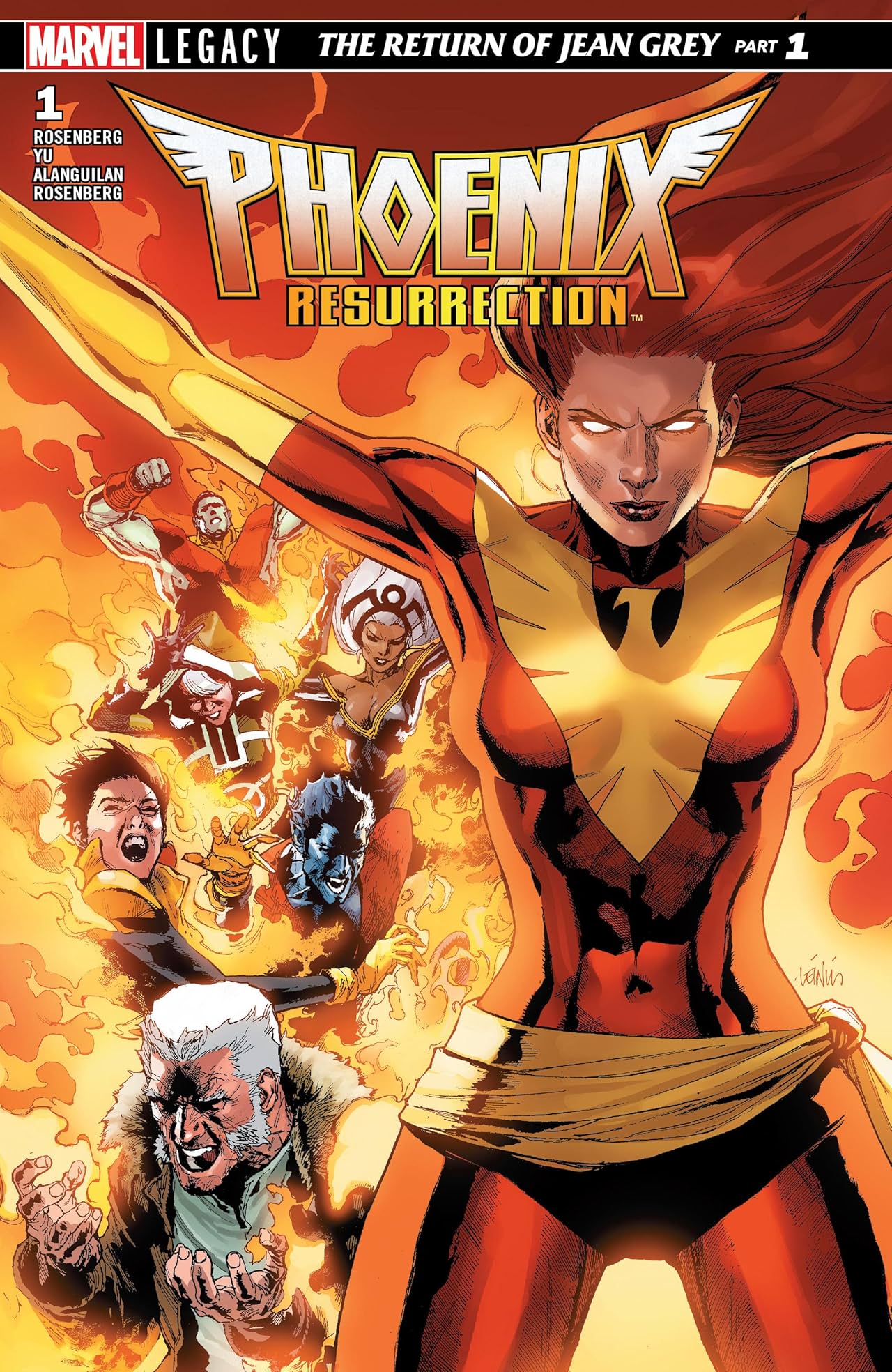
Patience, Virtue, Resurrection, and Heart: Phoenix Resurrection: The Return of Jean Grey #5

The following is my review of Phoenix Resurrection: The Return of Jean Grey #5, which was posted on PopMatters.com.


Patience in comics isn't just a virtue. It's built right into the industry. Unlike a movie or TV show, the stories are often structured in pieces and drawn out over multiple issues. That means if something exciting happens in one issue, it could be at least a week or several before anyone finds out what happens next. That structure works well within the unique storytelling format that comics utilize, but the need for patience is a lot harder in the era of binge-watching.

Other than video game fans still waiting Half Life 3, few comic fans exercise more patience than those waiting for the return of Jean Grey in the X-men comics. For over a decade-and-a-half, her absence acts as a glaring hole in the heart of the X-men's collective soul. Every now and then, there are teases like Phoenix Endsong, Hope Summers, and the teenage time-displaced version of Jean Grey. However, none of them can quite fill that hole. Only the real, non-clone, non-time displaced Jean Grey can do that.

Now, with Phoenix Resurrection: The Return of Jean Grey, the time for patience is finally at an end. At last, Jean Grey is set to return to a Marvel universe that is very different from the one she left in the flip-phone loving days of 2004. In a world that tried to replace her with Emma Frost, time travelers, and clones, the return of the one true Jean Grey promises the kind of catharsis for which even the most patient X-men fans have longed.

Matthew Rosenberg does not not shy away from hitting every emotional chord as hard as possible without bringing Juggernaut into the picture. Throughout the story, he puts Jean in a situation where the prospect of heartache and loss is unavoidable. Such themes are painfully common for Jean Grey, but also bring out the best in her and those around her. Phoenix Resurrection: The Return of Jean Grey #5 takes those themes, supercharges them with cosmic energy, and pushes the drama to limit. For a character as beloved and passionate as Jean Grey, there can be nothing less.

The mystery that plays out over the course of several issues gives way to a battle of heart, tragedy, and spirit. The blanks are filled in. The motivations, mechanisms, and undertones are all in place. The how, the why, and the context of Jean Grey's return to the world of the living is firmly established. All that's left is for Jean to confront it. That confrontation brings out every bit of passion that has made Jean Grey such a compelling character. From Chris Claremont to Grant Morrison, this moment highlights both the strength and tragedy of who she is.

This is not one of those struggles where the X-men have to fight to save Jean. This is a battle Jean fights largely by herself. The X-men are there and they provide support, but they don't try to fight the battle for her. Other than Old Man Logan putting himself in the line of fire, literally to some extent, to get the struggle going, it's Jean who does the heavy lifting. Between dealing with cosmic forces and being Emma Frost's rival, she's more equipped than most for this kind of battle.


It's the kind of battle that only a handful of characters can fight and do so in a compelling way. That's because Jean Grey is one of those characters whose story is so defined by tragedy, loss, and being overwhelmed by a situation. Whether it's a cosmic force or an attack by Juggernaut, Jean fights more of these battles than most, but still does it with a sense of heart and compassion. She never lets herself become too jaded or hardened by the struggle. It's part of why she's often considered the heart of the X-men.

That heart is often strained and the workings of the Phoenix Force push it to its limit in Phoenix Resurrection: The Return of Jean Grey #5. It doesn't just tempt Jean with the possibility of great cosmic power. That kind of power tempts someone in the X-men every other week. The Phoenix Force makes it more personal.

It reminds Jean of how many friends, family, and loved ones she has lost over the years. It also lets her know that embracing cosmic power will give her the ability to stop all that. It all sounds so tempting and reasonable, but Jean knows better than most how that kind of power tends to come at a price. Having been killed by that price more than once, though, such temptation only goes so far with Jean.

It's not just a matter of power corrupting, a theme that goes back to the original Phoenix Saga by Chris Claremont. The Phoenix Force, in this case, actually shows Jean that it's possible. It literally creates a fantasy world full of all the people Jean knows and loves, uncomplicated and untainted by tragedy, loss, and the influence of Emma Frost.

It's a world that anyone with any measure of emotional vulnerability would want to embrace. Jean has to do the opposite in lieu of reliving those painful themes that Claremont did so much to belabor. It's not the same inner struggle that Jean seems to deal with every time the Phoenix Force gets a little too clingy. Jean has to actively fight the Phoenix Force, pushing it away along with all the temptations that its power allows.

It's a fight that that involves much more than simply saying no or resisting temptation. Jean and the Phoenix Force have an overdue heart-to-heart, one that strains both her and the Phoenix Force on an emotional level. However, that doesn't stop the Phoenix Force from making the strain on Jean much greater, attacking her in ways that break her heart multiple times. It hits harder than any attack by Juggernaut or any snide comment by Emma Frost ever could.

It's because those attacks have such a dramatic impact that Phoenix Resurrection: The Return of Jean Grey #5 carries with it a unique weight that goes beyond just bringing Jean Grey back to the world of the living after 14 years. The way in which she struggles against the Phoenix Force and the way she confronts the many tragedies of her story resonates on so many levels. Those hit hard by her death 14 years ago are hit just as hard by her resurrection.

That, more than anything, is the primary appeal of Jean Grey's story. Whether through death or resurrection, hers is one that evokes all the right emotions. It goes beyond survival and tragedy. It even goes beyond the recurring themes of absolute power and its corrupting effects. Jean Grey, even at her most powerful, embodies the humanity that is so championed throughout the over-arching themes of the X-men. In both life and in death, Jean's ability to channel that humanity is what makes her so endearing.

Her death in the original Dark Phoenix Saga years ago remains one of the most defining moments in the history the X-men. Her return to life in the pages of Phoenix Resurrection: The Return of Jean Grey may not achieve the same iconic status, but Rosenberg still succeeds in capturing the themes that made that moment so special. Coming back from the dead is so common in comics that it's practically required for heroes of a certain status. Coming back in a way that still hits with such heart and rewards the patience of fans is a true accomplishment.

Final Score: 9 out of 10

Tuesday, January 9, 2018

Reborn and Revitalized: Phoenix Resurrection: The Return Of Jean Grey #1

The following is my review of Phoenix Resurrection: The Return Of Jean Grey #1, which was posted on PopMatters.com.


A lot can change in the span of a year, especially in a world full of cosmic cubes, infinity gems, and deals with Mephisto. One year, Wolverine is an Avenger, Spider-Man is married, and the Fantastic Four are still relevant. The next, Captain America is a Hydra agent, Thor is Jane Foster, and Spider-Man is sleeping on his Aunt May's couch again. Things change very fast, very quickly in the Marvel universe, often within the span of a single year. Go back even farther, say 14 years ago, and it may as well be a different multiverse.

That's because 14 years is how long Jean Grey, the non-time displaced version of her, has been dead. In December of 2003, during the tail end of Grant Morrison's famous run on New X-men, she dies at the ends of Xorn, who is actually Magneto, but is also an imposter. At that time, land lines are still common, YouTube doesn't exist, and people are actually excited about the release of a new Fantastic Four movie.

So much changes within the real world that it's impossible to overstate how different things are in the comics. The fact that Bucky Barnes comes back to life before Jean Grey in that span says a lot about the impact of her death. However, her being Jean Grey, the same character who attracts cosmic forces with a propensity for resurrection, it was only a matter of when and not if she returned.

After 14 years, multiple crossover events, multiple relaunches, and a takeover by Disney, the wait is over. Jean Grey is finally set to return in Phoenix Resurrection: The Return Of Jean Grey #1. After so much time and so many complications along the way, Matthew Rosenberg has both a privileged and responsibility in crafting this narrative. He gets to bring Jean Grey back, but he faces a challenge in doing it in a way that doesn't feel predictable or contrived, which is no easy feat for a character associated with a cosmic force.

His approach is one that relies heavily on mystery elements while also bringing every major X-men team into the picture. From a situational standpoint, that makes sense. Jean Grey coming back, and likely bringing a cosmic force with her, is bound to require more than a few veteran X-men. However, Rosenberg doesn't throw everything into the story all at once. That may work for the Cables, Deadpools, and Wolverine knock-offs of the Marvel universe, but Jean's story requires a different kind of nuance.

A big part of Jean's appeal, both as a character and as a catalyst for a major story, is how her stories are built around significant emotional undertones. The original Phoenix Saga itself is an emotionally-driven story, one that has a major impact because it makes the losses and emotions feel genuine. Phoenix Resurrection: The Return Of Jean Grey #1 already sets Jean up for a similar impact. While the situation is very different compared to previous stories, but when a character has been dead for over a decade, that's understandable and somewhat necessary.


This is where the mystery elements of Phoenix Resurrection: The Return Of Jean Grey #1 really shine. In the same way it avoids putting the X-men at ground zero of another Phoenix-powered clash, it establishes a series of unknowns that puts Jean and the X-men in a volatile situation. It doesn't start off with a cosmic bird, but it doesn't take long to hint at one. Even with those unknown, it makes clear that the X-men's path is eventually going to find its way to Jean.

Like going up the first steep hill of a roller coaster, it's fairly obvious what Jean and the X-men are about to face. Anyone who knows anything about the stories surrounding Jean and the X-men can sense it, but the subtleties of the story still find a way to make it enticing. Rosenberg doesn't try to use old formulas that involve cocoons, time travel, or evil clones. His approach is different, even if the themes are similar. That big drop at the top of the hill is still coming and it promises to be every bit as thrilling and dramatic as other Jean Grey stories before it.

Beyond just setting the stage for the X-men's reunion with their beloved friend, Phoenix Resurrection: The Return Of Jean Grey #1 also takes the time to acknowledge classic elements of Jean's story. There are references to the original Phoenix Saga, End of Greys, and even some of the lesser-known aspects of Jean's history. There's a sense that both the past and the present matter, which is difficult to do when it's just so much easier to use time machines, clones, and Skrull agents.

In a sense, the outcome of the story is already established. Phoenix Resurrection: The Return Of Jean Grey #1 makes clear that this isn't going to be a tease like Phoenix Endsong. Jean Grey is, indeed, coming back. It's just a matter of how volatile, dramatic, and impactful that return will be. Any story involving Jean Grey is bound to be emotional to some extent and Rosenberg puts everything in place for those emotions to shine.

The final page, alone, effectively guarantees that hearts will be broken and spirits will be wounded. The presence of Jean's loved ones, of which she has many, also guarantees that the drama will be intense. The narrative sets all these important themes up without utilizing a single clone or cocoon, which counts as an accomplishment.

While these nuances work beautifully for anyone familiar with Jean Grey's history and the dramatic undertones that her stories inspire, there are times when her prolonged absence hinders some of the impact. When a character is dead for so long and the world changes so much, it's hard to fit them into the bigger picture. In a sense, Phoenix Resurrection: The Return Of Jean Grey #1 is starting behind the curve in terms of creating impact on the larger Marvel universe. After multiple civil wars, a Skrull invasion, and a take-over by Hydra, Jean's return almost feels out of place.

However, even though the Marvel universe has gotten used to functioning without her, Phoenix Resurrection: The Return Of Jean Grey #1 does plenty to generate excitement for her overdue return. Her being dead for so long may have limited her impact, but it does little to diminish her place in the X-men and the Marvel pantheon of heroes. She still is, even after 14 years, the heart of the X-men. The team just isn't the same without her. No amount of time travelers or alternate universe versions can change that.

Final Score: 8 out of 10

Thursday, February 9, 2017

The Original Kingpin: Kingpin #1

The following is my review of Kingpin #1, which was posted on PopMatters.com.


Before Walter White, before Tony Soprano, and before Dexter Morgan, there was another criminal mastermind who set the bar for fictional crime lords. He's big, he's tough, he's ruthless, he's intimidating, and he's cunning on a level that frustrates every prosecutor from Hell's Kitchen to Harvard Law School. His name is Wilson Fisk, the original Kingpin. He is to crime lords what Captain America is to patriots. He is the standard by which all others are measured.

At a time when superheroes are more prone to fighting cosmic tyrants and/or each other, criminals like the Kingpin tend to fall to the wayside. In a sense, that creates a perfect environment for a competent and cunning crime lord to make a bold move. Wilson Fisk put himself in a position to make such a move during the events of Civil War II. Now, with the superhero community in a state of division and disarray, Fisk stands ready to make that move.

This is the narrative Matthew Rosenberg and Ben Torres forge in Kingpin #1. In many respects, their timing couldn't be better. This is an era where Lex Luthor is a member of the Justice League, Dr. Doom is the new Iron Man, and Donald Trump is President of the United States. It's an era defined by heroes becoming villains and villains becoming every bit as interesting as heroes. This creates a perfect opportunity for Wilson Fisk and if there's one thing crime lords know how to do, it's exploit an opportunity.

If Kingpin has a weakness, it's that he can only be so complex as someone whose entire persona is build around being a crime lord. The challenge for Rosenberg in Kingpin #1 is to add those layers of complexity without making Wilson Fisk something he's not. He can't turn him into Walter White. He can't turn him into Tony Soprano either, if only because that would be redundant. Despite these challenges, Rosenberg manages to give Fisk the extra complexity he needs while still making clear that he's the same ruthless Kingpin he's always been. Walter White can rest easy.


The story itself is told through the eyes of Sarah Dewey, a reporter in a city where the J. Jonah Jamesons of the world tend to stomp all over the souls of those who try to write objectively. She also happens to be down on her luck, divorced, and in need of money to mend an unbalanced custody arrangement with her son. In any other context, she's low-hanging fruit for someone like Wilson Fisk.

However, Rosenberg does not paint Sarah as the kind of character who will look at Fisk through rose-colored glasses. He makes a concerted effort to establish that this character has a point of view and that point of view is basically the same as anyone who has ever read Fisk's Wikipedia page. She knows his reputation. She knows his history, both the public persona as Wilson Fisk and the private persona as the Kingpin. She understands that getting involved with someone like him puts a target on her back and it doesn't take the skills of Bullseye for someone to hit it.

Despite knowing full-well that this is a dangerous man who tends to attract both drug dealers and costumed vigilantes, Sarah chooses to explore this world. She chooses to learn about this man. Along the way, she shows a fair amount of reluctance. She's still very much the average person who knows enough about Wilson Fisk to understands that it's good for her long-term health that she stay away from him.

This is where Kingpin #1 reveals its greatest strength. In addition to not hiding the obvious dangers that come with being around Wilson Fisk, Rosenberg creates a situation where Sarah Dewey make a believable, understandable decision to enter his world. She never gives the impression that she's overlooking that danger. She's taking a chance at getting to know both the man and the crime lord. It may still be hazardous to her health and lead to one too many encounters with costumed heroes, but it's a chance she's willing to take.

In doing so, Kingpin #1 also sets a different tone for Wilson Fisk as a character. He's not trying to redeem himself. He's not trying to make the public love him. He's not even trying to gloss over his crimes. Through Sarah Dewey, he's trying to present the objective, bias truth about who he is. There can't be a J. Jonah Jameson influence on the story. There can't be any alternative facts either. He wants to put his story out there and let it speak for itself.


It's an intriguing concept, one that creates a tone and theme for the series as a whole. However, while the intrigue is there, the substance is lacking in some areas. Other than Sarah Dewey's constant reluctance, there aren't a whole lot of memorable moments that make the story stand out. Kingpin #1 is more of a pilot episode in a sense. It doesn't try to do too much, but it doesn't necessarily do enough to tell a complete, self-contained story.

There are some moments that highlight the new layers of Wilson Fisk. They take him from fancy parties to donut shops. It's not exactly Latveria or the Savage Land, but it does fit the context of the story. There is also a moment that makes clear that Fisk isn't looking to change his Kingpin ways anytime soon. Given his uncanny ability to avoid Spider-Man's webs and the Punishers bullets, why should he?

Kingpin #1 sets up plenty of intrigue and creates a great deal of long-term potential. Not much of that potential is realized, but there's enough there to make the story feel engaging. This is a story that doesn't try to fit into the mold of Breaking Bad, The Sopranos, or House of Cards. It really does try to be its own story. Even if that story is centered around an unapologetic crime lord, it's still a story worth telling.

Final Score: 6 out of 10