Showing posts with label New X-men. Show all posts

Thursday, February 1, 2018

Patience, Virtue, Resurrection, and Heart: Phoenix Resurrection: The Return of Jean Grey #5

The following is my review of Phoenix Resurrection: The Return of Jean Grey #5, which was posted on PopMatters.com.


Patience in comics isn't just a virtue. It's built right into the industry. Unlike a movie or TV show, the stories are often structured in pieces and drawn out over multiple issues. That means if something exciting happens in one issue, it could be at least a week or several before anyone finds out what happens next. That structure works well within the unique storytelling format that comics utilize, but the need for patience is a lot harder in the era of binge-watching.

Other than video game fans still waiting Half Life 3, few comic fans exercise more patience than those waiting for the return of Jean Grey in the X-men comics. For over a decade-and-a-half, her absence acts as a glaring hole in the heart of the X-men's collective soul. Every now and then, there are teases like Phoenix Endsong, Hope Summers, and the teenage time-displaced version of Jean Grey. However, none of them can quite fill that hole. Only the real, non-clone, non-time displaced Jean Grey can do that.

Now, with Phoenix Resurrection: The Return of Jean Grey, the time for patience is finally at an end. At last, Jean Grey is set to return to a Marvel universe that is very different from the one she left in the flip-phone loving days of 2004. In a world that tried to replace her with Emma Frost, time travelers, and clones, the return of the one true Jean Grey promises the kind of catharsis for which even the most patient X-men fans have longed.

Matthew Rosenberg does not not shy away from hitting every emotional chord as hard as possible without bringing Juggernaut into the picture. Throughout the story, he puts Jean in a situation where the prospect of heartache and loss is unavoidable. Such themes are painfully common for Jean Grey, but also bring out the best in her and those around her. Phoenix Resurrection: The Return of Jean Grey #5 takes those themes, supercharges them with cosmic energy, and pushes the drama to limit. For a character as beloved and passionate as Jean Grey, there can be nothing less.

The mystery that plays out over the course of several issues gives way to a battle of heart, tragedy, and spirit. The blanks are filled in. The motivations, mechanisms, and undertones are all in place. The how, the why, and the context of Jean Grey's return to the world of the living is firmly established. All that's left is for Jean to confront it. That confrontation brings out every bit of passion that has made Jean Grey such a compelling character. From Chris Claremont to Grant Morrison, this moment highlights both the strength and tragedy of who she is.

This is not one of those struggles where the X-men have to fight to save Jean. This is a battle Jean fights largely by herself. The X-men are there and they provide support, but they don't try to fight the battle for her. Other than Old Man Logan putting himself in the line of fire, literally to some extent, to get the struggle going, it's Jean who does the heavy lifting. Between dealing with cosmic forces and being Emma Frost's rival, she's more equipped than most for this kind of battle.


It's the kind of battle that only a handful of characters can fight and do so in a compelling way. That's because Jean Grey is one of those characters whose story is so defined by tragedy, loss, and being overwhelmed by a situation. Whether it's a cosmic force or an attack by Juggernaut, Jean fights more of these battles than most, but still does it with a sense of heart and compassion. She never lets herself become too jaded or hardened by the struggle. It's part of why she's often considered the heart of the X-men.

That heart is often strained and the workings of the Phoenix Force push it to its limit in Phoenix Resurrection: The Return of Jean Grey #5. It doesn't just tempt Jean with the possibility of great cosmic power. That kind of power tempts someone in the X-men every other week. The Phoenix Force makes it more personal.

It reminds Jean of how many friends, family, and loved ones she has lost over the years. It also lets her know that embracing cosmic power will give her the ability to stop all that. It all sounds so tempting and reasonable, but Jean knows better than most how that kind of power tends to come at a price. Having been killed by that price more than once, though, such temptation only goes so far with Jean.

It's not just a matter of power corrupting, a theme that goes back to the original Phoenix Saga by Chris Claremont. The Phoenix Force, in this case, actually shows Jean that it's possible. It literally creates a fantasy world full of all the people Jean knows and loves, uncomplicated and untainted by tragedy, loss, and the influence of Emma Frost.

It's a world that anyone with any measure of emotional vulnerability would want to embrace. Jean has to do the opposite in lieu of reliving those painful themes that Claremont did so much to belabor. It's not the same inner struggle that Jean seems to deal with every time the Phoenix Force gets a little too clingy. Jean has to actively fight the Phoenix Force, pushing it away along with all the temptations that its power allows.

It's a fight that that involves much more than simply saying no or resisting temptation. Jean and the Phoenix Force have an overdue heart-to-heart, one that strains both her and the Phoenix Force on an emotional level. However, that doesn't stop the Phoenix Force from making the strain on Jean much greater, attacking her in ways that break her heart multiple times. It hits harder than any attack by Juggernaut or any snide comment by Emma Frost ever could.

It's because those attacks have such a dramatic impact that Phoenix Resurrection: The Return of Jean Grey #5 carries with it a unique weight that goes beyond just bringing Jean Grey back to the world of the living after 14 years. The way in which she struggles against the Phoenix Force and the way she confronts the many tragedies of her story resonates on so many levels. Those hit hard by her death 14 years ago are hit just as hard by her resurrection.

That, more than anything, is the primary appeal of Jean Grey's story. Whether through death or resurrection, hers is one that evokes all the right emotions. It goes beyond survival and tragedy. It even goes beyond the recurring themes of absolute power and its corrupting effects. Jean Grey, even at her most powerful, embodies the humanity that is so championed throughout the over-arching themes of the X-men. In both life and in death, Jean's ability to channel that humanity is what makes her so endearing.

Her death in the original Dark Phoenix Saga years ago remains one of the most defining moments in the history the X-men. Her return to life in the pages of Phoenix Resurrection: The Return of Jean Grey may not achieve the same iconic status, but Rosenberg still succeeds in capturing the themes that made that moment so special. Coming back from the dead is so common in comics that it's practically required for heroes of a certain status. Coming back in a way that still hits with such heart and rewards the patience of fans is a true accomplishment.

Final Score: 9 out of 10

Tuesday, January 9, 2018

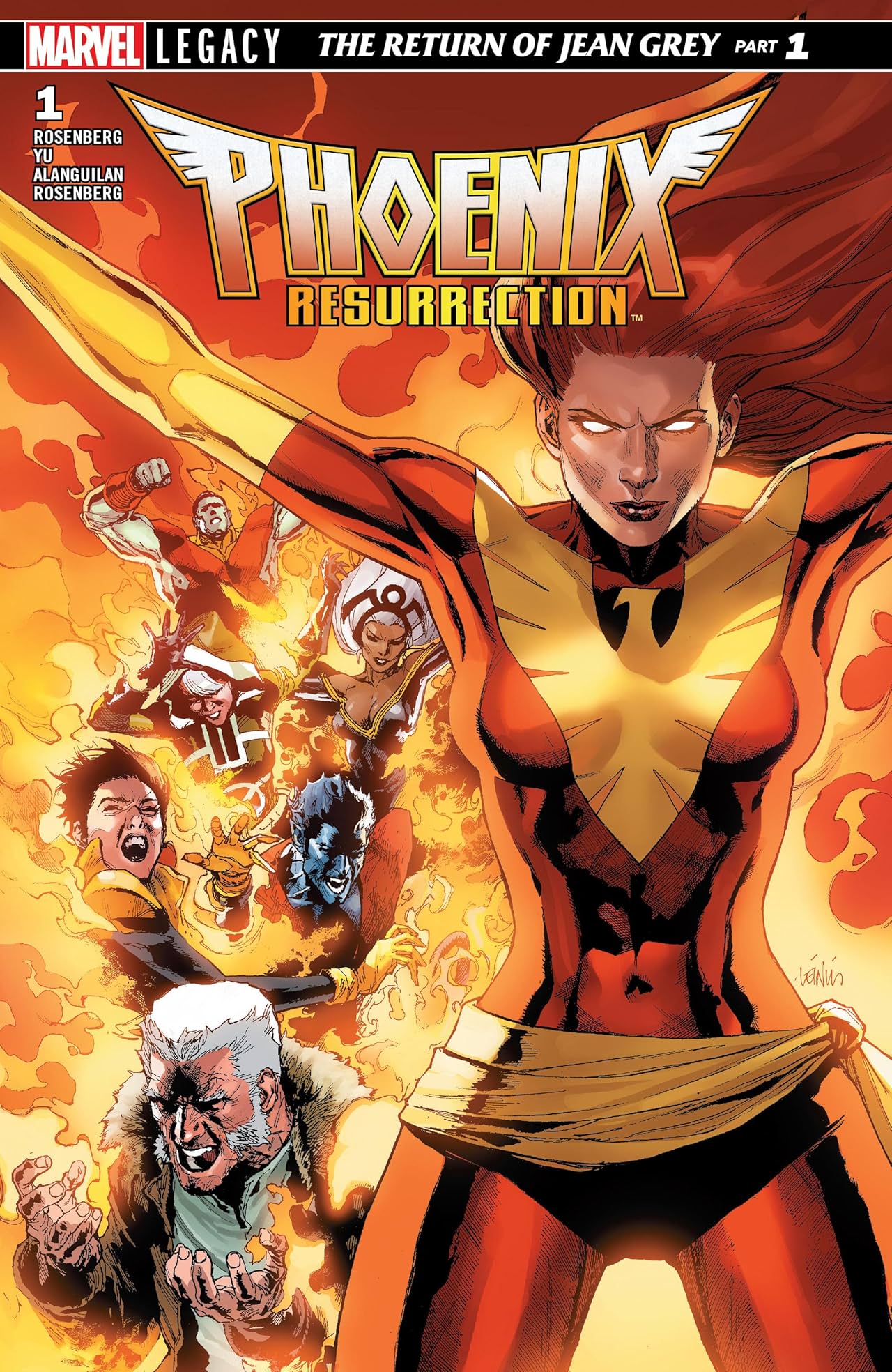
Reborn and Revitalized: Phoenix Resurrection: The Return Of Jean Grey #1

The following is my review of Phoenix Resurrection: The Return Of Jean Grey #1, which was posted on PopMatters.com.


A lot can change in the span of a year, especially in a world full of cosmic cubes, infinity gems, and deals with Mephisto. One year, Wolverine is an Avenger, Spider-Man is married, and the Fantastic Four are still relevant. The next, Captain America is a Hydra agent, Thor is Jane Foster, and Spider-Man is sleeping on his Aunt May's couch again. Things change very fast, very quickly in the Marvel universe, often within the span of a single year. Go back even farther, say 14 years ago, and it may as well be a different multiverse.

That's because 14 years is how long Jean Grey, the non-time displaced version of her, has been dead. In December of 2003, during the tail end of Grant Morrison's famous run on New X-men, she dies at the ends of Xorn, who is actually Magneto, but is also an imposter. At that time, land lines are still common, YouTube doesn't exist, and people are actually excited about the release of a new Fantastic Four movie.

So much changes within the real world that it's impossible to overstate how different things are in the comics. The fact that Bucky Barnes comes back to life before Jean Grey in that span says a lot about the impact of her death. However, her being Jean Grey, the same character who attracts cosmic forces with a propensity for resurrection, it was only a matter of when and not if she returned.

After 14 years, multiple crossover events, multiple relaunches, and a takeover by Disney, the wait is over. Jean Grey is finally set to return in Phoenix Resurrection: The Return Of Jean Grey #1. After so much time and so many complications along the way, Matthew Rosenberg has both a privileged and responsibility in crafting this narrative. He gets to bring Jean Grey back, but he faces a challenge in doing it in a way that doesn't feel predictable or contrived, which is no easy feat for a character associated with a cosmic force.

His approach is one that relies heavily on mystery elements while also bringing every major X-men team into the picture. From a situational standpoint, that makes sense. Jean Grey coming back, and likely bringing a cosmic force with her, is bound to require more than a few veteran X-men. However, Rosenberg doesn't throw everything into the story all at once. That may work for the Cables, Deadpools, and Wolverine knock-offs of the Marvel universe, but Jean's story requires a different kind of nuance.

A big part of Jean's appeal, both as a character and as a catalyst for a major story, is how her stories are built around significant emotional undertones. The original Phoenix Saga itself is an emotionally-driven story, one that has a major impact because it makes the losses and emotions feel genuine. Phoenix Resurrection: The Return Of Jean Grey #1 already sets Jean up for a similar impact. While the situation is very different compared to previous stories, but when a character has been dead for over a decade, that's understandable and somewhat necessary.


This is where the mystery elements of Phoenix Resurrection: The Return Of Jean Grey #1 really shine. In the same way it avoids putting the X-men at ground zero of another Phoenix-powered clash, it establishes a series of unknowns that puts Jean and the X-men in a volatile situation. It doesn't start off with a cosmic bird, but it doesn't take long to hint at one. Even with those unknown, it makes clear that the X-men's path is eventually going to find its way to Jean.

Like going up the first steep hill of a roller coaster, it's fairly obvious what Jean and the X-men are about to face. Anyone who knows anything about the stories surrounding Jean and the X-men can sense it, but the subtleties of the story still find a way to make it enticing. Rosenberg doesn't try to use old formulas that involve cocoons, time travel, or evil clones. His approach is different, even if the themes are similar. That big drop at the top of the hill is still coming and it promises to be every bit as thrilling and dramatic as other Jean Grey stories before it.

Beyond just setting the stage for the X-men's reunion with their beloved friend, Phoenix Resurrection: The Return Of Jean Grey #1 also takes the time to acknowledge classic elements of Jean's story. There are references to the original Phoenix Saga, End of Greys, and even some of the lesser-known aspects of Jean's history. There's a sense that both the past and the present matter, which is difficult to do when it's just so much easier to use time machines, clones, and Skrull agents.

In a sense, the outcome of the story is already established. Phoenix Resurrection: The Return Of Jean Grey #1 makes clear that this isn't going to be a tease like Phoenix Endsong. Jean Grey is, indeed, coming back. It's just a matter of how volatile, dramatic, and impactful that return will be. Any story involving Jean Grey is bound to be emotional to some extent and Rosenberg puts everything in place for those emotions to shine.

The final page, alone, effectively guarantees that hearts will be broken and spirits will be wounded. The presence of Jean's loved ones, of which she has many, also guarantees that the drama will be intense. The narrative sets all these important themes up without utilizing a single clone or cocoon, which counts as an accomplishment.

While these nuances work beautifully for anyone familiar with Jean Grey's history and the dramatic undertones that her stories inspire, there are times when her prolonged absence hinders some of the impact. When a character is dead for so long and the world changes so much, it's hard to fit them into the bigger picture. In a sense, Phoenix Resurrection: The Return Of Jean Grey #1 is starting behind the curve in terms of creating impact on the larger Marvel universe. After multiple civil wars, a Skrull invasion, and a take-over by Hydra, Jean's return almost feels out of place.

However, even though the Marvel universe has gotten used to functioning without her, Phoenix Resurrection: The Return Of Jean Grey #1 does plenty to generate excitement for her overdue return. Her being dead for so long may have limited her impact, but it does little to diminish her place in the X-men and the Marvel pantheon of heroes. She still is, even after 14 years, the heart of the X-men. The team just isn't the same without her. No amount of time travelers or alternate universe versions can change that.

Final Score: 8 out of 10

Thursday, May 18, 2017

A Familiar Youth Revival: Generation X #1

The following is my review of Generation X #1, which was posted on PopMatters.com.


Adolescence, in some respects, is a fitting metaphor for mutation. Bodies change, mentality changes, and strange new abilities develop that are downright scary for those experiencing them, as well as those around them. Anyone who goes to high school or spends any significant amount of time around teenagers understands this. In that respect, the themes in X-men are both relevant and personal for many. Some call it puberty. Some call it an omega-level hormone surge.

This also makes the stories about the younger, less experienced generation of mutants more salient to the themes of the X-men comics as a whole. These aren't characters who have received extensive Danger Room training. These aren't characters who have they proven themselves by surviving no less than a fifty Sentinel attacks either. They're still teenagers trying to find their place in the world while going through a traumatic change in their bodies and minds. It's hard enough just making it through high school. Adding real superpowers to the mix is like giving the Hulk a migraine.

Given the recent trends in extinction plots and mass sterilization, there haven't been many opportunities to explore the youthful side of the X-men. That finally changes with Generation X, a series where mutant teenagers can just be mutant teenagers without having to worry about poison clouds or the Scarlet Witch's mental health. Christina Strain and Amilcar Pinna bring the X-men's young guns back into the mix with a fresh foundation devoid of sterilization or extinction.

In Generation X #1, that foundation emerges through the perspective of familiar and not-so-familiar faces. The Xavier Institute is open once more. It's back to using its old title, no longer acting as a testament to Wolverine's creepy obsession with Jean Grey. It's not just a school anymore either. The Xavier Institute's mission is bolder and broader. After facing issues like cosmic forces, toxic gas clouds, and time travelers, it sort of has to be.

Teenagers have a hard enough time with school and hormones, but Generation X dares to add even higher stakes. The world after Inhumans vs. X-men is still taking shape in the sense that both teams are still finding their place in a new status quo. That's where Jubilee's familiar perspective helps give context. Beyond being a character closely associated with the classic 90s series, she brings her own story into the narrative.

It's a story that fell to the wayside during the conflict with the Inhumans. She's still a mutant vampire. She still has an adopted son named Shogo. She's still trying to navigate a world where her mentor, Logan, is dead. Her taking on a leadership role for a team of young, inexperienced mutants almost seems like overkill. However, Strain and Pinna make it easy to root for her. True to the spirit of the classic X-men cartoon from the 90s, she carries herself with an infectious spirit that sets the mood for the story and her supporting cast.


By contrast, a less familiar perspective offers more traditional adolescent angst. Nathanial Cavier, also known as Hindsight, is the other character that Strain and Pinna utilize to set the tone for Generation X. His is one that anyone who felt anxious on their first day of high school can relate to. He spends most of the story just in his surroundings, coming across the rest of the cast and learning about their quirks. It's like orientation with destructive mutant powers and nosy telepaths. From a teenage perspective, it's like boot camp and brain surgery all rolled into one.

Having both a familiar and unfamiliar character lead the narrative helps create a balanced perspective as the cast takes shape. While the main cast for the series includes Jubilee, Bling, Kid Omega, Nature Girl, Morph, Hindsight, and Eye-Boy, there are other major X-men characters that help tie Generation X into the larger narrative of the X-men comics. Kitty Pryde, being the new headmaster and leader, is the most notable. She's also the one who gives Jubilee her blessing to lead a new generation of students who are still learning how to fight Sentinels.

In terms of bringing the main cast together, Generation X #1 succeeds in that it navigates the X-men's unofficial bureaucracy. They don't get distinct uniforms or anything, but Strain and Pinna craft a narrative that establishes a new team with Jubilee acting as the catalyst. Beyond that success, though, the story doesn't check quite as many boxes.


Even as the team takes shape, the diverse and quirky class of young mutants don't get a chance to do much. While a new host of challenges and conflicts are set up towards the end, there's not really a major clash that helps bring the team together. In fact, the greatest source of action in the story involves Kid Omega throwing a temper tantrum over losing an expensive pair of shoes.

Granted, Kid Omega has thrown tantrums over far less and with far greater destructive power, but it doesn't exactly harden the cast of Generation X against other prospective threats. At the very least, though, it sets the tone for the kind of volatile dynamics they'll be dealing with. Being a team of superpowered teenagers, that should be the first and most important lesson of any mutant team.

Beyond Kid Omega's tantrum, only a handful of other characters get a chance to interact or participate. Other than Jubilee, Hindsight, and Kid Omega, the rest of the cast just puts themselves in a position to participate in Generation X. In that sense, Generation X #1 works as a successful orientation for an incoming freshman class. Between new and familiar faces, as well as the inherent volatility that comes with adolescence, Strain and Pinna set the stage for a new generation of X-men. Whether they survive the experience, or even wish they did, remains to be seen.

Final Score: 6 out of 10

Thursday, November 14, 2013

The Legacy of Uncanny X-men

The following is a special feature that I wrote for PopMatters.com to commemorate the 50th anniversary of X-men.


What does it mean to be hated and feared for being different? Minorities throughout history have had to ask this difficult question and confront the equally difficult answer. Every society in every era has had minorities of some kind. It can be based on class, race, ethnicity, religion, gender, or sexual orientation. But the common thread for every minority is hatred and fear from those that doesn’t understand them and at times doesn’t even attempt to. This common human experience that has spanned the ages is why the X-men have resonated with audiences after 50 years.

Before the X-men, there had been plenty of superheroes. However, superheroes at the time rarely reflected the struggles of humanity. Superheroes were meant to be embodiments of human ideals. They were defined by their ability to overcome these struggles with power and resolve that sets them apart from normal humans. This common theme has been reflected throughout history, long before the era of comic books and billion dollar blockbuster movies. The epic heroes of mythology, from Hercules to Gilgamesh, were personifications of human ideals. But heroes like the X-men focused on a different set of ideals while confronting the much harsher realities.

Stan Lee and Jack Kirby created the X-men in 1963 and billed them as “The Strangest Heroes of All.” On the surface, however, they weren’t all that strange. There was nothing very unique about the powers wielded by Cyclops, Marvel Girl, Iceman, Beast, and Angel. But one of the key features that set them apart was their youth. Like Spider-Man, they were teenagers. They weren’t mature adults dealing with a mature world. They were five confused teenagers who found out that they were very different. And because they were different, they would be doomed to a life of fear and persecution.

The X-men weren’t the first team of teenage superheroes, nor would they be the last. However, they were the first to tap into that universal experience of being a young, vulnerable minority. And this came at a time when minority relations in the United States and throughout the world were undergoing significant change. It’s no coincidence that the X-men resonated during a time when the Civil Rights movement was unfolding. The struggles of minorities were finally being confronted and today, they’re still being confronted. That’s a big reason why the X-men have endured for 50 years.

But it is more than just the minority themes that have made the X-men resonate. It’s easy to forget for many fans that it took a while for the X-men to become one of the most successful franchises in comic book history. The original run of Uncanny X-men by Stan Lee and Jack Kirby did not generate a great deal of interest and even faced cancellation at times. Then Giant Sized X-men #1 came along and a writer named Christ Claremont took the X-men into a bold new era that solidified their position in comic book lore.


And it wasn’t enough to just explore the struggles of minorities. The X-men were pioneers in creating strong, enduring characters that also happened to be minorities. Characters like Storm, Kitty Pryde, and Northstar became more than just heroes. They ushered in a wave of diversity that helped set the X-men apart from other superhero teams. They weren’t like the Justice League or the Avengers. The added diversity of the X-men created a team that did more than embody the struggles of minorities. It created a sense of unity between these different races, ethnicities, and backgrounds. And almost as much as their mutant powers, this unity was among the X-men’s greatest strength.

That unity was fueled by the dream of Professor Charles Xavier. From the very beginning, the X-men were motivated by his dream of peaceful coexistence between humans and mutants. To the average person, such a dream seems overly idealistic and unattainable. And no matter how powerful the X-men were as a team, it seemed they could never achieve this impossible dream. It seems almost unheroic in a sense. Superman achieves the impossible all the time and is beloved by the people despite having power that would otherwise garner fear and hatred. But the reason Charles Xavier’s dream resonates with the X-men and the readers isn’t because it’s impossible. It’s because pursuing peace and understanding is far more difficult than succumbing to hatred in fear.

This hatred and fear has manifested in many daunting threats throughout the history of the X-men. From killer Sentinels to Magneto’s Brotherhood of Evil Mutants, they embody this fear and hatred of a minority and the natural inclination to respond with violence. In many ways, this is what makes the villains the X-men face every bit as compelling. Unlike the Joker or Lex Luthor, it’s easy to understand the motivations of characters like Magneto. Bryan Singer, the director of the first two X-men movies, compared their differing ideology to that of Dr. Martin Luther King Jr. and Malcolm X. One seeks peace while the other seeks to exact vengeance for crimes committed against a minority. It’s easy to understand both sides and unlike traditional villains, it can’t be resolved by just throwing someone in jail or killing them.

Over the years, the message of the X-men has evolved. However, the underlying theme has remained the same. It could still be argued that mutants are an improper allegory for minorities. Unlike mutants, other minorities don’t cause mass destruction with telekinesis, optic blasts, or ice beams. And unlike other minorities, mutants don’t realize how different they are until adolescence. Puberty itself is already a dramatic enough transformation, but what mutants experience is far more chaotic. And that inability to predict or control these powers creates a legitimate concern. Anyone living in the Marvel universe would rightly share that concern. However, the X-men remind people in both the real and fictional world that no matter how chaotic or dangerous these changes may be, there are still human beings behind these changes.


As a child, my favorite time of day was the hour after school where I would come home and watch cartoons. And the two cartoons I watched the most were the Spider-Man and X-men animated series. And one episode of the X-men cartoon best embodied this message of focusing on the humanity rather than the superficial traits around them. In Season One, Episode 13, “The Final Decision,” Bolivar Trask and Senator Robert Kelly are preparing an army of Sentinels led by Mastermold to protect humanity from the mutant race. But at one point, Mastermold disobeys its creator when it tells them, “Mutants are human.” This machine, which is devoid of all fear and hatred, comes to an inescapable conclusion that humans cannot or will not confront. No matter how different a mutant is or how dangerous they may be, they are still human. And because they are human, they are part of the same world and part of the same struggle.

This moment best reflects the core message of the X-men and that message is more important today than it has ever been. Regardless of anyone’s race, gender, class, sexual orientation, or ability, they are all still human. They live, love, suffer, and die. They have human parents and human problems. The divisions that people impose on themselves or others are arbitrary because at the end of the day, we’re all still human. And we can accomplish much more together than we ever could on our own.

This is the message that the X-men embody. Charles Xavier’s dream is as relevant today is it was 50 years ago. They are more than just a team of superheroes. They do more than just save the world from dangerous super-villains. They carry out acts of heroism despite the knowledge that many still hate and fear them. They seek to live peacefully in a world where so many have rejected them. Without them, it would be too easy for mutants or minorities of any kind to become alienated and separate themselves from the world. But the X-men remind everybody that this world is big enough for everybody. It doesn’t take heroes to embrace those who are different as human. It only takes a dream and inspiration.

For 50 years, the X-men have told stories that have inspired generations of readers. And in the real world, the struggles of minorities will continue. So long as society remains imperfect and human beings remain flawed, there will be many struggles for those who are hated and feared because of their differences. That’s why the core message of the X-men will always be important. And as the world grows and faces challenges too big for any one group of people, it is all the more vital that humanity to come together in understanding rather than remain divided by fear and hatred.