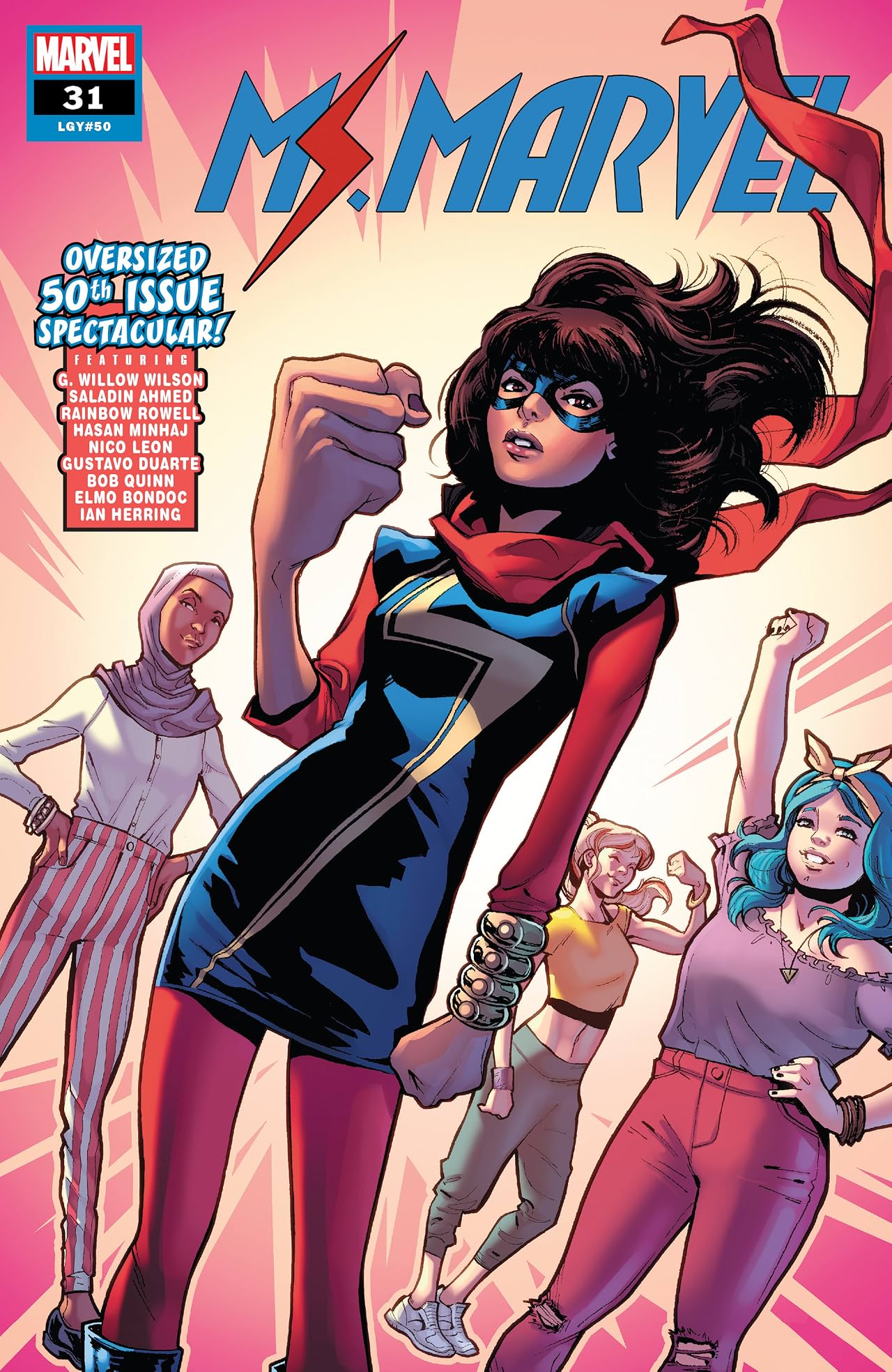
Every now and then, a popular character comes along who reveals more about the audience than the world they inhabit. Over the past five years, few characters have proved more revealing than Kamala Khan and it's not just because she takes a moniker once held by Carol Danvers. A big part of her appeal comes from her being a self-proclaimed superhero fan. Before she gets her powers, she carries herself the same way many fans in the real world do, writing fan fiction and participating in debates on message boards over who can lift Thor's hammer.
Another part of her appeal comes from her reflecting the growing diversity of the real world. She's the daughter of Pakistani immigrants, a practicing Muslim, and resides in a community where she is both a minority and an outsider. She deals with all that on top of being a teenager. Even before she gets her powers, Kamala deals with her share of struggles. Even with all the controversies surrounding diversity in media, Kamala stands out as someone people of all backgrounds can relate to and cheer for.
This sets a celebratory tone for Ms. Marvel #31, which marks the 50th overall issue of the series since its debut in 2015. While fairly recent in the context of the Marvel Universe, which spans five decades and multiple Secret Wars, Kamala Khan's impact still stands out more than most. To celebrate that achievement, G. Willow Wilson gathers a sizable cast of writers that include Saladin Ahmed and Rainbow Rowell to tell a story befitting of that growth. The fact it happens in the context of both a slumber party among teenage girls and a milestone issue only seems too fitting.
In the context of a milestone issue for a teenage superhero, a slumber party is a fitting setup. It gives Kamala a chance to be Kamala instead of Ms. Marvel for a while. She assembles several female friends who have become important supporting characters to her story over the course of 50 issues. Nakia, Mike, and Zoe may not be on the same level as a Bucky Barns, Harry Osborn, or Pepper Potts, but they bring something important to Kamala's persona and not just because they also happen to be teenage girls.

Every superhero, especially the ones still in high school, goes through their share of hardship and melodrama. Being a teenager is hard enough, but being a hero on top of that just compounds every issue. The weight of that stress gets to Kamala more than once over the course of 50 issues. The past several issues really add to the strain by including romantic issues with her long-time friend turned love interest, Bruno. That gives a non-superhero gathering with her female friends a sense of urgency.
Beyond simply enjoying some sense of normalcy, it gives Kamala a moment to reflect and even lament a little. Wilson conveys the impression that Kamala needs that cathartic moment and she needs the support of her friends. Many heroes either struggle to make that effort with their allies or just never get the opportunity. It has the potential to be therapeutic for Kamala. Unfortunately, complications emerge, but in a way that's both entertaining and reflective of why Ms. Marvel is such an endearing story.
Even in the comfort of her own home, surrounded by friends and her mother's cooking, Kamala ends up having to be Ms. Marvel for multiple conflicts over the course of the night. These conflicts range from dealing with an angry Inhuman to teaming up with Miles Morales to chasing two teleporting animals through an alien planet. It never gets too dire. Some of the plots are downright cartoonish, but they maintain an appropriate undertone.
Kamala makes clear from the beginning that she wants to have one night where she doesn't have to be a hero, but she keeps getting pulled back into it due to forces beyond her control. The responsibilities of being a hero don't leave her, no matter how much she tries to catch her breath. She still never hesitates to act heroic, either. She doesn't even whine about it, which already makes her more mature than Peter Parker ever was at her age.
While some of these heroic efforts frustrate her, they also result in moments that demonstrate why Ms. Marvel is a lovable character who's worth rooting for. She's not just the kind of hero who fights villains and occasionally crosses paths with giant teleporting dogs. She's someone who tries to overcome a struggle with tactics that don't just involve punching things with an oversized fist. They don't involve comedic wisecracks, either. Again, she several steps ahead of Peter Parker in that respect.
Like Superman and other heroes that embody an ideal, Kamala will actually sit down with someone and talk to them before they descend into villainy on par with the Red Skull. She'll try to connect with them on a personal level. She'll make a genuine effort to help them and it always comes off as sincere. Kamala isn't the kind of person who just tells people what they want to hear so they'll stop smashing things. She genuinely cares. At a time when every other superhero seems jaded after one too many battles with Hydra, it helps her stand out.
These moments do plenty to derail Kamala's efforts to have a simple slumber party with her friends, but they never complicate the overall story. It remains remarkably concise, creating an over-arching theme around the current state of Kamala's struggle. She's a hero and a teenage girl. Her efforts to balance that have a lot of room for improvement. Throughout the story, there's a sense that she doesn't improve as she could have, but she still does more than most superheroes and teenagers, for that matter.
It culminates in a moment where Kamala decides to throw another complication into her superhero/teenage life. She takes a chance that most teenage heroes avoid in hopes of regaining some semblance of balance. The results aren't too surprising, given the strength and competence of Kamala's cast, but they're still satisfying. There's a sense that this is another defining moment for a young hero.
Ms. Marvel #31 doesn't attempt to reinvent Kamala Khan or redefine her identity as a hero. She's still the same lovable character she was before she got her powers. She's still growing and has plenty of room evolve, but her accomplishments over the course of 50 issues are still astonishing on multiple levels. That kind of achievement is certainly worth celebrating. A single slumber party may not entirely do it justice, but it's a good start.
Final Score: 8 out of 10


