Showing posts with label Champions. Show all posts

Thursday, June 28, 2018

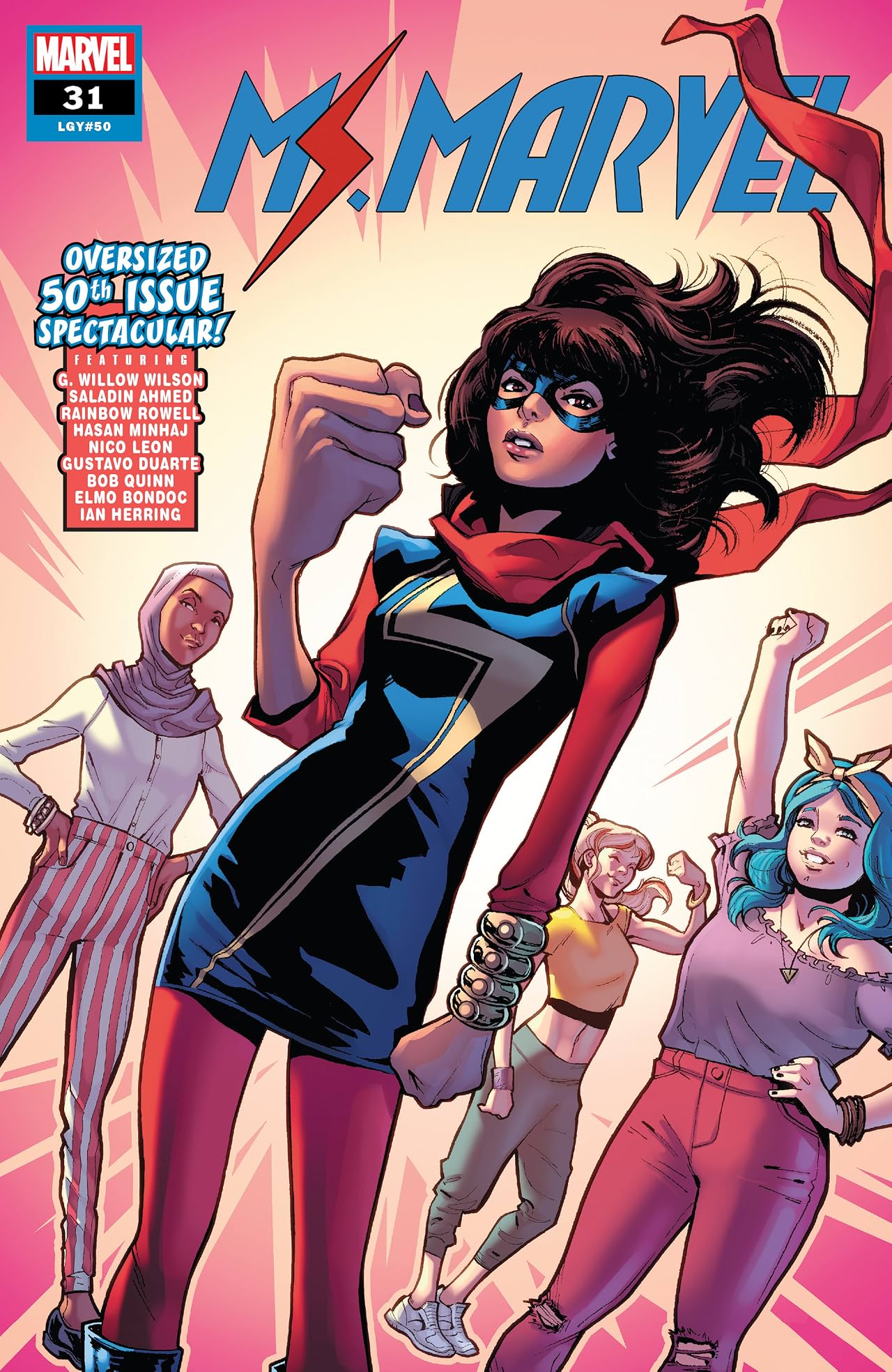
Milestones, Achievements, and Slumber Parties: Ms. Marvel #31

The following is my review of Ms. Marvel #31, which was posted on PopMatters.com.


Every now and then, a popular character comes along who reveals more about the audience than the world they inhabit. Over the past five years, few characters have proved more revealing than Kamala Khan and it's not just because she takes a moniker once held by Carol Danvers. A big part of her appeal comes from her being a self-proclaimed superhero fan. Before she gets her powers, she carries herself the same way many fans in the real world do, writing fan fiction and participating in debates on message boards over who can lift Thor's hammer.

Another part of her appeal comes from her reflecting the growing diversity of the real world. She's the daughter of Pakistani immigrants, a practicing Muslim, and resides in a community where she is both a minority and an outsider. She deals with all that on top of being a teenager. Even before she gets her powers, Kamala deals with her share of struggles. Even with all the controversies surrounding diversity in media, Kamala stands out as someone people of all backgrounds can relate to and cheer for.

This sets a celebratory tone for Ms. Marvel #31, which marks the 50th overall issue of the series since its debut in 2015. While fairly recent in the context of the Marvel Universe, which spans five decades and multiple Secret Wars, Kamala Khan's impact still stands out more than most. To celebrate that achievement, G. Willow Wilson gathers a sizable cast of writers that include Saladin Ahmed and Rainbow Rowell to tell a story befitting of that growth. The fact it happens in the context of both a slumber party among teenage girls and a milestone issue only seems too fitting.

In the context of a milestone issue for a teenage superhero, a slumber party is a fitting setup. It gives Kamala a chance to be Kamala instead of Ms. Marvel for a while. She assembles several female friends who have become important supporting characters to her story over the course of 50 issues. Nakia, Mike, and Zoe may not be on the same level as a Bucky Barns, Harry Osborn, or Pepper Potts, but they bring something important to Kamala's persona and not just because they also happen to be teenage girls.


Every superhero, especially the ones still in high school, goes through their share of hardship and melodrama. Being a teenager is hard enough, but being a hero on top of that just compounds every issue. The weight of that stress gets to Kamala more than once over the course of 50 issues. The past several issues really add to the strain by including romantic issues with her long-time friend turned love interest, Bruno. That gives a non-superhero gathering with her female friends a sense of urgency.

Beyond simply enjoying some sense of normalcy, it gives Kamala a moment to reflect and even lament a little. Wilson conveys the impression that Kamala needs that cathartic moment and she needs the support of her friends. Many heroes either struggle to make that effort with their allies or just never get the opportunity. It has the potential to be therapeutic for Kamala. Unfortunately, complications emerge, but in a way that's both entertaining and reflective of why Ms. Marvel is such an endearing story.

Even in the comfort of her own home, surrounded by friends and her mother's cooking, Kamala ends up having to be Ms. Marvel for multiple conflicts over the course of the night. These conflicts range from dealing with an angry Inhuman to teaming up with Miles Morales to chasing two teleporting animals through an alien planet. It never gets too dire. Some of the plots are downright cartoonish, but they maintain an appropriate undertone.

Kamala makes clear from the beginning that she wants to have one night where she doesn't have to be a hero, but she keeps getting pulled back into it due to forces beyond her control. The responsibilities of being a hero don't leave her, no matter how much she tries to catch her breath. She still never hesitates to act heroic, either. She doesn't even whine about it, which already makes her more mature than Peter Parker ever was at her age.

While some of these heroic efforts frustrate her, they also result in moments that demonstrate why Ms. Marvel is a lovable character who's worth rooting for. She's not just the kind of hero who fights villains and occasionally crosses paths with giant teleporting dogs. She's someone who tries to overcome a struggle with tactics that don't just involve punching things with an oversized fist. They don't involve comedic wisecracks, either. Again, she several steps ahead of Peter Parker in that respect.

Like Superman and other heroes that embody an ideal, Kamala will actually sit down with someone and talk to them before they descend into villainy on par with the Red Skull. She'll try to connect with them on a personal level. She'll make a genuine effort to help them and it always comes off as sincere. Kamala isn't the kind of person who just tells people what they want to hear so they'll stop smashing things. She genuinely cares. At a time when every other superhero seems jaded after one too many battles with Hydra, it helps her stand out.

These moments do plenty to derail Kamala's efforts to have a simple slumber party with her friends, but they never complicate the overall story. It remains remarkably concise, creating an over-arching theme around the current state of Kamala's struggle. She's a hero and a teenage girl. Her efforts to balance that have a lot of room for improvement. Throughout the story, there's a sense that she doesn't improve as she could have, but she still does more than most superheroes and teenagers, for that matter.

It culminates in a moment where Kamala decides to throw another complication into her superhero/teenage life. She takes a chance that most teenage heroes avoid in hopes of regaining some semblance of balance. The results aren't too surprising, given the strength and competence of Kamala's cast, but they're still satisfying. There's a sense that this is another defining moment for a young hero.

Ms. Marvel #31 doesn't attempt to reinvent Kamala Khan or redefine her identity as a hero. She's still the same lovable character she was before she got her powers. She's still growing and has plenty of room evolve, but her accomplishments over the course of 50 issues are still astonishing on multiple levels. That kind of achievement is certainly worth celebrating. A single slumber party may not entirely do it justice, but it's a good start.

Final Score: 8 out of 10

Thursday, January 18, 2018

Strength In Numbers With Youthful Idealism: Champions #16

The following is my review of Champions #16, which was posted on PopMatters.com.


Any gambler not named Remy Lebeau knows there's a time to fold, a time to double down, and a time to re-evaluate one's bluffing skills. So long as they're not down to their last penny, it's usually wise to know when the odds just aren't favorable anymore. Young superheroes, especially those still in their teenage years, face greater odds than most. At the same time, however, they have the benefit of not being too jaded to throw away their ideals the same way Peter Parker claims to give up being Spider-Man every now and then.

Youth may inspire the kind of wide-eyed optimism that makes most jaded adults roll their eyes. However, that's exactly what makes teams like Champions so endearing. They live in a world where adult superhero teams have waged a civil war on one another twice. They regularly see established heroes like Captain America fall prey to sinister influences like Hydra while villains like Magneto somehow manage to operate with some semblance of credibility. These are some pretty mixed messages, especially for impressionable youth.

Mark Waid and Hamberto Ramos don't shield the members of the Champions from those messages. In fact, confronting those heroic inconsistencies of the modern Marvel universe is a major theme of Champions, as well as a major appeal. This cast of younger, less jaded heroes want to cling to those superhero ideals that seemed to go out of style since the Frank Miller era. The world around them isn't making that easy. If anything, that world keeps upping its bets and skewing the odds.  

Champions #16 has these idealistic young heroes respond by having them go on a recruitment run. Considering the events of previous issues, which included crossovers and clashes with the far less idealistic adult Avengers, it comes off as strange, if not too soon. From the perspective of young, teenage heroes who cling ardently to their idealism, though, it makes perfect sense. Tragedy and drama may hit adults and teenagers equally hard, but teenagers will often find more creative ways of dealing with it. Those ways aren't always healthy or rational, but that's exactly what makes them endearing.

The tragedy and drama in this case has to do with the recent upheavals surrounding Viv Vision. Even by advanced android standards, she's in a strange position. After the Champions and Avengers' recent clash with the High Evolutionary, there are now two versions of her, one human and one android. It's an identity crisis that's unprecedented, even in a world full of clones and shape-shifting aliens. Neither version is able to make sense of the situation. Viv's teammates don't fare much better.

There's now a sense in Champions that the team is more vulnerable than it was when it began. It's not just because one of their members is a time traveler who could trigger a paradox with one bad decision. The events surrounding Viv painfully demonstrate that there are times when the team becomes fractured. There are moments when personal dramas hinder the team's ability to function. It's a problem adults face too, but adults are more inclined to stick with what works and preserve the past. Teenagers, not having much of a past to begin with, look to the future.


That's the underlying theme of the narrative that Waid crafts in Champions #16 and Ramos' colorful visuals make it feel optimistic, despite the dramatic circumstances. Despite the seriousness of these circumstances, Waid preserves the light-hearted, upbeat tone that gives Champions much of its appeal. Throughout the story, the fact that these are still teenagers never becomes lost. They see what happens to their friend. They don't make light of it, but they still move forward.

That part of the story works to the extent that it lays the foundation for more interactions between the Champions and other young heroes. While Viv heals, their recruiting run leads them to cross paths with the likes of Moon Girl, Red Locust, Iron Heart, and Patriot. Some of these characters have crossed paths with the Champions before. Like the Champions, though, they respond to the message because they too lack the jaded mentality that plagues older heroes.

It's a golden opportunity for young heroes to come together and remind older heroes that there's still room for the kind of wide-eyed idealism that most superheroes lose in their first year. Unfortunately, little of that opportunity is realized in Champions #16. The recruitment run does get off to a good start, but there's not much depth beyond just interacting with other young heroes. Some, like those with Moon Girl, fit the spirit and character of the story. Others, like the moments with Iron Heart, don't really contribute much.

That lack of depth is partially due to the unfolding side-plot surrounding Viv. In many respects, this plot carries with it much heavier drama. Viv's identity crisis and sense of self are in flux. There's a lot of internal conflict that plays out in between interactions with her android self and Vision. Some of it still echoes with the kind of teenage melodrama that is so distinct of Champions. Most of it, though, comes off as detached narration.

The intent is clear throughout the story, both with Viv Vision and the Champions' recruitment drive. It's the execution that leaves much to be desired. Both elements of the story have the right dynamics, but both end up feeling incomplete. It gives the impression that the story needed to be at least twice as longer for the necessary elements to play out. It makes Champions #16 feel somewhat truncated, even if the potential is still there.

The idealism and appeal of Champions never wanes, even in light of major upheavals, both personal and circumstantial. That remains one of the greatest strengths of the series. It's realizing the potential of the various plots and sub-plots that keep it from having the kind of impact that teenagers and adults alike can appreciate. Even if both are destined to end up jaded, the appeal of the idealism espoused by young heroes remains as strong as ever.

Final Score: 5 out of 10

Friday, April 21, 2017

Digital Dynamics With Analog Antics: Ms. Marvel #17

The following is my review of Ms. Marvel #17, which was posted on PopMatters.com.


A young hero trying to protect their identity is one of the oldest, most endearing narratives in superhero comics. From a literary standpoint, it's the equivalent of rescuing a princess from a dragon. Young heroes, especially, endure this narrative more than most. Typically, they have a lot more to lose and a lot more to manage. Fighting a dragon is hard enough. Fighting it with the knowledge that there's a history exam the next morning makes it even harder.

While Peter Parker has been the poster child for protecting a secret identity for nearly half-a-century, Kamala Khan is very much the new gold standard for young heroes with a lot to lose. Like Peter Parker before her, she struggles to manage being a superhero with being an ordinary teenager, who also happens to be a minority in a society that isn't that supportive of minorities. These struggles embody the heart and spirit of a young hero trying to juggle having a real life and a superhero life. Kamala, being a minority, has to juggle more than most.

Since Kamala's superhero life as Ms. Marvel began, G. Willow Wilson has gone out of her way to make her story feel relevant and modern. Ms. Marvel isn't the kind of hero who still takes Polaroid pictures or uses a phone booth to change into her costume. She's a teenager who knows how to use a smartphone, is active on social media, and plays online video games. That means the narrative surrounding a young hero protecting their identity needs an update too and that's exactly what Ms. Marvel #17 brings to the table.

Kamala's life as a superhero is on the line. A digital enemy named Doc.X is threatening to expose her double life to her friends, family, and everyone with an internet connection. In many respects, that's far more dangerous than J. Jonah Jameson publishing photos of Spider-Man without his mask. At least with a newspaper, there's less chance of a compromising photo becoming an internet meme.

The danger Kamala faces has been escalating for several issues now and Ms. Marvel #17 acts as a last ditch effort, of sorts. Since Doc.X isn't a killer robot she can punch, she has to get creative. In this case, being an overly-idealistic teenager who spends a lot of her free time playing video games actually works in her favor. Those looking for Captain America to punch a Nazi or Iron Man to blow something up may be disappointed, but those looking for something different will find it here.


Wilson continues the tradition of creating non-traditional threats for Ms. Marvel. These threats aren't always just criminals looking to swipe a wad of bills from an open cash register. They're a different kind of threat that younger generations understand more than those whose primary fear was being mugged in a dark alley. A threat like Doc.X is even scarier than that for most millennials because it threatens both their digital life and their real life. Insurance can cover a stolen car. It can't cover the cost of exposing someone's darkest secrets.

Ms. Marvel knows this because Doc.X already exposed the secrets of one of her friends, Zoey. It's not a trivial secret either. Zoey was a closeted lesbian until Doc.X comes along. Wilson shows just how devastating this kind of exposure can be. It acts as a dire warning of sorts to Kamala because if that's what it can do to someone just trying to hide their schoolyard crushes, then there's no telling what it can do for a superhero trying to maintain a closet identity.

The stakes are very personal. Some of Kamala's friends are already suffering because of it. The emotional undertones are there for Ms. Marvel. When it comes to actually fighting Doc.X though, the story does somewhat falter. That's not to say it falls flat, but it doesn't exactly hit with the same epic overtones that comes with fighting the Red Skull and an army of Nazi Hulks.

It helps that Ms. Marvel adapts her tactics, enlisting the help of fellow gamers and flipping the script on Doc.X. However, the way those tactics play out is lacking in substance and requires that a lot of other things happen off-panel. Some of those off-panel happenings are actually more intriguing than anything Ms. Marvel does, but it's never shown how that actually plays out. It's only shown that it works just enough to get Doc.X out in the open.

Eventually, there is a final boss battle of sorts. Kamala does get a chance to actually punch Doc.X. However, it's a battle that is over way too quickly and never gets a chance to generate much excitement. For a story that sets up such high emotional stakes, which is the cornerstone of Ms. Marvel's appeal, it makes for a rushed and unsatisfying conclusion. Beyond the emotional backdrops, Ms. Marvel #17 doesn't just deliver the kind of impact that gives the overall story a sense of weight.


There are still some wholly relevant themes, both for the traditional superhero narrative and a younger generation whose concerns are more likely to emphasize WiFi speeds over petty crime. Ms. Marvel still has that appeal. G. Willow Wilson makes Ms. Marvel a uniquely appealing hero by blending these narratives. For this particular story involving Doc.X, the blend just isn't there.

Ms. Marvel is still a character that plays into the sensibilities of the millenial crowd, much more so than traditional heroes like Spider-Man and Captain America. It does make her distinct. It makes her stories distinct as well. For those who just want to see the Hulk smash things, those stories aren't going to carry the same weight. They will, however, offer something different.

That's the most Ms. Marvel #17 accomplishes. It's different. It's relevant. It's a story with problems that can't be solved with punching, smashing, or one of Tony Stark's fancy gizmos. Even if that's all it accomplishes, it still ensures that Ms. Marvel will resonate with a new generation that fears more than just killer robots.

Final Score: 5 out of 10

Thursday, March 2, 2017

Aspirations For Inspiration: Champions #6

The following is my review of Champions #6, which was posted on PopMatters.com.


Seeking to inspire others to do good is one of the most fundamental acts of heroism that any superhero can do. Superman inspires by embodying an ideal for humanity to aspire towards. Captain America inspires by embodying the patriotic spirit that emboldens and strengthens an entire nation. Deadpool inspires by embodying the power of tacos and machine guns. These are among the most basic traits of a hero and after Civil War II, the entire Marvel universe needs a refresher course.

That's what Mark Waid and Hamberto Ramos are doing with Champions, getting back to basic and showing the rest of Marvel's superhero community that there are better ways to do good and they don't require superhero civil wars. Ms. Marvel, Nova, Spider-Man, Cyclops, Hulk, and Viv Vision are all uniquely qualified to teach this lesson in that they're young, idealistic, and haven't been revealed as Skrulls or Hydra agents yet. Beyond being diverse, coming from many different backgrounds and even different time periods, they are essentially a disaffected generation that sees what's happening with established heroes and think there's room for improvement.

It's a common spirit that pervades inexperienced youth. They see the flaws of the older generation and think they can do better, but the cast of Champions accomplish much more than any hippie protest or online petition. They embody a spirit often gets muted by politics, bureaucracy, or one too many retcons. This eclectic cast of young heroes aren't quite that jaded just yet, if only because they haven't dealt with SHIELD or Maria Hill enough.

The first several issues of Champions show this diverse cast coming together and establishing a standard for how they conduct themselves as heroes. That standard proves quite effective, leading to some meaningful victories and a kiss involving the Hulk. However, as often happens with many efforts involving ambitious youth, they encounter a few challenges and Champions #6 establishes the scope of those challenges, complete with relevant social commentary.

Now it's debatable how important these undertones are to the underlying themes of the series. There are any number of rants, tirades, and bemoaning that can be levied against a series that unambiguously reflects a particular political affiliation. Any comic that risks being vocal about any relevant issue risks agitating a world that would turn Superman into a Nazi if he says the wrong thing in the wrong context. That's the power of hashtags, phony outrage, and too much free time.

Regardless of how anyone may feel about social commentary in a comic book, Champions #6 shows that a certain level of social appeal can go a long way. Waid and Ramos make it a point to show how the Champions have influenced the world as a whole. They demonstrate how the Champions have created an entire social movement for all the right reasons with all the right impacts.


The Champions aren't just saving the day from monsters, human traffickers, and internet trolls. They're inspiring others to get up, embrace the Champion's principles, and do something. Given how much it takes to drag people away from their cell phones and jobs, that's quite an accomplishment.

Given how detached other superhero teams have become from the people at large, such an impact carries a great deal of weight for the greater Marvel universe. If a bunch of teenagers, one of which is a robot and another of which is a time traveler, can have this kind of positive impact, then those with helicarriers and space stations have no excuse.

Beyond that impact, though, the story in Champions #6 is just as much about the unintended backlash to this new superhero team as it is their success. The team is still coming together and Waid gives them a chance to show that they're still teenagers in addition to being heroes. Having them train through a game of paintball makes for a fun, light-hearted tone that even those who whine about the book's social commentary can appreciate.

From the perspective of the larger narrative, this kind of team activity doesn't raise the stakes or heighten the drama. However, it does flesh out the various personalities on the team and shows how they interact. Despite the diversity, they function as well as any group of teenagers armed with superpowers and paintball guns. They're not necessarily a dysfunctional family, but they're not the Fantastic Four either.

Those more light-hearted elements get balanced out when Waid explores the first major backlash that the Champions inspire. Such a backlash is always bound to happen and most teenagers have to learn the hard way that no good deed goes unpunished in the real world. In this case, the punishment hardly fits the deed because the Champions have no way of knowing how those with greater authority than a bunch of teenagers opt to react to their impact.

This is where the Freelancers come in. They are, in essence, the counter-punch to the movement that Champions have inspired. Much of Champions #6 involves introducing this team and establishing how they're going to undermine everything the Champions have accomplished. Like the Champions, they're a bunch of jaded teenagers with superpowers. Unlike the Champions, however, they care less about social commentary and more about their bank statement.

Waid reveals this in a somewhat elaborate manner. At first, the Freelancers give the impression that they're just a bit less ethical than the Champions. By the end, though, they make clear that they'll gladly rub elbows with big oil companies, Hydra agents, and tobacco lobbyists to improve their living standards. They care less about being a hero and more about making the most money with the least amount of effort and/or ethical constraints.


In the context of the major themes surrounding Champions, the Freelancers are the perfect adversaries. Waid makes this abundantly clear in Champions #6. However, this clarity doesn't come with any larger plot developments. A paintball game of super-powered teenagers is fun, but does little to expand their story. The only ones who get any real progression are the Freelancers and while their mission is fairly clear, their respective personalities are under-developed and overly forgettable.

Champions #6 still accomplishes and important feat for the greater narrative. It establishes what the Champions are up against and how their new movement of less civil wars and more heroics is creating an impact. Waid and Ramos to mix that impact with the fun of a paintball game. While the entertainment value of paintball is beyond dispute, the larger implications of the Champions' story remains underdeveloped and unresolved.

Final Score: 6 out of 10

Tuesday, January 24, 2017

Marvelous Monstruous Mayhem: Monsters Unleashed #1

The following is my review of Monsters Unleashed #1, which was posted on PopMatters.com.


It says something about the current state of superhero comics when the idea of superheroes not fighting each other seems like a novel concept. It may seem like such a long time ago, but there was once a time when superheroes primarily fought villains, criminals, and monstrous manifestations ripped right out of old Roger Corman movies.

It's getting harder and harder to remember those times. These days, it seems every major superhero team, in both Marvel and DC, can't go a year without fighting one another. Cullen Bunn and Steve McNiven clearly remember those simpler times and if Monsters Unleashed #1 is any indication, they remember them fondly. The challenge for them is to remind readers that there's still a place for stories that don't involve superheroes fighting each other.

It's one of those concepts that shouldn't be such a challenge, but between Civil War II and Batman vs. Superman: Dawn of Justice, it may as well be a chess match with Dr. Doom. Bunn and McNiven are getting back to basics, having Marvel's premier heroes take a break from clashing with each other to confront a new threat. The end result is an over-the-top, action-packed thrill ride that pits iconic heroes against giant monsters. It's as basic a formula it can possibly be without Deadpool making a poop joke, but it works.

The story doesn't try to be overly complex or nuanced. Monsters start falling from the sky in cities all over the world. Marvel's various superhero teams, including the Avengers, the X-men, the Inhumans, the Champions, and the Guardians of the Galaxy, all get to step up and fight some monsters. There's no elaborate exposition. There is some mystery, but Bunn never lets it get in the way of the spectacle of heroes fighting monsters.


He seems to understand the audience. He knows there's too much entertainment value in giant monsters. It should be as obvious as a temper tantrum by the Hulk, but it still feels refreshing in that it provides a simple, entertaining story that allows heroes to just be heroes. Nobody has to worry about characters acting strangely, timelines being tampered with, or reputations being ruined. It's just heroes fighting monsters. No fan need agonize over their favorite characters and in at a time where Captain America can be a Hydra agent, that counts for something.

That's not to say that the narrative in Monsters Unleashed #1 is overly simple. It does have some refinements that make it more engaging than a typical Power Rangers rerun, although not by much. While Bunn does make it a point to emphasize the battles between heroes and monsters, he does squeeze in some mystery behind the wanton destruction.

The details of that mystery, which involves a kid who enjoys drawing monsters more than fighting them, are somewhat ambiguous. It involves Elsa Bloodstone and another dime-a-dozen doomsday prophecies, of which there are plenty in the Marvel universe. It's not nearly as engaging as seeing the Hulk punch a giant eye monster, but does add a sense of purpose to the hero vs. monster clash. There is a larger story behind it, even if that story offers as few hints as necessary. At the very least, it ensures that Monsters Unleashed #1 never devolves into a glorified Michael Bay movie.

The main appeal of the story is still its simplicity. McNiven's art further supplements that appeal, providing rich and colorful battles that give a diverse cast of heroes plenty of opportunities to shine. These are the kinds of scenes that will never make it into a Marvel movie, if only because even Disney's pockets aren't bottomless. That helps add to the overall spectacle in Monsters Unleashed #1 and in a story that involves giant monsters, that's saying something.

There's something to be said about the overall context of this story. In real estate, it's all about location. That's the key to making a project work. In comics, the closest equivalent is timing. While some stories are indeed timeless, as those of Superman and Captain America have proven, work best when the time is just right in both the real world and the fanciful world of comics.

Stories like the Phoenix Saga and the first Civil War have an impact because they reflect a certain time and sentiment with the audience. Monsters Unleashed is one of those concepts that could be shrugged off in the extremes of the '90s, the macho grittiness of the '80s, or the psychedelic mindscape of the '60s. However, its presence in 2017, a time when audiences are burned out on superheroes fighting each other, feels both right and overdue.


Comics don't need to blow minds, break hearts, and shatter spirits every other week. They just need to entertain. Bunn and McNiven succeed in delivering just that with Monsters Unleashed #1. They go out of their way to avoid complicating the plot. They also avoid crafting a story that devolves into shameless disaster porn as well. There is story. There is mystery. Some details are lacking, but it still works. No major characters are getting reinvented, retconned, or replaced by clones. In this particular era of comics where everything gets shaken up every other year, that counts for something.

Monsters Unleashed #1 is not a story that's going to get anyone thinking too hard about real-world parallels or blurred lines between good and evil. It's not going to reinvent an entire genre either. This story caters to the kid in everybody who plays with action figures, imagines giant monsters attacking big cities, and comes up with over-the-top battles full of fiery explosions and crumbling buildings. Anyone's inner child, especially those that pestered their parents for action figures every Christmas, will be thrilled with this story.

Final Score: 7 out of 10