Showing posts with label Star Wars comics. Show all posts

Thursday, November 9, 2017

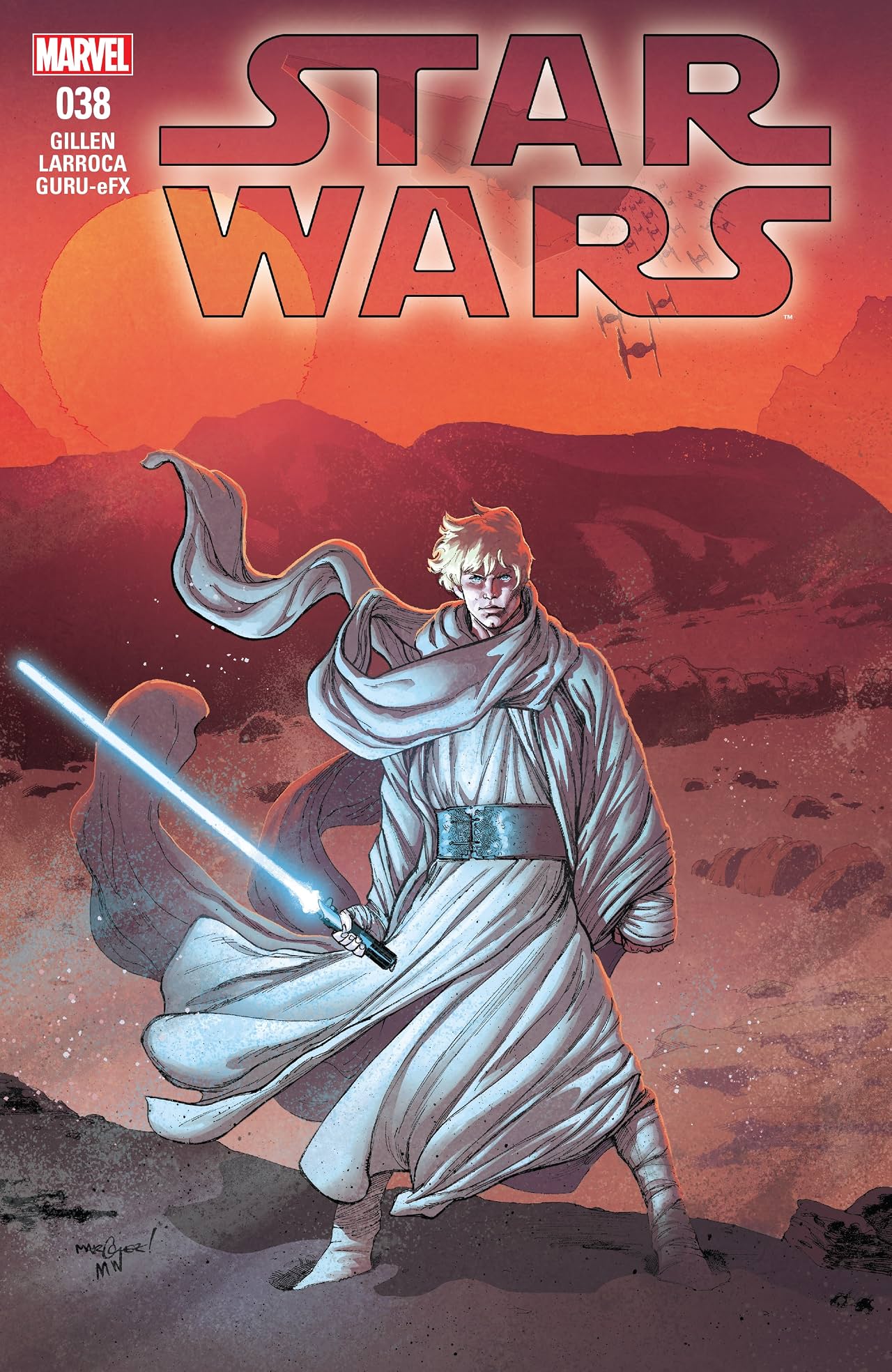
Empires, Ambitions, and Atrocities: Star Wars #38

The following is my review of Star Wars #38, which was posted on PopMatters.com.


When it comes to evil empires, Star Wars sets the bar high and the scope even higher. It's one thing to subjugate a kingdom, continent, or planet. It's quite another to conquer an entire galaxy. Even someone as bad as King Joffrey from Game of Thrones can only inflict so much evil. It says a lot about Darth Vader, Emperor Palpatine, and the Empire, as a whole, when that evil is so far-reaching that blowing up a planet is no more ambitious than Joffrey cutting out someone's tongue.

At times, however, the evil of the Empire becomes an afterthought in order to focus on the story surrounding Luke Skywalker, Han Solo, and Princess Leia. While the original trilogy and the much-maligned prequels do plenty to explore the cruel nature of the Empire, few outside the ruins of Alderan can appreciate how bad it can get for those living under its thumb. It's important for the overall Star Wars mythos to belabor why the Empire is evil in the first place. That makes seeing the Death Star blow up all the more satisfying.

This is where Kieron Gillen and Salvador Larroca come in. Having made various contributions to Marvel's line of Star Wars comics, they enter a mythos far, far away that is rarely short of drama, dread, and droids. At times, the narrative lacks direction, but Gillen and Larroca have already made numerous contributions through Darth Vader and Dr. Aphra. Star Wars #38 offers them a chance to contribute to the bigger picture and leave a more indelible mark on the galaxy. Having to do that without the aid of another Death Star is always a challenge.

The Force is on Gillen's side, though, because the Empire's atrocities don't stop at just blowing up planets. Like many other evil empires, it also goes out of its way to plunder the places they've destroyed. While there are many real-world parallels of evil empires that plunder, going back to the days of the pyramids, not even the most blood-thirsty ruler could do so on the scale of the Empire.

That's what brings Luke, Han, Chewy, and Princess Leia to Jedha, a planet that the Empire partially destroyed, but not out of mercy. The planet happens to be a rich source of kyber crystals, a mineral that the Empire values. That means they can only partially destroy it, but that still means blowing a huge chunk of the planet away. For the Empire, that's the most mercy it'll ever show. This says a lot about how they operate and why blowing up multiple incarnations of the Death Star is so cathartic.

There's nothing that big for the Rebels to destroy in Star Wars #38, but there's still a chance to frustrate the Empire. That's an opportunity that Luke and his friends rarely pass up. That also involves teaming up with the residents of Jedha, which include someone named Chulco Gi, a name that sounds custom-made for the world of Star Wars. His story and the way it ties into that of the Rebels further expands on the evil of the Empire because that can never be too belabored.


It isn't enough that the Empire partially destroyed Jedha, just to get its resources. It also isn't enough that it displaced a huge chunk of its population and did so with the kind of overkill that's akin to swatting a fly with a bazooka. The people of Jedha have their own culture, customs, and religion. Gi is a pious adherent of that religion. However, the Empire just blows that up like they do everything else that gets in their way. Whether it's a planet, a people, or a culture, they deal with it by destroying it. When they have weapons that blow up planets, it's just easier than diplomacy.

This sort of callous approach leaves plenty of scars, even on Gi. He, like Luke to some extent, believes that all the suffering and loss has a greater destiny in mind. So much of the Star Wars mythos is built around fulfilling or fighting destiny. The atrocities of the Empire just raise the stakes even more, which helps give greater weight to the struggle in Star Wars #38.

That struggle has more moving parts than simply sending Storm Troopers and Imperial Droids to shoot things. Gillen also takes some time to explore the logistics of plundering a planet with the Empire. It doesn't just involve shooting giant lasers or Darth Vader force choking subordinates. Gillen actually taps some characters from the pages of the Darth Vader comic, namely Shu-Torun. While the Empire makes few allies that aren't easy to blow up, they tend to be pragmatic when it comes to allegiances. That shows that the Empire isn't just evil. It's competent, which only makes it scarier.

That added fear factor helps make Star Wars #38 feel like part of a larger picture, one that is actually impacted by events in other Star Wars comics. That's something many of the Star Wars comics have been missing since the Vader Down event, which Gillen also helped right. The fact that a story with those connections unfolds without creating a new Death Star makes the story that much more impressive.

It's still a story that only gets so much time to develop. Star Wars #38 does plenty to establish that the situation on Jedha is dire and its people are suffering. It also establishes the personal stakes for characters like Gi, who have more reason than most to fight the Empire. What isn't clear, at least from the outset, is the larger plan the Rebels have. When there's no Death Star to blow up or plans to steal, their tactics tend to be more subtle. They also tend to be vague, which makes it hard to evoke the same drama that comes with watching Luke hit a thermal exhaust port only two meters wide with nothing but the Force.

There are a number of blanks that need to be filled. Star Wars #38 creates a story that feels part of a larger narrative, but that story isn't quite as concise in terms of purpose and intent. It still marks an overdue improvement, of sorts, with Marvel's Star Wars comics. It's not just trying to fill the sizable gaps between iconic movies. It's trying to build bigger worlds in a story where worlds regularly get blown up. It's still a challenge, as is often the case with Evil Empires, but the payoff is worth its weight in destroyed Death Stars.

Final Score: 7 out of 10

Thursday, July 13, 2017

Convergence of Character and Chaos: Dr. Aphra #9

The following is my review of Dr. Aphra #9, which was posted on PopMatters.com.


Every now and then, a character comes along that fills a need that nobody even knows is there until it's shoved in their face. It's like there are all these blind spots in the world of popular culture and nobody bothers to look until something jumps out and surprises everyone for the best possible reasons. For a mythos like Star Wars, where endless debates rage over whether Han Solo or Greedo shot first, it's hard to imagine there are any blind spots left. Then, Dr. Aphra and her two homicidal droids, Triple-0 and BT, come along and suddenly everyone has a reason to forget about Greedo.

Ever since her debut in Darth Vader #3, Dr. Aphra keeps finding ways to be the most compelling character in Marvel's evolving Star Wars universe. She's part Indiana Jones, part Han Solo, part Lara Croft, and part Catwoman. For such a new character, relative to a mythos that has been around since the disco era, that's an eclectic mixture, to say the least. However, Kieron Gillen finds a way to make Dr. Aphra work brilliantly. She's a character Star Wars didn't know it needed, but it's that much better because of her.

What helps set Dr. Aphra apart from Luke, Han, Leia, and Jar Jar Binks is her ability to play both sides. She's neither on the side of the Empire nor the Rebel Alliance. She's very much on her own side, as seen in arcs like Vader Down and Screaming Citadel. She has no qualms with changing her allegiance on a whim whenever it suits her. She's downright Machiavellian in her tactics, but somehow finds a way to be lovable.

These tactics are on full display within Dr. Aphra #9. While fans of all things noble and true in the galaxy may have a hard time rooting for her, it's hard to deny her ambitious. Dr. Aphra is the personification of Mos Eisley in that she surrounds herself with the worst thieves, thugs, and deviants in the galaxy. Unlike Luke Skywalker, she's exceedingly comfortable in their company. She gives the impression that she prefers it. For her, the scum of the galaxy are preferable to Jedi or Sith, if only because they have deeper pockets.

That's another aspect of her character that sets her apart. Like Han Solo, Dr. Aphra is more concerned with paying off old debts and turning a profit rather than bringing balance to the Force. Unlike Han Solo, though, she's not as inclined to step up and play the hero when the chips are down. If it means losing a payday or a valuable asset, she'll generally brush it off. She'll even screw over anyone who tries to nudge her in a certain direction. More than anything else, Dr. Aphra prefers to serve her own agenda and will employ any number of murder drones and renegade wookies to achieve it.

The agenda in Dr. Aphra #9 isn't that complex, but the setup is pretty elaborate. For the past several issues, she's been trying to make use of an ancient Jedi artifact that dates back to the Old Republic. Beyond satisfying her scientific curiosity as a renegade archeologist, she also understands that all things Jedi have greater value in a galaxy where most were wiped out. She may be a deviant, even by Sith standards, but she understands market forces.

Knowing the Empire is more prone to blow up planets rather than bargain, she invites some of the galaxy's most accomplished thieves and criminals to bid on it. She even turns it into a party of sorts, one in which puts Dr. Aphra's charisma and cunning on full display. She's not some inexperienced farm boy. She's not even some privileged princess. She's very much in a category all her own. In a galaxy full of Death Stars, smugglers, droids, and Lando Calrissians, she finds a way to stand out.

That's not to say Dr. Aphra is that efficient at pursuing her agenda. In fact, a good chunk of her nascent history is full of ambitious plans blowing up in her face, going all the way back to when Darth Vader first enlisted her help. It's one of the reasons she finds herself in so much debt in the first place. She's great at forging these elaborate schemes to acquire resources. She's just not that good at adapting those schemes when something goes horribly wrong, which tends to happen a lot in a galaxy where even Death Stars are prone to blowing up.

In a sense, she's very much the anti-Rey. Nobody can read Dr. Aphra #9 and claim she's a Mary Sue type character. Dr. Aphra is ambitious and skilled, but she doesn't exactly endear herself to everyone around her. It's also painfully obvious by the end that at least part of her plan is doomed to fail again. Unlike Han Solo and Princess Leia, she can't expect to rely on the love of friends and allies to save her.

Dr. Aphra isn't that kind of person. For her, friends and allies are expensive and potentially distracting. Granted, that puts her in many difficult positions, especially when her schemes go awry, but that's what provides so much of the entertainment value in Dr. Aphra #9 and her story as a whole. She is very much a deviant and a renegade, but she's no Jabba the Hut. She's not cruel or vindictive. She's not the kind of person who will Force choke anyone who disagrees with her. However, she is willing to leave dead bodies and broken droids in her wake.

Those who've grown fond of Dr. Aphra since her introduction in Darth Vader #3 will find plenty to enjoy in Dr. Aphra #9. In a sense, Dr. Aphra #9 highlights all of the traits that make her story compelling and her character endearing. Those who haven't been following her exploits since Screaming Citadel may be lost, though. Dr. Aprha's story is difficult to just pick up and follow. There are also times when the flaws in her schemes seem a bit too obvious. Those hoping for a big revelation on par with The Empire Strikes Back will be disappointed. That's not how Dr. Aphra works. It's the little revelations that make her story so engaging.

That doesn't prevent Dr. Aphra's character from being any less endearing. She's still someone that's easy to root for. At the same time, she's also someone that can slip up and not upset too many people. Gillen's development of her character continues to be strong and Andrea Broccardo's art adds visual appeal with that distinct Star Wars style. Dr. Aphra may not care much for the Force since it can't pay her debts, but she doesn't even need it to be a great character. Debts or not, the galaxy is inherently richer because of her presence.

Final Score: 8 out of 10

Monday, July 10, 2017

Sci-Fi Cast Away: Star Wars #33

The following is my review of Star Wars #33, which was posted on PopMatters.com.


In terms of a modern mythos, complete with philosophical, psychological, and cos-playing implications, Star Wars is the standard by which all others are measured. Few other sagas, from Marvel's ever-evolving continuity of reboots and retcons to multiple eras of Star Trek, even come close. It manages to be both incredibly expansive, yet remarkably concise. It's themes, emotions, and drama create a perfect blend that gives it a special place in popular culture.

Given the sheer breadth and scope of Star Wars, it's easy to forget that there are various parts that remain unexplored. Ever since Disney and Marvel began expanding some of those unexplored areas, new elements of that mythos are emerging. Given the iconic status that Star Wars has for generations of fans, it's a careful balancing act. There are only so many ways that Star Wars can be expanded without undermining the larger narrative. Even an iconic mythos cannot withstand the force of too many Jar Jars.

Jason Aaron manages that balancing act better than most, taking full advantage of the gap between A New Hope and The Empire Strikes Back to flesh out elements of Star Wars that never get a chance on a movie screen. One element that never gets much development is the relationship between Luke and Leia. Even without knowing their secret sibling connection, so much of the drama is centered around Leia's constant clashes with Han. It's easy to forget that her story is closely tied to Luke. Aaron, with the artistic talents of Salvador Larroca, use Star Wars #33 as an opportunity to explore that story.

The setup is simple, if not unremarkable by Star Wars standards. Luke and Leia get stranded on a planet that's mostly water and dotted with a few small islands. The circumstances are fairly generic in that it's not part of some larger story arc. It's just another case of a routine mission going horribly wrong, which seems to happen at least once a week for the Rebellion. There's nothing about it that rattles the continuity of the original trilogy. It's basically the sci-fi equivalent of Cast Away, but with more sea monsters and fewer volley balls.

This bland, but simple setup does serve an important purpose though. It puts Luke and Leia in a position where they have to work together and rely on each other to survive. They know they can survive an onslaught of storm troopers and escaping the Death Star. They've even shown they can survive working with Han Solo for more than two weeks and survive. However, their strength is often defined by their ability to be part of a team. They're rarely in a situation where they can only rely on each other.

It makes for some compelling moments, exploring some of the inner struggles within both characters. It's easy to forget between blowing up the Death Star and falling in love with a smuggler that Luke and Leia are still processing some major upheavals. A part of Luke still sees himself as a farm boy and a part of Leia still sees herself as a princess, complete with all the ceremonial formalities. What stands out in Star Wars #33 is just how uneasy they both feel with their previous roles.

There's a distinct sense that being a farm boy never sat well with Luke. Leia shows a similar sentiment. She reveals that at one point, she ran away to escape some of the formalities that come with being a princess. While this puts her at odds with most traditional Disney princesses, it reveals an important element to both characters.

On some levels, they sense that their situations in life aren't right. They sense that they're meant for something else. Aaron gives the impression that the Force is somehow letting them know that their story is tied with that of Darth Vader and the legacy of Anikan Skywalker. They don't know this, given the story's place in the existing Star Wars timeline. However, they do feel it. If it is a manifestation of the Force, then Yoda himself would be proud.

Beyond the personal exploration, there's also some reflection on recent events, relative to the outcome of A New Hope. Leia is still mourning the destruction of Alderan. The emotions don't get too heavy, though. Leia comes off as more hardened than most princesses. She's no Cinderella, but she's no Elsa either. If she ever broke into song, it wouldn't be very uplifting.

These moments of personal insight and inner character struggles are the highlight of Star Wars #33. While they succeed at providing greater insight into Luke and Leia, as characters, the rest of the narrative falls somewhat flat. Their struggles for survival on the island never create much strain. At most, they only ever seem inconvenienced by their situation. There's never any despair, anguish, or strain. Despite one of them being a princess and the other being a farm boy, their outlook on the situation is remarkably dispassionate.

There are some elements that keep the story from becoming too much like Cast Away. They eventually find out that the planet isn't as desolate as they think. That helps put them in a position to escape and even make a few new allies. However, that story is lacking in terms of detail and insight. It comes off as just a simple, convenient way to get Luke and Leia off the planet before readers can start making incest jokes.

There's nothing about the story in Star Wars #33 that feels out of place, out of character, or inconsistent with the larger mythos. Even if parts of the story lack details, it never comes off as flawed or incomplete. The primary strength of the narrative is the deeper exploration of Luke and Leia, as characters.

When all is said and done, they both come off as more complex characters, which can only give greater weight to the iconic narrative that is Star Wars. While that won't stop some fans from cracking incest jokes about Luke and Leia, Star Wars #33 will give them a greater appreciation for who they are as characters. Anyone hoping for more than that, though, is asking too much of the Force.

Final Score: 6 out of 10

Thursday, October 13, 2016

The Polish of the Dark Side: Darth Vader #25

The following is my review of Darth Vader #25, which was posted on PopMatters.com.


In the post-Breaking Bad era of popular culture, it's not enough for our villains to just be villainous anymore. The qualities of overtly evil characters like Lex Luthor, Thanos, and every James Bond villain that ever existed are no longer sufficient. These characters deserve layers, personalities, and development every bit as much as the heroes. It seems like an unwarranted consideration for villains, but it's one that helps craft more compelling narratives.

In this respect, Darth Vader is a character that was ahead of his time. When he shows up in Star Wars Episode IV: A New Hope, he carries himself as a traditional bad-to-the-bone villain who will blow up a planet full of sick puppies in order to crush the rebels. Then, by the end of Star Wars: Episode VI: Return of the Jedi and the maligned prequels that followed, he becomes a more complex villain who does what he does for reasons beyond just enjoying the cries of dead Alderaneans.

Kieron Gillen takes this complexity and hits the ground running full speed when his Darth Vader series begins. He succeeds where three prequels with production budgets north of $100 million failed, building new layers to Darth Vader as a character and as a villain. Gillen never tries to make Vader an anti-hero. He doesn't try to make him sympathetic either. He just uses this series Darth Vader a more compelling character. As such, Darth Vader #25 acts as the cherry on top of a very delicious cake.

Make no mistake. Darth Vader does nothing remotely heroic in this issue. Darth Vader #25 still occurs within the context of the period before Star Wars Episode V: The Empire Strikes Back. This means he's not remotely close to the character who sacrifices himself to save his son. He's still on that path, but he's going to dig himself into a deeper hole before he gets there.

For much of this series, Gillen has Darth Vader focus on a different goal, but one that's more relevant for this particular part of the Star Wars mythos. It begins with him acknowledging that he failed to prevent the destruction of the Death Star. He gives Emperor Palpatine a valid reason beyond mustache-curling evil to question the competence of his apprentice. It's Darth Vader's job to prove himself again and, true to his devious legacy, he goes the extra parsec.


It doesn't just involve Darth Vader confronting and defeating the Emperor's efforts to defeat Cylo, who the Emperor taps as a possible replacement. It also involves Vader himself going behind the back of his Emperor, carrying out missions that undermine his blind obedience to his master. This is what led him to cross paths with Dr. Aphra, Triple-0, and BT, three characters that frequently steal the show in this series. There's just something inherently charming about a murderous version of C-3P0.

These subversive efforts, alongside his efforts at redeeming himself, give extra weight to Darth Vader's villainous legacy. It's a legacy that doesn't really need to be refined, especially in wake of the ill-fated, Gungan-filled prequels. However, this extra layer of complexity acts like the extra layer of frosting on a cake. It makes everything sweeter in the end.

The battle against Cylo comes to an end, one that involves a creative yet destructive use of the Jedi mind trick. Darth Vader's dealings with Dr. Aphra come to a head as well. All the secrets and plotting create such a unique dynamic between Darth Vader and Dr. Aphra, making for a confrontation with the Emperor that carries a significant amount of dramatic weight.


Anyone hoping for Darth Vader to show mercy for Dr. Aphra after all she's done for him will be disappointed. Within the context of this stage of the Star Wars mythos, nobody should be surprised either. Darth Vader at this stage of development is willing to encase Han Solo in carbonite and cut his son's hand off. He's more than willing to toss a loyal ally like Dr. Aphra out of an airlock. If anything, that's as merciful as he can possibly be at this point.

While not surprising, this moment carries weight because Gillen puts time and effort into crafting a unique relationship between Darth Vader and Dr. Aphra. Those efforts help give the moments in Darth Vader #25 the dramatic weight it needs to have an impact. It feels much more meaningful than Darth Vader just force choking an entire legion of Gungans, but is every bit as satisfying.

There's no question that Darth Vader is still bad to the cybernetic bone at this stage in the Star Wars mythos. His battle against Cylo and his confrontation with Dr. Aphra prove that beyond any doubt. However, Gillen does offer some hints that the Darth Vader who goes onto sacrifice himself to save his son is starting to emerge.

These hints are somewhat subtle, sometimes excessively so. They show mostly through the crisp artwork of Salvador Larroca. It's not as overt in Darth Vader #25 as it is in previous issues of this series, but the subtext is there. It doesn't add much to the dramatic weight of the story, which does skew the balance more to the Dark Side. However, given the context of the story, it's still appropriate.

Kieron Gillen didn't set out to remake or redefine Darth Vader with this series. More than anything else, he works to reinforce the devious, villainous part of the character that the prequels tried too hard to circumvent. There's still an internal struggle here that will manifest in the final minutes of Star Wars Episode VI: Return of the Jedi, but the tone of the narrative in Darth Vader #25 is clear. This narrative embraces the dark side and the results are impressive. Most impressive.

Final Score: 9 out of 10

Friday, November 20, 2015

Dark Side Die Hard: Star Wars Vader Down #1

The following is my review of Star Wars: Vader Down #1, which was posted on PopMatters.com.


It's the common theme that made Die Hard a successful movie franchise. It spawned a generation of sequels, rip-offs, and parodies, all of which failed to rekindle Sylvester Stallone's career. But it's a theme that still has undeniable appeal, a lone warrior surrounded by enemies having to fight their way out. It's Captain America trapped behind enemy lines surrounded by Nazis. It's Superman trapped in a subterranean cave surrounded by kryptonite-powered cyborgs. It's a classic underdog story in the mold of the Karate Kid and the Mighty Ducks, albeit with more guns and explosions.

But what happens when this classic setup is turned inside out and upside-down? What if it's the Red Skull who's behind enemy lines, surrounded by Captain America's friends? What if it's Lex Luthor trapped in the Fortress of Solitude, surrounded by cyborg Supermen? Does the story still have the same appeal? It's like rooting for the axe murderer in a slasher movie. It tests an audiences sensibilities in uncomfortable ways not seen outside a Marilyn Manson concert. And those are the exact sensibilities that Star Wars Vader Down #1 appeals to.

This isn't the hero escaping the villain. It's the villain escaping the hero. It's not the rebels beating the Empire against overwhelming odds. It's the Empire outwitting the rebels, snatching away a tantalizing sliver of hope. Like cheering for Ivan Drago in a Rocky movie, it sounds like one of those things we shouldn't enjoy. But it's that inverted nature which plays out in Star Wars Vader Down #1 that makes the story uniquely appealing.

It's a story that unfolds seamlessly from recent events in the Star Wars and Darth Vader comic series. However, neither of these books are required reading. Even if Star Wars: A New Hope is the only Star Wars movie you ever saw, you won't be lost at any point. You might be confused by the presence of a homicidal version of C-3PO in Triple-0, but in a good way.


The story feels organic in that it follows Darth Vader's pursuit of Luke Skywalker. He knows he's the one who destroyed the Death Star. He also knows Luke is his son. So he's more than a little motivated to hunt him down and kill anyone or anything that gets in his way, as one would expect of a Sith Lord. However, like diving into a mosh pit at a Metallic concert unprepared, this level of motivation leads Darth Vader into a situation much deadlier than most mosh pits.

Our decidedly unheroic Sith Lord arrives at Vorgas Vas where his secret ally/fangirl, Aphra, says Luke Skywalker has been holding up. It's a setting that has the same feel as a graveyard in a slasher movie in that it's a fitting location for everything to go horribly wrong. There aren't any promiscuous teenagers, but there are plenty of X-wings and space battles. For Star Wars fans, this is every bit as appealing.

Mike Deodato's art really shines here. It's not the Battle of Hoth, but it has the same intense feel. It's dark, detailed, and destructive, the three D's of every successful space battle. Darth Vader, making every character in Top Gun look like rookie, makes the Rebels pay a high price for getting in his way. Even though he's completely surrounded and has no Imperial support, he doesn't retreat or evade the danger. He shoots at it. If he could do it with a smile, he probably could. But being Darth Vader, he doesn't need to.

It's Darth Vader's utter tenacity and his cold attitude that makes him worth rooting for. It's not like rooting for the New England Patriots after another cheating scandal. It's a testament to just how powerful and dangerous Darth Vader really is. Throw an entire squadron of X-wings at him? Go ahead. Send a whole battalion to the planet? Do it. None of that matters. Darth Vader will still make it feel like an unfair fight and he doesn't need a rousing speech from Mel Gibson to rise to the occasion.


While Darth Vader's imposing tenacity is the main driving force of the story, the rest of the classic Star Wars cast play critical roles as well. Fittingly enough, it's Luke who delivers the shot that downs Darth Vader while the rest of his squadron act as glorified target practice. Princess Leia and Han Solo get involved as well once word gets out that the Rebels have a chance to take down Darth Vader. With the destruction of Alderan still fresh in Leia's memory, it's a given that she's every bit as motivated as Vader. It once again shows that being excessively motivated runs deep in the Skywalker family.

At no point does the pace slow down. At no point does the danger stop escalating. Even after Darth Vader crashes on Vorgas Vas, he keeps fighting. The Rebels have X-wings, troops, and tanks. Darth Vader has only a light sabre. And yet it still feels as fair a fight as anyone can hope to have against Darth Vader. In many respects, that is the greatest accomplishment of Star Wars Vader Down #1. It doesn't just invert every major Die Hard theme. It puts Darth Vader in a position where he has to show just how menacing he is.

There are times when you'll feel inclined to root for the rebels. There are times when you'll feel inclined to root for Darth Vader. But it never feels conflicted or forced. This isn't a matter of rooting for Jason Vorhees or against a virgin teenage girl. This is just a different kind of epic Star Wars battle. It might not involve a Death Star, but it feels every bit as epic and won't be decided by some obscure design flaw.

Final Score: 10 out of 10

Monday, October 26, 2015

Covert Subversion: Darth Vader #11

The following is my review of Darth Vader #11, which was posted on PopMatters.com.


Most people learn about dramatic irony in high school English classes, albeit only by reading novels and plays that no teenager has willingly read since the 1830s. It's an important storytelling tool. It puts the reader in a position to understand the context of a story in a way that isn't possible for any of the characters, unless one of those characters happens to be Deadpool. By knowing what the characters can't know or having already seen the sequel, the story takes on a new meaning. It can either enhance the subsequent stories or make them more needlessly complicated than the plot of the last Matrix movie.

Kieron Gillen has been attempting to accomplish the former and avoid the latter in Marvel's Darth Vader series. And by nearly every measure, he has succeeded. In fact, he's succeeded in measures nobody has expected.

He doesn't expect the readers to rely the events of the Empire Strikes Back and Return of the Jedi, two movies that have been effectively spoiled since 1983. He actually attempts to build a comprehensive story about Darth Vader in wake of the Death Star's destruction. And he does it in a way that somehow makes Vader even more menacing. Even James Earl Jones' voice might not do justice to the persona he's crafted.

More than anything else, Kieron Gillen's work on Darth Vader has crafted a story that laid the seeds for the events in Return of the Jedi. He succeeds where Revenge of the Sith failed so spectacularly in that he's made Darth Vader more than the emperor's puppet. He's shown that unlike the character Hayden Christiansen played in the movies, Darth Vader is capable of following his own agenda. And he's been doing so with help from a cast of surprisingly compelling characters in Aphra, BT, and Triple-0. But in Darth Vader #11, this agenda begins to clash with that of the emperor. Something has to give and it can't give until Luke loses a hand and Han takes a carbonite bath.

This means the story has to unfold in a careful, tactful way. That's not easy to do in a story that involves Darth Vader, an army of Stormtroopers, and a less-than-ethical archaeologist like Aphra. But somehow, Gillen manages to navigate this fragile narrative with the skill of a brain surgeon. He's very careful to mix in details that will later show up in the Empire Strikes Back, but not to the point that it would trigger another Han/Greedo situation.

This kind of attention to detail is refreshing in an era where continuity gaffs and retcons happen every other Thursday. Gillen channels his inner Stanley Kubrick, making sure every major and minor detail is addressed. And he does this without creepy twins or Jack Nicholson. Even with all these details, he still finds a way to include battles involving Stormtroopers, blasters, and light sabres. With no gungans or pod racers in sight, classic Star Wars fans will find plenty to enjoy.


But it's the use of dramatic irony that makes this story more satisfying than just seeing Stormtroopers get shot. This is where Thanoth, Darth Vader's new nemesis/ally, shows more competence than the average Imperial officer. Throughout this series, Vader has been subverting the Emperor, pursuing his own private agenda with Aphra. Being Darth Vader, he's made it look as easy as outsmarting Homer Simpson at times. That's no longer the case with Thanoth.

He's not Boba Fett. He's not Jar Jar Binks either. Thanoth is a Star Wars anomaly of sorts in that he's actually a competent bureaucrat. He's not content to just check out at five o'clock and count down the days until he can collect a pension. He sensed there was something not right about Darth Vader's latest covert mission and he's been investigating it, much to Vader's chagrin. It creates one of those situations where you know both of them can succeed without one of them being screwed over.

This marks the first time in this series where Darth Vader has to covertly help Aphra. He's only partially successful. This makes for some powerful moments where Vader is genuinely torn between his private agenda and his loyalty to the Emperor. Were he not Darth Vader, he might get nervous like Lance Armstrong during a drug test.


But the fact remains he is Darth Vader. He is the menacing Sith Lord that's destined to chop off Luke's hand and kill the Emperor. And his ability to pull this off under the watchful eye of someone like Thanoth is most impressive, even by Darth Vader's standards. He's very careful and covert in his ability to manipulate the battle. So he's not just a menacing Sith Lord with a light sabre. He's a menacing Sith Lord that knows how to use deception and tact.

These aren't just traits that neither Hayden Christiansen nor James Earl Jones can hope to capture. These are traits that add a complexity to Darth Vader that really didn't show until Return of the Jedi. The fact that Darth Vader is willing to go to such lengths to deceive the Emperor makes it more believable that he will eventually turn on him. Sure, it still takes the near-murder of his son, but it helps it feel less forced.

Darth Vader #11 acts as a culmination of sorts where Darth Vader's agenda finally clashes with that of the Emperor. It's a clash that's not quite on the level as the Battle of Hoth or the Battle of Endor. No planets blow up and nobody gets a hand chopped off. But it has all the necessary details. It conveys a refined, concise narrative that fits perfectly into the existing Star Wars mythos. And most importantly, it does this without gungans or Trade Federations.

Final Score: 9 out of 10

Monday, September 14, 2015

Epilogues and Prologues: Journey To Star Wars The Force Awakens Shattered Empire #1

The following is my review of Journey To Star Wars The Force Awakens Shattered Empire #1, which was posted on PopMatters.com.


The phrase, “Every new beginning comes from some other beginning’s end,” isn’t just a lyric to the only hit song Semisonic ever released. It’s the cornerstone of Disney’s strategy for expanding Star Wars beyond its iconic mythos and disappointing prequels. Not content with the billions of dollars that the Star Wars brand generated over several decades through six movies, Disney is betting that continuing the saga will yield even more billions. Everyone from George Lucas’ accountant to Disney’s top executives believes it’s a pretty safe bet.

But unlike a lotto ticket, Disney has the ability to guide Star Wars into this new era. They have the resources of the House of Mouse and the House of Ideas in Marvel to forge this new saga. But to date, the most Disney has done is create a trailer. Granted, that trailer nearly broke the internet with an outburst of fanboy squeals not seen since Carrie Fisher first put on a chain mail bikini. Even so, there’s still the matter of actually building this new era for a new generation, hoping that a new legion of fans will step forth and fork over enough money to build a new Death Star.

This is the process that Journey To Star Wars: The Force Awakens Shattered Empire #1 attempts to begin. It doesn’t explore the history of the Star Wars universe. It doesn’t expand on the time gaps in between the first six movies, which have already yielded great comics and a couple of hit cartoon series. It’s going to boldly go where no one has gone before, if that’s not too inappropriate a term. It’s going to explore the future of Star Wars, picking up right where Return of the Jedi left off.

It’s a bold move and one that might scare some fans who still have nightmares about Jar Jar Binks. Those fears, however, are mostly unfounded. This story that unfolds from the closing scenes of Return of the Jedi contains nothing that will blow up message boards or crash the internet. There aren’t any Han-or-Greedo moments that will have Star Wars fans arguing for decades. That said, there aren’t many moments that will inspire the same feelings as Luke blowing up the first Death Star.

This story doesn’t actually follow Luke Skywalker or Princess Leia or almost any of the now-iconic characters that made George Lucas obscenely rich. It follows the story of Shara Bey. She’s not a Gungan. She’s not a princess. She’s not some random bounty hunter either. She’s just one of the many hotshot pilots who took part of the attack on the second Death Star. However, it’s established early on that she’s not a faceless extra in a Walking Dead rerun. Her story is actually woven into Return of the Jedi.

She’s the one who helped Lando make the final attack on the second Death Star with the Millennium Falcon. She’s also the one who helped Luke Skywalker escape in an Imperial shuttle without getting shot down. So right off the bat, she establishes herself as a pretty important character. And there’s nothing she does that fundamentally changes or undermines the events of Return of the Jedi. It doesn’t try to be like the last Terminator movie and fundamentally change the whole setup. Instead, it tries to expand it.

This expansion is what gives the story appeal. However, that appeal has limited scope. While we do see Shara playing an important role in this iconic battle in the Star Wars mythos, we don’t see her do much else that’s really noteworthy. That’s not to say she just sits around and dances with Ewoks either. She does make an effort to distinguish herself and she’s able to do it without a light sabre.


As the story unfolds, we learn a few things about Shara. In addition to being a capable pilot, she’s also married to a fellow Rebel named Tuck. And for the most part, their relationship is as passionate as any that involves surviving Imperial tyranny. It’s not nearly the spectacle of Han Solo and Princess Leia. In fact, by comparison it’s downright bland. In some respects, it’s refreshing. Star Wars doesn’t need another romantic struggle at this point, especially if someone ends up frozen in carbonite again.

Refreshing as it is, Shara and Tuck don’t do anything that’ll inspire cos-players at a Star Wars themed wedding. They just share a quiet moment to establish that this is one of those marriages where the passion is genuine and not something Jabba the Hutt imposed. It’s a moment that really doesn’t have much relevance other than putting them in a position to help their fellow Rebels with a follow-up mission on Endor.

It’s a mission that basically reveals that killing the Emperor and destroying his oversized battle station isn’t enough to destroy an Empire. There are still people in this world that think the Civil War never ended. So it makes sense that there would be plenty of Imperial holdouts. It makes for some nice action. It’s not nearly as epic as the battle against the Death Star, but then again few things are.

There’s nothing inherently flawed with the narrative. There aren’t any major plot holes. Shara Bey isn’t going to remind anybody of Jar Jar Binks either. The story, as a whole, is solid and concise. However, there’s nothing about this story that’s really memorable or jarring. There are no shocking revelations. There aren’t even any hints as to how this ties into Star Wars: The Force Unleashed. If it were a college essay, Journey To Star Wars: The Force Awakens Shattered Empire #1would get a passing grade and nothing else.

This comic still offers a great deal of potential. Shara comes off as likable and compelling. The potential for battles against lingering Imperial forces also offers plenty of intrigue, but it fails to generate the kind of excitement that’ll start trending on Twitter. However, it does have a level of refinement that makes it a worthy supplement to Return of the Jedi. Princess Leia’s bikini will still be the most memorable part of that story, but every little detail helps.

Final Score: 6 out of 10

Thursday, September 10, 2015

Scanned Thoughts: Journey To Star Wars: The Force Awakens Shattered Empire #1


This year is set to be the ultimate nirvana for Star Wars fans. This Christmas, at a time when we’re obsessing over sales and getting drunk off eggnog, it’s going to happen. A new Star Wars movie is going to be released. Not since the destruction of Alderan will so many voices collectively cry out at once. It’s a moment that fans and Disney accountants have been anticipating since Disney bought the Star Wars rights. It’s a new movie for a new era of the movie that redefined sci-fi, cinema, and incest overtones.

But before this most epic of holiday feasts can begin, Disney has tasked Marvel with wetting our appetites, as if Star Wars fans weren’t already gnawing on their arms like crack addicts in withdraw. To bridge the gap between Return of the Jedi and The Force Awakened, they’ve commissioned Marvel to craft Journey To Star Wars: The Force Awakens Shattered Empire #1. This series is supposed to set everything up so that those of us who fork over more money than others in our Star Wars fandom aren’t completely lost. It’s either meant to reward our loyalty or suck more money out of our wallets. I don’t care which is the case. If it’s awesome, my wallet can kiss my ass.

This journey to Star Wars: The Force Awakened begins at the end of the last journey in Return of the Jedi, which is entirely appropriate. We’ve all seen the epic saga, complete with implied incest. For those who haven’t seen it in a while, there’s a nice recap page that shows Luke’s showdown with Darth Vader and the battle against the second Death Star. However, the focus isn’t on Luke, Han, or Lando this time. Rather than tell us shit we already know, this story adds a new dimension to this familiar scene. Return of the Jedi is already a delicious cake. Why not add more frosting?


This new dimension has a name and a codename. Her name is Shara Bey and she’s Green Four of the Green Squadron, who were part of the epic space battle against the second Death Star. Lando and the Millennium Falcon are still there. But again, we already know how their story pans out. Shara’s the one who gets the focus. She’s among those who helps the Millennium Falcon make its epic run into the Death Star’s core. So in that context, she’s not fucking Jar Jar. She has a big fucking role in Star Wars right off the bat.

She’s still an unknown, but this is still a good way to establish her importance. She’s not a character who is just randomly thrown into the shit storm and expected not to stink. She actually has a role in a familiar scene. That’s a good way to tie her into the core fabric of the Star Wars universe. We still don’t know much about her or why we should give a shit about her, but we do know that she’s already contributed to the moments we know and love in a major way.


Once Lando and the Millennium Falcon start their run, Shara ends up contributing in another major way. Remember when Luke escaped the Death Star? Well, he was in an Imperial Shuttle and last I checked, those things are easy targets. So how the hell did he make it down to Endor without getting shot down? Well, the movie never revealed that, but we finally find out now over 30 years later. It was Shara who found out that Luke was on board. And she helped keep the other Rebels from blowing him out of the sky.

It’s one of those minor details from the movie that didn’t need to get expanded. Even if there were message boards in the mid-80s, I doubt Star Wars fans would’ve been wondering how Luke made it down to Endor without getting shot down. Then again, these are the same fans who bitch and moan about who shot first, Han or Greedo. So maybe I’m giving them too much credit. But at least for now, there’s no more reason to bitch. Shara Bey is the reason Luke made it down to Endor in one piece and for that, I think she’s earned the right to be awesome.


More familiar details follow. The events of the movie take over again and we see nothing that hasn’t been seen or parodied by Family Guy and Robot Chicken before. Lando completes his run with the Millennium Falcon, the second Death Star explodes, and the Rebels rejoice. Shara joins her fellow squad mates back at the base where everyone is either ready to celebrate or take a long, overdue nap. There are some solemn words about their fallen commanders, but everybody is more inclined to party their ass off. And why shouldn’t they? They just beat the Galactic Empire. Even an Amish republican would say they’ve earned it.

That’s exactly what Shara does. She joins her fellow rebels down on Endor where the fireworks are going off, the Ewoks are dancing, and George Lucas is counting his money. There are some familiar faces with C-3PO, Lando, Chewy, and Han Solo. But they don’t really say much beyond the post-victory dick-measuring. Even so, their presence alone helps give Shara’s story more weight. It shows it’s a story that’s intimately entwined with the events of Star Wars.

At the same time, however, I’m still not seeing much reason to give more fucks about her than the other characters we know and love. As nice as it is to revisit this scene, we don’t really see anything with Luke, Han, Leia, or anyone else. I get that this is Shara’s story, but it feels like these major characters that people probably care way more about are getting overlooked. We’re seeing Shara’s post-Return of the Jedi story, but why the fuck his hers more important?


That question doesn’t really get answered. It really can’t be answered because we still know jack shit about who Shara is. Well, we do get some additional details, some of which are more important than others. While the others are partying, she catches up with a few of her squad mates in an Ewok hut. That’s where she meets Tuck Dameron, who happens to be her husband. And no, there’s no implied incest with these two. They really are just a husband and wife who have spent a good chunk of their lives and their marriage beating the shit out of imperials. And I guess the couple that fights the Empire together stays together.

There are some nice romantic scenes with these two, establishing that this isn’t one of those marriages that happens in Las Vegas over a bet. It’s a real, actual marriage. It’s the kind the Kim Davis’ of the world don’t quite appreciate. They actually talk about what the future holds for them and whether it’s truly over. It’s sweet, but fairly bland. There’s nothing about this scene that hasn’t played out in a Twilight book, minus emo vampires.


Naturally, beating the Empire and celebrating their victory makes them very horny. So of course Shara and Tuck are going to enjoy a little victory nookie. Again, it’s pretty bland. There’s nothing in here that hasn’t been seen in every other PG-13 movie with Linda Hamilton in it. It just shows that Shara and Tuck are in a relationship where they enjoy doing the nasty in exotic locations like Endor. There are couples in this world that enjoy getting it on in dumpsters behind McDonald’s. Again, it’s downright tame. But it shows a nice bit of intimacy between the two.

However, they don’t even get to enjoy the post-victory afterglow before someone starts barking orders outside. This is officially beyond the credits of Return of the Jedi. The ghosts of Yoda, Obi Wan, and some asshole who looks like Hayden Christensen are gone. Now, we’re officially in uncharted territory with Star Wars. I want to be excited, but I can only do so much while following Shara’s story at this point. That or I took an extra valium and forgot. It’s entirely possible.


Once everyone gets dressed and hides the puke stains, they find out from Han Solo that destruction of a Galactic Empire isn’t exactly a clean and tidy process. They found out from Imperial transmissions that while most are fleeing with their dicks tucked between their legs, there are some holdouts. And some of them happen to be on Endor. They still think the Empire is equipped to fight back. I want to laugh at them, but there are still people in this country who don’t know that the Civil War has been over for over 150 years. So I can’t give Stormtroopers shit.

Having saved Luke Skywalker and banged her husband, Shara is in a good mood. So she volunteers to be the pilot that transports a strike team to this rebel holdout. Again, there’s not much here that’s really memorable. They have a chance to rub salt in the wound of a defeated Empire. Fuck yeah, they’re going to take it. But beyond that, we learn nothing more about Shara or anything about Luke, Leia, or Lando. It just seems like there are better shows in town.


That’s not to say it isn’t enjoyable. When Shara arrives with the strike team, we get a nice battle that we never saw in the movie. It’s the Rebels and Ewoks against a bunch of Imperial holdouts. It makes for some visually stunning scenes that feel like they might as well have been ripped from the movie. Shara doesn’t really do much other than provide air cover while Han leads the team below. And this is the only part of it that’s disappointing. Maybe I’m just more gay for Han Solo than I’m willing to admit, but I’d rather see him beating the shit out of Imperials than watch Shara casually observe the battle from a pilot’s seat. This is Star Wars, not fucking Top Gun.


While the battle has some nice visuals, it’s over very quickly. It’s not all that epic, nor should it be. The Rebels just destroyed another Death Star. Any subsequent battle isn’t going to be nearly as epic by default. Some things just can’t be properly followed up. Trevor Noah is going to find that out soon enough. But it’s a battle that does serve a purpose. Han and the strike team emerge from the base announcing that they found more intel and battle plans from the Imperials. Even though the Death Star has been destroyed, it’s not over yet. There are more battles to come, which is to be expected. Emperor Palpatine might have looked like an infected scrotum, but he wasn’t a fucking idiot. He ran his Empire like Steve Jobs on crystal meth. That means unlike a typical crack whore, it’s not going to go down easy.


This is one of those issues that doesn’t do anything wrong, but it doesn’t do anything exceedingly awesome either. If the point of this issue was to expand on the events of Return of the Jedi, it succeeded. And if the point was to introduce an intriguing new character in Shara Bey, it succeeded at least in part. But like a stoner who fixes a broken window with duct tape, it doesn’t do anything beyond that. Don’t get me wrong. I want to like Shara Bey. There’s nothing about here that I don’t like. I just don’t understand why I should give what few fucks I have to give when Han Solo, Princess Leia, and Luke Skywalker are present. Greg Rucka made a conscious effort to establish Shara Bey and post-Empire galaxy. I won’t say he failed, but I will say my panties are very dry right now.

There’s nothing about Journey To Star Wars: The Force Awakens Shattered Empire #1 that tempers my excitement for the upcoming movie. There’s nothing that makes me want to beat up Dr. Who and steal his Tardis in order to see it either. It certainly has the potential to be awesome. It already took the first step in setting up the conflicts of the post-Empire Galaxy. It just needed to take a few more for me to spare some extra fucks. I give Journey To Star Wars: The Force Awakens Shattered Empire #1 a 6 out of 10. It’s concise, clean, and coherent. I don’t have to sober up to enjoy it. But it still a ways from being awesome in a way befitting of the Force. Nuff said!

Monday, March 9, 2015

Royalty and Rebels: Princess Leia #1

The following is my review of Princess Leia #1, which was posted on PopMatters.com.


Not so long ago, Disney made a comfortable living portraying a wholly unrealistic depiction of princesses. They made it out to be a world of ponies, servants, and elegant dresses. They often left out other details like having to marry cousins, raising inbred children with rare diseases, and being tabloid fodder every hour of every day. But even with those nasty details, the ponies would still be a major selling point. However, there’s another unrealistic depiction that tends to be a lot more appealing.

Princess Leia is the antithesis to many of the princesses that made Disney famous. She doesn’t wear elegant dresses. She doesn’t ride horses and sip tea. And her favorite fashion accessory is a blaster. At the beginning of the Star Wars trilogy, she was a damsel. However, she was a damsel that wasn’t afraid to fight back and have an attitude. By the end, she was on the front lines with Han Solo fighting the Empire. She even found time to look sexy in a chain bikini along the way. How many other princesses can boast that?

It’s every bit as unrealistic, a princess who will fight an evil empire and still look good in a bikini. But that doesn’t make it any less appealing. Princess Leia’s journey from damsel to warrior is just part of what gives the Star Wars mythos its appeal. But a good chunk of that journey is still undocumented. That’s the story that Princess Leia #1 attempts to explore and the results reveal that this journey had its share of potholes.

It’s easy to forget that Princess Leia is now the royal figurehead of a planet that just got blown up by the Death Star. Her entire world and the entire culture of Alderan was just wiped out with the same callousness that most exercise when closing an annoying pop-up ad. She never had a chance to deal with that in A New Hope, nor did she have a chance to confront the implications. It’s this event that starts Leia’s new journey, but it also shows she’s somewhat ill-prepared.

In addition to giving metals to Han and Luke for their efforts against the Death Star, she attempts to unite the rebels in their mourning for Alderan. However, she’s no Winston Churchill with her speeches. She doesn’t exactly bring her fellow rebels to tears like tweens attending a One Direction concert and that’s somewhat telling. It gives a distinct impression that Leia is not the kind of princess who is fit for these ceremonial roles. She’s not going to inspire the masses at rallies. She’s not going to worry them either by showing up in the tabloids with her getting drunk at a night club. In many ways, she’s not sure what kind of princess she’ll be and she’s exactly presented with many options.

It’s a situation that many other Disney princesses can relate to. She wants to be more than a royal version of Vanna White, but the Rebel generals don’t like the idea of her poking the Empire more than she already has. To be fair, they give a fairly reasonable explanation and that never would’ve flown in Downton Abby.


Being the princess of a planet the Empire went out of its way to destroy, she has a big price on her head. She could basically turn anyone with crippling gambling debt into a certified bounty hunter if she stumbles into the wrong area. Keeping her alive is good for the rebellion, especially at a time when they’re on a winning streak. She’s like a star running back on a football team that wants to take up rock climbing. It puts her in unnecessary danger when they need her to keep the streak going.

Reasonable or not, Princess Leia still makes that fateful decision to be than just a princess. But it isn’t a decision that she makes just because handing out metals is boring. She actually meets someone who openly criticizes her for her lackluster speech for Alderan. This character, Evaan, isn’t all that memorable. She’s basically Leia if she were a rebel pilot rather than a princess, but she essentially tells Leia what she needs to hear to make her decision.

By going against the leaders of the Rebel Alliance, she starts that journey that will eventually take her to tundra of Hoth and the forests of Endor. It’s an important step for her character, but it’s a step that lacks significant drama. There isn’t much emotion that goes into her decision. There’s a sense that she already wanted this. She just needed to find someone who would give her the right nudge. It slows the pace of the story at times, but it still focuses on the right elements. Princess Leia is going to help the Rebel Alliance and she’s going to do it her way. Sure, she might end up in a trash compactor at times, but it still establishes her as the kind of Princess who is more comfortable with a blaster than an evening gown.

The themes in Princess Leia #1 fit nicely into the overall mythos of Star Wars in that it explores Leia’s role in wake of the loss of Alderan. It’s a critical time where she’s in a position to make plenty of fateful decisions. The effects of these decisions eventually play out in The Empire Strikes Back and Return of the Jedi, but they now have a greater context in terms of the journey that got her to these fateful moments. That journey is still unfolding and at a somewhat sluggish pace. But the fruits of that journey have been known since the mid-80s. Knowing the context of that journey just helps make those fruits taste even sweeter.

Final Score: 7 out of 10

Wednesday, March 4, 2015

Scanned Thoughts: Princess Leia #1


I used to think that only women saw the appeal of princesses. I admit, it’s a sweet gig. They get to live in a big ass castle, spend a fuckton of money they never worked a day of their life to earn, and have an army of servants that will do anything short of gouging their own eyes out for shits and giggles. But then I discovered the internet and Rule 34. I think it’s safe to say that men have a sweet spot for princesses in addition to some pretty fucked up tastes in porn. Men are just as capable of being allured by a rich, powerful woman and will channel their inner Anna Nichole Smith to get it. In that sense, Princess Leia is the ultimate princess for man-child-whores.

She’s got everything most princesses only wish they had. She’s sexy, tough, charismatic, and she doesn’t need to throw money at people to get them to listen to her. And instead of spending her money on Gucci purses and manicures, she spends her money refining her skills with a blaster. That and she looks great in a metal bikini. Can’t take that away from her. And now that Star Wars is owned by Disney, the mack daddy of fantasy princesses, it’s only natural that they would give Princess Leia her own series. And Princess Leia #1 makes a strong case that she fucking deserves it.

First, she shows that she knows how to be a princess in the classical sense. She can look all pretty and royal during a ceremony. And as it just so happens, she gets to do just that at the iconic ceremony where she awards Luke, Han, and Chewy with metals for their efforts to destroy the Death Star. It’s a nice touch because it helps pick things up directly where A New Hope left off, giving a sense of continuity that the Marvel movies have gotten us addicted to. She also gives a nice, but half-hearted speech about the destruction of Alderan. It’s not exactly a speech in the spirit of Winston Churchill, but it is a fitting job for a princess in terms of being an inspirational figure. In terms of being a princess, that’s something that will surely satisfy the Disney overlords.


Her lackluster speech doesn’t go unnoticed by the other rebels. They have a right to be a little concerned. She’s still the fucking princess now. Like it or not, she’s a figurehead. She’s supposed to inspire a rebellion that’s going against an Empire that has the resources to build giant planet-killing space stations. Some say she just needs time to mourn for the loss of her home world and that’s fair. But when they’re up against enemies like Darth Vader, whose idea of mourning probably involves Force choking a gungan, mourning is kind of a luxury.

She still takes the time to meet with Han, Chewy, and Luke. It makes for some nice moments that perfectly capture they chemistry they established over the course of A New Hope. And because this happens before numerous revelations, some might get a bit of an incest vibe from Luke and Leia. But that shit is best left to perverse minds that ensure Rule 34 has no exceptions. What makes this moment meaningful is that Luke points out how Leia tends to avoid leaning on others for support. That’s kind of how they ended up in a trash compactor on the Death Star. And if they want to end up in less trash compactors, then that might be something she should think about.


This leads to some more royal paper-pushing that’s barely as compelling as it sounds. Leia meets up with Admiral “It’s a Trap!” Ackbar in hopes of meeting with General Dodonna. Despite looking like a prop in a fish tank, he’s a real hardass. He just barely touches on the loss of Alderan, giving Leia the same attention as Homer Simpson gives his kids during a football game. It feels unnecessary and tedious, but it helps establish the kind of environment Leia has to work in. I just think there are much easier ways of showing how royal politics sucks.


She eventually does get to meet General Dodonna, who isn’t much more charismatic than Ackbar. He just looks like a bad cross between an Amish guy and Jor-El from Superman. He’s not as much a hardass, but he offers more proof that rebel politics still suck. Leia makes it clear that she wants to serve the rebellion as more than just a pretty figurehead who gives out metals. Dodonna takes it about as seriously as my high school guidance counselor when I told him I wanted to fly rockets and bang hot alien women. But unlike my guidance counselor, Dodonna offers a more valid reason aside from my rocket science skills being on par with my last algebra test.

Dodonna points out that because of her status, the Empire has a price on her head that would turn any drunk with an excessive bar tab into a bounty hunter. Like it or not, she’s still the face of the rebellion. It wouldn’t be good for anyone if that face ended up getting served on a platter with a side of Wookie’s leg in front of the Emperor. He even says that the Empire is hunting down surviving Alderanians to look for her. So if she has any plans to head out into the galaxy and piss off the Empire, she can forget it. This still isn’t the typical excuse that old men in Disney movies use to keep princesses in line, but it serves the same purpose.


Even if Dodonna’s reason is valid, Princess Leia doesn’t care for it. So she starts snooping around some of the other rebels, listening in on what they think of her as a figurehead. She probably heard more than a few remarks about how she looked sexier with her Cinnabon hair, but she eventually does come across something more valid.

One female rebel pilot, Evaan, was especially vocal about her lackluster speech. She quickly bites her tongue and clenches her asshole when Leia approaches, but she doesn’t ask for her head. She asks for an honest assessment and she fucking gets it. Evaan reveals that she was among the lucky Alderans who wasn’t there when the Death Star paid them a visit. She even reveals that she was mentored by Leia’s (adopted) mother. So she has an emotional stake in losing her planet as well and she get pissed when the so-called princess doesn’t react as strongly as she should.

She still shows some loyalty to Leia, but she’s not exactly lining up to kiss her royal boots. She wants what Leia wants. She wants to save what’s left of Alderan, but she’s not going to do that by just fucking mourning. Evaan’s point is entirely valid and Leia probably agrees with it. That said, I’m still not sure what to make of Evaan. She’s a pretty blonde rebel pilot, but not in the Emma Frost sort of way. She’s basically a copy of what Princess Leia already feels. She has some history, but not enough to make her interesting just yet.


But this story isn’t about Evaan or her opinion on ineffectual princesses. This is about Leia going from a princess who hands out shiny metals and kisses smugglers to a badass rebel fighter. She finally takes a big step when she leaves General Dodonna an elaborate message essentially telling him she understands his advice, but she thinks it’s full of shit. So in the form of another holographic message from R2, she doesn’t ask for help. She just tells him that she’s going to be a stubborn, hardass princess who actually fights for her people. She basically says she’s going to be the ruler that some people wish President Obama could be. Except Leia doesn’t have to deal with Congress so she’s got a leg up.

She ends up getting help from Evaan. While General Dodonna is shitting himself and/or jerking off to the idea of a princess being a badass rebel, they jump an X-wing and fly off Yavin. It’s a critical step and one that’s pretty momentous in the context of the Star Wars mythos. This is Leia going from the woman who needed rescuing to the woman who rescues others. It’s a big part of what made her even sexier in that metal bikini during Return of the Jedi and now that process has begun. Star Wars fans of all kinds should appreciate this moment.


The rest of the rebels aren’t quite as enthusiastic about it. General Dodonna sends a couple of other X-wings after her to reel her in. He even includes Luke and Wedge. That adds a little extra tension because if they were just random rebels, Princess Leia could just tell them to go fuck off. But these are two pilots whose last mission involved blowing up the Death Star. She can’t exactly challenge them to a space drag race or something, especially when Luke went through the trouble of rescuing her. I’m sure he doesn’t want to get stuck in a trash compactor with her again.


While the tension is nice, it’s not all that dramatic. There’s no heartfelt plea or anything. But there is a nice space dog-fight. There are no shots fired or anything so it’s not as flashy as the Death Star battle, but it isn’t intended to be. It’s pretty much the only major action in the story thus far, but it serves a purpose. I guess in a poetic sense, it can symbolize Leia running from her old duties as Princess to embrace her new duties as a rebel. I never cared much for poetry so I’ll just say it’s a glorified chase scene.

It takes a little tact and deception, but Leia does eventually manage to get the better of Luke and Wedge. Evaan is able to make the jump into hyperspace and they get away. So Luke and Wedge fail in their mission to retrieve her, but Luke isn’t all that upset about it. He probably had a feeling that dragging Leia back to Yavin would be more trouble than it’s worth. He just got done destroying the Death Star. He deserves a pass, especially if Leia is going to do something badass. She just needs to stay away from trash compactors.


Now in hyperspace, Princess Leia embraces her new friend and they set out on a new mission. And hopefully, this one won’t end with them needing to be rescued. It’s a good moment, although it’s still hard to make a judgment on Evaan. Right now, she’s just the pilot crazy enough to help the princess. She doesn’t have much of a personality or a role yet, but she’ll probably have to get one soon if she’s going to survive a mission with Princess Leia. She’ll just have to hope that Hugh Hefner’s method of using hot blondes to fulfill his life goals has some merit.


There’s something to be said about powerful women rebelling against propriety, even in an age where there are more washed up reality stars than there are royal families. It’s a concept that terrifies powerful men for some reason or another. The idea that a princess has to be sheltered rather than kick ass sounds like one of those old school traditions that was basically an elaborate excuse to keep powerful women from fucking around and having illegitimate kids. It may or may not apply in the world of Star Wars, but Princess Leia gave that shit the finger in a very satisfying way.

The strength of this issue is establishing clearly that Princess Leia is not content with just being a princess anymore. She just lost her planet. She recently got herself kidnapped. Rather than curl up in a ball and cry about it into a pile of royal silk sheets, she decides to do something about it. She decides to be part of the rebellion rather than just be a symbol. It’s a defining moment that helps highlight her transition from a helpless princess in A New Hope to a badass rebel in The Empire Strikes Back.

It still unfolded a bit too slowly and lacked good melodrama, but it felt like a complete transition. Princess Leia made the decision that will set her on the path to teaming up with Ewoks and she made it in a convincing manner. She even gained a new gal pal in Evaan to help her. She’s not exactly iconic just yet, but she’s already more compelling than Queen Amadala ever was. I give Princess Leia #1 a 7 out of 10. This is a book that feminists and fanboys alike can enjoy. Raging douche-bags or Downton Abby fans might not care for it, but the existence of those assholes are the exact reason why characters like Princess Leia are so important.