Showing posts with label Salvador Larroca. Show all posts

Thursday, November 9, 2017

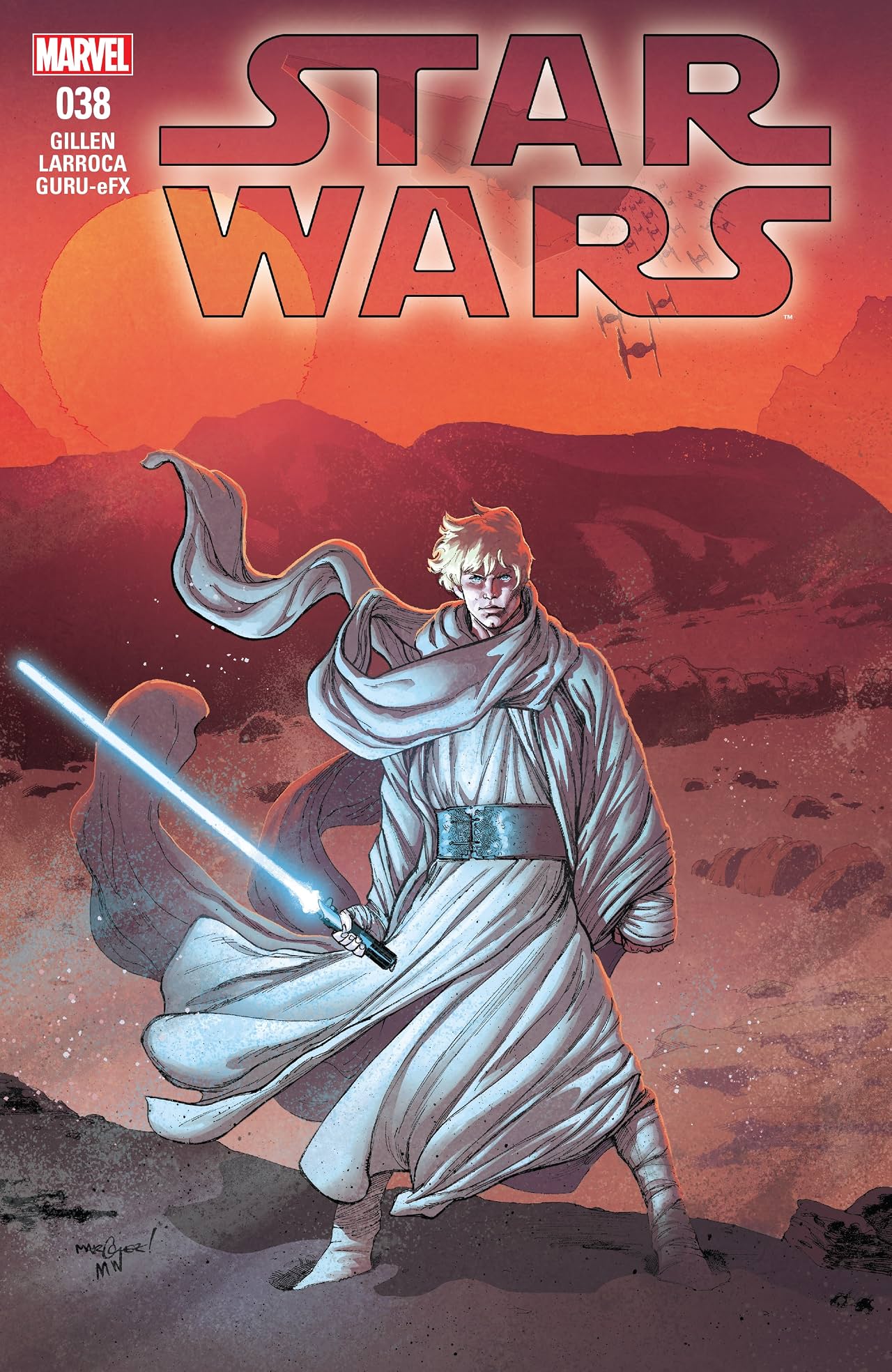
Empires, Ambitions, and Atrocities: Star Wars #38

The following is my review of Star Wars #38, which was posted on PopMatters.com.


When it comes to evil empires, Star Wars sets the bar high and the scope even higher. It's one thing to subjugate a kingdom, continent, or planet. It's quite another to conquer an entire galaxy. Even someone as bad as King Joffrey from Game of Thrones can only inflict so much evil. It says a lot about Darth Vader, Emperor Palpatine, and the Empire, as a whole, when that evil is so far-reaching that blowing up a planet is no more ambitious than Joffrey cutting out someone's tongue.

At times, however, the evil of the Empire becomes an afterthought in order to focus on the story surrounding Luke Skywalker, Han Solo, and Princess Leia. While the original trilogy and the much-maligned prequels do plenty to explore the cruel nature of the Empire, few outside the ruins of Alderan can appreciate how bad it can get for those living under its thumb. It's important for the overall Star Wars mythos to belabor why the Empire is evil in the first place. That makes seeing the Death Star blow up all the more satisfying.

This is where Kieron Gillen and Salvador Larroca come in. Having made various contributions to Marvel's line of Star Wars comics, they enter a mythos far, far away that is rarely short of drama, dread, and droids. At times, the narrative lacks direction, but Gillen and Larroca have already made numerous contributions through Darth Vader and Dr. Aphra. Star Wars #38 offers them a chance to contribute to the bigger picture and leave a more indelible mark on the galaxy. Having to do that without the aid of another Death Star is always a challenge.

The Force is on Gillen's side, though, because the Empire's atrocities don't stop at just blowing up planets. Like many other evil empires, it also goes out of its way to plunder the places they've destroyed. While there are many real-world parallels of evil empires that plunder, going back to the days of the pyramids, not even the most blood-thirsty ruler could do so on the scale of the Empire.

That's what brings Luke, Han, Chewy, and Princess Leia to Jedha, a planet that the Empire partially destroyed, but not out of mercy. The planet happens to be a rich source of kyber crystals, a mineral that the Empire values. That means they can only partially destroy it, but that still means blowing a huge chunk of the planet away. For the Empire, that's the most mercy it'll ever show. This says a lot about how they operate and why blowing up multiple incarnations of the Death Star is so cathartic.

There's nothing that big for the Rebels to destroy in Star Wars #38, but there's still a chance to frustrate the Empire. That's an opportunity that Luke and his friends rarely pass up. That also involves teaming up with the residents of Jedha, which include someone named Chulco Gi, a name that sounds custom-made for the world of Star Wars. His story and the way it ties into that of the Rebels further expands on the evil of the Empire because that can never be too belabored.


It isn't enough that the Empire partially destroyed Jedha, just to get its resources. It also isn't enough that it displaced a huge chunk of its population and did so with the kind of overkill that's akin to swatting a fly with a bazooka. The people of Jedha have their own culture, customs, and religion. Gi is a pious adherent of that religion. However, the Empire just blows that up like they do everything else that gets in their way. Whether it's a planet, a people, or a culture, they deal with it by destroying it. When they have weapons that blow up planets, it's just easier than diplomacy.

This sort of callous approach leaves plenty of scars, even on Gi. He, like Luke to some extent, believes that all the suffering and loss has a greater destiny in mind. So much of the Star Wars mythos is built around fulfilling or fighting destiny. The atrocities of the Empire just raise the stakes even more, which helps give greater weight to the struggle in Star Wars #38.

That struggle has more moving parts than simply sending Storm Troopers and Imperial Droids to shoot things. Gillen also takes some time to explore the logistics of plundering a planet with the Empire. It doesn't just involve shooting giant lasers or Darth Vader force choking subordinates. Gillen actually taps some characters from the pages of the Darth Vader comic, namely Shu-Torun. While the Empire makes few allies that aren't easy to blow up, they tend to be pragmatic when it comes to allegiances. That shows that the Empire isn't just evil. It's competent, which only makes it scarier.

That added fear factor helps make Star Wars #38 feel like part of a larger picture, one that is actually impacted by events in other Star Wars comics. That's something many of the Star Wars comics have been missing since the Vader Down event, which Gillen also helped right. The fact that a story with those connections unfolds without creating a new Death Star makes the story that much more impressive.

It's still a story that only gets so much time to develop. Star Wars #38 does plenty to establish that the situation on Jedha is dire and its people are suffering. It also establishes the personal stakes for characters like Gi, who have more reason than most to fight the Empire. What isn't clear, at least from the outset, is the larger plan the Rebels have. When there's no Death Star to blow up or plans to steal, their tactics tend to be more subtle. They also tend to be vague, which makes it hard to evoke the same drama that comes with watching Luke hit a thermal exhaust port only two meters wide with nothing but the Force.

There are a number of blanks that need to be filled. Star Wars #38 creates a story that feels part of a larger narrative, but that story isn't quite as concise in terms of purpose and intent. It still marks an overdue improvement, of sorts, with Marvel's Star Wars comics. It's not just trying to fill the sizable gaps between iconic movies. It's trying to build bigger worlds in a story where worlds regularly get blown up. It's still a challenge, as is often the case with Evil Empires, but the payoff is worth its weight in destroyed Death Stars.

Final Score: 7 out of 10

Monday, July 10, 2017

Sci-Fi Cast Away: Star Wars #33

The following is my review of Star Wars #33, which was posted on PopMatters.com.


In terms of a modern mythos, complete with philosophical, psychological, and cos-playing implications, Star Wars is the standard by which all others are measured. Few other sagas, from Marvel's ever-evolving continuity of reboots and retcons to multiple eras of Star Trek, even come close. It manages to be both incredibly expansive, yet remarkably concise. It's themes, emotions, and drama create a perfect blend that gives it a special place in popular culture.

Given the sheer breadth and scope of Star Wars, it's easy to forget that there are various parts that remain unexplored. Ever since Disney and Marvel began expanding some of those unexplored areas, new elements of that mythos are emerging. Given the iconic status that Star Wars has for generations of fans, it's a careful balancing act. There are only so many ways that Star Wars can be expanded without undermining the larger narrative. Even an iconic mythos cannot withstand the force of too many Jar Jars.

Jason Aaron manages that balancing act better than most, taking full advantage of the gap between A New Hope and The Empire Strikes Back to flesh out elements of Star Wars that never get a chance on a movie screen. One element that never gets much development is the relationship between Luke and Leia. Even without knowing their secret sibling connection, so much of the drama is centered around Leia's constant clashes with Han. It's easy to forget that her story is closely tied to Luke. Aaron, with the artistic talents of Salvador Larroca, use Star Wars #33 as an opportunity to explore that story.

The setup is simple, if not unremarkable by Star Wars standards. Luke and Leia get stranded on a planet that's mostly water and dotted with a few small islands. The circumstances are fairly generic in that it's not part of some larger story arc. It's just another case of a routine mission going horribly wrong, which seems to happen at least once a week for the Rebellion. There's nothing about it that rattles the continuity of the original trilogy. It's basically the sci-fi equivalent of Cast Away, but with more sea monsters and fewer volley balls.

This bland, but simple setup does serve an important purpose though. It puts Luke and Leia in a position where they have to work together and rely on each other to survive. They know they can survive an onslaught of storm troopers and escaping the Death Star. They've even shown they can survive working with Han Solo for more than two weeks and survive. However, their strength is often defined by their ability to be part of a team. They're rarely in a situation where they can only rely on each other.

It makes for some compelling moments, exploring some of the inner struggles within both characters. It's easy to forget between blowing up the Death Star and falling in love with a smuggler that Luke and Leia are still processing some major upheavals. A part of Luke still sees himself as a farm boy and a part of Leia still sees herself as a princess, complete with all the ceremonial formalities. What stands out in Star Wars #33 is just how uneasy they both feel with their previous roles.

There's a distinct sense that being a farm boy never sat well with Luke. Leia shows a similar sentiment. She reveals that at one point, she ran away to escape some of the formalities that come with being a princess. While this puts her at odds with most traditional Disney princesses, it reveals an important element to both characters.

On some levels, they sense that their situations in life aren't right. They sense that they're meant for something else. Aaron gives the impression that the Force is somehow letting them know that their story is tied with that of Darth Vader and the legacy of Anikan Skywalker. They don't know this, given the story's place in the existing Star Wars timeline. However, they do feel it. If it is a manifestation of the Force, then Yoda himself would be proud.

Beyond the personal exploration, there's also some reflection on recent events, relative to the outcome of A New Hope. Leia is still mourning the destruction of Alderan. The emotions don't get too heavy, though. Leia comes off as more hardened than most princesses. She's no Cinderella, but she's no Elsa either. If she ever broke into song, it wouldn't be very uplifting.

These moments of personal insight and inner character struggles are the highlight of Star Wars #33. While they succeed at providing greater insight into Luke and Leia, as characters, the rest of the narrative falls somewhat flat. Their struggles for survival on the island never create much strain. At most, they only ever seem inconvenienced by their situation. There's never any despair, anguish, or strain. Despite one of them being a princess and the other being a farm boy, their outlook on the situation is remarkably dispassionate.

There are some elements that keep the story from becoming too much like Cast Away. They eventually find out that the planet isn't as desolate as they think. That helps put them in a position to escape and even make a few new allies. However, that story is lacking in terms of detail and insight. It comes off as just a simple, convenient way to get Luke and Leia off the planet before readers can start making incest jokes.

There's nothing about the story in Star Wars #33 that feels out of place, out of character, or inconsistent with the larger mythos. Even if parts of the story lack details, it never comes off as flawed or incomplete. The primary strength of the narrative is the deeper exploration of Luke and Leia, as characters.

When all is said and done, they both come off as more complex characters, which can only give greater weight to the iconic narrative that is Star Wars. While that won't stop some fans from cracking incest jokes about Luke and Leia, Star Wars #33 will give them a greater appreciation for who they are as characters. Anyone hoping for more than that, though, is asking too much of the Force.

Final Score: 6 out of 10

Thursday, October 13, 2016

The Polish of the Dark Side: Darth Vader #25

The following is my review of Darth Vader #25, which was posted on PopMatters.com.


In the post-Breaking Bad era of popular culture, it's not enough for our villains to just be villainous anymore. The qualities of overtly evil characters like Lex Luthor, Thanos, and every James Bond villain that ever existed are no longer sufficient. These characters deserve layers, personalities, and development every bit as much as the heroes. It seems like an unwarranted consideration for villains, but it's one that helps craft more compelling narratives.

In this respect, Darth Vader is a character that was ahead of his time. When he shows up in Star Wars Episode IV: A New Hope, he carries himself as a traditional bad-to-the-bone villain who will blow up a planet full of sick puppies in order to crush the rebels. Then, by the end of Star Wars: Episode VI: Return of the Jedi and the maligned prequels that followed, he becomes a more complex villain who does what he does for reasons beyond just enjoying the cries of dead Alderaneans.

Kieron Gillen takes this complexity and hits the ground running full speed when his Darth Vader series begins. He succeeds where three prequels with production budgets north of $100 million failed, building new layers to Darth Vader as a character and as a villain. Gillen never tries to make Vader an anti-hero. He doesn't try to make him sympathetic either. He just uses this series Darth Vader a more compelling character. As such, Darth Vader #25 acts as the cherry on top of a very delicious cake.

Make no mistake. Darth Vader does nothing remotely heroic in this issue. Darth Vader #25 still occurs within the context of the period before Star Wars Episode V: The Empire Strikes Back. This means he's not remotely close to the character who sacrifices himself to save his son. He's still on that path, but he's going to dig himself into a deeper hole before he gets there.

For much of this series, Gillen has Darth Vader focus on a different goal, but one that's more relevant for this particular part of the Star Wars mythos. It begins with him acknowledging that he failed to prevent the destruction of the Death Star. He gives Emperor Palpatine a valid reason beyond mustache-curling evil to question the competence of his apprentice. It's Darth Vader's job to prove himself again and, true to his devious legacy, he goes the extra parsec.


It doesn't just involve Darth Vader confronting and defeating the Emperor's efforts to defeat Cylo, who the Emperor taps as a possible replacement. It also involves Vader himself going behind the back of his Emperor, carrying out missions that undermine his blind obedience to his master. This is what led him to cross paths with Dr. Aphra, Triple-0, and BT, three characters that frequently steal the show in this series. There's just something inherently charming about a murderous version of C-3P0.

These subversive efforts, alongside his efforts at redeeming himself, give extra weight to Darth Vader's villainous legacy. It's a legacy that doesn't really need to be refined, especially in wake of the ill-fated, Gungan-filled prequels. However, this extra layer of complexity acts like the extra layer of frosting on a cake. It makes everything sweeter in the end.

The battle against Cylo comes to an end, one that involves a creative yet destructive use of the Jedi mind trick. Darth Vader's dealings with Dr. Aphra come to a head as well. All the secrets and plotting create such a unique dynamic between Darth Vader and Dr. Aphra, making for a confrontation with the Emperor that carries a significant amount of dramatic weight.


Anyone hoping for Darth Vader to show mercy for Dr. Aphra after all she's done for him will be disappointed. Within the context of this stage of the Star Wars mythos, nobody should be surprised either. Darth Vader at this stage of development is willing to encase Han Solo in carbonite and cut his son's hand off. He's more than willing to toss a loyal ally like Dr. Aphra out of an airlock. If anything, that's as merciful as he can possibly be at this point.

While not surprising, this moment carries weight because Gillen puts time and effort into crafting a unique relationship between Darth Vader and Dr. Aphra. Those efforts help give the moments in Darth Vader #25 the dramatic weight it needs to have an impact. It feels much more meaningful than Darth Vader just force choking an entire legion of Gungans, but is every bit as satisfying.

There's no question that Darth Vader is still bad to the cybernetic bone at this stage in the Star Wars mythos. His battle against Cylo and his confrontation with Dr. Aphra prove that beyond any doubt. However, Gillen does offer some hints that the Darth Vader who goes onto sacrifice himself to save his son is starting to emerge.

These hints are somewhat subtle, sometimes excessively so. They show mostly through the crisp artwork of Salvador Larroca. It's not as overt in Darth Vader #25 as it is in previous issues of this series, but the subtext is there. It doesn't add much to the dramatic weight of the story, which does skew the balance more to the Dark Side. However, given the context of the story, it's still appropriate.

Kieron Gillen didn't set out to remake or redefine Darth Vader with this series. More than anything else, he works to reinforce the devious, villainous part of the character that the prequels tried too hard to circumvent. There's still an internal struggle here that will manifest in the final minutes of Star Wars Episode VI: Return of the Jedi, but the tone of the narrative in Darth Vader #25 is clear. This narrative embraces the dark side and the results are impressive. Most impressive.

Final Score: 9 out of 10

Tuesday, February 17, 2015

The Dark Side of Empires: Darth Vader #1

The following is my review of Darth Vader #1, which was posted on PopMatters.com.


When the Star Wars prequels were originally announced, the main appeal was that it would provide a context for how Anakin Skywalker became Darth Vader. That is a story that's worth telling and one that helps cast the events of the later movies in a new light. However, the story failed make that new context all that compelling. Darth Vader really didn't become more interesting as a result of the prequels. Those movies just made Anakin Skywalker out to be a whiny, overly gullible kid with poor impulse control.

There's much more appeal in seeing Darth Vader as the sinister, intimidating villain he was when introduced. Darth Vader is a freshly mixed batch of ice cream while Anakin Skywalker is just the ingredients. There's little appeal in the ingredients on their own, but the ice cream that is Darth Vader has plenty of appeal.

He's a powerful Sith Lord who, unlike the far less imposing Emperor, is willing to get his hands dirty. He's not like Dr. Doom, who prefers letting his Doombots do the fighting. He's not even like Lex Luthor, who wastes time belittling and berating his enemies with his brilliance. Darth Vader speaks only as much as he needs to and in the most intimidating way possible. And when that's not enough, he'll finish the job no matter how many Stormtoopers or Death Stars it costs.

This is the version of Darth Vader we're given in Darth Vader #1. There's no elaborate effort to make him a more sympathetic character. There's no shocking revelations about who might be who's father. This is just Darth Vader, fresh off a humiliating defeat on the Death Star, looking to get back at those responsible. The end result is much more engaging than the prequels ever were. The lack of Jar Jar Binks is only a bonus.

The structure of the story is heavy with exposition and that's not necessarily a bad thing. The loss of a resource as big as the Death Star should definitely have some major ramifications and since Darth Vader was tasked with defending it, he should face some level of scrutiny. He's not some renegade official who took one too many bribes or got drunk at one too many office parties. He lost the Empire's greatest weapon. It would be like someone misplacing an atomic bomb during World War II. There should be some fallout.

The fallout in this story revolves around Emperor Palpatine holding Darth Vader personally responsible for the destruction of the Death Star. It's the kind of fallout that has genuine impact because the Emperor is one of the few characters who can berate Vader and live to tell about it. He provides a context for what the loss of the Death Star means. It's a context that was never explored in the movies, but it's one worth exploring because it portrays the Empire as something more complex than a standard GI Joe villain.

The Emperor lays out the plan that Darth Vader failed to uphold. The Death Star was just the culmination of 20 years of solidifying the Empire's rule. Losing it means the Empire is vulnerable in a way that'll make any Emperor feel uncomfortable. The consequence of that discomfort means Darth Vader gets a brief demotion and a new task that involves dealing with criminals like Jabba the Hut. In terms of a demotion, it's not quite the same as being given janitorial work, but it still sends a message.

That message brings out the tough, ruthless, force choking side of Darth Vader that Hayden Christensen never properly portrayed. When he visits Jabba the Hut, there's no elaborate deception or struggle. Nobody ends up in a chain bikini either. Darth Vader just tells Jabba what he wants and what he'll do to him if he doesn't give it to him. It's the kind of negotiation tactics that would make the John McClanes of the world smile.

It gives Darth Vader a chance to show off why he's much more interesting as a dark lord than he ever was a pod racing kid. Jabba still attempts to use the same tactics that will eventually get him killed in Return of the Jedi. Darth Vader easily fights them off. He doesn't end up fighting a Rankor or a Sarlac, but he gets his point across. It's the best action in the story and that might be somewhat of a problem.

There's never a real sense of struggle. Even the cave-dwellers who never saw Empire Strikes Back or Return of the Jedi would never get the impression that there was any real struggle between Darth Vader and Jabba's thugs. The battle was extremely one-sided. If it were a football game, it would not be a game the NFL scheduled for prime time. It attempts to inject a little intensity into a story that's so heavy on exposition. It just doesn't succeed nearly enough. A Rankor would've helped, but even that wouldn't be a fair fight against Darth Vader.


In many ways, that's the challenge of a story like this. Darth Vader is so powerful and ruthless that it's hard to give him a challenge. Unless it involves protecting moon-sized battle stations, he makes it look easy. The real appeal in Darth Vader #1 involves putting his character in a difficult position where he has to regain his credibility with the Emperor. The added context of his failure to protect the Death Star and the challenges he now faces in making up for it make this story compelling. It'll appeal to fans of the West Wing, but not fans of Die Hard movies.

This story is deeper than Darth Vader being ruthless and that's one of its greatest strengths. However, the overall narrative has a few holes in it and won't put anybody on the edge of their seat. It still puts Darth Vader front and center in a story that explores his character in a way the prequels failed to do. And if it can do this without Gungans and pod racers, then it's definitely a story worth telling.

Final Score: 7 out of 10

Monday, June 16, 2014

Humanizing The Gods: Amazing X-men Annual #1

The following is my review of Amazing X-men Annual #1, which was posted on PopMatters.com.


The concept of humanizing a god is like trying to humble Donald Trump. On paper, it sounds daunting. In practice, it creates a powerful narrative that takes beings of extraordinary ability and makes them more relatable. Superman might be a being with the ability to bench press a planet and fly to the edge of the solar system in the span of an afternoon, but a big part of his story is built around humble beginnings. He grew up on a farm in Kansas. It can’t get more humble than that without becoming a Charles Dickens novel. This presents a challenge to characters like Storm in X-men, but it’s a challenge that is taken up in the pages of Amazing X-men #1.

Compared to Superman, Storm’s origins aren’t nearly as humble. She was worshipped as a goddess at one point. That’s the very antithesis of humble. However, this well-known part of her life only represents a fraction of her life. While most are familiar with her life as Storm, her life as Ororo Munroe is less known and often underdeveloped. It wasn’t until the past ten years that her history with Black Panther was revealed. Granted, it was a contrived history meant to justify her marriage to Black Panther, but it revealed that Ororo Munroe’s early life was anything but divine.

The heart of the story revolves around Storm’s efforts to save her cousin, Abuya, who was abducted by a newly minted Inhuman calling himself, Meruda. He’s got powers similar to Storm’s in that he can conjure winds and create dust storms, but he lacks her grace and personality. He also claims to have a very personal vendetta against Storm. This is where the humanizing begins, but that humanization process is somewhat obscured by circumstances. Despite being one of the most popular X-men of all time, not much of Storm’s early life is explored. Hallie Berry might have captured her personality in the X-men movies, but there isn’t much in terms of the source of that personality. In that respect, Storm is like a beautiful flower from an unknown garden.

By bringing Storm’s extended family into this story, it offers a brief yet compelling glimpse into the life made her into the goddess is now. At one point, she wasn’t the powerful woman who could end droughts on a whim and survive dating Wolverine. She was just a girl trying to save her friends and family with powers that she didn’t fully understand. It might seem strange for those used to seeing only Jean Grey lose control of her powers, but it makes perfect sense and maybe it makes too much sense to explore. Powers that involve controlling something as complex as weather must be difficult. Even goddesses have to deal with insecurities at some point.

That’s a lesson Storm had to learn at a young age and a lesson that Meruda hasn’t bothered to learn. In some respects, that makes them reflections of one another. Whereas Storm is Warren Buffet, Meruda is Jordon Belfort. He doesn’t try to control his powers. As soon as he gets them, he uses them to get back at Storm. That’s why he abducts Storm’s cousin. That’s why he skips the process of developing a respect with nature and immediately becomes the kind of arrogant god that demands animal sacrifices and punishes his followers for knocking over candles. It’s not just petty. It’s shrugs off humility as if it were mosquito. But what makes it particularly egregious in Meruda’s case is that his grudge against Storm might not even be warranted.


After going through the trouble of turning Storm’s cousin into a monster and subduing her with his dust powers, Meruda claims that Storm was responsible for triggering a dust storm that wiped out his entire family. The fact that Storm was just 12-years-old at the time and was trying to save a young Black Panther means nothing. It may sound like the kind of traumatic experience that brings out the Dr. Doom in everyone. However, Storm has had her share of traumatic experiences as well. This is a girl who lost her parents at a young age and had to survive as a pick-pocket in Cairo. Yet unlike Meruda, she didn’t immediately use her new powers to take revenge on everyone smart enough to hide their wallets in their shoes. She used it as a means to become someone better. They’re two distinct paths. Storm took the path of the graceful goddess. Meruda took the path of the petty, vengeful god.

In the end, the graceful goddess proves to be more resilient than any vengeful thug. While the X-men save her cousin, she shows Meruda that even a graceful goddess is not someone he should provoke. Unlike Meruda, she has spent a lifetime developing her connection to nature and using it to hone her powers the same way Peyton Manning hones his quarterbacking skills. Meruda just got his powers from the recent events surrounding the Inhumans. He might as well be a rookie trying to beat a Hall of Famer blindfolded and with one hand tied behind his back.

Storm’s triumph isn’t just a testament to her power and grace. It reveals the scale and scope of her humility. Even though she was worshipped as a goddess, she still maintains close ties to her family and loved ones. Those loved ones might not be well-developed. Nobody is going to confuse her cousin with the Kents and nobody is going to confuse Meruda with Lex Luthor, but the story conveyed in Amazing X-men Annual #1 provides a conflict and a struggle for Storm that contains a very personal touch. It might not have the kind of breadth that is going to fundamentally change Storm’s character, but it will reinforce the humility that makes her a goddess worth worshipping.

Final Score: 8 out of 10

Thursday, September 19, 2013

Scanned Thoughts: Cable and X-Force #14


How many awesome stories area result of teenage girls who have serious daddy issues? By that same token, how many shitty stories come from teenage girls who have serious daddy issues? Most of the time, these girls are easy prey for douche-bags who show them as much respect as they show the semen encrusted sock they keep in a box with their porno stash. In comics, these girls can either be a fanboy's wet dream or an annoying bitch that deserves way more respect than any sock. Hope fucking Summers has long past sealed her fate as an annoying little cunt who has as many redeeming features as Ryan Seacrest has talent. Yet she's still bitching and moaning in the pages of Cable and X-Force. So far that hasn't kept the book from being awesome, but how much longer can it hold out? Keep some blood pressure medication handy because I'm about to review Cable and X-Force #14 and it may be one of the only instances where teenage girls with daddy issues don't give me a boner.

So far, Hope fucking Summers made it all the way to the future to find out from her future self that she’s the one who fucked up Cable’s mind and fucked up the future. Now she has to work with her future self to unfuck it. It may sound more confusing than the plot of Godfather 3 after smoking a few too many joints, but it’s actually pretty basic. Both her older self and Blaquesmith equip her with a weapon and a jet pack to help her fix what her future self would fuck up. She tries to come off as sympathetic in her inner musings, but at this point there’s as much sympathy for Hope fucking Summers as there is for Miley Cyrus. Her returning to the past to fix her own mistakes is probably the best anyone can hope for with a whiney little bitch like her.


But I haven’t stuck with Cable and X-Force because I like being reminded of how much I hate Hope fucking Summers. I read it because it offers the possibility of many awesome concepts, like X-Force fighting the Uncanny Avengers. It already led to Havok being punched in the jaw in the first arc. And as satisfying as that was, it left me wanting more. And in a recent issue, X-Force decided to make a daring rescue attempt for Cable, who the Uncanny Avengers captured for some of the excessive vandalism his team was responsible for in the first arc. And since it involved blowing up a fast food joint in a world where fat-asses have a lot of influence, that just couldn’t go unpunished.

Despite having to read too much about Hope fucking Summers, it’s still a very satisfying fight. It’s not a very fair fight though and that’s to be expected. The Uncanny Avengers have fought the fucking Red Skull and the Apocalypse Twins. X-Force is strong, but they are pitifully overmatched by the likes of Thor, Captain America, Rogue, and the Scarlett Witch. At times it makes the fights seem less-than-epic, but some fights shouldn’t be epic. In the same way a fight between a lion and a squirrel is nothing to put on pay-per-view, a fight between the Uncanny Avengers and X-Force is not a battle that anyone should expect to be too drawn out. That’s part of what makes it both satisfying and believable.


And the one person who is supposed to be responsible for convincing X-Force to surrender peacefully isn’t even partaking in the fight. Havok, who is still new to this whole leadership deal, is stuck sitting on the fence and looking more indecisive than George W. Bush at a hotdog stand. Wolverine, who is just calmly drinking a beer with no desire to fuck up the lawn of the Avengers Mansion, comes off as the smartest guy on the team for once. He tells Havok that he has to make a decision on what to do with Cable. Sure, he’s a wanted terrorists, but now he knows he had a damn good reason for doing what he did. He has to decide how he wants to deal with it.

Lucky for Havok, he doesn’t end up having to make his choice immediately. Before he can confront Cable, that elaborate mind-fuck that Hope fucking Summers did to him finally overwhelms his mind and he starts going Carrie White. And Havok might as well have been the one to pour pigs blood all over his prom dress. I want to have some sympathy for Havok since he couldn’t possibly know how much Hope fucking Summers would fuck up Cable’s mind. But I’m too sober and too logical to give him the courtesy. Until he makes a decision that Cyclops wouldn’t have made with much more conviction, he’ll still be that guy that deserved the punch to the jaw he got earlier in this series.


As if it wasn’t bad enough that X-Force had to go up against Earth’s mightiest heroes and X-men, news choppers pick up on the fight. It’s a nice touch that doesn’t often happen in the pages of a comic book. When a bunch of superheroes slug it out on the front lawn of a mansion, that’s not just newsworthy. That’s the kind of shit that Don King would try to sponsor. It also gives a nice reminder that X-Force is still wanted. The Uncanny Avengers are the heroes and they’re the fugitives that blew up a fucking fast food factory. They can’t expect anybody to be rooting for them. It’s an important distinction that every X-Force comic needs to make and this scene does it nicely while continuing to show that X-Force is more overmatched than Betty White in a boxing match with Mike Tyson.


It would have been a fairly predictable match anyways. The stakes only change when Hope fucking Summer finally joins the party, armed with her new jetpack. She basically skips the battle between the Uncanny Avengers and X-Force because fuck X-Force. She couldn’t give a nanogram of shit about anybody who ever helped her if it kept her from confronting her serious daddy issues. But Wolverine, who is still the smart one avoiding the clash while drinking a beer, stops her just long enough for her to explain herself. He just wants a simple reason why he shouldn’t stab her, which is something he has tried to do in the past on more than one occasion. She just tells him that a lot of people will die if she doesn’t get to Cable. That alone isn’t very convincing, but when the mansion starts shaking that seems to do the trick. So with his beer still in hand, Wolverine lets her through, thereby making him the only character in this comic who didn’t fuck up on some level.


The whiney little bitch and unapologetic rip-off character arrives just in time to see Cable’s mind going batshit and she has nobody but her future self to blame. I suppose this could be a metaphor or something about messed up teenage girls that try to resolve their daddy issues and only end up making shit worse in the long run. But it’s Hope fucking Summers. She only seems to make everything worse no matter what she does or where she goes. So I’m not going to lump her together with the teenage girls out there who have real daddy issues. They deserve better while this little bitch doesn’t even deserve a stripper pole at a Mexican brothel.

Again, she tries to come off as sympathetic in her inner monologues. I’m glad they’re actually there because if she just did the shit she was doing without any insight into her thought, drunks like me would just assume she’s doing this because she’s a bitch. I get that Marvel is trying to keep her from becoming too irrelevant now that she’s no longer the mutant messiah and she has basically done what she was supposed to do. But there’s just no redeeming this whiney little bitch at this point.


What she does undo the shit her future self started isn’t going to make her seem any less whiney though. In a quick flashback, Blaquesmith reveals that the fancy battle ax he and her future self gave her is a specially designed tool that takes the excessive psionic energy from Cable’s brain and channels away from activity that involves putting him in chronic pain and destroying mansions. But like buying a cheap Iphone over Ebay, there’s always a catch. In order for it to work, she has to stab him in the fucking forehead. Because it just wouldn’t be in character for Hope fucking Summers to do something that doesn’t look like a dick move on some levels. Granted, it works. It effectively stops Cable’s outburst while unleashing a psionic wave that disrupts the battle between X-Force and the Uncanny Avengers. It doesn’t make it any less a dick move.


The reunion between Cable and Hope isn’t something that would fit into a Hallmark card. In fact, it’s pretty damn underwhelming. There’s no hug. There are few emotions. Granted, these are two battle-hardened soldiers. But Hope fucking Summers has a history of getting so damn emotional about Cable. Yet when she confronts him, she does it with the same attitude that I have when I meet up with my pot dealer. It could have been a big moment, but instead it’s just a scene where they catch their breath. That’s understandable to a point, but since there’s no hint about how this affected the battle going on outside or what it means for Cable’s visions, it’s still lacking.


The last issue to resolve is Havok. He still has to make a decision on what to do with Cable and his team. He could continue being a total dick and have him arrested along with the rest of X-Force, but after seeing what Cable showed him in the previous issue, he’s willing to be a bit more understanding. Captain America probably wouldn’t approve and neither would any DEA agent in the fine states of Colorado and Washington, but it’s his decision and he decides to take a chance. That means not arresting Cable and letting X-Force operate in a way that just doesn’t look good around news choppers. It actually is a decision that Cyclops would probably make, but Havok just seems nicer about it. I still think he’s a douche, but he effectively frees X-Force to keep doing what they’re doing. And now that Cable’s brain isn’t having a Chernobyl style meltdown anymore, they can do what they need to do. It’s satisfying while still missing a few minor details. But since they’re minor, it’s nothing that can’t be overlooked with a few extra joints and a line of blow.


This issue and this arc failed to make Hope fucking Summers any less a puissant little cunt. However, this issue did succeed in one key area. It effectively tied up nearly every loose end while establishing Cable’s new team as the kind of X-men squad that’s willing to get dirtier than the septic tank that feeds into Congress. It wasn’t as clean or detailed as it could have been, but it got the job done and was pretty damn awesome in the process. Hope fucking Summers is still going to be an insufferable bitch, but at the very least this issue didn’t give too many additional reasons to hate her. For that, I give Cable and X-Force #14 an 8 out of 10. So a bratty teenage girl abandons everyone that ever tried to help her, mind-fucked her own adopted father, and still gets rewarded with ice cream? That right there, my friends, is how teenage girls become grown up bitches. Nuff said!

Thursday, August 22, 2013

Scanned Thoughts: Cable and X-Force #13


On this blog, I look for ways to combine the joys of reviewing comics with the fun of making dick, poop, and fart jokes. I’m no Seth MacFarlane, but I think there should always be a medium that mixes dick, poop, and fart jokes into the things we hold dear. I’ve always held comic book in high regard and not just because the women are overly sexualized and the men make me feel more inadequate than Mitt Romney’s PR campaigns. I believe comic books have something to offer the human race and I’m here to make sure it’s as fucked up as it is entertaining. So here’s my fucked up take on Cable and X-Force #13. Grab a dick, take a shit, and have a good fart because this comic gave me plenty to work with.

For a book that is supposed to be about an outlaw team of X-men, it has been dealing with a fuckton of magical creatures lately. In the previous issue, Domino and Colossus had to fight off an army of demons while talking about how they were going to go about being regular fuck buddies. In this issue, they meet up with Forge and Dr. Nemesis to fight a giant monster that looks like Cthullu’s dildo. I’m not sure if it’s magic, but in comics I guess it’s always a safe assumption in the same way it’s always a safe assumption that the slut will die a horrible death in a slasher movie. I also think the bitching between Forge and Dr. Nemesis helped. It reminded me of why I didn’t really miss them over the past two issues. It’s not as epic a battle as it could have been, but it continues X-Force’s recent history of fighting of fucked up threats.


Instead of a more detailed battle of how X-Force fights off yet another mystical monster, this issue focuses heavily on Hope fucking Summers dealing with the only thing more annoying than her…another older version of Hope fucking Summers. The previous issue revealed that the future female Stryfe that had been helping Blacquesmith was actually an older Hope fucking Summers. It was somewhat surprising, but only to the extent that a kick in the nuts from a transsexual hooker is surprising. And her reason for pulling her younger self out of the past is even less surprising. Hell, the only thing that Hope fucking Summers could do to surprise me at this point is admit she pleasures herself to old Ted Nugant songs.

Her explanation will make some readers yawn and others just roll their eyes. Apparently, the world went to hell because Cable decided that he had enough fighting and just wanted to sit back, relax, and fall asleep drunk watching Monday Night Football like someone who hasn’t been stuck in apocalyptic futures for most of his life. But him not fighting somehow meant that the world gets fucked worse than the IRS fucked Wesley Snipes. So using Deathlok’s ability to calculate the future, they started fucking with Cable’s mind in the past. Somehow, I think just sending him a letter taped to a brick would have been just as effective. But Hope fucking Summers can’t resist causing people more headaches, or in this case seizures.


Yet Hope fucking Summers has the audacity to claim that causing her adopted father painful seizures is working. Well in this case she might be right. Because as she’s trying to justify this dick move to her younger self, X-Force successfully subdue the giant Cthullu dildo. But it’s not as epic as previous battles. Colossus and Domino don’t even dirty talk with each other. It’s a very subdued battle that ends with Colossus just dive bombing the ugly monster in the head while Boom Boom blows the rest up. The only thing the battle accomplishes is getting X-Force back in one place again where Domino just happens to remember that Cable is still a prisoner of the Uncanny Avengers and probably isn’t too happy about it.


Even though another killer monster shaped like a sex toy is defeated, the younger little bitch is able to see through the older bitch’s ruse. In hearing that her older self chose to fuck with Cable’s brain rather than find a more efficient means of informing him of an apocalyptic future, Hope fucking Summers is actually able to figure it out. She finds out that her older self chose this incredibly invasive method because it meant Cable would not be able to tell her to fuck off anymore. Saving the future wasn’t her goal. She just wanted her adopted daddy to spend time with her. For someone who was supposed to be the mutant messiah, Hope fucking Summers has some incredibly petty issues.

I don’t know if this was supposed to make Hope seem sympathetic. It seems like this series has tried to do that a number of times, but no matter what happens, Hope fucking Summers always comes off as an even bitter little cunt than before. She actually fucks with the brain of her own adopted father just so she can spend more time with him. At no point does she mention the Avengers, the X-men, or the dozens of other superpowered individuals who beat up giant monsters in between snack breaks. Yet somehow it was all because Cable wanted to retire that the world went to hell? It’s as if somehow every one of Marvel’s best heroes became total pussies and it’s not explained in the slightest. I know this book is supposed to focus on Cable and X-Force, but since the Uncanny Avengers have shown up multiple times it’s a pretty gross oversight. It’s like a man finding out on his wedding day that his bride is a donkey with a Hilary Clinton mask. It takes way too much stupid to overlook shit like that.


Cable still doesn’t know that his own adopted daughter is causing him all this pain, but I imagine he has a pretty good idea. The Uncanny Avengers still have him imprisoned at the Avengers Mansion and Havok, who Cable did punch in the jaw back during their first encounter, is tasked with trying to figure out what to do with him. That’s like my ex-girlfriend being my parole officer. Nothing good can come of it. He has another seizure that probably way more painful than any punch to the jaw that Havok ever got. And since Havok and the rest of the Avengers don’t know shit about his crazy visions of the future, they might as well a headless chicken stumbling into a KFC.


Luckily for Havok and his jaw, Cable manages to focus enough to show him his dark visions of the future. The visions are pretty generic. More monsters are rampaging across the city. And for some reason, the Avengers, the X-men, and every other hero in the Marvel universe is too lazy or too hung over to do anything about it. Again, there’s no explanation as to why the same heroes that went toe-to-toe with Thanos and the Phoenix Force couldn’t stop a few rampaging monsters. But it is enough to leave Havok with a solid explanation as to why Cable has to punch him in the jaw.

He then makes a point that makes about a much sense as Sarah Palin’s stance on Russia. He says that rather than informing the most powerful heroes on the planet, the Uncanny Avengers should leave this shit to X-Force. He claims that they can do the kind of dirty shit that nicer, more upstanding heroes can’t be seen doing. He’s basically telling them to let X-Force fuck the ugly hookers so that they can keep the attractive ones can stay employed. It makes no sense. Aside from the incident with the fast food place, when have tactics ever mattered when fighting monsters? I’m pretty sure the public doesn’t mind seeing the Avengers and X-men being extra violent with monsters ravaging a city. So I think Cable is full of shit here and if Havok has any brains that haven’t been punched out of him yet, he would see that.


In the future, Hope fucking Summers would be also be wise to see that fucking with Cable’s mind probably isn’t going to make him any more inclined to spend some quality time with his adopted daughter. Even Blaquesmith tells them that despite their efforts to inform Cable of the future, shit is still getting worse. And not only is it getting worse. It could end up killing Cable. When daddy issues end up with daddy’s brains melting out of his ears, they cease to be issues and become something else entirely that requires potent medications. I don’t think all the anti-psychotics in the world could help Hope fucking Summers at this point. It shows that once again she cared more about working out her daddy issues than she did actually saving the future. It gives me yet more reasons to call her a puissant little cunt, as if I needed any more at this point.


At the very least, Cable is able to convince Havok that his visions are real and the threat is real. Even though his reason for leaving this shit to X-Force makes no fucking sense, Havok still seems perfectly willing to let Cable go so he can do what he needs to do. However, he’s understandably reluctant to just let him walk out the front door and give the finger to Captain America along the way. It just wouldn’t look good for the leader of the Uncanny Avengers if he let prisoners go without a fight. It quickly becomes a moot issue though when X-Force storms the mansion in an effort to rescue Cable. I guess this solves one problem for Havok, but it’ll probably mean he gets punched in the jaw again. So in that sense it’s a win-win.


X-Force may be unwilling cannon fodder for Hope fucking Summers and her daddy issues, but they’re neck deep in the shit right now. Even her older self knows this. So she eventually decides that maybe just fucking with Cable’s brain isn’t going to be enough. She needs to send her younger self back into the past to either fix things or fuck them up even more. She even gives her a weapon. At this point though, I wouldn’t be surprised if she uses that weapon to turn the Statue of Liberty into a giant dildo. That’s how little faith I have in Hope fucking Summers. I’m certainly glad to see X-Force battling the Uncanny Avengers again, but I can do without Hope fucking Summers being an even bigger cunt about it.


I have a soft spot for girls with daddy issues, but a lot of those girls are prone to suggestion and don’t bitch as often when they try kinky shit in bed. And that soft spot has no room for Hope fucking Summers. Only she could turn saving the world from yet another apocalyptic future into just another manifestation of her bitching and moaning about Cable. Even her younger self saw through the bullshit that her older self was feeding her. Saving the world and showing some fucking gratitude to the other heroes that saved her is not even top 10 on her to-do list. She just wants to shoot shit with Cable. While Cable and X-Force #13 didn’t make me hate Hope fucking Summers any less, it finally got Cable involved more and set the stage for yet another clash between X-Force and the Uncanny Avengers. That in and of itself is pretty fucking awesome and if it ends with Havok getting punched in the face again, I’m all for it. I give Cable and X-Force #13 a 6 out of 10. Unless strippers get involved with this series, I think it has enough daddy issues. I’ll be content to just see X-Force kick the Uncanny Avengers’s ass again. Nuff said!

Thursday, August 8, 2013

Scanned Thoughts: Cable and X-Force #12


Looking for an insightful assessment of a comic that incorporates legitimate literary criticisms and puts the story into a larger context of modern life? Well I'm sorry to say you're shit out of luck. If you want something written by an overly intellectual douche-bag, go somewhere else. This is a review written by a raving drunk with strong opinions and poor impulse control. So the New Yorker and the Walls Street Journal can kiss my ass because this is my review of Cable and X-Force #12. So unless you're one of those overly intellectual douche-bags, read on and enjoy the uncritical musings of an unsober mind.

The format in this issue is the same as the last issue in that it divides the ink between Cable’s team trying to stop one of his terrible visions of the future and Hope Summers becoming more of a whiney little puissant. It was fun in the last issue because we had two beautiful woman with Domino and Boom Boom having more fun than a hooker and a gallon of lube. Now Colossus gets in on the action. But instead of a car chase, he has to break into the safe in a Swiss bank. Granted, it’s not as thrilling or anywhere near as sexy, but it’s definitely an appropriate use of his skills.


And once again, Domino is the partner in crime with this issue. She’s a busy girl, first dealing with an explosive yet sexy Boom Boom and now dealing with a guy whose bone she jumped a few issues back. She gets around and not just in the way a Las Vegas stripper would with a double shift. She’s the one with the plan and Colossus is the one with the muscle. So together, they bust into the Swiss safe to retrieve what she calls the “Spawning Wellspring.” It sounds like a bad nature film or an awesome porno. It looks like a simple chess piece, but it’s actually a key to unlocking a demonic dimension. And as is often the case with demonic relics, they accidentally activate it and trigger a demon onslaught.

A demon threat alone would be a basic enough plot for this story. But that’s not all that happens here. Colossus, being either a hopeless romantic or starved for pussy during his stint in prison, tries to talk to Domino about their night together. She’s dismissive as Donald Rumsfeld, brushing it off as one of those “the adrenaline made me horny and the batteries on my vibrator died” situations. It’s cold, but it’s very in character for Domino. This woman once boned Wolverine on top of a bed of money. Why? Because she’s horny and because she can. What more could you want in a comic book woman?


On the other side of that coin, what LESS could you want in a comic book woman that hasn’t been demonstrated in Hope fucking Summers to date? Yes, I still hate her fucking guts. And yes, she gives me more reasons to do so in this issue. But it’s not immediately apparent. Sadly, Blaquesmith didn’t take his chance to end her sorry ass in the previous issue and she ended up transported to…you guessed it, ANOTHER apocalyptic future. Seriously, didn’t apocalyptic futures lose their appeal after the last Terminator movie? I guess not because this future involves killer robots, sentinels, and a female version of Stryfe. Hope is obviously confused, but why should she be? Hell, why should anyone be? It’s an apocalyptic future. Does there need to be an explanation? It only helps if Marvel wants that story to actually be good.


A much better story is already unfolding in the past. Colossus and Domino are fighting an army of evil demons, which on its own is only slightly more entertaining than fighting robots in an apocalyptic future. But what makes the battle here a lot more intriguing is that Cable and Domino actually manage to have a serious conversation about their relationship, or lack thereof, while it’s going on. It seems pretty out of place. Talking about relationships while fighting demons is like trying to play dodge ball with bowling balls while doing a crossword puzzle. One activity serious hinders another. Yet there is actually some genuine drama that comes from this chaos.

Colossus seems to want to try something serious with Domino. That must mean the sex with her is really that awesome. But Domino basically brushes it off, saying the sex was fun and all. But the relationships for people in their line of work rarely pan out. And she’s right. She could have referred to Cyclops and Emma Frost, but she doesn’t really need to provide examples when demons are attacking them. She could have just offered to still have sex, but not do much else. Most men spend their whole lives trying to set up an arrangement like that. Colossus is either a total dipshit or a genuine guy that Domino has never dealt with before. I’m leaning towards the former.


But as much fun as this relationship talk is, they still have to give the demon army a higher priority. And yes, I mean a higher priority than Domino’s pussy. This was supposed to be another pit stop in the ongoing mission to prevent Cable’s visions from coming to pass. They may have stepped in a few piles of cow shit by letting the demons out early, but they’re able to effectively wipe off their shoe and kick the ass of the cow. It’s a tough battle that feels more meaningful because of the relationship talk. It’s like a soap opera mixed with professional wrestling. It sounds like it shouldn’t work, but it does.


And the effects of Cable and Domino’s victory over the demon army doesn’t just mean more time to figure out how they’re going to keep boning. Apparently, this demon army that they unleashed somehow contributed to the apocalyptic future with Hope fucking Summers and the boobalicious version of Stryfe. The fight with Hope running from the killer robot demons isn’t all that intriguing. I don’t usually enjoy apocalyptic futures where I root for whatever fucked up the world. But for once, Hope fucking Summer actually becomes part of the story in a way that makes her scenes less frustrating.

By destroying the demon army in the past, they disappear in the future. So Hope fucking Summers gets a quick lesson in the Back to the Future physics of time travel. It may sound simple, but this sort of shit rarely happens in comics. It has only been recently that Marvel has tried to actually show time travel affect the future with Age of Ultron. The effect in this issue isn’t quite as dramatic, but it proves a valid point. X-Force is actually doing more than pissing off Havok and the Avengers. They are saving the future. In other words, suck it Avengers!


Saving the future also makes it easier for Colossus and Domino to finally have a quiet moment. The demons are gone and they’re stuck in a confined area with awkward silence. It would have been less awkward if they just started boning again. But Colossus has to be the romantic and flat out tell Domino that they can make it work beyond just casual fucking. A bigger question for him might be why the fuck would he want to? But that doesn’t stop him from sneaking in a kiss with Domino and effectively getting the ball rolling on what may be either a very volatile or very sexy relationship. Either way, Colossus can finally get his man card back. Anyone who can bone Domino deserves a second chance.


With all this drama and saving the future, it’s almost easy to forget that Cable had been captured by the Uncanny Avengers a few issues back. And we didn’t get even a hint at what was going on with him in the previous issue. Well now we finally catch up again and it makes that punch in the jaw he gave Havok in the first arc all the more justified. Havok is basically interrogating Cable while he’s in a contentment field of sorts. He’s trying to understand why Cable suddenly has an urge to punch him in the jaw and fight the Avengers, not paying attention to the fact that he’s been a cheap imported douche. And Cable, who is still dealing with the kind of seizures you don’t get without watching 10 hours of old anime in a row, tells him that he needs to stop his visions from happening and the Uncanny Avengers are getting in the way.


That still doesn’t explain the mystery of where the fuck these visions came from in the first place. Well at the end of the book, we finally get an answer and another reason to hate Hope fucking Summers. Still in the future, Blaquesmith and lady-Stryfe lead her into some kind of lair. And that’s where they make the big reveal. Lady Stryfe isn’t exactly Stryfe. She’s an older and presumably bitcher Hope fucking Summers. It’s not too surprising, but not too inane either. She basically admits that she’s the one giving Cable the visions because she understands better than anyone that fixing the future requires that she fuck with the past.

Now let’s examine the implications here. Hope fucking Summers is already a whiney little bitch who ditches the X-men after they do everything they can to save her, ditches the Avengers after they try to give her a normal life, and mind-fucks her foster parents after they try to give her a decent home. You would think that this puissant little rip-off character can’t do much worse, but she does here because she now admits that she’s the one fucking with Cable’s head. She’s actually tormenting the one person she claims to care about more than anyone else. Even if she’s doing it to save the future, she doesn’t seem to give a shit that she’s tormenting Cable. I want to say I’m surprised, but I’m either numb to her being such a bitch at this point or I’ve smoked too much weed. Or maybe it’s both.


Hope Summers is still a total bitch and every comic she’s in just keeps adding more reasons. But the chemistry between Domino and Colossus is pretty fucking hot. It’s amazing that this kind of drama can unfold in the midst of a fucking demon attack, but it did. I suspect Marvel is already in the process of patenting this therapy for future use. Plus, it shows that Colossus is finally flexing some balls, something he hasn’t done since the end of Avengers vs. X-men. That along with some beautifully convergent plots that finally start filling in the blanks make this comic a quality and boner-inducing story. Now let the smut fanfiction begin! I give Cable and X-Force #12 a 9 out of 10. It’s quite possibly the best issue in the series to date and if anyone feels otherwise, you’re welcome to challenge me in a drinking contest. Or just because you feel like it. Whichever comes first. Nuff said!