Showing posts with label Weapon H. Show all posts

Friday, March 23, 2018

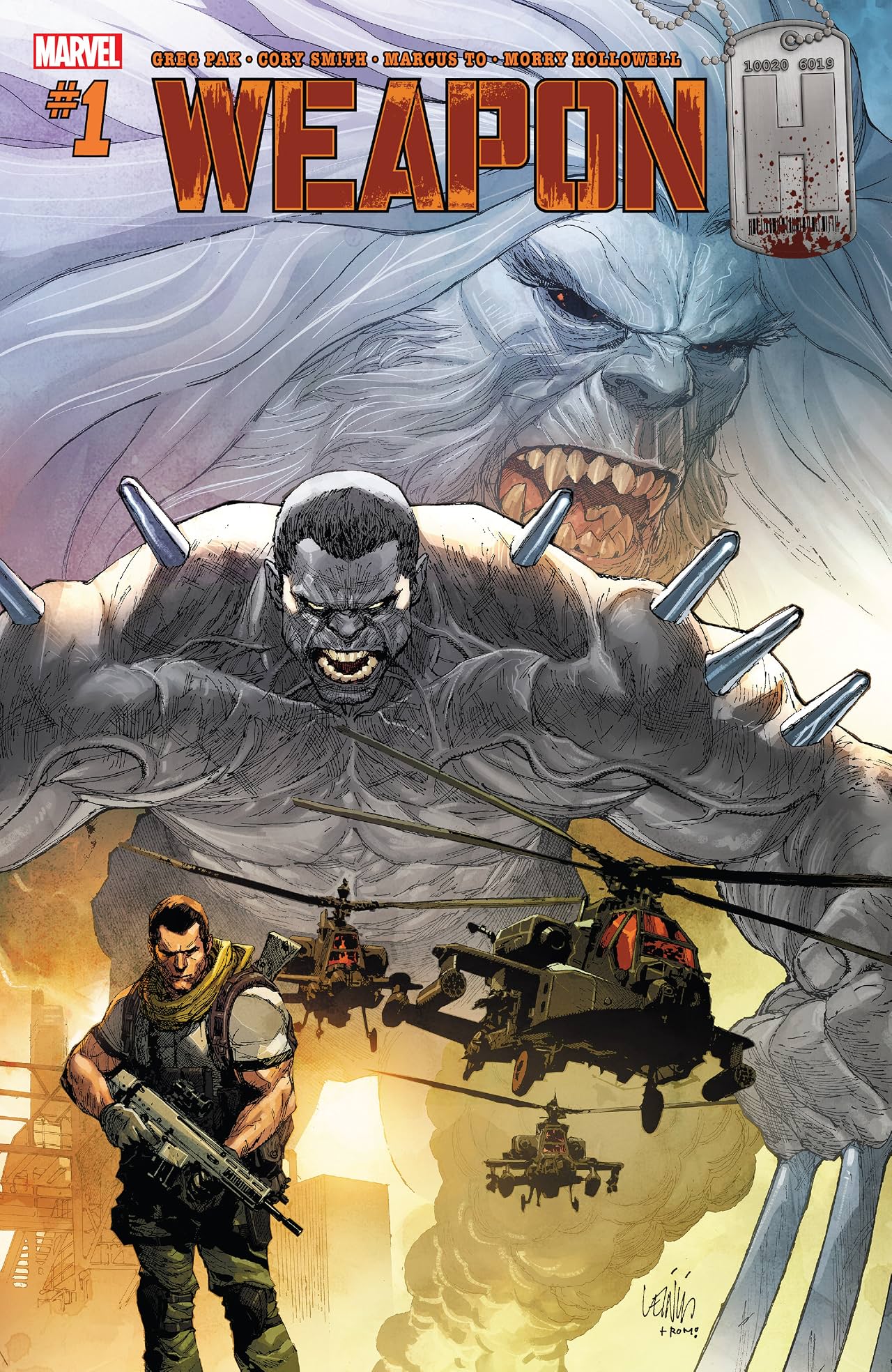
Mixing, Mashing, and Monsters: Weapon H #1

The following is my review of Weapon H #1, which was posted on PopMatters.com.


In an era of reboots, remakes, and re-castings, the bar for what constitutes overdone or overused seems to rise every year. Taking a chance and trying something new is just too risky and expensive. It's safer and easier to go with an established trend, even if it means leeching off its popularity to a point where it's so intentional that no one bothers joking about it. While it may frustrate those hoping for something new, it's hard to argue the power of the market. As long as it sells, it doesn't matter how uncreative it seems.

On paper, Weapon H sounds like a concept that is 95 percent gimmick and only 5 percent story. It combines Wolverine and the Hulk. The results are exactly what they sound like. In the pages of Weapon X, it emerges as a daunting threat from people who still aren't convinced that any effort to create a living weapon in the Marvel universe is anything other than an elaborate death wish. The idea that anything anything good could come from combining Wolverine and the Hulk sounds like the kind of thinking that requires repeated head trauma from Juggernaut.

Even if the concept seems basic and shallow, it somehow finds a way to be compelling. Greg Pak, who created Weapon H in the pages of Weapon X, uses the full range of his X-men and Hulk pedigrees to create a character who deserves to be more than just a gimmick. Weapon H is one of those characters that anyone who believes that Wolverine and the Hulk are too exposed can find an excuse to discount.

However, Pak finds a way to set Weapon H up for a compelling story that starts to unfold in Weapon H #1. It's story that has to take chances by being based on such a simple premise, combining Wolverine and the Hulk into a single character. It faces more obstacles than most in its effort to be compelling. Combined with the art of Cory Smith, it has more going for it than the concept may suggest.

In one issue, it establishes a narrative and a character that never feels too much like the Hulk or too much like Wolverine. Pak goes out of his way to put Weapon H on his own path. It's not entirely unique in that there are some elements that Hulk and Wolverine fans alike will recognize, but the story never feels too familiar or predictable beyond the messy monster battles. That's one element that can never be overdone.

Fighting monsters, however, is a very small part of the story in Weapon H #1. It may be too small to some extent, but necessary in order to establish who Weapon H and his alter ego, Clay, is in this story. He's not the smart, yet meek man with anger management issues like Bruce Banner. He's not a hard-drinking, womanizing brute like Wolverine either. He's a trained soldier who made the mistake of thinking a living weapons program wouldn't screw him over and leave him with lasting scars.

However foolish that assumption might seem to anyone who knows anything about the history of living weapons in the Marvel universe, Clay still carries himself like an honorable man and a dutiful soldier. These same traits are what helped him survive the events in Weapons of Mutant Destruction that play out in Weapon X and Totally Awesome Hulk. They're also what motivates his actions in this new phase of his story.

Clay is hardened at this point. He knows he's a target and not just because living weapons tend to draw out the worst kinds of people for the worst reasons. He also knows there are plenty of things that need smashing and stabbing. He doesn't put on a cape or a goofy costume and go out looking for it. He understands it's bound to come to him, which is why he tries to keep a low profile. He works odd jobs, pretending he doesn't speak English or Spanish. He avoids populated areas or established trails. He basically does what Bruce Banner does, but without as much whining.

That, in and of itself, makes Clay and Weapon H more appealing. His situation is bad, but he doesn't spend half his story lamenting or complaining about it. He's a trained soldier. He grits his teeth and toughs it out, fighting whatever problems come his way, including the non-monster variety. At a time when many soldiers aren't given the Captain America treatment, Clay's story feels more real, even when he eventually has to fight a monster.

To some extent, that kind of realism undercuts the monster-fighting spectacle of the story. A good chunk of that story is dedicated to telling the story Clay's family, who think he's dead. This is where the overall flow of the narrative loses some momentum. There's an effort to establish drama among Clay's wife and kids, but it comes off as flat. Their moments take away valuable time from what could otherwise be utilized for fighting monsters.

Along with Clay's family, there's another sub-plot involving Roxxon, one of the few organizations in the Marvel universe that are bold or foolish enough to get involved in living weapons. While there's a legitimate reasons within the context of the story as to why they would be interested in a claw-wielding Hulk, it only comes off as some generic evil plot from a James Bond villain. If nothing else, Roxxon gives Weapon H something other than monsters to smash.

There's certainly plenty of potential for smashing in Weapon H, as a whole. Clay's story is just beginning. Both Pak and Smith lay a solid foundation for a character who could easily be overlooked as just another rip-off/mash-up. However, Weapon H never attempts to replace the Hulk, Wolverine, or any other character. He doesn't even attempt to subvert their stories in pursuit of his own. He tries to chart his own path within the Marvel universe. That shouldn't be such a novel concept, but it's frustratingly rare in the current era of superhero saturation.

There's enough appeal with Clay and Weapon H to make the story in Weapon H #1 feel compelling. While there are plenty of familiar elements derived from established characters, Pak succeeds in making the story feel unique and personal. It just doesn't have enough spectacle or monsters to feel exciting or nuanced. That can certainly change, but he's going to have to fight more monsters if he wants to catch up to Wolverine and the Hulk.

Final Score: 6 out of 10

Thursday, November 16, 2017

Life, Living Weapons, and (Unlearned) Lessons: Weapon X #11

The following is my review of Weapon X #11, which was posted on PopMatters.com.


There are certain narratives that can only offer so much novelty and shock value. Audiences can only see Captain America punch the Red Skull so many times before it loses its underlying impact. There's nothing inherently wrong with these stories. They can still be uniquely satisfying in their own sort of way. However, there comes a point where the novelty is so absent that the concept lacks any sense of tension.

When it comes to the Marvel Universe, there aren't many rules, written or otherwise, that don't get bent or broken at some point. The dead come back to life with almost as much regularity as Spider-Man's immature wisecracks. Villains become heroes and villains become heroes with the ease of changing car insurance providers. The malleability of Marvel, and comics as a whole, is part of what makes it so entertaining in the first place.

However, there are still a few rules carved into adamantium that rarely get broken. One such rule involves living weapons. It may as well be as ironclad as Deadpool's immaturity. Anyone who creates a living weapon will be unable to control it. It's as inevitable as the Hulk's mood swings. That still doesn't stop the forces Weapon H, the latest attempt to subvert the living weapons rule within the pages of the Weapon X comic.

In a sense, this attempt is the most ambitious effort to date to make a story about living weapons seem novel. It involves both the Hulk and Wolverine, two characters that Greg Pak has extensive experience writing. It plays to his strengths and the over-the-top destruction plays into Marc Borstel's strengths as an artist. Weapon X #11, which marks the conclusion of the Weapon H arc, has every necessary tool to succeed. The results are somewhat generic, but the conclusion is still satisfying.

Weapon H has an uphill battle from the beginning, but does plenty to set himself apart, even if he is a simple mix of Wolverine and Hulk type brutality. Like nearly every living weapon ever created in an X-men comic, Weapon H has a wannabe puppet-master in Dr. Alba. Having already gotten assistance from the likes of William Stryker, Dr. Alba establishes herself as the kind of callous, corrupt manipulator who is crazy enough to think she can buck the trend of living weapons turning violently on their creators. To her credit, though, she manages to accomplish more than most.

Her hold on Weapon H comes off as more complex than simple brainwashing, at first. For much of the Weapon H arc, as a whole, Dr. Alba proved herself to be more thorough than the typical Hydra spy or used car salesman. She places herself at the center of Weapon H's world, making it seem as though she's less a puppet-master and more a friend. Throughout the story, she presents herself as the only friend Weapon H has left whereas William Stryker sees him as just another blunt instrument to satisfy his thirst for mutant blood.

It's cunning and it helps create a solid backstory around Weapon H, whose identity remains somewhat guarded. However, he is shown to have a civilian life. Like the Hulk and Wolverine, there is a man behind the monster. While that man makes his share of questionable decisions, especially being a special ops soldier who gets involved with a living weapons program, he does make clear that he values his humanity. He shows that he's not quite as eager to throw that away, which is something Logan can't always claim.


However, whatever complexity the man behind Weapon H may have, much of that gets undercut when Dr. Alba resorts to using the kind of outdated control methods that failed miserably with Wolverine and everyone like him since the late 70s. Not surprisingly, she still can't make anyone who values their humanity to willingly become a living weapon. She ends up resorting to hypnotic suggestions and a mind control serum. That may occasionally work in a bad CIA movie, but against the Hulk, that's akin to giving Deadpool unlimited amounts of tacos and napalm.

It still makes for some brutal, Hulk-level action that Borstel's art brings to life nicely. However, it never gets too brutal, primarily because Old Man Logan and his Weapon X crew don't let that happen. To some extent, that does limit the impact of the action. There's never a sense that the brutality has some sort of price beyond property damage. Unless insurance premiums are sentient, nobody suffers beyond the utter terror that comes with seeing a monster that blends the Hulk and Wolverine.

Even if the action is generic, the way the conflict gets resolved still feels satisfying and carries with it a fair amount of drama. While the method by which Weapon H regains control of his faculties are somewhat predictable, the way he deals with his situation is probably the healthiest way any living weapon can cope. He doesn't suffer the kind of violent, blood-rage breakdown that Wolverine seems to endure every other week. What he does is actually consistent with that of a soldier who understands what that role entails.

This is what gives Weapon X #11 more staying power, beyond simply resolving the Weapon H arc and bringing yet another living weapon into the Marvel universe. It creates a character in Weapon H, or Hulkverine as he's also called, who has something to offer that goes beyond the standard narratives that Wolverine and the Hulk have been telling since the Cater Administration.

Weapon H may be the latest in a long line of failed living weapons, but he establishes his own unique character and story. He's not like Wolverine and Sabretooth in that he's not a mutant. He's not like Bruce Banner either in that he's not a scientist with anger management problems. He's a soldier, but the complexity Pak establishes in previous issues help set him apart.

In doing so, the way in which Weapon H ends the conflict has a sense of dramatic weight. It also lays a foundation for more stories involving this character. Even if he is a basic blend of Hulk and Wolverine, that blend is still pretty potent. Like putting a fresh coat of paint over a new car, there's still plenty of appeal with Weapon H.

That, in essence, is Weapon X #11's greatest accomplishment. It doesn't just give Old Man Logan and his team of Weapon X outcasts another victory in the never-ending war against people who still think living weapons are a good idea. It creates a character in Weapon H that is worth rooting for and caring about. Even in a world where there are multiple Hulks and multiple Wolverines, it makes clear that there's still a place for someone like Weapon H. In the same way a world can never have too much chocolate or free donuts, it can never have too many compelling Hulk/Wolverine characters.

Final Score: 7 out of 10