Showing posts with label Greg Pak. Show all posts

Friday, March 23, 2018

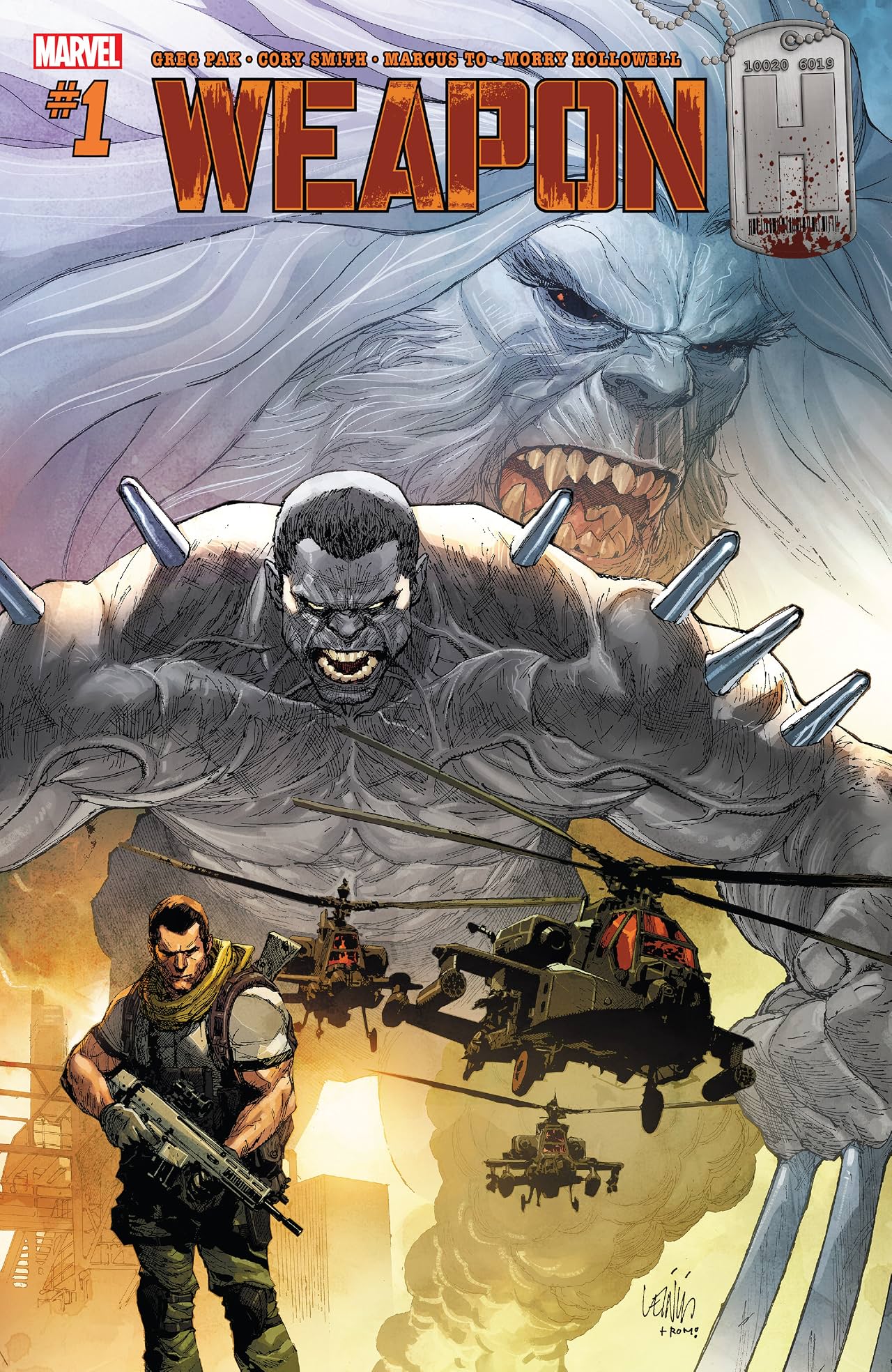
Mixing, Mashing, and Monsters: Weapon H #1

The following is my review of Weapon H #1, which was posted on PopMatters.com.


In an era of reboots, remakes, and re-castings, the bar for what constitutes overdone or overused seems to rise every year. Taking a chance and trying something new is just too risky and expensive. It's safer and easier to go with an established trend, even if it means leeching off its popularity to a point where it's so intentional that no one bothers joking about it. While it may frustrate those hoping for something new, it's hard to argue the power of the market. As long as it sells, it doesn't matter how uncreative it seems.

On paper, Weapon H sounds like a concept that is 95 percent gimmick and only 5 percent story. It combines Wolverine and the Hulk. The results are exactly what they sound like. In the pages of Weapon X, it emerges as a daunting threat from people who still aren't convinced that any effort to create a living weapon in the Marvel universe is anything other than an elaborate death wish. The idea that anything anything good could come from combining Wolverine and the Hulk sounds like the kind of thinking that requires repeated head trauma from Juggernaut.

Even if the concept seems basic and shallow, it somehow finds a way to be compelling. Greg Pak, who created Weapon H in the pages of Weapon X, uses the full range of his X-men and Hulk pedigrees to create a character who deserves to be more than just a gimmick. Weapon H is one of those characters that anyone who believes that Wolverine and the Hulk are too exposed can find an excuse to discount.

However, Pak finds a way to set Weapon H up for a compelling story that starts to unfold in Weapon H #1. It's story that has to take chances by being based on such a simple premise, combining Wolverine and the Hulk into a single character. It faces more obstacles than most in its effort to be compelling. Combined with the art of Cory Smith, it has more going for it than the concept may suggest.

In one issue, it establishes a narrative and a character that never feels too much like the Hulk or too much like Wolverine. Pak goes out of his way to put Weapon H on his own path. It's not entirely unique in that there are some elements that Hulk and Wolverine fans alike will recognize, but the story never feels too familiar or predictable beyond the messy monster battles. That's one element that can never be overdone.

Fighting monsters, however, is a very small part of the story in Weapon H #1. It may be too small to some extent, but necessary in order to establish who Weapon H and his alter ego, Clay, is in this story. He's not the smart, yet meek man with anger management issues like Bruce Banner. He's not a hard-drinking, womanizing brute like Wolverine either. He's a trained soldier who made the mistake of thinking a living weapons program wouldn't screw him over and leave him with lasting scars.

However foolish that assumption might seem to anyone who knows anything about the history of living weapons in the Marvel universe, Clay still carries himself like an honorable man and a dutiful soldier. These same traits are what helped him survive the events in Weapons of Mutant Destruction that play out in Weapon X and Totally Awesome Hulk. They're also what motivates his actions in this new phase of his story.

Clay is hardened at this point. He knows he's a target and not just because living weapons tend to draw out the worst kinds of people for the worst reasons. He also knows there are plenty of things that need smashing and stabbing. He doesn't put on a cape or a goofy costume and go out looking for it. He understands it's bound to come to him, which is why he tries to keep a low profile. He works odd jobs, pretending he doesn't speak English or Spanish. He avoids populated areas or established trails. He basically does what Bruce Banner does, but without as much whining.

That, in and of itself, makes Clay and Weapon H more appealing. His situation is bad, but he doesn't spend half his story lamenting or complaining about it. He's a trained soldier. He grits his teeth and toughs it out, fighting whatever problems come his way, including the non-monster variety. At a time when many soldiers aren't given the Captain America treatment, Clay's story feels more real, even when he eventually has to fight a monster.

To some extent, that kind of realism undercuts the monster-fighting spectacle of the story. A good chunk of that story is dedicated to telling the story Clay's family, who think he's dead. This is where the overall flow of the narrative loses some momentum. There's an effort to establish drama among Clay's wife and kids, but it comes off as flat. Their moments take away valuable time from what could otherwise be utilized for fighting monsters.

Along with Clay's family, there's another sub-plot involving Roxxon, one of the few organizations in the Marvel universe that are bold or foolish enough to get involved in living weapons. While there's a legitimate reasons within the context of the story as to why they would be interested in a claw-wielding Hulk, it only comes off as some generic evil plot from a James Bond villain. If nothing else, Roxxon gives Weapon H something other than monsters to smash.

There's certainly plenty of potential for smashing in Weapon H, as a whole. Clay's story is just beginning. Both Pak and Smith lay a solid foundation for a character who could easily be overlooked as just another rip-off/mash-up. However, Weapon H never attempts to replace the Hulk, Wolverine, or any other character. He doesn't even attempt to subvert their stories in pursuit of his own. He tries to chart his own path within the Marvel universe. That shouldn't be such a novel concept, but it's frustratingly rare in the current era of superhero saturation.

There's enough appeal with Clay and Weapon H to make the story in Weapon H #1 feel compelling. While there are plenty of familiar elements derived from established characters, Pak succeeds in making the story feel unique and personal. It just doesn't have enough spectacle or monsters to feel exciting or nuanced. That can certainly change, but he's going to have to fight more monsters if he wants to catch up to Wolverine and the Hulk.

Final Score: 6 out of 10

Thursday, November 16, 2017

Life, Living Weapons, and (Unlearned) Lessons: Weapon X #11

The following is my review of Weapon X #11, which was posted on PopMatters.com.


There are certain narratives that can only offer so much novelty and shock value. Audiences can only see Captain America punch the Red Skull so many times before it loses its underlying impact. There's nothing inherently wrong with these stories. They can still be uniquely satisfying in their own sort of way. However, there comes a point where the novelty is so absent that the concept lacks any sense of tension.

When it comes to the Marvel Universe, there aren't many rules, written or otherwise, that don't get bent or broken at some point. The dead come back to life with almost as much regularity as Spider-Man's immature wisecracks. Villains become heroes and villains become heroes with the ease of changing car insurance providers. The malleability of Marvel, and comics as a whole, is part of what makes it so entertaining in the first place.

However, there are still a few rules carved into adamantium that rarely get broken. One such rule involves living weapons. It may as well be as ironclad as Deadpool's immaturity. Anyone who creates a living weapon will be unable to control it. It's as inevitable as the Hulk's mood swings. That still doesn't stop the forces Weapon H, the latest attempt to subvert the living weapons rule within the pages of the Weapon X comic.

In a sense, this attempt is the most ambitious effort to date to make a story about living weapons seem novel. It involves both the Hulk and Wolverine, two characters that Greg Pak has extensive experience writing. It plays to his strengths and the over-the-top destruction plays into Marc Borstel's strengths as an artist. Weapon X #11, which marks the conclusion of the Weapon H arc, has every necessary tool to succeed. The results are somewhat generic, but the conclusion is still satisfying.

Weapon H has an uphill battle from the beginning, but does plenty to set himself apart, even if he is a simple mix of Wolverine and Hulk type brutality. Like nearly every living weapon ever created in an X-men comic, Weapon H has a wannabe puppet-master in Dr. Alba. Having already gotten assistance from the likes of William Stryker, Dr. Alba establishes herself as the kind of callous, corrupt manipulator who is crazy enough to think she can buck the trend of living weapons turning violently on their creators. To her credit, though, she manages to accomplish more than most.

Her hold on Weapon H comes off as more complex than simple brainwashing, at first. For much of the Weapon H arc, as a whole, Dr. Alba proved herself to be more thorough than the typical Hydra spy or used car salesman. She places herself at the center of Weapon H's world, making it seem as though she's less a puppet-master and more a friend. Throughout the story, she presents herself as the only friend Weapon H has left whereas William Stryker sees him as just another blunt instrument to satisfy his thirst for mutant blood.

It's cunning and it helps create a solid backstory around Weapon H, whose identity remains somewhat guarded. However, he is shown to have a civilian life. Like the Hulk and Wolverine, there is a man behind the monster. While that man makes his share of questionable decisions, especially being a special ops soldier who gets involved with a living weapons program, he does make clear that he values his humanity. He shows that he's not quite as eager to throw that away, which is something Logan can't always claim.


However, whatever complexity the man behind Weapon H may have, much of that gets undercut when Dr. Alba resorts to using the kind of outdated control methods that failed miserably with Wolverine and everyone like him since the late 70s. Not surprisingly, she still can't make anyone who values their humanity to willingly become a living weapon. She ends up resorting to hypnotic suggestions and a mind control serum. That may occasionally work in a bad CIA movie, but against the Hulk, that's akin to giving Deadpool unlimited amounts of tacos and napalm.

It still makes for some brutal, Hulk-level action that Borstel's art brings to life nicely. However, it never gets too brutal, primarily because Old Man Logan and his Weapon X crew don't let that happen. To some extent, that does limit the impact of the action. There's never a sense that the brutality has some sort of price beyond property damage. Unless insurance premiums are sentient, nobody suffers beyond the utter terror that comes with seeing a monster that blends the Hulk and Wolverine.

Even if the action is generic, the way the conflict gets resolved still feels satisfying and carries with it a fair amount of drama. While the method by which Weapon H regains control of his faculties are somewhat predictable, the way he deals with his situation is probably the healthiest way any living weapon can cope. He doesn't suffer the kind of violent, blood-rage breakdown that Wolverine seems to endure every other week. What he does is actually consistent with that of a soldier who understands what that role entails.

This is what gives Weapon X #11 more staying power, beyond simply resolving the Weapon H arc and bringing yet another living weapon into the Marvel universe. It creates a character in Weapon H, or Hulkverine as he's also called, who has something to offer that goes beyond the standard narratives that Wolverine and the Hulk have been telling since the Cater Administration.

Weapon H may be the latest in a long line of failed living weapons, but he establishes his own unique character and story. He's not like Wolverine and Sabretooth in that he's not a mutant. He's not like Bruce Banner either in that he's not a scientist with anger management problems. He's a soldier, but the complexity Pak establishes in previous issues help set him apart.

In doing so, the way in which Weapon H ends the conflict has a sense of dramatic weight. It also lays a foundation for more stories involving this character. Even if he is a basic blend of Hulk and Wolverine, that blend is still pretty potent. Like putting a fresh coat of paint over a new car, there's still plenty of appeal with Weapon H.

That, in essence, is Weapon X #11's greatest accomplishment. It doesn't just give Old Man Logan and his team of Weapon X outcasts another victory in the never-ending war against people who still think living weapons are a good idea. It creates a character in Weapon H that is worth rooting for and caring about. Even in a world where there are multiple Hulks and multiple Wolverines, it makes clear that there's still a place for someone like Weapon H. In the same way a world can never have too much chocolate or free donuts, it can never have too many compelling Hulk/Wolverine characters.

Final Score: 7 out of 10

Thursday, August 3, 2017

Anger Across The Ages: Generations: Banner Hulk & Totally Awesome Hulk #1

The following is my review of Generations: Banner Hulk and Totally Awesome Hulk #1, which was posted on PopMatters.com.


There are few constants in the ever-evolving, constantly-retconning narrative that is the Marvel universe. Costumes may change. Marriages may be undone by deals with Mephisto. Characters may turn out to be from an alternate universe, a Skrull agent, or evil clones of characters that died years ago. The fact that anyone can accept that kind of convoluted continuity with a straight face is a miracle, in and of itself. That makes the constants that remain all the more important and few are as memorable or iconic as the Hulk's anger.

His enemies may not like it when he's angry, but the Hulk's destructive rage makes for some of the best entertainment that the Marvel universe can offer. That anger, as blinding as it can be sometimes, takes many forms over the course of the Hulk's illustrious life. The rage that begins under Stan Lee's legendary pen is not the same as the one that continues under Greg Pak. That's what makes the concept of mixing the past and present so intriguing. That's the premise behind the Marvel Generations series. That's how the rage of one Hulk meets the rage of another in Generations: Banner Hulk and Totally Awesome Hulk #1.

In terms of context, the differences between Bruce Banner and Amadeus Cho are considerable. While both carry the burden of the Hulk, the weight of that burden is different for both characters. The death of Bruce Banner in Civil War II and the emergence of Amadeus Cho in Totally Awesome Hulk puts both characters on a different path. Pak, with the skilled art of Matteo Buffagni, brings those paths together in a story of shared anger.

The premise of the story is somewhat unclear. The mechanism by which Cho ends up in the past, confronting the Hulk during one of his earliest clashes with General Ross, is not overtly explained. Cho is in the present one moment. Then, he's in the past. That's the extent of the explanation.

That's not to say it's wholly contrived. In a world routinely driven by reality-bending hardware like the Cosmic Cube, the Infinity Gauntlet, and editorial mandates, it's not that much of a stretch that Cho would find himself unexpectedly in the past. That sounds like the sort of thing that happens to anyone who hangs out with Cable too much.

The lack of a premise does little to undermine the gamma-powered action, though. Pak doesn't waste any time giving Hulks from two different eras to start smashing something. He understands that if there are going to be two hulks in a story, then there needs to be twice the smashing. Generations: Banner Hulk and Totally Awesome Hulk #1 does plenty to fill that quota. Buffagni also does plenty to give it the distinct visual elements that make a Hulk story stand out. There are open spaces, raging monsters, and hard-nosed old men trying to solve problems by blowing them up.

In terms of checking the boxes for a classic Hulk story, Generations: Banner Hulk and Totally Awesome Hulk #1 covers most of the basics. However, the boxes it doesn't check are arguably the most important and that represents the most significant flaw in a story that otherwise has ample entertainment value. It's not enough to just have two Hulks smashing things. That's all well and good, but smashing without any greater meaning or drama behind it is just empty smashing. Even with the Hulk, that kind of smashing only goes so far.

 
It's when Cho and Bruce Banner aren't bulky green behemoths where the story really stalls. There's some initial confusion, as is to be expected whenever someone not named Dr. Doom warps time and space. Then, they start interacting, but not much comes of it. They try to avoid General Ross. They attempt to conceal themselves in populated areas. They even talk about their respective struggles to control the Hulk and the rage that drives him.

However, not much really comes from those conversations. Cho and Banner don't tell each other anything that they don't already know about themselves or the Hulk. There's not much dramatic impact in anything they do. Cho barely references the Hulk's future death in Civil War II, nor does he show much emotion when interacting with Banner. Given their history and their various connections throughout the Hulk's mythos, it feels downright muted.

There's still an underlying theme. There's still a sense of connection between Amadeus Cho's version of the Hulk and Bruce Banner's version. Concepts of anger, burdens, and dealing with inner monsters are all there. There's just no melodrama behind it. It may as well be an unnecessary reminder. Anyone who reads a Hulk comic from any era will get that same message, albeit with different varieties of smashing.

There's nothing about the narrative in Generations: Banner Hulk and Totally Awesome Hulk #1 that's out of place in terms of characterization, plot, or style. Both Banner and Cho get a chance to be their own Hulk. Pak, whose Hulk pedigree is beyond dispute, handles both characters as well as he has in previous efforts. Buffagni's artwork helps supplement those efforts. That's what makes the utter lack of impact so glaring and for a character who specializes in smashing, that's saying a lot.

Mixing elements from the past and present creates opportunities to explore classic themes while expanding on the dramatic weight that has built up to such a massive extent over the years. Generations: Banner Hulk and Totally Awesome Hulk #1 feels like one of those opportunities that was only partially realized. It does enough to smash all the right things. It just doesn't add enough merit behind the smashing.

Final Score: 5 out of 10

Friday, June 23, 2017

A Familiar and Weaponized Narrative: Weapons of Mutant Destruction #1

The following is my review of Weapons of Mutant Destruction #1, which was posted on PopMatters.com.


There are some ideas that are just so wrought with failure that the mere act of entertaining them again is akin to giving Deadpool an unlimited supply of napalm. It's one thing to revamp and reconsider a failed idea. Sometimes, ideas are just too ahead of their time or not properly managed. Others, however, are akin to fixing a cracked windshield with a sledgehammer.

When it comes to ideas that fail in the most spectacularly destructive ways possible, the Weapon X program and the gamma experiments that made the Incredible Hulk are basically co-champions. These are experiments with simple, albeit devious goals. One seeks to create the ultimate living weapon. The other seeks to create an unstoppable monster that can be controlled and directed like a bomb that never stops going off.

They are weapons that anyone, be they the Avengers or Hydra, wouldn't mind having in their arsenal. When it comes to developing them, however, there sheer breadth of the failures are so staggering that even the most deranged James Bond villain wouldn't dare attempt them again. Even with the combined efforts of the Scarlet Witch and every good luck charm that ever existed, the odds just aren't in anyone's favor.

That's why the premise for Weapons of Mutant Destruction is akin to waiting for a demolition derby where every car is armed with a machine gun and a rocket launcher. Weapon X and all things gamma related have done enough damage to the Marvel universe to buy Hulkbuster armor for every man, woman, and child. Greg Pak and Mahmud Asrar believe there's still plenty of entertainment value in that level of destruction. Weapons of Mutant Destruction #1 shows that even if that value is there, making it compelling is a challenge that even heavy doses of gamma can't help.


The foundation of the story is built on ongoing stories unfolding in two of Pak's other books, Weapon X and Totally Awesome Hulk. From a structural standpoint, the transition is seamless. A narrative that begins in Weapon X #1 starts to culminate in Weapons of Mutant Destruction #1. The key, with respect to the actual substance of the story, is that the culmination only starts. It just doesn't go very far. It's akin to a drag racer that makes a lot of noise, but stalls just as the race commences.

That's not to say the ingredients are there. Pak makes it a point to give the conflict in Weapons of Mutant Destruction #1 larger implications that go beyond his own books. Mutant-killing living weapons, as overdone as they may be, still pose an existential threat to the rest of the X-men. The use of gamma power poses a similar threat to anyone still affiliated with the Hulk. Every character involved has a purpose and a clear motivation in the story. Nobody ever gets involved in a living weapons program for fun. Even Deadpool isn't that deranged.

As the story unfolds, though, there's a sense that it's trying to avoid the familiar tropes associated with conflicts built around living weapons. There's a lot of exposition, not all of which is necessary. There are some mystery elements, which are organic extensions of the events unfolding in Weapon X. However, the very fact they involve living weapons somewhat limits the mystery.

The obscenely poor and exceedingly violent track record of living weapons programs in Marvel Comics doesn't hint at any major twist. In an era where Skrull agents and Hydra agents are overused, twists like that are limited in terms of impact. There's never a sense that Weapons of Mutant Destruction is going to break new ground. It has mutant-killing cyborgs and gamma-powered monsters. For both the X-men and the Hulk, these kinds of stories are aren't exactly as rare as adamantium.

Even though the story has many familiar elements, Pak does manage to mix in some unique details along the way. Teaming Amadeus Cho up with the likes of Old Man Logan, Sabretooth, and Lady Deathstrike adds some much-needed novelty to the story. Unlike Bruce Banner, Cho is less experienced with smashing mutant-killing machines. At the very least, though, Pak gives him plenty of incentive to learn quickly and not hesitate.


At one point, Cho is a little disturbed at the brutality of living weapons programs. Considering how Lady Deathstrike and Old Man Logan barely bat an eye, that's pretty revealing in terms of how common these stories are and how inexperienced Cho still is as the Hulk. From his perspective, fighting mutant killing machines isn't something he does every other Monday like the X-men. His role creates some new dynamics that help make the story feel fresh to a limited extent.

That extent still isn't enough to make Weapons of Mutant Destruction more than the latest in a long line of living weapons programs that need to be smashed and/or stabbed with adamantium claws. The story's reliance on exposition, as well as its slow pace, isn't going to make anyone hulk out. With the way the events plays out, the story acts more as a teaser rather than a culmination. That kind of structure works when a story is breaking new ground. It doesn't work quite as well when it's relying on the kind of living weapons tropes that have played out any number of ways since the disco era.

The concept of Weapons of Mutant Destruction is still sound. The story is, by no means, bereft of value. By most measures, Pak's handling of the story is competent and concise. The characters are spot on and the plot never gets too convoluted. Asrar's artwork complements these efforts as well, creating the kinds of dark, sinister undertones that are to be expected with any story involving living weapons or anyone who has ever had to deal with Lady Deathstrike and Sabretooth.

There's something to be said about a story that's so familiar that nothing short of clowns and Cosmic Cubes can make it feel novel. The concept of living weapons in the Marvel Universe is still one that will make anyone who has ever had to clean up blood stains roll their eyes. It can still make for a fun story though. Like a cold beer for Wolverine, it's a familiar and comforting experience. There will always be a place for stories like that in Marvel.

Final Score: 5 out of 10

Tuesday, August 23, 2016

Requiem For The Green Goliath: Civil War II: The Fallen #1

The following is my review of Civil War II: The Fallen #1, which was posted on PopMatters.com.


What makes a defining moment so defining has little to do with the immediate impact it has on a story. That impact may be intense and memorable by every objective measure, but it's often just a prelude to the much larger conflicts that it inspires. Whether it's Doomsday killing Superman, the Joker crippling Barbara Gordon, or Tony Stark taking his first shot of tequila, these moments only become defining when that larger conflict takes shape.

Without question, the death of Bruce Banner is the defining moment for Civil War II. The impact of this moment creates the catalyst for the real meat of the story. After this moment, the lines are drawn, the divisions are set, and the hearts of Marvel's greatest heroes are pulled in opposite directions. It's the last straw for Tony Stark. It's that painful moment of clarity that only admitted alcoholics can appreciate.

There's no question that the death of the Hulk lit the match that ignited the powder keg that is Civil War II. However, in the midst of this raging inferno, it's easy to overlook the personal impact of the Hulk's death. Bruce Banner dies surrounded by friends and former teammates who knew him as more than just the oversized brute with anger-management issues.

That sentiment is understandably sidelined by the larger conflict in Civil War II, but Greg Pak and Mark Bagley attempt to explore that sentiment in Civil War II: The Fallen #1. That sentiment proves vital to delivering the dramatic impact of the Bruce Banner's death. It takes a step back from the legal, philosophical, and ethical debate surrounding proactive punishment and focuses solely on the emotions surrounding those closest to Hulk and Bruce Banner. There's nothing that'll overwhelm a message board here. There's just raw, genuine drama surrounding the death of a beloved friend.

There are no monster battles. There are no alien invasions. There are no homages to Bill Bixby walking solemnly down a highway. Civil War II: The Fallen #1 deals solely with the reactions among Bruce Banner's friends and family. Those reactions are not divorced from the larger context of Civil War II, but they are secondary. The primary focused here is the mixed legacy the Hulk leaves behind.


The bitter part of that mixture plays out at Bruce Banner's funeral. Whereas Bruce's friends and fellow heroes are on hand to honor his memory, there are plenty of protesters as well who still condemn the Hulk in death. This is an important context to include because it highlights the unique dimensions of the Hulk. It's a big part of what makes him unique among heroes. Plenty of heroes have green skin and big muscles. Few deal with the kinds of complications that the Hulk deals with, even when he isn't angry.

It's easy to forget that the Hulk's rampages can be pretty destructive. Given the enemies he deals with, his battles incur more collateral damage than most. In a world that includes shape-shifting aliens, uncontrollable mutant powers, and helicarrier that crash every other week, that's saying something. Unlike those destructive elements though, the Hulk is a singular face on which people can focus their blame. As any minority, real or fictional, can attest, it doesn't take much blame to inspire outrage.

Despite this outrage, Bruce Banner spends his life trying to make the Hulk a force for good. Those are the efforts that his friends and family honor. Throughout Civil War II: The Fallen #1, the darker parts of his legacy aren't ignored. Instead, they are seen in context, which isn't easy to do with a rampaging monster. It's a testament to Banner's efforts and it nicely highlights the sentiment of every character involved.

However, the funeral of Bruce Banner isn't what gives Civil War II: The Fallen #1 the bulk of its dramatic weight. It's the living will that Bruce shares with his friends and family after death that evoke the most emotion. It doesn't just involve his assets, his work, or his acknowledgement that his anger management skills had room for improvement. It involves creating a legacy that appropriately embodies the impact of the Hulk. Naturally, it has to do with anger.

It all comes back to anger and how to deal with it. For most people, including Hulk's own friends and family, dealing with anger doesn't result in the same consequences or collateral damage as him. As a result, he has to work harder than most. That means he has to master anger management techniques that cannot be found in self-help books or overpriced seminars. His efforts to share this mastery, as imperfect it may be, acts as his greatest legacy as the Hulk.

It's fitting in so many ways. How many problems in the real world and comic book world could be solved if people just managed their anger better? How many battles would that avoid? How many buildings would go un-smashed? It's the best legacy that Bruce Banner could've left. However, it resonates with some more than others.


As fitting and heartfelt as Bruce Banner's final testament may be, there are those who need more than better anger management skills. Amadeus Cho, who Pak is developing in Totally Awesome Hulk, does not take time to grieve like so many of Hulk's friends. For him, the sentiment in Civil War II: The Fallen #1 is hollow at best. He sees what happened to Bruce Banner as an injustice and that just makes him too angry.

Cho's reaction, as well as the reaction of others like General Ross, are somewhat muted at times. There are some inconsistencies in the narrative and with certain characterizations, but the underlying sentiment is spot on. The tone in Civil War II: The Fallen #1 is solemn, but appropriate. Pak and Bagley craft a fitting, heartfelt sendoff to the Green Goliath. For once, anger takes a back seat to a Hulk story and it works, creating far less collateral damage in the process.

Final Score: 8 out of 10

Wednesday, May 20, 2015

Clear Skies and Clearer Understanding: Storm #11

The following is my review of Storm #11, which was posted on PopMatters.com.


There are certain characters whose appeal we'll never understand. Can anyone truly claim they know why Andy Dick had his own show or why Rebecca Black had a hit single? On the other end of the spectrum are characters like Storm, whose appeal goes beyond any viral video or Twitter trend. She's as much an icon for the X-men as Wonder Woman is for the Justice League. It's gotten to the point where we can accept a world where the X-men can function without Wolverine, settling instead for clones or inverted enemies. But we can't accept a world where the X-men can function without Storm. Just ask Black Panther.

In many respects, Greg Pak's has done for Storm what Grant Morrison did for Superman in his All-Star Superman series. He makes concepts like killing giant robots or humiliating the Lex Luthors of the world secondary. Instead, he focuses on fleshing out the defining traits that make us love Ororo Munroe.

Throughout this series, he's touched on many core aspects of her character. There's Storm, the dedicated teacher. There's Storm, the dedicated humanitarian. And there's Storm, the woman who just lost her lover. But no matter which Storm she is, she's a character that commands love and respect. And she does it while looking sexier than Superman ever could. She doesn't even need an obscenely revealing costume designed by Rob Liefeld either. It's one of the many testaments to Storm's character.

So before Secret Wars blinds everyone to the simpler pleasures of refined, likable characters, Pak explores one more core trait to Storm's character in Storm #11. And it's a trait that truly epitomizes the concept of the X-men as a whole. The imagery of Charles Xavier's bald head or Wolverine's chest hair might be more defining to some. But for Storm, the act of reaching out to a scared and unstable young mutant is what defines the X-men.

It's this act that Storm has raised to an art form that Pablo Picasso himself would admire. And she has to push her skills in this craft to their very limit because she has to deal with the kind of unstable mutant that wouldn't even be welcome on the set of Jerry Springer. Kenji Uedo, once the least unstable member of Generation Hope, has returned and he's still as unstable as ever. And since nobody has cared about Hope Summers since Andrew Luck's rookie season, he's taking his anger out on Storm.

In this respect, he chose the perfect target. Storm is the very antithesis of who he is. In addition to being a blatant Akira rip-off, Kenji is the ugliest manifestation of mutants. He's obscenely disfigured, exceedingly unstable, and can't be controlled. On the other end of the spectrum, Storm embodies beauty that even Hallie Berry couldn't sufficiently capture and power so balanced that it can end famine and bring joy. They're still similar in the sense that they both have the power to unleash untold destruction. The main difference is that Storm chooses to use that power to bring peace while Kenji chooses to use that power to make the world his personal toilet bowl.

Beyond just the physical and personal struggles, Kenji attempts to break Storm's spirit down by touching on all those she has interacted with throughout this series. Every struggle that has helped emphasize why she's the most iconic and beloved X-man in history is brought into the fold. It's a perfectly structured act of convergence that DC Comics should take note of. It effectively raises the emotional and personal stakes for Storm. And true to the goddess we know and love, she rises to the occasion in ways that even an army of Hallie Berry's couldn't capture.

Storm exercises every level of her strengths. First, she shows off the kind of power she has over the elements. Kenji, being an immature mutant who hasn't destroyed enough killer robots to call himself an X-man, tries to break Storm by attacking all the friends and allies she reconnected with over the course of the series. Instead of breaking, she gives Kenji a lesson that he won't get outside of an old Catholic school. In an act that would make Spinal Tap proud, she turns the volume up on her powers to 11 and creates a dazzling weather display that effectively purges Kenji's Akira-inspired attacks off the world. However, it's her second attack that is truly defining.


She was still in a position to give Kenji the kind of discipline that even the most sadistic nun wouldn't condone. She has more than enough power to make him wish he was born without skin. However, she chooses not to fight him. Instead, she and the friends she made in this series connect with Kenji. In doing so, she shows him that she too has an ugly side. She has a history of making bad mistakes and not just because of her choice in haircuts. She may carry herself with a beauty and grace that would inspire countless Sir-Mix-A-Lot songs, but she is still as flawed as he is. She just chooses to be something greater.

This is what ends up winning the battle. She doesn't have to kill or even hurt Kenji. She just has to inspire him. This is what makes Storm who she is. This is why she embodies the best of what the X-men have to offer. Cyclops may have the love of hot telepathic women. Wolverine may have the chest hair and bad boy appeal. Charles Xavier may have wisdom and likeness of Patrick Stewart. But Storm has the heart.

It is the best possible conclusion for a series. Storm #11 effectively links all the elements that have been explored throughout this series into one, concise narrative that acts as a love letter to Storm fans of every era. She is the last remaining anchor in the world of X-men that champions their ideals. She has the kind of spirit and heart that the Inhumans will never be able to match, although they'll certainly try. There are so many traits that make Storm the ultimate X-man. It's impossible for any issue or series to cover them all, but this one made a truly worthy effort.

Final Score: 10 out of 10

Thursday, April 9, 2015

Scanned Thoughts: Storm #10


There are some characters that find a way to be relatable, yet still have the kind of obscene power that makes gods, goddesses, and congressmen shit themselves. And I’m not talking about the kind of bullshit relatability that Spider-Man claims to have. Nobody not named Tom Brady can be a young, attractive white guy who bangs supermodels and still be relatable. And even though Peter Parker is the kind of guy who the Ted Cruzes and Hillary Clintons of the world would pander to in an election year, I find Storm to be much more relatable.

I know. That sounds like one of those things I say when I’ve had a few too many bong hits or lost a fight with a lawn gnome. But think about it. She’s an outsider who had to fight to survive under circumstances way more shitty than just making a mortgage payment. She’s very different in that she stands out in a crowd, but not to the point where the NYPD would subject her to a stop and frisk for reasons that don’t involve copping a feel. Yet still, she finds a way to be so loving and compassionate to all those around her, even when she’s surrounded by injustice and annoying teenagers.

Compared to that, her weather control powers are her second greatest abilities at best. Her solo series had given everybody so many reminders as to why she’s the most lovable and relatable X-men character in the Marvel Universe that nobody who isn’t in a coma has an excuse at this point. But Storm #10 still tries to reinforce it because damn it, it’s a point worth reinforcing.

It’s also a point that everyone in the Jean Grey Institute seems to understand. They know that when Storm arrives on the scene, everyone needs to step up their game. For a good chunk of this series, she’s gone on more than a few not-so-enjoyable excursions. One of them involved her getting wrongfully arrested. Luckily, she let the authorities off with a warning. So when she returns to the Jean Grey Institute, everybody stands up a little straighter because the bar for being a good X-man has once again been raised.


What follows is a brief, but meaningful exploration into the kind of life Ororo Munroe lives at the Jean Grey Institute when she’s not fighting Sentinels or inspiring others to worship her like the goddess she is at heart. That includes duties like teaching classes, answering emails, and sitting in on disciplinary hearings. It’s the kind of shit that goes on in real schools that don’t have a front yard that happens to be alive. It many sound menial, but it’s not beneath her. She never treats it as such.

That’s what makes her so much more lovable than most of the other heroes that get solo series and major movies. She’s willing to do these menial things and she finds a way to do them in a way that’s both graceful and awesome. That includes something as simple as clearing up a mold problem in the sewers and watering her plants. Storm doesn’t just accomplish these tasks with stunning efficiency. She does it with a grace and humility that makes her more worthy of worship than most every other god or goddess. How many other gods will take time out of their day to clean mold?


But the menial aspects of Storm’s duties at the Jean Grey Institute don’t last. They never do. After establishing that Storm is capable of handling her day-to-day duties with the divine beauty that we’ve come to expect, she faces a more typical X-men style problem. For once, this one doesn’t involve killer robots or corrupt mutant-hating diplomats. It involves some creepy, anime-porn inspired monster that shoots up from the sewer system that she just cleaned. I guess at a place like the Jean Grey Institute, this counts as a fairly typical Thursday afternoon.

Storm makes quick work of it. She’s not some cute anime school girl. She’s Ororo fucking Munroe. But in doing so, she also reveals that this creepy anime wannabe is actually a familiar face. It’s Kenji Uedo, also known as the most butt-ugly batshit character from the Generation Hope days. He’s been listed as dead for a while. But in a universe occupied by Jean Grey, he should know by now that’s no excuse. It turns out he’s back and the only way he could get the X-men’s attention was attacking them. That or his email was going too damn slow. He might still be using Yahoo.


Being the kind and understanding woman she is, Storm resists the urge to finish Kenji off again and rushes him to the infirmary. It’s there where she reveals in the most polite manner possible that he’s supposed to be dead. He died back on Utopia after he went ape shit and tried to kill everybody in ways that even tentacle porn doesn’t depict. As a result, he’s wearing a strait jacket. For what this asshole deserves, he should consider himself lucky.

This doesn’t stop Storm from being kind and comforting to Kenji. She gives him a chance to explain himself and he comes off as sincere. He’s weak, scared, and nothing at all like the Akira rip-off who fell in love with a brain in a jar (not a joke, by the way). It’s almost believable. He even has a reason for how he came back to life.

This asshole named Harmon, who Storm clashed with earlier in this series, used his exotic body to give his busted up physiology an upgrade. It’s pretty sick in a way that probably gives Sinister a boner. But it’s both believable and consistent with the recent events of the series. It’s not overly forced or contrived. It works. Compared to most resurrections that involve clones or shape-shifting aliens, it’s a huge plus. That doesn’t mean Storm is going to be his Oprah and hug him like a sick puppy. He’s still going to be on lockdown while a couple of telepaths monitor his mind. As kind and compassionate as Storm is, she understands it’s never wise to trust creepy teenage boys with a history of homicidal douche-baggery.


Other elements from previous issues in this series come into play as well. A few issues back, Storm met up with Callisto and a group of run-aways living in the sewers. It turns out they’re also having a nasty mold problem and they don’t have Storm’s powers to clear it up while looking sexy as hell in the process. So they either have to pick up a sponge or learn to live with it. There’s some nice quips about how shit was easier in the sewer when they had Morlock powers to rely on. It’s still the sewers though. Mutant powers can only go so far. Not having them also really sucks with scary shit starts attacking, as Callisto learns the hard way.


In addition to Callisto, another one of Storm’s friends from earlier in this series calls up and says shit is starting to stink. Forge, who actually had the privlidge of seeing Storm naked at one point, reveals that he also had a mold problem while working in Kenya. But windex and paper towels can’t clear this shit up because apparently, it’s not ordinary mold. It’s the kind that fuels a legion of Kenji Uedo style monsters.

It started with mold in the Jean Grey Institute, which Storm easily took care of. Now that shit has found its way to some of Storm’s other recent hangouts. It’s a nice bit of convergence for a series that has been remarkably concise in making Storm awesome in so many different ways. She’s had to battle her share of assholes along the way, but none quite like this. Any army of monsters that originated from an unstable teenage boy is bound to be disturbing than any killer robots.


When Storm hears about this, she quickly connects the dots. She knows Kenji Uedo has to be the source and she doesn’t need a Batcave, a Fortress of Solitude, or a Cerebro to figure that shit out. She understands that the best way to help her friends and allies is to go to the source. So she’s not just awesome and lovable. She’s also competent. That not as common as it should be. Look at Peter Parker’s long list of fuck-ups for proof of that.

She eventually does arrive at the source, but it’s a bit too late to unfuck the situation. More Akira-inspired monstrosities emerge and they’ve already got Rachel Grey and Beast. Kenji Uedo is still coming off as innocent. He’s trying to fight it off and doing a pretty shitty job. A metal chair might be marginally effective in a WWE match. It’s not nearly as effective is a big fucking tentacle monster. Still, I give the kid points for at least giving the impression he’s not the same asshole.


He loses those points pretty damn fast when he eventually gets sucked up into the monster and not like a cute school girl in a short skirt. As it absorbs him, he starts to talk like his old self again. That means he’s channeling his inner douche-bag again, sounding like a deranged artist who would make a statue of Paulie Shore out of dead baby seals if he could. Now it’s not clear if he’s still somewhat innocent in all this. That lack of clarity is somewhat confusing. The line between where Kenji Uedo ends and this oversized Akira rip-off begins is not easily defined. Maybe that’s on purpose, but it’s still overly obscure and lacks emotional impact.


Even so, Storm tries to be the kind and loving person she is at heart and reaches out to Kenji. She’s way more merciful and kind that Kenji deserves, but that only helps reinforce the traits that make her so awesome. This kid has already gone on multiple Godzilla-style rampages. He’s already carried himself with the kind of douche-baggery that would’ve made him a perfect cast member on the Jersey Shore. But she’s still willing to give him a chance. In an era where being caught with a tiny bag of weed means jail time for most people, that says a lot about Storm.

It also says a lot about Kenji when he basically spits in the face of Storm’s compassion. This is both a dick move and incredibly stupid. She’s a fucking weather goddess. She can use a tornado to do root canal on him if she wants. Even so, he’s got batshit insanity on his side so the battle feels more even than it is on paper. He wants to re-establish his douche-baggery in a story that re-established all the less obvious traits that make Storm awesome. In both instances, they succeed.


It would be easy at times to accuse Storm of being too competent and kind. Then again, that would be like saying a certain Playboy model is too beautiful. It’s not a valid complaint. But this issue does something besides give Storm a new challenge to overcome with the kind of grace and swag that she wields. It showed how she conducts herself as headmaster of the Jean Grey Institute. It also shows that for all the respect and authority she wields, she earns every fucking bit of it.

On the opposite end of the spectrum, Kenji Uedo has done everything possible to be unworthy of such respect. He was the chief asshole prior to Avengers vs. X-men and since he was on a team with Hope fucking Summers, that’s saying something. He makes a concerted effort to be sympathetic in this issue. He even ties it into some of the recent conflicts Storm has been dealing with. But given his history and his personality, it’s just hard to give his words any credibility. So it was hard to be surprised to see him go full tentacle porn in the end.

It was still nice to see Storm give him a chance. Granted, he pissed that chance away like a bad cup of coffee, but it once again demonstrated the kind of character Storm is. It also nicely tied in a few other stories that had been explored in previous issues. This sense of cohesion and the many respectable moments Storm brought make this series special. It’s special because she’s a special character that Marvel will never be able to replace with some bullshit Inhuman rip-off. I give Storm #10 an 8 out of 10. Kenji Uedo is a dick an a total Akira rip-off. Ororo Munroe is a loving, compassionate goddess that combines the heart of an angel with the badassery of an army of Amazon warriors. Nuff said!

Tuesday, April 7, 2015

Exposing Strengths and Weaknesses: Batman/Superman Annual #2

The following is my review of Batman/Superman Annual #2, which was posted on PopMatters.com.


There aren't a whole lot of things from the 1930s that are still around in their original form. Phones have gotten more advanced, cars have gotten more efficient, and polio is not nearly the concern it once was. But of the few things that have endured from that time of jazz, vaudeville, and economic stagnation, the most memorable constant that doesn't involve an FDR speech is still Superman.

Across generations and multiple wars, both hot and cold, we all know what Superman stands for. He is the embodiment of an ideal. He stands for truth, justice, and the American way before the American way became associated with drone strikes and bank bailouts. He might be the most powerful being in the world, capable of moving planets and winning a fight with Lex Luthor by sneezing. But he still always does the right thing, using his power to help people. It's the way we wish presidents, dictators, and prime minsters would behave. Most of them fail, but Superman still embodies the idea that power doesn't shouldn't keep people from doing the right thing.

So what if he didn't have that power? Could he still help people? Could he do so without being outwitted and overpowered in a way that most would experience if they challenged Chuck Norris to a cage fight? Those are all questions that Batman/Superman #2 Annual attempts to answer and it certainly is a question that's worth answering. Because if Superman can only do what he needs to do because of his powers, then that undermines his credibility in the same way Bruce Wayne being a lousy tipper would undermine his.

And that answer ends up making for an entertaining, action-packed struggle that once again shows that Superman's greatest strengths don't lie with his powers. He doesn't just prove it to those he's trying to help either. He also proves it to Batman. And when Batman is convinced of something, the argument is over. Even a creationist wouldn't deny it at that point.

What makes this struggle so entertaining is that it doesn't just put Superman in a position where he has to save the day without using his powers. It doesn't involve him stopping an armed robber, getting a cat down from a tree, or helping an old lady across the street. He has to battle the likes of Bane, Killer Corc, Cheshire, and an army of Man-Bats. These are the sorts of battles that Batman might be used to fighting during his summer vacation, but it's new to Superman. Even so, he finds a way to rise to the challenge.

The setup is pretty straight-forward. The Phantom King forces Superman to use his newly discovered solar flare power to save a city that had been devastated by Doomsday. This makes him vulnerable and since the Phantom King is still stuck in the Phantom Zone, he enlists some of Batman's cast-offs to finish Superman off while he's vulnerable. From a purely strategic point of view, it's actually pretty brilliant. De-power Superman and then have him face the kind of thugs that give Batman trouble. Because if they can annoy Batman, they're perfectly capable of maiming 99 percent of non-powered individuals.

But Superman proves he's part of that tiny one percent that can handle himself without powers. And he does this while Batman keeps trying to take care of the situation himself. Whereas most are content to let Batman do what he does bast, Superman still seeks to help and he seeks to do it as Clark Kent and not Superman. It's one of those rare instances where the strength of Clark Kent and the strength of Superman are really one in the same. It is possible for him to save the day without having to move planets or bend the laws of physics. And unlike Batman, he does it in a way non-brooding, non-Christopher Nolan manner.


At no point in the struggle does Clark Kent show any fear or hesitation to participate in this battle. Even though he's as vulnerable as any unlucky tourist that ended up on the wrong side of downtown Detroit, he still carries himself with the strength of Superman. He does this even when Batman attempts to restrain him for his own safety. It's a very unfamiliar and pretty humorous take on Superman. It would be like Adam Sandler attending the Oscars.

Moments like this help highlight the unique dynamic between Batman and Superman. Usually it's Superman who has to do the heavy hitting in a struggle. This time Batman has to play that role and he plays it in a way that would make Christian Bale proud. But in the end, he still needs Superman's help to finish the job. And this is what leads to the most defining moment of this story.

It's not enough for Batman/Superman Annual #2 to explore Superman's strengths, even in the absence of his powers. There have been stories about that since the Great Depression. The main strength of this story comes from revealing Superman's greatest weakness and this time it doesn't involve a glowing green rock. Even though Batman and Superman win the main battle, the Phantom King still wins the war. He does this in a way that plays to one of Superman's most admirable traits. He trusts people.

It's not a weakness in and of itself. We all need to trust others to some degree. Even Ayan Rand had to trust that her books wouldn't become fodder for political attack ads, as misplaced as it may have been. But it's a weakness that's exposed in the worst possible way for Superman. It's a weakness that the Phantom King exploits at the perfect moment when it seems as though Superman once again proved that he can be Superman without his powers. It provides an ending that has just the right impact after a battle that struck just the right balance.

Like the final play of this year's Superbowl, Batman/Superman Annual #2 gave a thrilling ending that will thrill some and horrify others. And this time, it isn't just the city of Seattle that's horrified. The questions surrounding whether Superman can be who he is without his powers are all neatly answered. But the answer isn't as comfortable as some probably wish it were. At the end of the day, doing the right thing for the right reasons is a great power to have. But not being bulletproof means it's a lot easier for the wrong people to ruin your day.

Final Score: 10 out of 10

Thursday, December 4, 2014

Scanned Thoughts: Action Comics #37


I find it remarkable at how as we get older, the shit that used to scare the piss out of us stops being scary. Forget the monster under the bed or the psycho-killer in the hockey mask watching horny teens fuck. Odin help us if the rent check bounces, the IRS audits our income, or the doctor finds a strange lump during a routine checkup. That's real horror right there. I imagine Superman has never had to get all that scared. Hell, a hockey mask and a machete would only mildly annoy him. This is a guy who can crush diamonds with his eyelids. There can't be too much outside the IRS that scares him.

But if Superman does have one major fear, it's protecting the people who are vulnerable. That vulnerability was exploited like a corporate tax loophole during the Doomsday arc. But even after he returned and started helping his hometown, Smallville, rebuild from the damage, more horror finds a way to fuck with him. It's not exactly the most novel kind of horror. It involves zombies and evil aliens that turn people into zombies, including Lana Lang's parents. It sounds like a rejected script from the Walking Dead, but it puts Superman in a difficult situations in Action Comics #37. And seeing him overcome these difficult situations has been entertaining since 1938 so why stop now?

A big part of Superman's ability to overcome these situations is his ability to get help from his friends. And remarkably, not all his friends are super sexy female scientists, reporters, or warriors. One is actually an obscenely rich Japanese kid with a robot toy fetish. It's not as creepy as it sounds. Toymaster is actually remarkably sane, even by Japanese standards. He's also utilizing his billions of dollars and arsenal of Japanese gadgets that only a teenage boy could conjure to help him with the strange Stephen King style mist that has fallen over Smallville. The problem is he hasn't yet figured out that it's a good idea to avoid the mist. It's like a cute, big-breasted blonde avoiding an abandoned meat factory in a horror movie. It's just common sense.


Superman is able to save Toymaster before he suffers the same fate every slutty woman in every slasher movie suffers. He gets him to the other side of the cloud before the mist turns him into a Walking Dead cosplayer permanently. But, true to form, Superman does this while exposing himself to the mist again. It fucked him and his friends up in the previous issue. Not surprisingly, it fucks him up again this time. It's like a guy that's hung over getting food poisoning. It's just adding insult to injury at this point. Something is attacking him, but it's not the typical giant monkey or alien robot. This is Smallville, Kansas. Not downtown Metropolis or the Batcave. So when a couple of typical, salt-of-the-Earth Smallville types approach with Children of the Corn style eyes, it feels genuinely creepy even for Superman.


This leads into a flashback that at first seems out of place for a story about a town being taken over by an alien monster, but it actually provides some meaningful context for Superman in terms of his relationship with Smallville. It takes us to a time when Superman is still just a prepubescent Clark Kent. It's a special time, taking place before he goes through the Kryptonian equivalent of puberty and learns why X-ray vision next to the girls' locker room is the best power ever. He's just a kid, but he still has the same traits that make him Superman.

One day during recess, Clark finds a burning field across town. Being way more compassionate than a typical kid his age, who is usually reluctant to share his juice box, he rushes to the scene. There are four people in danger, but one of them is stuck in the flames. He has to find a way to save that person without turning them into a walking pot roast. He decides to employ his superbreath. It does the trick, but it doesn't exactly help the guy he's trying to save.

It's a powerful moment for a young Superman. It shows that while he still has a knack for helping people, he wasn't always that good at it. In the past, he has screwed up. Yes, Superman can screw up, especially when he's a kid. And this is in his hometown no less. It adds some emotional weight to his desire to save Smallville. This isn't just his home. This is where he learned to be Superman and fucked up a little along the way. Something about that should give the non-trolling population of fans a warm and fuzzy feeling inside.


When Superman wakes up from this flashback, the score is officially Creepy Alien Mist 1 and Superman 0. He wasn't able to fight his way through without getting excessively hung over. Steel and Lana Lang have gotten Superman to a bed where he can rest and awaken. Sure, he has a massive headache and for a guy who can bitch-slap a black hole, that's saying something. But he's still in one piece, minus a sliver of his dignity. It's actually an intriguing notion, Superman having a headache after a battle. Now he knows how Batman must feel every 15 minutes of his life.

But as intriguing it might be, the details get a little fucked up here. There's no explanation for how Steel and Lana Lang retrieved him from the migraine-inducing mist in the first place. And when Superman steps outside, he finds out that he's still in the mist and nobody else in Smallville is all that terrified. In fact, they're still going about their business as though being shrouded in an alien mist is as minor as a shaving cut. I guess in the DCU it is to some extent, but it's still creepy as fuck. It would be like a team of sexy nudist cheerleaders casually taking a stroll through a graveyard full of serial killers. And maybe that's the point. It's meant to be creepy and it succeeds a little too well.


This doesn't stop Superman from being Superman. Even though the folks of Smallville are just going about their day, assuming Superman will triumph over whatever creepy force is behind this mist, he urges them to return to their homes and wait for the punching to stop. And being such nice, polite folk despite probably having voted for Mitt Romney, they listen to him. They all seem to trust him completely. It's one of those other great superpowers that can only come from not being an occasional douche-bag. By being the kind of hero that inspires others, people are a bit more willing to listen to Superman out of choice and not fear. The Batmans and Iron Mans would do well to remember this.


With Steel and Lana at his side, Superman ventures back into the mist, assured that the people will be safe while he beats the living shit out of whatever is giving him such a headache. They eventually make their way back to the graveyard where this all began, complete with a miniature zombie attack. Along the way, Superman notes that this was where he fought Doomsday and that fight left more than a few wrinkles in the Phantom Zone, which offers at least a partial explanation of where this crazy Stephen King reject came from. But in this age of infinite Earths and inversion spells, a partial explanation is sometimes the best we can hope for.


With or without this explanation, Superman is able to find this creature, who looks like a bastardized version of Cthullu and a Power Rangers monster. That monster even managed to capture Toymaster, giving Superman even more reasons to beat it in ways that every Japanese school girl in anime porn probably wishes they could. There's just one minor complication and it has nothing to do with panties for once. Remember all those people who were so unconcerned and cooperative with Superman? Well if it sounded too good to be true, I'm sorry to say that like all emails from a Nigerian prince, it was.

The mist still has a hold on them. It hasn't turned them into zombies, but it has turned them into a group of brainwashed people capable of mind-fucking whoever this creepy alien creature finds annoying. So once again, Superman learns how much headaches suck. It's another powerful moment. This creature isn't actually the one hurting him most. It's the people he's trying to save. It's the kind of irony that would make Alanis Morissette extremely horny. They don't just attack him either. They also attack Lana and Steel. So once again, Superman is in a situation where he can't just punch his way to victory. At this point, anyone would have a headache.


This is where Superman takes those lessons he learned in that flashback and applies them. Unlike many adults I know, he actually learned from his mistakes as a kid. He's able to use the same superbreath that once ruined so many perfectly innocent birthday cakes to make the citizens of Smallville cold and uncomfortable enough to stop attacking him. He doesn't hurt them. He doesn't kill them. He just makes them as uncomfortable as someone walking outside on a cold winter day without a jacket. Let's face it, there are way worse things these people could endure. Hell, this isn't even as painful as cutting their internet connection or running out of bacon.

It's not just a display of Superman's compassion. It shows that as powerful as he is, he's actually smart when it comes to applying that power. He never applies more than necessary. Compare that to the SWAT team raids on homes that are suspected to have a couple marijuana cigarettes. The DEA could learn a lot from Superman's approach. Maybe if the anti-drug folks in the government didn't use excessive force the same way a compulsive masturbator uses lube, the pot smokers wouldn't be gaining so much support. But that's not going to happen. That might actually make sense.


By saving the people and breaking the hold the mist has on them, Superman is now able to focus on the monster. Sure, it means all the civilians no longer under its control are terrified as fuck and probably shitting themselves as they're running away. But if soiled pants is the worst they have to deal with, then they should consider themselves lucky. I'll take shit-stains over being mind-fucked any day of the week. It finally puts Superman, Steel, and Lana in a position to solve this problem with the excessive violence and punching that is so overdue at this point. It might have been tedious, but it made the end result all the more satisfying.


On paper, the concept of putting Superman in a horror movie type plot sounds as laughable as putting OJ Simpson in a family friendly Disney movie. It really shouldn't work, but it still somehow finds a way to be interesting. It puts Superman in a conflict that he can't just punch his way out of like the Hulks of the comic book world would prefer. It even attempts to humanize him, giving him a headache and to go along with this "I'm too old for this shit" type struggle. Throwing in Lana Lang and a few flashbacks and there's some emotional weight as well. It turns what could've been a story with the depth of a B-rated horror movie in the 1950s to a fairly well-balanced story. It's still not a story that has enough "Oh shit!" type moments. It's also lacking in memorable dialog in the sense that it uses the word "No" more times than an obese kid before a fitness test.

But these shortcomings aren't extreme to the point where the story descends to Adam Sandler caliber absurdity. For that reason, I give Action Comics #37 a 7 out of 10. This comic is proof that Superman can make even basic horror stories awesome. It's also further proof that the man can rock a beard like few others. I guess it was just too sexy for the women of the DCU to keep. Nuff said!

Friday, September 26, 2014

Scanned Thoughts: Storm #3


I know I give ex-girlfriends a lot of shit on this blog. To be fair, some do plenty to earn it. But I understand there are some that are actually civil when it comes to breakups. These women might as well be on the endangered species list with the tiger and the spotted owl. That’s what makes them so precious. In terms of ex-girlfriends, having someone like Storm could either be really good or really bad. Most people who get on Storm’s bad side live every waking moment terrified that a lightning bolt will get shoved up their ass at any given moment. But unlike most gods, she’s merciful and understanding. She’s had her share of love interests in the past. She’s done a lot in recent times to make Wolverine her most passionate interest, which is fitting since he’s about to die. But of all the lovers Storm has had, few have been more complicated and confusing as Forge. For a time, they had the kind of chemistry that would’ve made them the tabloid equivalent to Brad Pitt and Angelina Jolie. Then they had to become Ben Affleck and Jennifer Lopez. It’s been a long time since they’ve interacted. Hell, Storm has been married and divorced in that period. Now in Storm #3, their paths are set to cross again. I don’t expect Storm to be the kind of vindictive ex-girlfriend who dedicates her every breath to emasculating all men around her. But even if she did, who would I be to question a goddess like her?

By this standard, I would say Beast counts as an infidel because he keeps busting Storm’s balls for some of the exceedingly noble shit she’s been doing lately. First, she dared to help a village that had been under the thumb of a ruthless dictator. Then, she located a bunch of missing teenagers that Callisto had been looking after and decided to leave them in her hands. This all seems too Cyclops-like to Beast so he complains, but as always nothing comes of it. He just reminds her that doing the right thing and being awesome sometimes has consequences and his balls are too fragile to take some of those consequences. But that’s his problem.

Beyond being a douche, he does give her something of substance beyond his constant whining. Someone wants Storm to visit Kenya to oversee the deployment of a new technology that will combat drought. It’s pretty exciting because if it works, it means her homeland would be free of famine and U2 fundraisers forever. Having once been worshipped as a goddess back in Kenya, she has plenty of reasons to go and getting away from Beast’s bitching is definitely top five.


She returns to Kenya, recounting all the ways it’s near and dear to her along the way. Anyone not familiar with her history won’t have to rely entirely on Wikipedia for once, which might be jarring for some readers. She’s then greeted by an elder named Esther Shira, who was among those who worshipped her. It’s not every day someone gets to actually meet the goddess they worshipped without the aid of potent hallucinogens. Usually, that takes the fun out of it, but Storm’s beauty and grace more than makes up for it. Esther provides a kind and welcoming face for Storm and the villagers, who I imagine wouldn’t hesitate to worship her again if she could ensure they never had to listen to another U2 concert again.


At first, it’s shaping up to be a nice, pleasant visit to her homeland. Then Storm meet’s Esther’s son, Noah, who’s kind of an asshole. He’s not an Iceman-caliber asshole, but at least he has an excuse. He’s helping with the new irrigation system, which apparently had its water cut off three years ago because someone didn’t get their bribe or someone just felt like being a dick. Not going to start accusing Iceman or Beast, but I’m not removing them from my list of top suspects. Whatever the reason, it provides a decent context as to why this town wants this new technology to work. It would help them sleep easier at night knowing their likelihood of going hungry isn’t contingent on how much of a dick someone is willing to be.


Then Storm’s trip home gets even less pleasant because Esther reveals who is responsible for providing this technology. It’s not the Gates foundation or Warren Buffet. It’s her old flame, Forge. I’m sure Storm was hoping that Brad Pitt and Angelina Jolie were the ones behind this, but that might have been asking for a bit too much. It makes for an awkward, yet somewhat hollow moment. But it’s a moment that has been a long time in the making.

I say it’s hollow because as awkward as it was, it didn’t really have much of an emotional impact. It was basically, “Oh…my ex is here. Okay then, now I want to kick Beast’s ass.” It undermines the history between these two characters. Granted, that history is somewhat buried and hasn’t really been a factor since the Reagan administration. But for a time, Storm and Forge were a pretty serious relationship. Now their paths finally cross again after she’s been married, a queen, and re-adopted her Mohawk hair style.

It’s not completely random either. Forge actually decided to test this technology in this village because Storm told him about it back when they were together. And he specifically didn’t mention his name when he sent Storm the invitation. I don’t want to say that’s a dick move because he’s trying to feed starving people here. I’ll just say that he’s lucky Storm is so understanding because inviting an ex is usually like inviting a hungry pit bull to bacon factory.


Despite the minimal emotional impact, Forge gets right down to business. He starts demonstrating his technology, which is capable of creating a small storm cloud over a field. It’s basically the kind of shit Storm can do in her sleep. The problem is when he tries to turn it up, he triggers the kind of shit she would conjure if she found Sinister choking a baby kitten. There’s very little balance in between. It’s like my shower, which has only two settings: arctic blast and devil piss. He says it needs calibrating, but the blessings of a goddess certainly couldn’t hurt. Storm tells him that nature is all about balance and by fucking with that balance, he’s going to get way worse than a few lightning bolts up his ass. Most people probably pray for that whenever they need to call tech support for Verizon.


But making this technology work isn’t the only conflict here. Some, namely that prick Noah, aren’t too keen about getting this kind of help, even if it’s from a goddess. I would say that’s a dick move, but he and Forge do make some valid points. With the exception of stoners and S&M enthusiasts, nobody likes having to rely on outsiders to survive. Noah thinks relying on this technology could make them the equivalent of crack heads. Forge makes clear that he intends to let the village control this technology, not some poorly-managed foundation run by rock bands looking for good PR. There’s not a lot of trust and given Forge’s history, that’s not entirely unreasonable. It still feels like a shitty excuse to refuse a way to combat famine. There are many legitimate complaints about not accepting handouts, but even the Koch brothers would agree that preventing famine deserves an exception.


Whatever their reservations, Storm still decides to help. Preventing famine in her home country is kind of important to her. She starts helping Forge out, but this is where she starts recalling all the reasons why trusting her ex-boyfriend might not be the best way to aid her people. She starts reminding him of some of the shit he pulled back in the day and she doesn’t just focus on the nasty stuff that probably made it into Penthouse. It makes for a much more volatile test and volatile by Storm standards means hiding in the basement like doomsday preppers for those of us with less divine standards.

She starts listing more instances where Forge fucked up. He tries to make the same excuses that so many others made, saying he wasn’t in his right state of mind. If that excuse doesn’t work for Cyclops, it sure as hell doesn’t work for Forge. Storm then makes clear that if for any moment she suspects his asshole inclinations factor into this technology of his, she’ll make sure it fails before it can screw over the innocent people it’s supposed to help. And being her ex, he can expect her to be extra careful when judging him. That means Forge better have an adamantium cup protecting his balls.


To his credit, Forge keeps up his end of the bargain. He’s able to calibrate the machine and makes sure it works in a way that won’t punch Mother Nature in the jaw. The problem is that Noah, the second biggest asshole in this series after Beast, isn’t satisfied with that. He wants Forge to make it so they still have the option to fuck with the weather if they’re so inclined. Maybe they think a gentle rain just isn’t enough. Maybe they’ll just get bored one day and decide to unleash a hurricane at some neighboring village that gave them a dirty look. Forge doesn’t like it, but he’s not in a position to oppose him. For Storm, however, Noah can safely assume he’s more fucked than a wounded deer in front of Ted Nugant’s house.

Storm doesn’t wait for anyone to reason with Noah. She lives with Beast and Iceman. She knows when douchebags can’t be reasoned with. So she does what she has to do and destroys the machine before Noah can claim it. This rightly upsets Forge and Esther, but Storm rightly points out that nobody trusts each other enough with this gear. She then lists all the ways it could be horribly misused and after Noah expressed an interest in having that option, she’s perfectly justified in destroying it. The threat of famine sucks, but the threat of fucking up the weather sucks even worse and for way more people. It’s a difficult decision that even gods struggle to make, but it’s one Storm makes and she does it with a grace worthy of a goddess. I know I should be used to that by now in this series. I really should. But like a cold beer on a hot summer day, it never gets old.


Storm leaves Forge to continue working with Noah in hopes they’ll rebuild the machine and the trust they’ll need to run it. It’ll also give Esther plenty of time to punish Noah for being such an asshat. It makes for one last nice moment between Storm and Forge. They don’t go so far as to have any makeup sex, although I’m sure the thought crossed Forge’s mind. Storm isn’t even ready to have the, “Let’s just be friends,” talk either. But she makes clear that she doesn’t hold grudges and she’s willing to give friendship a chance. Whereas most goddesses would smite infidels and laugh while they suffer, Storm is willing to be friends with them. I’m pretty sure that puts her several rungs above every other god ever worshipped, but that really shouldn’t surprise anyone at this point.


Having a good ex-girlfriend is like having an inoperable but benign tumor. It can be horribly uncomfortable and unsightly, but it’s better than the alternative. Now Storm certainly has reasons to be a lousy ex-girlfriend to Forge. Their history has been troubled at times, albeit not to the degree that Tom Cruise’s last marriage, but she’s not one to hold a grudge. For any ex-girlfriend to say that is like hearing a cop say, “Meh, don’t worry about all those unpaid parking tickets.” It’s both liberating for forge and symbolic for Storm. It once again shows that she’s a goddess worthy of worship. She’ll take the moral high ground and look dead sexy doing it.

And like previous issues, she’s willing to go out of her way to take on heroic tasks that don’t involve killer robots. Helping a poor African village create a better irrigation system to avert famine might not be as impressive as hitting a Sentinel with a few dozen bolts of lightning, but it’s every bit as heroic. It’s the kind of shit Bono fights for when he’s not pissing off ITunes users. This issue didn’t hit the same emotional chords as the first two, but it’s still a quality story about Storm being awesome. Storm #3 gets an 8 out of 10. Forge is in an elite club of men, having dated a beautiful woman and not been subject to their bitter wrath. His balls should thank him every day for that because there are too many men in this world, especially those who have never heard of a pre-nup, who can’t say the same. Nuff said!

Wednesday, August 20, 2014

Scanned Thoughts: Storm #2


I don’t claim to be an expert on women. I can only claim to be an expert in finding ways to piss them off. Any man claiming to be an expert in women is either lying, delusional, or mistakes having a fuckton of money as charm. It’s for that reason I think comics that focus on one female character are so hard to make awesome. Most comic book writers are men. I’m sorry feminazis, that’s just the reality. Bitching about it won’t change that. But there are so many powerful women in comics that it’s easy to forget that many of them were created by men. And even when women get a chance to write them, it doesn’t always work out. That’s why I think we’re in a golden age of female comic characters. Between Captain Marvel, X-23, Elektra, and Ms. Marvel, there is a wealth of strong female characters to go around. I’m sure feminazis will still find a reason to bitch about it, but they should at least give Storm a pass. She’s one of the most powerful and endearing characters in the history of Marvel and after what I can only describe as a crack-induced oversight, she has her own solo series again. The first issue was a testament to all the things that make Storm awesome. Storm #2 now has the task of adding a little shine to that testament. In the past, I would be skeptical at best. But in this wonderful age of wonderful comic book women besides Wonder Woman, I’m going to try and be optimistic without the aid of cocaine.

It’s much easier for Storm to be optimistic. In the previous issue, she roughed up a few angry militia types in an area where the local government gives human rights the same priority as used toilet paper. It also pissed of Hank McCoy, which is always a bonus these days. Whereas I would celebrate such a feat with 30 strippers and a case of whiskey, Storm has simpler tastes in that she opts to have a lunch date with Wolverine over beer and a burger. So not only is she a goddess, she appreciates beer and burgers. Anyone not worshipping this woman yet has no fucking soul.

They talk about the incident and how it pisses off Beast, which I imagine counts as foreplay for them. Wolverine comments that she’s being a little reckless than usual and while it does give him a boner, he does worry because that’s his job and she’s just going to upstage him. Storm claims it might be him influencing her, but that only gives her a pussy boner so I guess the feeling is mutual. Rather than arguing like most couples would, Storm gets up and asks Wolverine to dance a little. Wolverine comments she’s always had a bit of a bad girl inside her and not just because she used to be a thief. He’s probably not wrong either. When the owner of the restaurant tells them no dancing, she gives him the Johnny Manziel treatment and does it anyways. And unlike Manziel, not even the NFL would dare fine her.


After a nice little dance that should keep Storm/Wolverine fans squealing until Labor Day, Wolverine says he has to go back to his binge drinking and super-secret missions. I have a hard time believing any of that shit is more appealing than spending quality time with Storm. But before he leaves, she shows him that she can be a bad girl and the best possible ways. It’s the kind of gesture that should keep Storm/Wolverine fans squealing until Labor Day in 2017. It also sucks in a way because the Storm/Wolverine relationship that began after Avengers vs. X-men really hasn’t gotten a lot of development until recently. And as it just so happens, Wolverine is set to die so this blossoming relationship has an expiration date on par with milk from Wal-Mart. It’s tragic, but at least they’re getting in nice moments like this. We can’t have the makers of Prozac getting too excited.


With her lover now off on his super-secret stabbing missions, Storm is left on her own. She can do anything she wants. She’s a fucking weather goddess. But while some would use their absent lover as an excuse to bang half the fire department, Storm decides to use her powers to find a missing girl. Why? Does she even need a reason? Like I said, she’s a fucking weather goddess. I don’t dare question how she spends her free time because I enjoy not having a lightning bolt shoved up my ass.

But helping a missing girl isn’t just some random act she decides to do in the same way I might randomly decide to dip bacon in a can of baked beans. A missing girl is something that resonates with her personally because she was once one of them. It’s hard to imagine that the goddess so worthy of worship now was once a pickpocket in Cairo. It’s like imagining Marlon Brando when he weighed under 250 pounds. A nice flashback captures all the emotions and struggles that she dealt with. She had to watch fend for herself after watching her own mother die from under a pile of rubble yet she still became this kickass X-woman/goddess. She makes the people who bitch that they didn’t have cable growing up sound like real assholes.


The girl she hopes to find is named Angie and her story is the kind of shit that Nancy Grace built her career on. She lived in a shelter, got involved with an abusive asshole boyfriend of the Ike Turner variety, and just disappeared. Since she just turned 19, the police are taking a “Let’s not and say we did,” approach to finding her so they could focus on more important things like harassing minorities with weed. That means it’s up to Storm to find this girl and she has nothing to go on but Angie’s old cell phone. Being a goddess, she can succeed where the police fail to give a shit and look damn sexy doing it.


She’s able to convince Beast to stop being a douche-bag for at least three minutes and help her use the phone to track Angie’s possible location. He may make shitty excuses to Cyclops and Wolverine, but even he’s not a big enough douche to fuck around with Storm. With his help, Storm finds out that she’s somewhere in the sewer systems of Manhattan. That makes sense because that’s the only place that doesn’t cost twenty bucks just to get into. It’s still not a pleasant place for Storm. She still has severe claustrophobia on the same level that I have a severe phobia of running out of beer. But that isn’t really a factor and that’s somewhat of a disappointment because a dark sewer is the kind of thing that would make most claustrophobics shit themselves. There’s still some nice internal monologue to provide more insight into Storm’s motivation for finding this missing girl, but she’s still way too comfortable than anyone should be in a New York City sewer, claustrophobic or otherwise.


It gets extremely uncomfortable very quickly when her search for Angie leads her directly to Callisto, who is about as welcoming to visitors as North Korea. It also doesn’t help that Storm and Callisto have a history. And by that I mean her history is almost on the same level as the history between Giants fans and Eagles fans. They don’t need to start arguing which team is going to suck worse this year. They just start fighting.

It’s a volatile, but somewhat tame fight. It contains some nice references to past X-men stories involving the Morlocks. It also provides a more personal kind of action that goes beyond just blowing up killer robots. However, anyone who doesn’t know that history very well is just going to see a couple of mutants fighting for no fucking reason. Even for those who do know their history, the way the fight just happens feels off. It’s like a bar fight that starts when everyone is still sober. It might be personal, but it has little purpose.


Storm naturally gains the upper hand, forcing Callisto to get help from some friends of hers that look like Voldermort cos-players. But they still know they’ve got no chance against Storm. I’ll say it again. She’s a fucking weather goddess. They might as well be a bunch of grasshoppers trying to take down Godzilla. Knowing this, they wisely run. Storm follows them, probably assuming that these people are using girls like Angie for ritual sacrifices to some lesser god with the head of a llama and the body of a squid.

But when she catches up to them, she finds something completely different. Not only are there no ritual sacrifices going on, but Angie is there and she’s incredibly pissed at what Storm did to Callisto. She even finds out that what she thought could be an evil ritual chamber is actually the equivalent of a college dorm. And she just fucked it up without even giving them the courtesy of a keg party. It’s an awkward moment on par with showing up to a job interview in a bikini.


After the awkwardness passes, the shit storm settles down and Callisto gives an explanation. She says these kids weren’t kidnapped. They were just scared runaways that needed a safe place to stay. And since the Morlocks are long gone/massacred, Callisto has a void in her life to fill. So instead of getting six dozen cats and moving to the mountains, she agrees to take in these runaways and protect them. It’s probably the nicest thing she’s ever done that didn’t involve winning an arm wrestling contest for charity. The problem is it makes Callisto’s reason (or lack thereof) for picking a fight with her all the more fucked up. She knows Storm well enough to understand she’s not the kind of person who just comes looking for missing teenagers to make them more miserable than they already are. It makes their fight completely unnecessary. All it accomplishes is making a mess without the fun of a party.

Storm, once again showing the kind of humility that the Sarah Palins of the world never dare show, offers her sincere apology and helps clean up the mess she made. She doesn’t try to throw money at them either or make excuses. She actually uses her bare hands. When has Sara Palin ever used her bare hands for anything other than writing notes on shit she’s too lazy to remember? I’m not just saying I would vote for Storm over any woman. I’m saying there wouldn’t need to be a vote in the first place.


Before she leaves, Storm decides she still hasn’t been awesome enough. She charges their batteries and says she’ll have other X-men bring them supplies that will make living in the sewer feel less like living in the sewer. Even though Callisto was a total ass who picked a totally unnecessary fight with her, Storm shrugs it off and trusts her to look after these kids. Most people usually don’t trust those who pick fights with them for no reason. But most people are a compassionate weather goddess who looks good in a mohawk.

Just to make sure there are no lose ends like a truly benevolent goddess, Storm convinces Beast to stop being a douche for three more minutes. He agrees to keep monitoring Callisto in these kids, just in case someone comes along to pick a fight for much less trivial reasons. He even manages to get Angie’s asshole ex-boyfriend arrested. It’s been a while since Beast has done something that doesn’t make me want to punch a baby seal. It’s refreshing, but he still has a long fucking way to go.


Having found a missing girl and aided a group of runaways stuck living underground, I think Storm can officially say she’s had a productive day. She didn’t get to destroy any robots or fuck up any repressive dictatorships, but she still made a positive difference on the lives of others. She has more than earned a chance to catch up with Wolverine again and have a little personal time before he runs off to stab more shit again. It’s a genuinely good day in the life of Ororo Munroe and a good day for Wolverine as well. She was bad when she needed to be bad and good when she needed to be good. For once, my penis, my brain, and my heart are in total agreement. Storm is awesome.


Remarkably, I didn’t need any cocaine to make this comic awesome. This was one of those rare books that can be enjoyed both sober and stoned. Like the first issue, it captures so much of what makes Ororo Munroe one of the most lovable, endearing characters in comics. She’ll go out of her way to rescue a run-away girl. Then she’ll go out of her way to help said girl when she finds out that she doesn’t need rescuing. She’ll fight when she needs to fight. She’ll help when she needs to help. And most importantly, she’ll find just the right time to be damn sexy. She’s the perfect blend of the woman a guy would want to marry and the woman they would want to have a one night stand in Vegas with. Of all the powerful women in the Marvel universe, Storm is the most worthy of being worshiped, loved, and respected while being divinely bonerific. This issue shows why and more than anything else, shows that Wolverine can die happy knowing he died as Storm’s lover. Storm #2 gets a 9 out of 10. There may never be a woman in real life as awesome as Storm. We’re all pitiful lumps of shit compared to a goddess like her. But I think feminists and Fox News anchors can agree that Ororo Munroe sets a high standard and looks pretty damn awesome while doing it. Nuff said!