Showing posts with label Iron man. Show all posts

Thursday, May 3, 2018

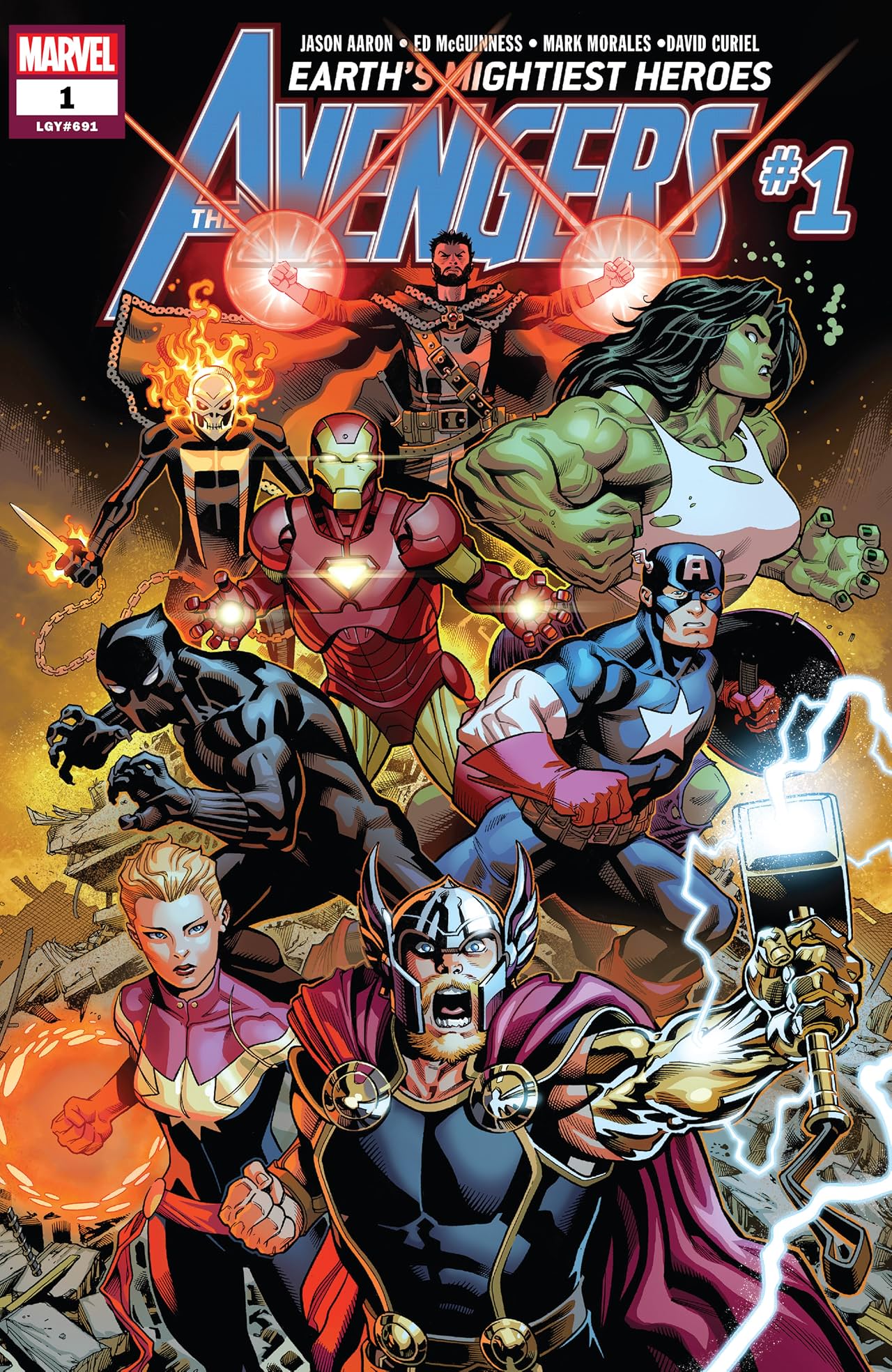
Defending Old School Avenging: Avengers #1

The following is my review of Avengers #1, which was posted on PopMatters.com.


Superhero comics often go through cycles upheavals. There's an accepted status quo that acts as a baseline, of sorts. Then, every once in a while there will be some upheavals that try to shake up the system and introduce new reforms. Some of those reforms stick. Some fail spectacularly. Most just fade into the background. Eventually, though, that familiar status quo returns to maintain the core appeal of a series.

For the Avengers, the traditions established by Thor, Captain America, and Iron Man act as the pillars of Marvel's top-tier heroes. The membership of the team may fluctuate every other week with Wolverine showing up one day while Squirrel Girl shows up another, but the core identity of the Avengers emerges from these three heroes. Every now and then, there's an effort to shake things up by bringing in new characters. No matter who shows up, though, be it a time traveler, a teen prodigy, or a Skrull agent, the Avengers are still built around these three iconic heroes.

In recent years, this core underwent plenty of upheaval with Thor becoming unworthy of Mjolnir, Captain America becoming a Hydra agent, and Tony Stark languishing in a coma. Some of those plots are still controversial and not necessarily for the right reasons. Whatever the controversy, though, it's only ever a matter of time before the Steve Rogers, Tony Stark, and Thor Odinson regain their roles as the Avengers' trinity of heroes.

Jason Aaron, who was behind some of the upheavals, and Ed McGuiness are now tasked with bringing that core back together and moving them forward in Avengers #1. At a time when the Avengers: Infinity War is topping the box office, the stakes are higher than usual for a new Avengers series. There are still lingering scars from the events of Secret Empire and Civil War II. There are also some extenuating circumstances that bring the Avengers together once more.

Despite these strained particulars, though, the stage for is set for the classic core of Avengers to return and Aaron makes good use of it. The events that kept Steve, Tony, and Thor apart aren't ignored. They even acknowledge the sentiment that the world around them is changing, both in terms of world-destroying threats and with respect to the growing diversity among the superhero community. However, even in musing over such changes, this classic trio finds a way to reaffirm that there's still a place for them.

It certainly helps when new threats emerge in the form of dead Celestials falling out of the sky. It's a threat that's not quite as random at it initially seems. This sudden catalyst for such a classic reunion has a basis in the events from Marvel Legacy #1, which introduced the Avengers of 1,000,000 BC. It's a concept that, even within that single issue, hasn't had much impact on anything in the present time to date. Those connections begin to emerge as the Avengers, new and old, begin to assemble.

While it's a refreshing scene, especially to those still recovering from the end of "Avengers: Infinity War," the spectacle is somewhat scattered. Captain America, Iron Man, and Thor are the driving force of the story, but there's also a supporting cast that's caught up in the same plot. That cast includes Black Panther, Dr. Strange, Captain Marvel, She-Hulk, and Ghost Rider. It's a potent mix of heavy hitters and a few emerging stars, but there aren't many opportunities for then to contribute.

They're still in a position to assemble, as Avengers do. Their part in the story, though, is somewhat disconnected from the personal drama going on among Iron Man, Captain America, and Thor. They don't do much to influence the uncertainties that Tony expresses about the future of the Avengers. Those uncertainties are almost as important as the threat of Celestials falling out of the sky, if only because it keeps the story from becoming another generic excuse to get the Avengers to unite.

Avengers #1 doesn't present itself as a simple reunion. Aaron dedicates just as much time discussing the place of the Avengers' old guard in an era where they're shortcomings and vulnerabilities catch up to them more and more. To some extent, their legacy works against them. New threats learn from old threats, adapting and evolving their attacks. They're now at the point where they can make Thor unworthy, turn Captain America into an agent of Hydra, and render Tony Stark comatose.

None of this is lost on the team. At one point, Tony even expresses doubt that he, Steve, and Thor should be the ones to re-assemble the Avengers. That doubt reflects the sentiment that old heroes need to step aside in order for new ones to emerge. It's a sentiment that has fueled a lot of the controversies surrounding these characters, going all the way back to the events of Original Sin.

While the events of Avengers #1 acknowledge that sentiment, it does little to actually address it. Some of that is due to the unavoidable distraction that comes with Celestials showing up out of nowhere, but it still leaves some questions unanswered. The assorted side-plots that put other Avengers in a position to assemble later on do little to help find those answers. One minute, Tony is pondering some important questions that have real implications for the future of the Avengers. The next, he just jumps back into his old role with his fellow Avengers to confront a new threat.

That threat is still intriguing in its own right, thanks to the tie-in with the 1,000,000 BC story line. It also helps that McGuinness' artwork makes it the kind of cosmic spectacle that warrants having these classic heroes take on their iconic poses once more. There are layers to the story and Aaron does plenty to establish the potential for this latest round of upheaval. It even says something about the extent of recent upheavals when it's just refreshing to see classic heroes reunite and feel relatively confident that it's not due to Skrull agents.

Overall, Avengers #1 does plenty to get the Avengers back on track, but doesn't do much to address why they got off track in the first place. There are important conversations to go along with the major events, both in the present and in the distant past. Most of those discussions remain incomplete, but there's still plenty of opportunities to have those discussions, preferably when there aren't dead Celestials lying in in the middle of major cities.

Final Score: 6 out of 10

Thursday, September 28, 2017

Past, Present, and Perspective: Marvel Legacy #1

The following is my review of Marvel Legacy #1, which was posted on PopMatters.com.


Building a legacy is a long, tedious process that usually involves twice as many mistakes than it does successes. In some cases, a half-century of world-building is hardly enough to forge the kind of legacy that stands the test of time, changing writers, and retcons. For Marvel and the extensive world that continues to unfold after over 50 years of continuity, it's safe to say that its legacy has proven its worth. The world that Stan Lee and Jack Kirby created decades ago is worth an entire workshop of Mjolnirs.

The legacy of the Marvel universe is often in flux with the times. There are all sorts of eras that vacillate from grim and dark to upbeat and optimistic. Events like Onslaught, Age of Apocalypse, and Civil War define and redefine what the world of Marvel stands for. Sometimes it takes years to appreciate way in which these events shaped Marvel's legacy. That will likely be the case with Marvel's latest legacy-shaping event, Secret Empire.

Being an event so controversial, coming at a time when all things related to fascism inspire Hulk-level outrage, the current legacy of Marvel is in a tenuous position. It's at one of those forks where it can either go down a dark, dire path or re-invent itself in a new, more positive light. These are uncertain times for Marvel and Marvel Legacy #1 is in a position to shape a new path, provide a sense of certainty, and showcase the strengths of top-level writing and artistic talent.

Jason Aaron, one of Marvel's top writers, and an all-star team of artists that include Esad Ribic, Russell Dauterman, Stuart Immonen, Ed McGuinness, and many more, have a chance to use Marvel Legacy #1 as a gateway towards the future of the Marvel universe. With so much talent to work with, the scope and scale of the story can be nothing short of awe-inspiring. While that bar may be impossibly high, Aaron and his all-star cast of artists come very close to matching and exciting it.

The structure of Marvel Legacy #1 is both fitting and overdue in that it revisits elements from Secret Wars that have been absent for years, namely those of the Richard family. In a sense, their presence acts as a reminder regarding what the greater Marvel universe is missing. To date, Marvel operates in a world where the Fantastic Four are no more, Thor is unworthy, the X-men's leadership is dead or time-displaced, and Steve Rogers is a secret Hydra agent. To say that legacy is on shaky ground is like saying the Hulk is moody.

Aaron doesn't try to fix all that in the span of a single issue. However, the story in Marvel Legacy #1 does establish links to the past, present, and future. It doesn't just provide hope that the missing elements of Marvel's legacy will return. It provides a potential mechanism. It doesn't just offer promises. It offers solutions that don't involve time machines, retcons, or deals with Mephisto.

The links to the past offer the most intriguing and complete part of the plot in that it establishes a period in the history of the Marvel universe that has major implications for the present. It takes familiar faces and forces like the Phoenix Force, the Iron Fist, and the spirit of the Black Panther and personifies them in a battle against a Celestial. That added personality gives greater weight to the events that unfold in the present.


Those events are a little less cohesive, though. Marvel Legacy #1 is understandably ambitious, attempting to jump around into multiple areas and explore a wide variety of elements throughout the greater Marvel universe. It touches on the Avengers, the X-men, the Guardians of the Galaxy, and the remaining members of the Fantastic Four. It even tries to deal with the lingering aftermath of Secret Empire, from Steve Rogers' efforts to rebuild his credibility to the disillusion of SHIELD. There are so many elements to explore that the narrative gets downright erratic at times.


There's only so much Marvel Legacy #1 can address, but it manages to avoid Deadpool-level eccentricity. While the transitions from setting to setting aren't all that seamless, they never feel totally random or out-of-place. If anything, they feel like a succession of teaser trailers that offer glimpses into the near and distant future of the Marvel universe. Some are more subtle than others. Others, namely the ones involving Norman Osborn and Loki, offer a more overt hint. Certain characters, despite being actual gods, just aren't capable of such subtlety.

Beyond just the teaser elements, though, Marvel Legacy #1 adds some significant upheavals to the mix, namely by revealing the return of a certain grumpy Canadian that helped make Hugh Jackman a star. His appearance comes off as sudden, but it also comes with purpose. It feels like part of a larger story that's just beginning to unfold. In many respects, that's the core theme of the entire story. It doesn't just lay the foundation. It provides some very specific, very compelling building materials.

That's not to say every element is equally compelling. Some are underdeveloped and overlooked. Some aren't effectively linked to the larger narrative, but they still have a place in the greater legacy of Marvel so their presence never feels too random. That, in many respects, is the most revealing accomplishment of Marvel Legacy #1. It crafts a story in which everything feels connected on some level. While some connections are stronger than others, it still conveys the sense that Marvel has a vision and that vision is worth exploring.

While the Marvel universe seems to get redefined at least once a month, it's rare for a story to feel as large in scope as it's trying to be. Marvel Legacy #1 succeeds in conveying that feeling. From those disillusioned by Marvel's recent direction and enamored by its past, it offers something to latch onto. The fact it does all that without a time machine, clones, or magic spells makes it all the more astounding.

Final Score: 8 out of 10

Thursday, September 7, 2017

Building (and Tinkering with) a Legacy: Generations: Iron Man and Ironheart #1

The following is my review of Generations: Iron Man and Ironheart #1, which was posted on PopMatters.com.


When a new character takes on the legacy of an older one, the greatest challenge is making that transition seem fitting and meaningful. It helps when the older character has a sizable network of friends, family, and side-kicks in the wings, ready to carry on that legacy in a way that feels like a true extension of the story. This is how Batman's legacy can continue whenever Bruce Wayne is MIA, whether it's through Dick Grayson, Terry McGuinness, or the occasional robot.

Unfortunately for the legacy of Iron Man, Tony Stark isn't as keen on side-kicks and family. Throughout his history, he tends to monopolize all things Iron Man. At times, he gives the impression that he only tolerates War Machine because he doesn't use a title or color scheme that undermines his brand. He's akin to a musician who doesn't mind people doing goofy parodies of his music. That may be an effective way to control a legacy, but it does create issues once Tony is unavailable. With no Robin or even a Bucky Barnes waiting in the wings, Iron Man's legacy is especially vulnerable.

That makes the task Brian Michael Bendis undertook in creating Riri Williams all the more daunting. He doesn't have the time or capacity to create the kind of built-in legacy that Batman has. He has to put Riri in this role of filling in for Tony Stark with next to no build-up or dramatic underpinnings. Riri just happens to be in the right place at the right time when Tony Stark goes down in Civil War II. It's the kind of happenstance that can only come at Marvel where Cosmic Cubes, deals with Mephisto, and the Scarlet Witch going crazy constantly skew the odds.

With Generations: Iron Man and Ironheart #1, Bendis has a chance to forge a greater personal connection between Tony Stark and Riri Williams. In a sense, that sort of connection is overdue because even in his AI form, Tony acts more as a guide than a mentor to Riri. The lack of any deeper undertones still creates the impression that Riri's role is forced and contrived. Creating a more personal connection can help mitigate that impression.

Bendis makes that effort and even tries a different approach, compared to previous iterations of Marvel Generations. Whereas the other stories have taken characters to the past, he takes Riri to the future. That's somewhat more practical, given the inherent themes of futurism in Iron Man. However, pragmatics only go so far. When it comes to actual substance, the story falters and only ends up highlighting the reasons certain fans complain about Riri in the first place.

By taking the story to the future instead of the past, she ends up in a very different world, compared to the one she comes from. This is inherently an issue for her character because so much of her story is tied to her situation in the present. Her family, being from Chicago, and stumbling through the growing pains of being a hero are part of what makes Riri's story compelling. None of that is present in Generations: Iron Man and Ironheart #1. That leaves Riri isolated and only highlights some of her less flattering traits.

From the moment she arrives in the future, Riri basically acts as her own narrator. It tries to come off as cute and awkward, as is often the nature of teenagers, but it just comes off as annoying and self-centered. She doesn't say or ponder anything that isn't depicted by Marco Rudy's skilled art. When she encounters familiar-looking heroes from the future, including a next-generation Avengers team and a 126-year-old Tony Stark, who also happens to be the Sorcerer Supreme, the moment falls flat. For overly-emotional teenagers, that just goes against the laws of physics.

That's not to say Riri is cold in the story. She does make it a point to hug Tony when she gets the chance. However, that's pretty much the extent of the connection they forge. It's also the extent of the drama in the story. There's no epic battle. There's no shared struggle. One is teased, but goes absolutely nowhere. There's no point where Riri really works with Tony, thereby gaining a better understanding of what it means to be Ironheart. She basically just sits back, watches, and gets a crash course in how great the future is.

While that sort of techno-utopian ideology is a key component to Iron Man, Generations: Iron Man and Ironheart #1 doesn't present it in a very compelling way. It's mostly done through Tony Stark talking, Riri Williams reacting, and everyone else just shrugging their shoulders. It's as compelling as it sounds. There aren't any moments of real struggle with Riri. She's basically just a guest passing through and not much else. Her passing out when she first arrives is the most she does to move the story forward.

That's not to say there's no overall impact for Riri. Seeing the future and all the beauty that Rudy's art can depict leaves an important impression. It shows that the future she, Tony, and all things Iron Man are trying to build is worth building. That's a meaningful impression, but one that doesn't need to be belabored in an Iron Man comic, which is built on the very premise that a better future can be built. Riri's story already involves plenty of future-building so the impression comes off as redundant.

Bendis has many opportunities to craft a more meaningful connection between Riri and Tony in Generations: Iron Man and Ironheart #1. Few, if any, of those opportunities pan out. Riri still comes off as an annoying teenager who basically stumbles to success at every turn as Ironheart and Tony comes off as overly coy with his ego. The story succeeds at capturing the futurism themes inherent of most Iron Man stories, but that's all it succeeds with. For someone as capable as Riri Williams and Tony Stark, that's just too low a bar.


Final Score: 4 out of 10

Thursday, August 31, 2017

Rising, Falling, and Rebuilding: Secret Empire #10

The following is my review of Secret Empire #10, which was posted on PopMatters.com.


The dramatic rise and spectacular fall of an empire is one of those rare narratives that can be just as dramatic in real life as it is in fiction. From the Ancient Rome to Star Wars, the story behind an empire has an undeniable impact on the human psyche, as well as the annuls of history. Every empire is unique in how it rises, grows, prospers, and falls. Sometimes it plays out over the course of centuries. Sometimes it happens over the course of a few decades. Marvel, with its ever-changing landscape, tries to squeeze that story into ten comic books.

Given the scope of empires, as a concept, that's pretty daunting for anyone not equipped with Reed Richards' mind or Tony Stark's gadgets. Nick Spencer and Steve McNieven may not have such resources, but they've made every moment count in Secret Empire. It's a story that taps into real world fears about powerful individuals seizing power and imposing tyranny under the guise of order. It evokes all sorts of passions, reservations, and arguments on message boards. That alone is a testament to the scope and scale that empires carry, as a story.

Secret Empire is not just about Hydra taking over the world. It's not just about Captain America betraying the Avengers either, although that is the emotional gut punch that makes it so controversial. These elements feed into that larger narrative of an empire coming to power, taking advantage of a vulnerable moment in time and trying to shape the course of history. The ascension of Hydra and Captain America into this position is established. Now, the downfall is underway.

For nine issues, the story sets up various plot-lines that lead to numerous skirmishes. It's not an exhibition game anymore. Both sides are carrying themselves like a couple prize fighters entering the last round. They each bear the scars of all the blows they've taken. They make clear that there will be no judges decision. One of them is going to get knocked out. It's just a matter of who can land the finishing blow. In Secret Empire #10, that blow finally lands with an impact that has both huge reverberations and major implications.

The rise of Hydra and the Hydra-affiliated Steve Rogers centers around reality-warping power capable of making good into evil, right into wrong, and making Deadpool less annoying. Any story that builds itself around that kind of power risks going too far and needing more reality-warping power to fix. It goes beyond resorting to another Deus Ex Machina, especially when that same device is used to set everything up in the first place.

Spencer sets up from the beginning of Secret Empire that a certain amount of warping will be necessary to resolve the story. There's just no way an empire as large as Hydra's can rise, fall, and leave a meaningful impact within ten issues of a series. The biggest risk any story takes in attempting to tell a story within these constraints is rendering reality a messy ball of mud that gets molded and remolded on a whim.

For the most part, the story strikes an appropriate balance between confronting the reality-warping forces behind the story and using them to defeat Hydra. Those involved in delivering that final blow even throw in some Loki-level cunning. It isn't just a matter of all the heroes gathering in one place and collectively beating up an over-powered villain. The Hydra-affiliated Steve Rogers is not Onslaught, Thanos, or some cosmic space god. He's someone with which every hero in the Marvel universe has an emotional connection.

It's that connection that makes the very concept of Steve Rogers becoming a fascist feel so untenable to begin with. That's like making Frank Castle the Kingin or Emma Frost a nun. It's so utterly antithetical to the core of the character that it just feels wrong for everyone involved. In a sense, both the characters in the story and those who know Captain America as the ultimate enemy of fascism are on the same page, in terms of emotional overtones. Nobody reading or participating in the story can accept a reality where Steve Rogers is, and always has been, a fascist.

By the end of Secret Empire #10, that untenable feeling is still there, to some extent. While the story does end up having to warp and re-warp reality to some extent, it stops short of completely undoing everything the Cosmic Cube changed. Certain characters stay dead. Certain places remain destroyed. Steve Rogers isn't the ultimate fascist anymore. A good chunk of the story, along with the best aspects of McNieven's art, is spent giving Rogers a chance to literally attack the fascist monster that Hydra created. While it's as satisfying as it often is when a fascist gets defeated, some of those feelings still linger.

Even though Secret Empire #10 crafts as concise a conclusion it can, given the cosmic forces involved, it still carries a distressing sentiment that may plague Captain America fans the same way the Clone Saga plagues Spider-Man fans. Regardless of the details, it's impossible to get around that Steve Rogers became a fascist. It doesn't matter that cosmic forces were involved. The very concept that such a story is even possible and a character must move forward with that kind of burden just evokes too many conflicting feelings.

The overall structure of the story still works with respect to showing the rise and fall of Hydra's empire. Secret Empire #10 even helps streamline some of the confusing, disjointed elements that are scattered throughout the previous nine issues. However, the manner in which it ends, the feelings surrounding it, and the prospect of moving forward from such a reality-shattering event are still mixed. It doesn't help that too much is narrated and too little is said in the end. It also doesn't help that some of the side-plots in the story don't connect as strongly to others and don't add to the overall impact.

These details, however, don't take too much away from the bigger picture surrounding Secret Empire. Spencer still succeeds at striking the necessary balance that's so hard to achieve when crafting a story that requires a complete deconstruction and subsequent reconstruction of the space-time continuum. That, in and of itself, is an accomplishment.

That accomplishment, however, will be forever lost in the stigma that Secret Empire will inevitably carry. While it might not be on the same level as the original Clone Saga, it will still be the story in which Marvel makes Captain America a fascist. It doesn't matter if someone makes a deal with Mephisto to ensure everyone in the Marvel universe forgets about it entirely. The fact it's still a story that got told in the first place, striking all the wrong emotional chords in the process, will plague it for the foreseeable future. If every fallen empire seeks to leave its mark, then Hydra definitely leaves theirs, albeit not for the reasons they probably intended.

Final Score: 7 out of 10

Thursday, April 27, 2017

Role Reversing Recourse: Infamous Iron Man #7

The following is my review of Infamous Iron Man #7, which was posted on PopMatters.com.


When it comes to comic book rivalries, Reed Richards and Victor Von Doom are akin to Coke vs. Pepsi. They are so bitterly opposed to one another that their conflict has shaped the world as we know it. Just as the cola wars shape our economy and the kinds of Super Bowl commercials we see, the war between Reed Richards and Victor Von Doom shapes the foundation of the Marvel universe.

Going all the way back to the of Stan Lee and Jack Kirby, Reed and Doom embody two extremes. They are both brilliant minds who seek to shape a flawed world in need of guidance. Reed seeks progress through enlightenment, using the power of discovery and knowledge to unite a conflicted world. Doom seeks a more direct approach, using his natural brilliance to impose progress through force. These are not methods that can be resolved through compromise and a friendly chess game.

These two opposing views are what led to many of the iconic clashes between Dr. Doom and Mr. Fantastic. From cosmic powers to soul-stealing demons, these clashes have taken both characters in many different directions. That's why the situation that Brian Michael Bendis and Alex Maleev have created in Infamous Iron Man is so compelling. They essentially flip the script, putting Victor Von Doom on the opposite end of the spectrum. It shows how he goes about doing what Reed does, but without ever admitting he was wrong. For someone like Doom, that's pretty important.

Some aspects of the script are somewhat different. Dr. Doom, even if he is reformed and that's still a big if, isn't going to conduct himself like the thoughtful and studious Reed Richards. He's going to do things his way while ripping off Iron Man along the way. Unlike Reed, he's not above usurping someone else's brand. However different his approach might be, Infamous Iron Man #7 offers insight into the effectiveness of Doom's new Reed-like methods. By and large, the results are pretty impressive.

Dr. Doom playing the role that Tony Stark and Reed Richards once played is still an uncomfortable novelty for some. Those, such as Ben Grimm, SHIELD, and every Marvel superhero who ever existed since the Kennedy Administration, are rightly concerned about Doom's sincerity. There are so many occasions where Doom has revealed a hidden agenda that even Reed Richards couldn't surmise the breadth of his agenda.


For the villains now in Doom's cross-hairs, though, the novelty is far more distressing. These villains, which include the likes of the Hood and the Wrecking Crew, are used to dealing with a specific kind of hero. Namely, they deal with heroes who follow Reed's script, working within a set of parameters and operating by a set of principles that is fairly well-understood. With Dr. Doom, however, there is no more script and even for hardened villains, that's genuinely terrifying.

This is what makes the narrative within Infamous Iron Man #7 so uniquely compelling. It doesn't just involve Dr. Doom fighting villains in his own unique way. It explores the larger impact he's having on the greater Marvel landscape. The past few issues spent a great deal of time touching on the reactions from those are still skeptical of Doom's intentions. With villains like the Hood, there's much less skepticism and a much harsher impact.

Unlike every other hero these villains have faced, they know what Dr. Doom is capable of. They know how skilled he is. He can create world-ending technology on his lunch break and spend the afternoon taking on Mephisto. Unlike the Reed Richards of the world, though, they know he's willing to go much further than any card-carrying Avenger would ever dare. That ends up being Doom's greatest weapon and for a man with a functioning time machine in his closet, that's saying something.

It makes for a pretty lopsided battle when Doom shows up. For once, though, that battle doesn't feel bland or boring. It's very much a spectacle, akin to watching the Hulk in an arm-wrestling contest. Seeing a powerful hero take down an entire contingent of villains is nothing new. Seeing Dr. Doom be that hero is still new for many and the sheer efficiency with which he works sends a powerful message, both to the villains and Doom's former enemies.

Doom does more than just defeat a bunch of villains. He genuinely scares them. For once, they don't stand on a pedestal, laughing manically and twirling their mustache as they insult or mock the hero. They understand that this is not Reed Richards, Spider-Man, or Squirrel Girl they're fighting. This is Victor Von Doom, a man who can do things that make every one of those heroes violently ill. When someone can inspire that level of fear in villains, then that's a clear they've found a new method and it works.


Even the likes of SHIELD and Thing end up acknowledging Doom's efficacy. They're still understandably skeptical. They still debate just how much they should trust Doom's new endeavor as Iron Man. However, they clearly have it easier than the villains for once. They're still genuinely terrified, so much so that one member of the Wrecking Crew turns himself in rather than facing Doom. Even Thing's Aunt Petunia would be impressed by that.

Infamous Iron Man #7 offers a greater insight into a new narrative for Victor Von Doom, one that he handles as masterfully as anyone would expect of someone who regularly frustrated Reed Richards. It also continues the evolving narrative surrounding Doom's evolving relationship with SHIELD, Thing, and other established heroes. Bendis takes the long road, letting those relationships develop slowly and steadily. As effective as Doom is, they're still a long way from giving him his own Helicarrier.

Between the character relationships and the methods Doom utilizes, Infamous Iron Man #7 gives polish to the overall narrative. It also sets up some new challenges that will test Doom's overly-efficient methods, as well as his commitment to being a hero. While stories about heroes becoming villains is nothing new, a character like Victor Von Doom requires a certain level of refinement. For the story unfolding in Infamous Iron Man, Bendis and Maleev continue to deliver. Terrifying hardened villains is just a nice bonus.

Final Score: 7 out of 10

Thursday, February 23, 2017

The Long Road From Infamy: Infamous Iron Man #5

The following is my review of Infamous Iron Man #5, which was posted on PopMatters.com.


When a hero crosses a line, it's rare that they stay over that line. There are times when Batman kills. There are times when Spider-Man acts irresponsibly. There are times when Deadpool skips Taco Tuesday. For the characters and the stories around them, these moments can be agonizing and compelling. At the same time, however, the outcome is frustratingly predictable. At some point, they'll do something to absolve themselves. If it's really bad, it'll often get retconned via time travel, clones, or several extra orders of tacos.

That predictability isn't quite so obvious in the narrative surrounding Infamous Iron Man. Brian Michael Bendis and Alex Maleev aren't sticking to tried and true formula in making Victor Von Doom the new Iron Man. They've set up a story where it's easy to see Doom going in any direction.

He could either use his new outlook to become Earth's greatest hero, showing up both Tony Stark and the entire Fantastic Four in the process. He could just as easily cross those old lines again, becoming that devious villain who would sucker-punch the Hulk if it made everyone acknowledge his superiority.

It's not at all clear which direction Dr. Doom will go and that's why Infamous Iron Man carries so much intrigue. There are still many questions surrounding Dr. Doom's motivations and his approach to being the new Iron Man, some of which have only been hinted at since Secret Wars. Infamous Iron Man #5 finally attempts to answer some of those questions. Those answers are still incomplete, but the story does make one thing clear. Doom is serious about this new role as Iron Man. He really wants to do something other than subversion, conquest, and megalomania.

It's clear he's serious because the narrative to this point is built around a world that still sees Victor Von Doom as the alpha and omega of villains. SHIELD, Ben Grimm, Tony Stark, and pretty much everyone with access to Wikipedia aren't convinced that he has turned a corner and for good reason. Doom's record of honesty is right up there with Loki, Thanos, and tobacco lobbyists. It's perfectly understandable that those tasked with protecting the world are inherently skeptical about Doom's intentions.

 
The events and subsequent aftermath in Infamous Iron Man #5 act as major tests of Doom's resolve. Everyone expects him to revert back to the mustache-twirling villain he's always been. Maria Hill, Thing, and everyone in between are bracing themselves while, at the same time, provoking him into uncrossing that line. That doesn't happen though. Doom, despite being treated like he's a ticking time bomb in need of preemptive defusing, remains serious about this new heroic path.

This leads him to a confrontation that would be very difficult if he were just plotting another scheme to one-up Reed Richards. Unlike the beginning of this series, it doesn't involve some C-list villain that nobody minds seeing used as target practice. It's Dr. Doom's mother, Cynthia Von Doom.

Her presence alone is revealing. Few who don't possess the omnicians of the Watcher can understand the importance of Doom's mother confronting her son. In terms of Victor Von Doom's motivations, both as villain and a man, his mother is right up there with showing up Reed Richards. For a good chunk of Doom's history, one of his primary motivations was saving his mother's soul from the clutches of Mephisto. It added even more incentive for him to master science, sorcery, and everything in between. If only Peter Parker could be so motivated.

Having succeeded in that primary motivation, meeting his mother here gives the story in Infamous Iron Man #5 a great deal of weight. Naturally, he's not too keen on believing outright that his mother is alive and just wants a hug. Victor Von Doom may be serious about not being a villain, but that doesn't mean he's gullible.

With Thing having already picked a fight on SHIELD's behalf, it leads to one of the most meaningful clashes to date in Infamous Iron Man. It doesn't exactly end in a moment ripped from a Hallmark card, but it doesn't end with Doom wanting to burn the entire planet to a crisp either. If anything, it further affirms Doom's resolve for this new path as Iron Man. In that sense, it's a clear victory for him.

That's not to say there aren't losers as well. Infamous Iron Man #5 will not go down as one of Ben Grimm's proudest moments. The same can be said for Maria Hill and the rest of SHIELD. As for Dr. Amara Perera, someone who only crossed paths with Doom because she had the misfortune of dating Tony Stark, she loses the most. To his credit, Doom tries to apologize. However, she makes clear that she still doesn't see him as a hero. She may not see him as a villain, but he's no hero.


This is the most relevant theme in Infamous Iron Man #5. Bendis and Maleev are putting Doom on the longer, more arduous road to being what he wants to be. They're not just tempting him to revert to his old ways. They're showing him that walking this path is a lot harder and he has an uphill battle, to say the very least. There's even a teaser at the end hinting that this path is going to keep tempting him into fits maniacal laughter once more. It promises plenty more intrigue for a story that still seems so strange on paper with Victor Von Doom being a hero.

While the themes and content are strong in Infamous Iron Man #5, there are times it still feels lacking in some details. In some respects, the story feels condensed and truncated. It gives the impression that the conversations needed to be longer and that certain characters didn't get to say what they needed to say. Bendis and Maleev try to do a lot and they succeed for the most part, but some parts of that success still feel incomplete.

This doesn't make Infamous Iron Man any less engaging as a larger story. It may very well be one of the most engaging stories of the post-Secret Wars world. The story is still in a very nascent stage, but it's maturing rapidly and in a way that would make any mother proud.

Final Score: 7 out of 10

Tuesday, January 3, 2017

Winning Streaks and Resolutions: Civil War II #8

The following is my review of Civil War II #8, which was posted on PopMatters.com.


Every major sports dynasty in every meaningful sport learns at some point that a winning streak has to end. Whether it's the Russians in the 1980 Winter Olympics, the undefeated New England Patriots in Super Bowl XLII, or the New York Yankees every five years or so, they learn that no winning streak can last forever. More often than not, learning that lesson is pretty painful.

In the context of Marvel Comics, Tony Stark is very much on par with the New York Yankees. He's been managing a winning streak that dates back to the conclusion of the first Civil War back in 2005. Within the Marvel/Disney hierarchy, he's right up there with princesses and talking animals in terms of importance and prominence. He's not just the character that revived Robert Downey Jr.'s career. He's very much the catalyst for the modern Marvel universe, as it has manifested over the past decade.

With Civil War II, he faces the biggest threat to his losing streak to date. Once again, he finds himself leading a team of heroes against another team of heroes, caught up in a powerful philosophical struggle on how heroes should conduct themselves. This time, it's not just Captain America or the American legal system he's up against. He's taking on Captain Marvel, who has a winning streak of her own, and the very forces that shape the future of the Marvel universe. Even with the star power of Robert Downey Jr., Tony Stark faces extreme odds.

He finally puts his vision and his winning streak on the line in Civil War II #8 for the final struggle. It has the fixings of a dramatic struggle, ripe with the same high emotions as Mark Millar's memorable narrative in the first Civil War. Unfortunately, those high emotions that worked so well for Millar end up falling much flatter with Bendis.

That's not to say that Civil War II #8 doesn't deliver in terms of drama and high emotions. Those factors are definitely in place and they do give the story plenty of weight. However, the actual mechanics of the story and the way everything gets resolved just come off as rushed and contrived. Nobody will be gasping for air or picking their jaw up off the floor with the big climax of the story here. The most anyone will probably do is shrug and sigh, but not necessarily in a bad way.

There are some powerful moments that play out here. These moments highlight the sheer strength and weight that Captain Marvel and Iron Man wield in the context of the current Marvel hierarchy. These are two of Marvel's most popular characters fighting over a conflict that Bendis made sure was every bit as balanced as the one Mark Millar molded in the first Civil War. The clash never feels like a glorified street fight or something that can be written off as a product of mind control, clones, or Skrull agents.


Captain Marvel and Iron Man are literally fighting for the future of the Marvel universe and their place in it. Over the course of that fight, it's clear that neither character harbors a seething hatred of the other. They don't insult each other. They don't engage in the kind of trash talk usually reserved for a rap battle. They carry themselves with the utmost conviction that they're right. They both believe they are the New York Yankees on the cusp of another championship.

In the end, only one can win out. Eventually, one does win out, albeit in an outcome that feels somewhat hollow. After all the high emotions that helped make Civil War II so impactful, from the first battle against a rogue Celestial to the death of Bruce Banner, the end result feels muted because the battle doesn't really resolve the main issue. In some respects, the issue resolves itself, which makes the conflict seem more trivial than it actually is.

Nothing that Captain Marvel and Iron Man do, either through fighting or through the hard choices they make, influences what happens to Ulysses. As the Inhuman who started this all, his role in the final conflict is surprisingly minimized, which really undermines the narrative. It's like Wolverine trying to win a fight without his claws. It is possible, but it lacks that a certain touch that gives the conclusion its satisfying feel.

Absent this satisfaction, the conclusion in Civil War II feels so rushed. If the conflict does affect Ulysses, it's an indirect influence at most and that influence is not really clear. Unlike the first Civil War, neither side gets a chance to really prove that their side was right. There's no way to actually put into practice all these the passionate arguments that Captain Marvel and Iron Man make throughout the conflict. They still fight, but they don't get to find out whose ideas actually win out.

Despite this lack of resolution, Civil War II still tries to establish a clear winner. It succeeds in this to some degree. It makes clear who comes out ahead and whose winning streak comes to an abrupt end. However, establishing the winner in the story doesn't necessarily explain why they're the winner in the first place. There's an argument to be made that nobody really won Civil War II. In the end, one person is still standing. That's more a technicality than a win, but it still counts. It's like a championship game ending in a tie, but one side still gets to act like a winner.


On the whole, Brian Michael Bendis and Oliver Copiel succeed on numerous levels in making Civil War II the same high-stakes, high-drama conflict as its predecessor. The heavy emotions and painful losses are there. The impact of those losses are felt. Civil War II #8 does nothing to underscore those emotions or those losses. The characters never feel insincere. There's never a sense that one of them could be a Skrull agent. The refinements are there. It's the overall resolution that's lacking.

One winning streak ends. Another winning streak continues. There are impacts, scars, and plenty of arguments to be had on message boards for years to come. In the grand scheme of things, Civil War II counts as a success. It's just not the kind of success that will make anyone less tired of superheroes fighting each other.

Final Score: 6 out of 10

Friday, December 23, 2016

Ambitious Humanization: The Mighty Captain Marvel #0

The following is my review of The Mighty Captain Marvel #0, which was posted on PopMatters.com.


Whenever there's a major war, it's only when the dust settles that we learn just how devastating the struggle really was. When wars end, there's usually a period of jubilation and celebration. The victors throw parades in the streets. The losers, while defeated and devastated, can at least let out a sigh of relief, knowing the bloodshed is over. That feeling, much like a victory parade, is often temporary. Nobody gives much thought to those who must clean up after that parade, figuratively and literally.

Captain Marvel is, by all accounts, on a winning streak. Ever since Kelly Sue DeConnick elevated her to the status of Marvel's Wonder Woman, Carol Danvers keeps jumping from victory to victory. Whether she's holding down multiple solo titles or inspiring new generations of heroes in Kamala Khan, it's pretty clear that she's doing okay for herself. Now with Brie Larson's star power and a movie set to debut in 2019, she's well on her way to carving her face on the Mount Rushmore of superheroes.

This ascension, however, is not without cost. No superhero ever became iconic or got to carve a giant statue of themselves without pushing a little harder and upsetting a few fans in the process. The narrative in Civil War II definitely checks all the boxes in terms of putting a price on Captain Marvel's ascension. It put her in a position to be either vindicated or vilified with very little gray area in between. As a result, she's no longer this universally praised symbol of girl power. She's a walking message board of controversy.

This presents a unique challenge for Margaret Stohl in The Mighty Captain Marvel #0. With the dust settling from Civil War II, what does this mean for Captain Marvel moving forward? How does she continue her ascent into that special place usually reserved for Captain America, Spider-Man, or any other hero that ever appeared on a lunch box? Stohl addresses this challenge by making a concerted effort to humanize Carol Danvers. For the most part, she succeeds.

The Mighty Captain Marvel #0 isn't built around the tried and true formula of having Captain Marvel punch, blast, and flex her way through a threat. For her story and her character to gain greater complexity, the plot needs more substance than style. The substance here paints a different, but intriguing picture of who Carol Danvers is and where she's at right now.


Civil War II effectively forced Captain Marvel to into a difficult role and in many respects, she still clings to parts of that role, even though it costs her some close friends. Stohl makes it a point to emphasize how much Captain Marvel wants to confront dangers before they blow up in someone's face. In the Marvel Universe, where everything from Thanos to talking ducks can randomly show up, this is not entirely misguided.

That element is key to making The Mighty Captain Marvel #0 work. It's also key in making Captain Marvel a balanced character. She never comes off as arrogant, angry, or petty. Stohl goes to considerable lengths to show how the outcome of Civil War II really haunts Carol, so much so that she's battling intense nightmares and crippling insomnia. Sure, she can deal with these issues by punching asteroids and arm-wrestling She-Hulk, but it still torments her. The very human side of her still shows.

This human side is emphasized far more than her Kree side. This makes the story work because it creates a conflict for Captain Marvel that she can't solve through punching. This requires her to use coping skills that ordinary humans who can't punch asteroid actually use. She enlists the aid of a therapist. She reaches out to her closest friends, namely Spider-Woman. She tries burying herself in her work. These are all skills that both a superhero and an overworked high school teacher can use.

This goes a long way towards humanizing Captain Marvel. She's more vulnerable here than she's ever been in a situation that didn't involve Thanos or a raging Hulk. However, that vulnerability never becomes too overplayed. When humanizing a character, it's easy to fall into the same trap that many Disney princesses stumble into. They become vulnerable so they either start crying or break out into song. Carol Danvers never does that here. Instead, she tries to grit her teeth and push forward. It's the kind of tactic that would've made Frozen and Brave a much shorter movie.


The humanization and vulnerability bring out the best in Captain Marvel, but it also highlights some of her flaws. Anybody who didn't side with her in Civil War II probably isn't going to side with her after reading The Mighty Captain Marvel #0. She never apologizes for doing what she did. While the loss of her friends haunts her, she doesn't regret the decisions that led to those losses. It creates a strange mix of tension within the character that's difficult to resolve.

That tension plays out in a narrative that isn't always cohesive. One minute, Captain Marvel is dishing out orders with Alpha Flight to aid in alien refugees. The next, she's in a diner with Spider-Woman in need of a hug. The sequence of events is a little choppy, but it never becomes chaotic. Emilio Laiso's artwork also does a lot to highlight the dramatic moments that gives this issue its impact.

For those wanting to see Carol Danvers punch and blast things in a large-scale cosmic conflict, The Mighty Captain Marvel #0 will be a disappointment. That isn't the story Stohl tries to tell here. Those looking for a story that builds on the dramatic shifts Carol endures during Civil War II will find plenty to appreciate in this issue. Any punching or blasting she does is just a bonus.

In many respects, this comic acts as an epilogue for Civil War II. Carol Danvers is such an ambitious character, wanting to do more than just tie up villains and throw them in front of police stations after they've committed a heinous crime. That ambition shows in both her ability to punch things and her desire to ensure the danger doesn't punch back. It sets her apart from many heroes and Brie Larson would be wise to reference The Mighty Captain Marvel #0 in preparing for this role.

Final Score: 8 out of 10

Thursday, October 20, 2016

Channeling Heroism Through Infamy: Infamous Iron Man #1

The following is my review of Infamous Iron Man #1, which was posted on PopMatters.com.


It's become an annoyingly popular trend in recent years, turning heroes into villains and villains into heroes. It's like Marvel and DC Comics are trying desperately to make their own version of Walter White. They want a character who can fluctuate between heroism and villainy without the aid of mind control, evil clones, or shape-shifting aliens.

It's entirely understandable. A character that can navigate these narrow, poorly defined lines between heroism and villainy tends to be much more compelling. We don't know if this character will help rescue a cat in a tree or just set the tree on fire. They're unpredictable and volatile, never needing more than a friendly nudge to cross those lines that Superman and Captain America don't dare cross, at least without the aid of massive retcons.

This is what makes the premise of Infamous Iron Man #1 so compelling. It attempts to turn Marvel's alpha dog villain, Victor Von Doom, and into a genuine, non-mind controlled hero. That's right up there with making Thanos a nun in terms of seemingly ridiculous concepts. However, Doom's development in the pages of Invincible Iron Man, coupled with the end of Secret Wars, puts him in a unique position to do just that. Now, Brian Michael Bendis is ready to realize that potential.

The details of the story in Infamous Iron Man #1 don't involve Doom just stepping into a new suit of armor, calling himself Iron Man, and shooting the nearest Hydra agent. Instead, Bendis crafts a narrative that makes abundantly clear that Victor Von Doom is uniquely qualified to embrace this role. He makes it feel like a natural progression of the character that emerged in Invincible Iron Man. This is a version of Dr. Doom that has a very different outlook after the events of Secret Wars. What he does and why he does it feels organic, appropriate, and uniquely engaging.

There's no inversion spell. There's no clone involved. There's not even some sudden moment of clarity. Victor Von Doom's decision to become Iron Man fits perfectly with his ongoing efforts to do more than just terrorize the world with metal masks, evil boasting, and Doombots. He's trying to find a new place in the greater Marvel landscape and becoming Iron Man, especially in wake of Civil War II, is as fitting a place he'll find without the aid of Doombots.

What makes this setup even more compelling is the context surrounding Dr. Doom, even before the events of Secret Wars. Bendis makes it a point to explore this context, going back to Doom's days in the Illuminati where he didn't shy away from such infamy. In doing so, Bendis raises some important questions for Dr. Doom, courtesy of the Red Hood. Sure, these questions get the Red Hood shot and transported to India, but they're still valid questions.

The primary question at hand is what exactly drives Victor Von Doom at this point in his development? For many years, he defined himself as the one man who could outsmart Reed Richards. He defined himself as the one who mastered science and sorcery. He also defined himself by his desire to save his mother's soul from Mephisto. These are all core components of the evil, menacing Dr. Doom who will gladly kick a puppy if it makes him more superior to Reed.


Now, Reed Richards and his family are gone. His mastery of science and sorcery is beyond dispute. He even managed to finally save his mother's soul. On top of this, he has his own country, more money than any super-villain can reasonably steal in one lifetime, and an army of Doombots to ensure he'll never have to clean his castle or cook his meals. What else is left for Victor Von Doom?

Infamous Iron Man #1 shows that Dr. Doom has plenty to offer. He demonstrates as such in a lopsided, but revealing battle against Diablo, who for some reason thought kidnapping Maria Hill was a good idea. He also connects with Tony Stark's former lover, Dr. Amara Perera. He articulates through words, actions, and Alex Maleev's detailed artwork that there's a need in the Marvel universe and he's uniquely equipped to fill it.

Moreover, Doom makes the prospect of him being Iron Man seem exciting in the sense that we've never seen an Iron Man like this before. Tony Stark may have exercised questionable decision-making skills, both in and out of his armor, but there are lines he doesn't cross. He makes clear that when there's a conflict to confront, he'll play the part of the hero. With Victor Von Doom, we don't have such certainty.

How will Dr. Doom deal with a Hydra invasion of New York? How will he deal with the likes of the Mandarin, AIM, or angry Stark Industry shareholders? It's clear how a hero would handle them. It's not at all clear how Victor Von Doom will handle them and that's what makes the idea so compelling.

In the end, this idea is the greatest selling point of Infamous Iron Man #1. It gives context and reason for Dr. Doom taking on the mantle of Iron Man. Beyond that idea though, the details are fairly standard. There is some action, some significant character drama, and some mysterious reveals. However, some of these details are too short or abrupt. These are details that can easily be fleshed out in future issues, but it limits the substance of the story.


Despite this, the style points alone make Infamous Iron Man #1 one of the most intriguing development not involving a superhero civil war in quite some time. There's still something uniquely off-putting about rooting for Victor Von Doom to become a hero. He still makes clear that he's Dr. Doom. He still comes off as the kind of man who will punch Reed Richards in the jaw and blame the Avengers for it.

However, he also comes off as a character entering an exciting new phase of his development. He's not hiding from his infamy. He's channeling it into a new endeavor. It may not be as satisfying to him as punching Reed Richards in the jaw, but it gives him a bold new purpose. Whether it makes him famous or infamous remains to be seen, but it promises to be an exciting story.

Final Score: 8 out of 10

Tuesday, August 23, 2016

Requiem For The Green Goliath: Civil War II: The Fallen #1

The following is my review of Civil War II: The Fallen #1, which was posted on PopMatters.com.


What makes a defining moment so defining has little to do with the immediate impact it has on a story. That impact may be intense and memorable by every objective measure, but it's often just a prelude to the much larger conflicts that it inspires. Whether it's Doomsday killing Superman, the Joker crippling Barbara Gordon, or Tony Stark taking his first shot of tequila, these moments only become defining when that larger conflict takes shape.

Without question, the death of Bruce Banner is the defining moment for Civil War II. The impact of this moment creates the catalyst for the real meat of the story. After this moment, the lines are drawn, the divisions are set, and the hearts of Marvel's greatest heroes are pulled in opposite directions. It's the last straw for Tony Stark. It's that painful moment of clarity that only admitted alcoholics can appreciate.

There's no question that the death of the Hulk lit the match that ignited the powder keg that is Civil War II. However, in the midst of this raging inferno, it's easy to overlook the personal impact of the Hulk's death. Bruce Banner dies surrounded by friends and former teammates who knew him as more than just the oversized brute with anger-management issues.

That sentiment is understandably sidelined by the larger conflict in Civil War II, but Greg Pak and Mark Bagley attempt to explore that sentiment in Civil War II: The Fallen #1. That sentiment proves vital to delivering the dramatic impact of the Bruce Banner's death. It takes a step back from the legal, philosophical, and ethical debate surrounding proactive punishment and focuses solely on the emotions surrounding those closest to Hulk and Bruce Banner. There's nothing that'll overwhelm a message board here. There's just raw, genuine drama surrounding the death of a beloved friend.

There are no monster battles. There are no alien invasions. There are no homages to Bill Bixby walking solemnly down a highway. Civil War II: The Fallen #1 deals solely with the reactions among Bruce Banner's friends and family. Those reactions are not divorced from the larger context of Civil War II, but they are secondary. The primary focused here is the mixed legacy the Hulk leaves behind.


The bitter part of that mixture plays out at Bruce Banner's funeral. Whereas Bruce's friends and fellow heroes are on hand to honor his memory, there are plenty of protesters as well who still condemn the Hulk in death. This is an important context to include because it highlights the unique dimensions of the Hulk. It's a big part of what makes him unique among heroes. Plenty of heroes have green skin and big muscles. Few deal with the kinds of complications that the Hulk deals with, even when he isn't angry.

It's easy to forget that the Hulk's rampages can be pretty destructive. Given the enemies he deals with, his battles incur more collateral damage than most. In a world that includes shape-shifting aliens, uncontrollable mutant powers, and helicarrier that crash every other week, that's saying something. Unlike those destructive elements though, the Hulk is a singular face on which people can focus their blame. As any minority, real or fictional, can attest, it doesn't take much blame to inspire outrage.

Despite this outrage, Bruce Banner spends his life trying to make the Hulk a force for good. Those are the efforts that his friends and family honor. Throughout Civil War II: The Fallen #1, the darker parts of his legacy aren't ignored. Instead, they are seen in context, which isn't easy to do with a rampaging monster. It's a testament to Banner's efforts and it nicely highlights the sentiment of every character involved.

However, the funeral of Bruce Banner isn't what gives Civil War II: The Fallen #1 the bulk of its dramatic weight. It's the living will that Bruce shares with his friends and family after death that evoke the most emotion. It doesn't just involve his assets, his work, or his acknowledgement that his anger management skills had room for improvement. It involves creating a legacy that appropriately embodies the impact of the Hulk. Naturally, it has to do with anger.

It all comes back to anger and how to deal with it. For most people, including Hulk's own friends and family, dealing with anger doesn't result in the same consequences or collateral damage as him. As a result, he has to work harder than most. That means he has to master anger management techniques that cannot be found in self-help books or overpriced seminars. His efforts to share this mastery, as imperfect it may be, acts as his greatest legacy as the Hulk.

It's fitting in so many ways. How many problems in the real world and comic book world could be solved if people just managed their anger better? How many battles would that avoid? How many buildings would go un-smashed? It's the best legacy that Bruce Banner could've left. However, it resonates with some more than others.


As fitting and heartfelt as Bruce Banner's final testament may be, there are those who need more than better anger management skills. Amadeus Cho, who Pak is developing in Totally Awesome Hulk, does not take time to grieve like so many of Hulk's friends. For him, the sentiment in Civil War II: The Fallen #1 is hollow at best. He sees what happened to Bruce Banner as an injustice and that just makes him too angry.

Cho's reaction, as well as the reaction of others like General Ross, are somewhat muted at times. There are some inconsistencies in the narrative and with certain characterizations, but the underlying sentiment is spot on. The tone in Civil War II: The Fallen #1 is solemn, but appropriate. Pak and Bagley craft a fitting, heartfelt sendoff to the Green Goliath. For once, anger takes a back seat to a Hulk story and it works, creating far less collateral damage in the process.

Final Score: 8 out of 10

Thursday, August 11, 2016

A Fan Among Heroes: All-New, All-Different Avengers Annual #1

The following is my review of All-New, All Different Avengers Annual #1, which was posted on PopMatters.com.


The success of Deadpool proves there's a fertile market for a story that dares to be overly meta. It's not just about breaking the fourth wall or acknowledging the erratic sentiments of comic book message boards. The appeal of a meta-narrative acts as a mirror of sorts, reflecting the passions of fans, be they the healthy kinds and the not-so-healthy kinds.

Most fans agree that passions like Deadpool aren't exactly healthy. More often than not, they earn the same R-rating as his movie. That doesn't mean that a more PG-13 version of these passions is impossible. In fact, there's another character who embodies the best of these passions and doesn't need to make dirty jokes about it. That character, of course, is Kamala Khan.

There's a long list of reasons why Kamala Khan is such a lovable, endearing character. Chief among them is the fact that she's a fan. Before she becomes Ms. Marvel, she's just another passionate fangirl who loves superheroes and writes fan fiction . She is very much the embodiment of the passions of countless fans. That makes the setup in All-New, All-Different Avengers Annual #1 especially engaging because it offers insight into the fan fiction that reflects Kamala's passions for superheroes. That insight makes for a cartoonish yet uniquely entertaining narrative that inspires the fanboys and fangirls alike.

Some parts of that setup are built upon Ms. Marvel's current narrative. She's an Avenger now and rapidly ascending the ever-shifting hierarchy of the Marvel universe. She even manages to do it without time travel, clones, or someone dying. That alone is a testament to her strengths. Despite this, she is still a teenager and she is still woefully inexperienced. This means she constantly clashes with her teammates, especially her younger cohorts in Spider-Man and Nova.

This inexperience and immaturity, the foundation on which most teenage superheroes grow, makes her reaction to fan fiction stories about Ms. Marvel all the more entertaining. She can't be expected to just ignore the insanity that often manifests in fan fiction. She's a young hero who still isn't accustomed seeing her name associated with embarrassing, easily accessible media. After the events of  All-New, All-Different Avengers Annual #1, she'll likely need advice from Peter Parker.

The story is organized through several colorful, laughably cheesy stories written by multiple writers, including Mark Waid and G. Willow Wilson. They each act as a commentary of sorts on the colorful proclivities of fan fiction, such as tendencies to create bizarre romantic entanglements and making unpopular political statements. These stories never take themselves too seriously and aren't going to be confused with canon in this or any other universe. That's what gives them their charm.

It's because of that unique charm that these stories tend to evoke strong reactions. As some of these stories unfold, Kamala's reactions are almost as relevant as the story themselves. Take one story involving Ms. Marvel attaining the rank of Captain Marvel. At first, it plays out like a story that Kamala Khan would love. Then, an overtly politically incorrect twist at the end completely reverses her reaction. It's the kind of reversal that no competent editor will allow in a comic, but one that manifests all too easily in fan fiction.

Then, there's the story about She-Hulk and a love triangle. It's not a love triangle that would make it into an X-men movie, but it involves She-Hulk being woefully out-of-character in professing her love to a giant monster. It's as strange and entertaining as it sounds. It's also not-so-subtle commentary on the way love triangles play out, both in canon and in fan fiction. It doesn't take much to make them laughably absurd.

Despite this absurdity, it's the strange love story that involves Ms. Marvel, Miles Morales, and a world where everyone is an anthropomorphic animal that bothers Kamala the most. What makes this part of the story stand out is that, as quirky and cartoonish as it is, neither she nor Miles are completely out-of-character. It's another not-so-subtle comment about fan fiction. As crazy as it can be, it is possible for certain truisms to manifest within these absurdities.


These truisms play right into the meta themes of this story. In the end, Kamala Khan's sentiments are similar to those of fans. A few intriguing reveals at the end shows that she's not alone. It creates a larger message of sorts, one that implies that superheroes are aware of the quirky fandoms they inspire. Sometimes those quirks reveal genuine insight for these characters. It doesn't have to involve the bizarre quirks of fan fiction, but they do help get the point across.

For the most part, however, the quirky little stories in All-New, All-Different Avengers Annual #1 don't factor too heavily into Kamla Khan's reaction. Some are just pure entertainment value of the most absurd kind. At a time when Marvel is exploring the dire, depressing issues manifesting in Civil War II, this offers a nice reprieve, even if it doesn't tell a wholly cohesive story.

The lack of cohesion keeps the narrative from gaining any depth. In a story that explores the absurdities of fan fiction, there's only so much depth that's possible, but not much is realized outside a couple stories. Some of those stories may be quirky. Some are more forgettable than others. There's still undeniable entertainment value to be had. There's also an important message to convey.


The internet can and will annoy superheroes every bit as much as the villains they face. With All-New, All-Different Avengers Annual #1, Kamala Khan learns this the hard way. It's just one of many steps she'll have to take in her quest to become a better hero.

Final Score: 7 out of 10

Sunday, June 26, 2016

Bracing for Heartbreak and Embracing it: Ms. Marvel #8

The following is my review of Ms. Marvel #8, which was posted on PopMatters.com.


Everyone has an inflated opinion of those they idolize. Those inflated opinions allow people to overlook flaws like Tony Stark's drinking, Spider-Man's irresponsibility, or Deadpool's crude sense of humor. For better or for worse, idols often become tied to identity. When one of those idols messes up in ways that make for great tabloid headlines, some take it as an affront to their identity. In this sense, Kamala Khan is setting her identity up for a beating.

Civil War II effectively drew the lines in the conflict. Now, targets are finding their way towards certain characters and Kamala Khan is at the front of that line. Few characters who aren't Spider-Man clones are as closely tied as Kamala Khan and Captain Marvel. Kamala Khan's entire persona as Ms. Marvel is built around her idolizing Carol Danvers. She is the quintessential fangirl and it shows in lovably humorous ways every time their paths cross. Now, G. Willow Wilson is setting Kamala up for a level of heartbreak that exceeds that caused by any Skrull imposter or Hydra agent.

Ms. Marvel #8 begins the process of tying Ms. Marvel's story into the larger conflict unfolding in Civil War II. It's a process that is destined to pit this young, aspiring hero against the idol who inspired her. The emotions surrounding this conflict are as volatile as can be without a Hulk being involved, but G. Willow Wilson doesn't focus on this initially.

Instead, Ms. Marvel #8 starts from the opposite end of the emotional spectrum. Wilson focuses on the hope and benefits of having someone who can accurately predict the future without the added complications of time machines, stage tricks, or excessive phone bills. Just like Civil War II #1, these benefits manifest in major ways for Ms. Marvel. However, just like Civil War II #1, the fine print in these benefits promise to send her to the other end of that emotional spectrum and that end comes with a lot of pain, as War Machine can attest.

Captain Marvel, her trusted idol, tasks Ms. Marvel with making use of Ulysses' foresight. This means she gets her first team of side-kicks, an important milestone for any superhero not mentored by Bruce Wayne. Thanks to these new resources, she is able to stop the leader of a Canadian syndicate of ninjas from going on a rampage in a tank. The basic details of that scenario sound so absurd when said out loud, but they are a testament to the kind of cartoonish conflicts that make Ms. Marvel's narrative so much fun.

The fun doesn't last though. As often happens with teenagers trying to change the world for the better, they trip over some unpleasant realities along the way. Ms. Marvel finds herself treating potential crimes as actual crimes, something every non-Hydra version of Captain America would have problems with. However, Ms. Marvel still believes in the greater good that this method offers. She still believes in her idol and cherishes the trust she places in her. It's like having the keys to all of Tony Stark's cars. It's not easy to give up.

It reflects one of G. Willow Wilson's most effective tactics in making Ms. Marvel such a lovable, endearing hero. She sets Kamala up for heartbreak and disappointment, but she does it in a way that has a powerful emotional impact. That impact is perfectly consistent with the ongoing themes surrounding Civil War II and the themes that make Ms. Marvel such an impactful character.


Wilson effectively uses the opposite approach that slasher movies use with stereotypical jocks. She creates this narrative where its hard not to root for Kamala Khan and her ideals. Her heart is in the right place. Her ideals are respectable. She sees the world through Disney-like ideals. It's clear that those ideals are destined to shatter under the weight of the real world, but even though the outcome is hardly surprising, the emotional undertones are clear.

Those undertones are largely driven by Ms. Marvel's adulation of Captain Marvel. This adulation goes back to before Kamala Khan got her powers. She builds her entire superhero identity around the ideals the standards that Captain Marvel sets. In the same way fans of Spider-Man don't want to believe that he would make a deal with Mephisto, Ms. Marvel doesn't want to believe that Captain Marvel is on the wrong side of a conflict. It makes the looming heartbreak even more powerful. Kamala might even need counseling from Mary Jane Watson when the dust settles.


The emotions and drama mix well with battles involving Canadian ninjas hijacking tanks. G. Willow Wilson also attempts to add a more contemporary context on the whole Civil War II conflict, exploring the history of Kamala's family and the historical conflicts within that history. However, this part of the narrative falls flat and acts as a distraction more than a supplement. Some details are relevant, but not enough to have a noticeable impact on Ms. Marvel's narrative.

There are other attempts that are slightly more successful. Ms. Marvel shows some discomfort in treating potential crimes as actual crimes, but it's not the kind of discomfort that a typical teenage superhero doesn't handle on a regular basis. Some parallels between Civil War II and the whole "tough on crime" era of the '80s and '90s come into play. Again, these efforts fall flat. It's only when the threat becomes personal to Ms. Marvel that the impact starts to manifest.

That impact and the undertones surrounding it remain the greatest strength of Ms. Marvel #8. It takes the larger conflict created in Civil War II and personalizes it. Like a bad movie teaser, it does somewhat spoil the outcome. Ms. Marvel is setting herself up for disappointment and heartbreak. All that idolizing and admiration for Captain Marvel is going to take a crippling gut punch. That punch is going to hurt, but it's worth enduring for certain characters. Kamala Khan is one of them.

Final Score: 7 out of 10

Wednesday, June 22, 2016

Ms. Marvel #8: Nuff Said!

Let's face it. At some point, our idols are going to have days where they'll be total assholes. I'm sure Mother Teresa herself had days where she woke up and wanted to punch the first person she saw. It's a big part of reality that sucks elephant balls. We're all painfully human and that includes our idols. Eventually, we all learn this and if we're exceedingly unlucky, we learn it the hard way.

Kamala Khan has a lot going for her. She's both a popular new hero and an Inhuman, which means she gets the kind of preferential treatment usually reserved for members of the Hilton family. However, even her inherent luck has to run out at some point and it looks like Civil War II is that point. The shit storm is already in full force. The stench finally reaches Ms. Marvel's doorstep in Ms. Marvel #8. How will she handle the kind of shitty luck usually reserved for mutants and the Fantastic Four? That's what I'm here to discern in as sober(ish) way I can manage.


Flashback to Captain America's time for a quick history lesson. For those who didn't sleep through history class or show up stoned, this probably won't reveal much. For those of us who had great weed connections in high school, it helps to provide context.

It involves the formation of Pakistan after India gained its Independence from snooty British types who got tired of riding elephants to compensate for the size of their dicks. Why is this important for Ms. Marvel? Well, she's Pakistani. Her entire family came from Pakistan and anyone who watches CNN sober for more than a few moments understands that Pakistan has its share of problems. A lot of them start with its founding and a lot of innocent people who just wanted some distance from snooty British types got caught in the crossfire. Kamala's family is one of them.


Without revisiting the complex politics of India and Pakistan, most of which require more Adderall and weed than I'm willing to take, there is a relevant purpose to this flashback. It depicts a time when people could no longer trust the friends and neighbors they've always known because they MIGHT screw them over. They MIGHT decide to be petty, vindictive assholes for no good reason. It's the basis behind almost every kind of racism, border clash, flame war on message boards. It's one of mankind's less attractive birthmarks to say the least.

There's a nice bit of genuine human drama, something G. Willow Wilson loves to inject in all her stories. It adds a genuine personal touch that will resonate with all non-racist types. It's also fittingly relevant, given how the events of Civil War II is built around what some asshole MIGHT do rather than what they actually do. It's a bad sign for Kamala. For those of us who like to see Kamala confront tough situations and punch them in the dick, it's as good a sign as any.


Flash forward several decades, sift through a few stock market crashes and Presidential scandals, and we catch up with Ms. Marvel. At the moment, she's as happy as a stoner in a potato chip factory. She just got called to Alpha Flights awesome space station base by her idol, Carol Danvers. It's the equivalent of Jennifer Lawrence asking me to have a beer with her. She's understandably giddy.

Then, she learns about brewing shit storm from Civil War II. This is before it gets so bad that Iron Man and Captain Marvel want to choke each other out in the least sexy way possible. This is when the idea of having someone who can accurately predict the future seems like such a good thing. To Carol, it is and she wants to make use of it. Moreover, she wants Ms. Marvel to be at the front of the line in turning Ulysses' predictions into results that save lives. Naturally, Ms. Marvel has almost no reservations. Her idol is asking her to save lives and be more awesome. That's like Ryan Reynolds asking me to smoke weed with him. You just don't say no to something like that.


Captain Marvel doesn't send Ms. Marvel into the shit storm without some rubber boots either. To make use of Ulysses' predictions, she assembles a team for her. Granted, that team isn't exactly an army of Wolverine clones, but it's better than nothing. Ms. Marvel loves it because it means she has graduated to having side-kicks. Unlike Aquaman, hers don't include talking dolphins. They're basically a bunch of idealistic, hipster types with only a fraction of the douche-baggery. They're willing to work with her to actually make a meaningful difference in places like Jersey City, which is more than 99 percent of most hipster types can say.


Their first assignment involves the leader of the Canadian Ninja Syndicate, Hijinx. No, that's not a joke from Family Guy. Apparently, he's a real character. Even at my most stoned, I could never come up with something like that so whoever is selling weed to Marvel, please keep selling because this leads to Canadian Ninjas stealing tanks. It's every bit as awesome and fucked up as it sounds.

A ninja in a tank is like killer cyborg with a built-in flamethrower. It combines two kinds of deadly shit and makes both more deadly. However, Ms. Marvel and her sidekicks have the edge. They learn from Ulysses that this guy is doing to do a lot of crazy shit, as is to be expected with any mentally unstable asshole in a tank. They also learn that this tank will explode in the middle of Jersey City if they don't stop it. On paper, it's a perfect use of Ulysses' powers. They're not trying to win the lottery or create some Back to the Future II scenario. They're trying to save lives.


It leads to a fun, colorful clash the likes of which make so many issues of Ms. Marvel memorable. Where else are you going to see a Pakistani American teenage girl beat the shit out of a Canadian ninja? Since Ms. Marvel's team has foresight on their side, Hijinx doesn't stand a chance. In fact, he's genuinely surprised that someone caught up with him before he could do much joyriding. He didn't even know it was set to explode. Thanks to Ms. Marvel, he does no greater damage than a drunk redneck in a pickup truck driving down a deserted road. Given the road conditions in certain parts of New Jersey, most people probably won't notice.

It's another clear epic win, thanks to Ulysses. We saw it in Civil War II. Now, Ms. Marvel gets a taste of it and just like before, it all seems so clean and efficient. It's still kind of fucked up, heroes saving the day without destroying half a city. Maybe it's just a big middle finger to everyone who bitched about Avengers and Man of Steel, but it sends the same powerful message. Having foresight makes kicking ass insanely efficient.


Sadly, Ms. Marvel gets a major buzzkill from her triumph, courtesy of her friend Tyesha. In terms of friends, she strikes me as the kind that flushes your weed down the toilet when the mailman knocks on the door. That said, she brings up a few uncomfortable nuggets with Ms. Marvel. Apparently, Hijinx is going to be tried for shit he might have done with that tank and not just the shit he actually did. Tyesha rightly points out the parallels between this and the whole tough-on-crime shit that certain places endured during a time when Bill Clinton was getting a few too many blowjobs.

It's a relevant issue and one Kamala can't ignore. There are real-world examples of people being charged with shit they might have done and most of that shit is just thinly veiled racism that even the most ardent Trump supporters can see through. Being a minority herself, which is something Captain Marvel can't say being a hot blonde, it bothers Kamala. However, she still sides with her idol and the side of saving lives. That makes sense. She's a teenager. She hasn't yet learned the extent to which authority types will go to screw minorities over.


Ms. Marvel continues to operate Captain Marvel's new team, using Ulysses' predictions to stop crimes before they happen. This includes roughing up some guy who was just thinking about robbing a grocery store. Yeah, he was just thinking about it. As someone who thinks about a lot of dirty shit when I haven't had my coffee, this bothers me. However, Ms. Marvel still isn't bothered enough to step back. Then, her team shows up and says there's a much bigger shit storm on the horizon and it involves her school. Bear in mind, this is the same school that was infested with Loki's golems at one point. They've already endured one too many shit storms and Ms. Marvel isn't about to let another one pass.


That's when she finally gets the kind of dramatic gut punch that every teenager gets at some point. For most, it's being rejected by a prom date or finding out the cost of going to college. For Kamala, it involves one of her friends and classmates being the catalyst for the coming shit storm. Specifically, it's Josh, a recovering douche-bag from the early issues of this series. That means to prevent a crime, Kamala Khan may have to screw over a friend who is actively trying to not be an asshole anymore.

In terms of tough positions, this one couldn't be tougher without grinding against John Cena's chest muscles. It puts Ms. Marvel in the kind of position that brings out the best in her, but it's also the same position that almost guarantees heartbreak. It's a tough lesson for teenagers to learn, heartbreak and tough decisions. At least Kamala Khan gets to confront this situation with her pants on. Some teenagers aren't so lucky.


So...is it awesome?

A big part of Ms. Marvel's awesome comes from her lovable, fangirl nature and this issue definitely captures that. More importantly though, it also captures the primary themes of Civil War II and puts them into practice. There's no debate, discussion, or bitching. The setup in Ms. Marvel #8 is that she still trusts her idol, Carol Danvers. She willingly puts her agenda into action and it has results. Then, it gets personal and just like that, she puts herself in a perfect position for a dramatic gut punch that Carol helps set up.

Once again, G. Willow Wilson is masterful in setting up drama and making Kamala Khan the most lovable character that isn't a talking animal or a singing princess. Her interactions with Carol Danvers bring out the best in her, but this time it puts her in a shitty position. It's like Buffalo Bills fans watching a replay of Super Bowl XXV. You know how it's gonna end. You know it's gonna hurt. Yet you still can't look away. Like a flaming pile of shit in the middle of the freeway, it's bound to be a spectacle for all the wrong reasons, but those kinds of spectacles are when Ms. Marvel is at her best.

Final Score: 7 out of 10