Showing posts with label she-hulk. Show all posts

Thursday, May 3, 2018

Defending Old School Avenging: Avengers #1

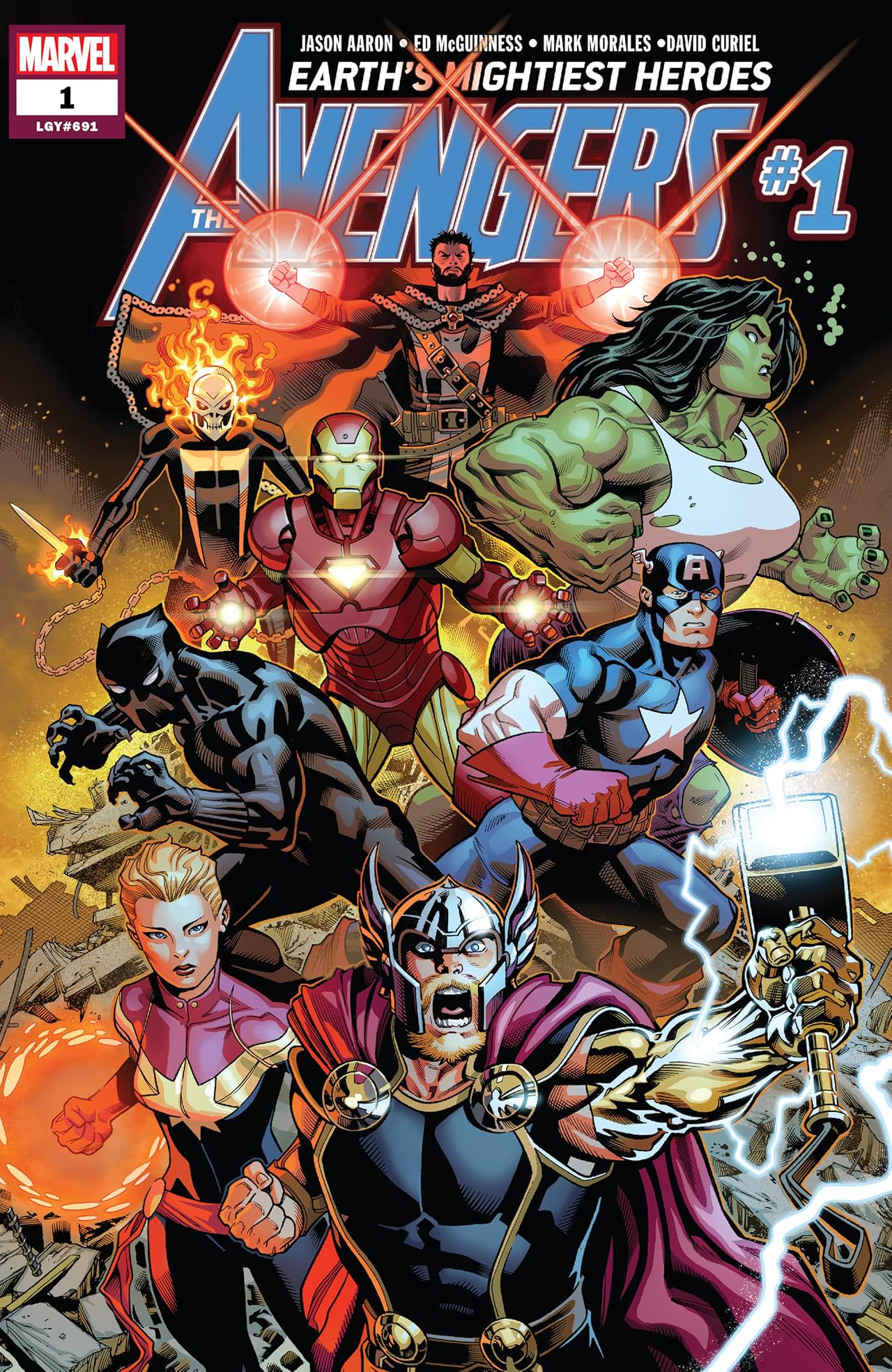
The following is my review of Avengers #1, which was posted on PopMatters.com.


Superhero comics often go through cycles upheavals. There's an accepted status quo that acts as a baseline, of sorts. Then, every once in a while there will be some upheavals that try to shake up the system and introduce new reforms. Some of those reforms stick. Some fail spectacularly. Most just fade into the background. Eventually, though, that familiar status quo returns to maintain the core appeal of a series.

For the Avengers, the traditions established by Thor, Captain America, and Iron Man act as the pillars of Marvel's top-tier heroes. The membership of the team may fluctuate every other week with Wolverine showing up one day while Squirrel Girl shows up another, but the core identity of the Avengers emerges from these three heroes. Every now and then, there's an effort to shake things up by bringing in new characters. No matter who shows up, though, be it a time traveler, a teen prodigy, or a Skrull agent, the Avengers are still built around these three iconic heroes.

In recent years, this core underwent plenty of upheaval with Thor becoming unworthy of Mjolnir, Captain America becoming a Hydra agent, and Tony Stark languishing in a coma. Some of those plots are still controversial and not necessarily for the right reasons. Whatever the controversy, though, it's only ever a matter of time before the Steve Rogers, Tony Stark, and Thor Odinson regain their roles as the Avengers' trinity of heroes.

Jason Aaron, who was behind some of the upheavals, and Ed McGuiness are now tasked with bringing that core back together and moving them forward in Avengers #1. At a time when the Avengers: Infinity War is topping the box office, the stakes are higher than usual for a new Avengers series. There are still lingering scars from the events of Secret Empire and Civil War II. There are also some extenuating circumstances that bring the Avengers together once more.

Despite these strained particulars, though, the stage for is set for the classic core of Avengers to return and Aaron makes good use of it. The events that kept Steve, Tony, and Thor apart aren't ignored. They even acknowledge the sentiment that the world around them is changing, both in terms of world-destroying threats and with respect to the growing diversity among the superhero community. However, even in musing over such changes, this classic trio finds a way to reaffirm that there's still a place for them.

It certainly helps when new threats emerge in the form of dead Celestials falling out of the sky. It's a threat that's not quite as random at it initially seems. This sudden catalyst for such a classic reunion has a basis in the events from Marvel Legacy #1, which introduced the Avengers of 1,000,000 BC. It's a concept that, even within that single issue, hasn't had much impact on anything in the present time to date. Those connections begin to emerge as the Avengers, new and old, begin to assemble.

While it's a refreshing scene, especially to those still recovering from the end of "Avengers: Infinity War," the spectacle is somewhat scattered. Captain America, Iron Man, and Thor are the driving force of the story, but there's also a supporting cast that's caught up in the same plot. That cast includes Black Panther, Dr. Strange, Captain Marvel, She-Hulk, and Ghost Rider. It's a potent mix of heavy hitters and a few emerging stars, but there aren't many opportunities for then to contribute.

They're still in a position to assemble, as Avengers do. Their part in the story, though, is somewhat disconnected from the personal drama going on among Iron Man, Captain America, and Thor. They don't do much to influence the uncertainties that Tony expresses about the future of the Avengers. Those uncertainties are almost as important as the threat of Celestials falling out of the sky, if only because it keeps the story from becoming another generic excuse to get the Avengers to unite.

Avengers #1 doesn't present itself as a simple reunion. Aaron dedicates just as much time discussing the place of the Avengers' old guard in an era where they're shortcomings and vulnerabilities catch up to them more and more. To some extent, their legacy works against them. New threats learn from old threats, adapting and evolving their attacks. They're now at the point where they can make Thor unworthy, turn Captain America into an agent of Hydra, and render Tony Stark comatose.

None of this is lost on the team. At one point, Tony even expresses doubt that he, Steve, and Thor should be the ones to re-assemble the Avengers. That doubt reflects the sentiment that old heroes need to step aside in order for new ones to emerge. It's a sentiment that has fueled a lot of the controversies surrounding these characters, going all the way back to the events of Original Sin.

While the events of Avengers #1 acknowledge that sentiment, it does little to actually address it. Some of that is due to the unavoidable distraction that comes with Celestials showing up out of nowhere, but it still leaves some questions unanswered. The assorted side-plots that put other Avengers in a position to assemble later on do little to help find those answers. One minute, Tony is pondering some important questions that have real implications for the future of the Avengers. The next, he just jumps back into his old role with his fellow Avengers to confront a new threat.

That threat is still intriguing in its own right, thanks to the tie-in with the 1,000,000 BC story line. It also helps that McGuinness' artwork makes it the kind of cosmic spectacle that warrants having these classic heroes take on their iconic poses once more. There are layers to the story and Aaron does plenty to establish the potential for this latest round of upheaval. It even says something about the extent of recent upheavals when it's just refreshing to see classic heroes reunite and feel relatively confident that it's not due to Skrull agents.

Overall, Avengers #1 does plenty to get the Avengers back on track, but doesn't do much to address why they got off track in the first place. There are important conversations to go along with the major events, both in the present and in the distant past. Most of those discussions remain incomplete, but there's still plenty of opportunities to have those discussions, preferably when there aren't dead Celestials lying in in the middle of major cities.

Final Score: 6 out of 10

Tuesday, January 3, 2017

Winning Streaks and Resolutions: Civil War II #8

The following is my review of Civil War II #8, which was posted on PopMatters.com.


Every major sports dynasty in every meaningful sport learns at some point that a winning streak has to end. Whether it's the Russians in the 1980 Winter Olympics, the undefeated New England Patriots in Super Bowl XLII, or the New York Yankees every five years or so, they learn that no winning streak can last forever. More often than not, learning that lesson is pretty painful.

In the context of Marvel Comics, Tony Stark is very much on par with the New York Yankees. He's been managing a winning streak that dates back to the conclusion of the first Civil War back in 2005. Within the Marvel/Disney hierarchy, he's right up there with princesses and talking animals in terms of importance and prominence. He's not just the character that revived Robert Downey Jr.'s career. He's very much the catalyst for the modern Marvel universe, as it has manifested over the past decade.

With Civil War II, he faces the biggest threat to his losing streak to date. Once again, he finds himself leading a team of heroes against another team of heroes, caught up in a powerful philosophical struggle on how heroes should conduct themselves. This time, it's not just Captain America or the American legal system he's up against. He's taking on Captain Marvel, who has a winning streak of her own, and the very forces that shape the future of the Marvel universe. Even with the star power of Robert Downey Jr., Tony Stark faces extreme odds.

He finally puts his vision and his winning streak on the line in Civil War II #8 for the final struggle. It has the fixings of a dramatic struggle, ripe with the same high emotions as Mark Millar's memorable narrative in the first Civil War. Unfortunately, those high emotions that worked so well for Millar end up falling much flatter with Bendis.

That's not to say that Civil War II #8 doesn't deliver in terms of drama and high emotions. Those factors are definitely in place and they do give the story plenty of weight. However, the actual mechanics of the story and the way everything gets resolved just come off as rushed and contrived. Nobody will be gasping for air or picking their jaw up off the floor with the big climax of the story here. The most anyone will probably do is shrug and sigh, but not necessarily in a bad way.

There are some powerful moments that play out here. These moments highlight the sheer strength and weight that Captain Marvel and Iron Man wield in the context of the current Marvel hierarchy. These are two of Marvel's most popular characters fighting over a conflict that Bendis made sure was every bit as balanced as the one Mark Millar molded in the first Civil War. The clash never feels like a glorified street fight or something that can be written off as a product of mind control, clones, or Skrull agents.


Captain Marvel and Iron Man are literally fighting for the future of the Marvel universe and their place in it. Over the course of that fight, it's clear that neither character harbors a seething hatred of the other. They don't insult each other. They don't engage in the kind of trash talk usually reserved for a rap battle. They carry themselves with the utmost conviction that they're right. They both believe they are the New York Yankees on the cusp of another championship.

In the end, only one can win out. Eventually, one does win out, albeit in an outcome that feels somewhat hollow. After all the high emotions that helped make Civil War II so impactful, from the first battle against a rogue Celestial to the death of Bruce Banner, the end result feels muted because the battle doesn't really resolve the main issue. In some respects, the issue resolves itself, which makes the conflict seem more trivial than it actually is.

Nothing that Captain Marvel and Iron Man do, either through fighting or through the hard choices they make, influences what happens to Ulysses. As the Inhuman who started this all, his role in the final conflict is surprisingly minimized, which really undermines the narrative. It's like Wolverine trying to win a fight without his claws. It is possible, but it lacks that a certain touch that gives the conclusion its satisfying feel.

Absent this satisfaction, the conclusion in Civil War II feels so rushed. If the conflict does affect Ulysses, it's an indirect influence at most and that influence is not really clear. Unlike the first Civil War, neither side gets a chance to really prove that their side was right. There's no way to actually put into practice all these the passionate arguments that Captain Marvel and Iron Man make throughout the conflict. They still fight, but they don't get to find out whose ideas actually win out.

Despite this lack of resolution, Civil War II still tries to establish a clear winner. It succeeds in this to some degree. It makes clear who comes out ahead and whose winning streak comes to an abrupt end. However, establishing the winner in the story doesn't necessarily explain why they're the winner in the first place. There's an argument to be made that nobody really won Civil War II. In the end, one person is still standing. That's more a technicality than a win, but it still counts. It's like a championship game ending in a tie, but one side still gets to act like a winner.


On the whole, Brian Michael Bendis and Oliver Copiel succeed on numerous levels in making Civil War II the same high-stakes, high-drama conflict as its predecessor. The heavy emotions and painful losses are there. The impact of those losses are felt. Civil War II #8 does nothing to underscore those emotions or those losses. The characters never feel insincere. There's never a sense that one of them could be a Skrull agent. The refinements are there. It's the overall resolution that's lacking.

One winning streak ends. Another winning streak continues. There are impacts, scars, and plenty of arguments to be had on message boards for years to come. In the grand scheme of things, Civil War II counts as a success. It's just not the kind of success that will make anyone less tired of superheroes fighting each other.

Final Score: 6 out of 10

Monday, July 18, 2016

Heavy Impacts with Heavy Hearts: Civil War II #3

The following is my review of Civil War II #3, which was posted on PopMatters.com.


In major and minor wars alike, there is usually a spark that ignites the conflict. That spark doesn't always get its own documentary on the History Channel, but it often reveals the scope and scale of the conflict that unfolds. In Civil War II, the spark is lit. The conflict over Ulysses, the Inhuman who can predict the future on a level that fantasy sports fans dream of, is just starting to grow.

It's a conflict that has already claimed multiple casualties, namely War Machine and She-Hulk. So already, the scope and scale of this conflict is pretty big. Brian Michael Bendis gives both sides plenty of reasons to shoot, punch, and yell at each other. These reasons aren't petty or contrived either. This goes beyond opposing an unjust law, suspecting who may or may not be a Skrull, or falling in love with the same redhead. True to Marvel's Civil War tradition, this conflict reflects real-world conflicts in terms of justice, due process, and using precognitive powers for more than just fantasy sports.

However, the true extent of the conflict Civil War II is still developing. There isn't yet a rallying point where the lines are drawn, the teams assemble, and the property damage escalates. So far, the conflict is still Iron Man and Captain Marvel having a friendly disagreement. In Civil War II #3, there's nothing friendly about it anymore. That spark is a raging inferno now. The lines are drawn, the divisions are clear, and the outrage cannot be contained in a message board.

Bendis uses a common tactic in major crossover events, crafting the big turning point around the death of a major character. However, the tactics Bendis uses to make this death meaningful in Civil War II #3 aren't quite so common. This being Marvel's second attempt at a Civil War story, the formula requires some tweaking. It can't go too overboard either. As the last Fantastic Four movie so tragically demonstrates, this can backfire.


Bendis avoids that pitfall by framing the conflict in Civil War II in a more sophisticated manner. There's a not much emphasis on the death itself. There isn't even much emphasis on the one who causes it. Instead, Bendis explores the larger implications. Those implications help expand the conflict in a way that feels personal, profound, and dramatic.

These same implications are the fuel that raises the stakes in Civil War II. It still echoes the same conflict that begins as a simple disagreement between Iron Man and Captain Marvel. That disagreement, however, is now a war that is claiming multiple casualties. Those casualties make the difficult questions surrounding Civil War II more pressing.

These questions are repeated in Civil War II #3, but in very different circumstances and in a very different context. The content is still the same though. Is it right to punish a crime before it is committed? Even when they have a powerful tool at their disposal in Ulysses that gives them unprecedented foresight? The answers to these questions, as well as the merits of those answers, is put on trial in a semi-literal way. It may not be as exciting as the battle against the renegade Celestial in Civil War II #1, but its contribution to the narrative is every bit as meaningful.

The narrative actually alternates between the present and the past, providing details and drama to the circumstances that led to this pivotal turning point. It gets a little chaotic, but never becomes overly confusing. That's quite an accomplishment at a time when the Marvel Universe is full of time-displaced characters and characters from other universes.

The shifting timeframe also allows for some powerful moments with certain characters, especially Bruce Banner and Hawkeye. Nobody does anything with a wink and a shrug. Nobody tries to lighten the mood. There are a lot of heavy hearts and serious concerns. Even Spider-Man doesn't dare make any wisecracks, which is a major sign in and of itself.

The most important impact, in terms of the bigger picture, is how the events of this issue entrench the two opposing sides. Carol Danvers, despite being personally affected by the growing list of casualties, makes her position clear. She believes that using Ulysses' visions to save lives is justified. The heavy losses she endures don't change that. If anything, they strengthen her resolve.


These events do the same for Iron Man, albeit in the opposite direction. The loss in this issue only confirms his greatest fears. He sees punishing a crime before it is committed as a crime itself. Once again, Bendis captures the most important element of Civil War by presenting both sides as reasonable. This isn't a debate on the morality of child labor laws or free medicine for sick orphans. This is a clash in philosophies where both sides occupy a very gray area of morality.

If there are any shortcomings in this clash, it's the lack of contribution from other heroes not named Iron Man, Captain Marvel, or Hawkeye. Nearly every major superhero team in the Marvel Universe takes interest in this issue, including those with conflicting movie rights. However, their contributions and reactions aren't really explored or hinted at. Even though the battle lines are drawn, it's difficult to determine who sides with who.

That's not to say that the scope of Civil War II is underplayed. Bendis makes an effort to show just how big a story this is for everyone in the Marvel Universe. He creates the sense that this conflict is being watched at levels not seen since the OJ Simpson trial. It extends the conflict beyond superheroes because for all the public knows, they're just one Ulysses vision away from being the next Red Skull.

Civil War II #3 succeeds in the most important part of any civil war. It draws the battle lines while establishing the merits of both sides. It also ends any possibility that this disagreement between Iron Man and Captain Marvel can end without someone getting punched in the jaw. Heroes are already choosing sides. Arguments are intensifying on message boards. This conflict is bound to get ugly, but Bendis makes sure it's a meaningful, relevant kind of ugly. Anyone who can make ugly things meaningful knows they've accomplished something.

Final Score: 8 out of 10

Monday, June 13, 2016

Fittingly Effective Foresight: Civil War II #1

The following is my review of Civil War II #1, which was posted on PopMatters.com.


There's a reason why some one-hit wonders are destined to fail in any effort to recapture their initial success. As Vanilla Ice and everyone whoever did the Macarena can attest, it's easy to get burned out on something when it's overdone and overexposed. Capturing that same success is even harder than capturing lightning in a bottle a second time. At least lightning obeys the laws of nature. Those that consume media tend to scoff at those laws in ways that frustrate every marketing department that ever existed.

This same dynamic applies to major crossover events in comics. Sometimes, the time and place is right for such an event. Mark Millar's work on Civil War couldn't have come out at a better time. It was a time where issues like the Patriot Act and pre-emptive war actively shaped the mindset of the public. It's hard to determine whether the time and place is right for Civil War II, but Marvel is rolling the dice, hoping they can succeed where Vanilla Ice failed.

Civil War II #1 ignites a conflict that promises to divide Marvel's iconic heroes every bit as much as the Superhero Registration Act/Sokovia Accords. It's a conflict that, much like its predecessor, reflects real-world issues in maintaining a safe and just society. It's all built around the prospect of punishing crime before it occurs. It's an untenable concept outside of a North Korean court, but in a world where there are enough psychics to start their own baseball team, it's a legitimate issue to discuss.

Brian Michael Bendis makes it a point to make this discussion the main driving force of the narrative, but it's the spectacle built around that driving force that gives Civil War II #1 an impact that rivals its predecessor. The story doesn't actually start with the debate. It starts with a full-fledged, unambiguous triumph. It's the kind of triumph usually reserved for the end of a crossover story after every effort is made to make the heroes the underdogs. Bendis effectively flips that script in the best possible way.


A rogue Celestial invades, the heroes of the Marvel universe unite, and they win the day with less collateral damage than mild Hulk rampage. At a time when every major superhero clash incurs enough damage to bankrupt Stark Industries, this feels like a refreshing novelty. However, it's the context in which this battle occurs that gives it a unique weight.

It centers around Ulysses, a recently-formed Inhuman who has the ability to accurately see the future. He's the reason why every hero of the Marvel universe was able to effectively coordinate against a Celestial attack. He shows that with enough warning, prep time, and access to Tony Stark's credit cards, there aren't many threats that Earth's mightiest heroes can't deal with. In the grand scheme of superhero dynamics, it makes perfect sense. Many devastating attacks are built on the element of surprise. Take that away and even Thanos on his best day can't win.

It's a rarity in modern comics, the heroes being so competent and effective in their efforts. It's rare because on paper, it makes for a boring story. There's not much drama behind Superman rescuing a cat from a tree or Captain America telling children to eat their vegetables. In some respects, it's that rarity that makes this epic battle against a Celestial so impactful. It establishes just what Marvel's greatest heroes can accomplish when they have sufficient foresight, effective coordination, and no hindrances from competing movie studios.

This easy, efficient victory leads right into the dramatic debate that echoes the conflict that gives Civil War II the impact it needs to make the narrative work. Carol Danvers and Tony Stark draw the lines and establish the sides. On Carol's side, there's the idea that they should use Ulysses' power to prevent crimes from ever happening. On Tony's side, there's the idea that the punishment shouldn't come before the crime. Both sides make valid points. Both sides make passionate arguments. Both sides are sure to divide fans and inflame message boards, but for all the right reasons.

This argument captures the most important component of the original Civil War. It creates a conflict in which both sides make valid arguments. This isn't a matter of democracy versus fascism, truth versus deceit, or The Phantom Menace versus The Empire Strikes Back. There's a case to be made by both sides. By establishing this important dynamic, Civil War II #1 succeeds at achieving its most critical goal.

With this success, the foundation for the conflict is effectively set. The two opposing sides form and the stakes are established. In terms of the big picture, Civil War II #1 checks all the right boxes. In terms of the little pictures within that big picture, however, the details are lacking. Like Deadpool at a shooting range, the narrative does jump the gun in some areas.


The pacing of the story, as well as the sequence of the events, is poorly organized and disjointed at times. It made sense to rush the battle against the Celestial because of Ulysses' impact. However, the subsequent battle against Thanos that incurred major casualties lacked the necessary context. While this didn't take away from the heavy emotions and high drama, it does come off as contrived to some extent.

Despite the disorganization and inconsistencies, Civil War II #1 hits the ground running in all the right ways for all the right reasons. Brian Michael Bendis succeeds in capturing the same spirit that Mark Millar captured with the original Civil War. It doesn't try too hard to be exactly like its predecessor. It doesn't try to radically reinvent the concept either. Civil War II strikes a perfect balance between the fresh and the familiar. It succeeds where so many one-hit wonders fail. It may be too late for Vanilla Ice, but the timing is perfect for this latest Marvel spectacle.

Final Score: 8 out of 10

Thursday, June 9, 2016

Civil War II: X-men #1 PREVIEW!

It's been a while since I singled out a preview on this blog. To be honest, I put a lot less stock in previews these days because they tend to be shitty teasers that rarely reflect the quality of a book. That's not just a problem Marvel has either. Pretty much all comics do that and like a trailer that gives away all the good parts, I think their value is overstated.

That said, some are worth staying sober for. We all know by now that Marvel has developed a new fetish for fucking over the X-men at every turn. Civil War II will likely contribute to that effort. At the rate it's going, the entire mutant race will need an extra asshole to accommodate the screw-job they'll endure. On the other side, I'm pretty sure the Inhumans will come off so glowing that they could all take a shit in a portopotty and make it smell like a chocolate factory. X-men fans just have to reside themselves to the fact that this is the new normal. Marvel will continue to fuck the X-men with an Inhuman-powered dick until Fox cough's up the rights some time in 2093.

So we can either whine about it or just sit back and enjoy the shit storm for what it is. Thankfully, the X-men comics still have writers like Cullen Bunn, Tom Taylor, and Jeff Lemire. They still seem to be putting a concerted effort to making the X-men comics awesome, despite Marvel's best efforts. While I'm sure it infuriate the lawyers, they do have a Civil War II tie-in book. It's coming out next week and I'm sure the entire mutant race will want to lube up their assholes accordingly.


So there are rich assholes in every group that will try to exploit the shit out of a bad situation. That makes sense. Being a mutant doesn't make anyone immune to being a total cunt. Looking at you, Hope fucking Summers.

Beyond rich assholes jerking off while other mutants suffer because of the Inhuman fart cloud, Magneto is once again showing that he can get shit done in ways that no pacifist can hope to match. It's a huge theme of Cullen Bunn's run on Uncanny X-men. I can only hope he'll take it way too fucking far here in Civil War II. That brings out the best in Magneto and the X-men as a whole. So even though I know this is going to end in a shit storm for mutants, I'm still going to grab a case of beer, sit back, and enjoy the show as best I can with an unsober mind. Nuff said!

Tuesday, May 24, 2016

Through Loosely Connected Sub-plots, a Foundation Is Laid in Civil War II #0

The following is my review of Civil War II #0, which was posted on PopMatters.com.


Any college student cramming for a final exam can attest that procrastination is a common, often unavoidable aspect of human nature. We human beings simply aren't wired to be overly proactive. The caveman in us often refuses to acknowledge the danger until a stampede of wooly mammoths is charging our village at a rate that registers as a small to mid-ranged Earthquake. We try to be proactive. We understand its values and benefits. Despite this, our capacity for foresight is laughable most of the time.

In the world of superheroes, killer robots, invading aliens, and whatever Tony Stark happens to build on an off-day, the stakes are much higher than any exam. Knowing when and how Thanos will attempt to destroy the Earth and spit on its ashes is pretty important. It's the difference between needing another Helicarrier and needing a time machine.

It's a factor that has many real world parallels. Law enforcement, the military, the NSA, and annoying internet ads need a certain level of foresight to function. That's what makes Civil War II such an intriguing concept and Civil War II #0 makes it a point to belabor the importance of this concept. It's a point worth belaboring, as those same procrastinating college students are destined to find out the hard way. The conflict doesn't erupt here, but the mood is definitively established.

The method for establishing this mood in Civil War II #0 isn't necessarily concise, nor is it engaging at times. However, it still conveys the necessary sentiment through the experiences of characters like She-Hulk, War Machine, and Captain Marvel. These characters help shape the mood of the conflict before it erupts. They don't reveal anything about the characters that can't be gleaned from Wikipedia, but they do establish their current mindset within the context of Civil War II.


Through these loosely connected sub-plots, the foundation is laid. On one side, She-Hulk argues passionately for the defense of the Jester, a known villain who most card-carrying members of the Avengers wouldn't hesitate to punch. Her defense, however, is as articulate as it is relevant, both in the context of Civil War II and in the context of the real world where no self-respecting criminal calls themselves the Jester.

The crime in this case may or may not qualify as a crime. The Jester isn't charged with stealing or hurting anyone. He's charged with merely discussing it. For him, the mere act of thinking about a crime is a crime in and of itself. It is, by definition, a thought crime. In the real world, civilized societies find convicting people of such crimes untenable. Maybe it's a little more understandable in a world where telepaths like Emma Frost and Jean Grey exist, but it's still inconsistent with a basic understanding of justice.

Our world might not have telepaths, but it does reflect a real problem, as the original Civil War did a decade earlier. In the realm of justice and security, it's not always clear what constitutes an imminent threat. For some people, a threat only becomes pressing when someone is standing in a doorway dressed as a clown and carrying a knife. For others, a critical tweet constitutes a threat. The line isn't just blurred. It's a constantly shifting, often nebulous concept that rarely keeps up with the needs of society.

She-Hulk ends up losing her case, but her concept of proactive justice is very different from that of Captain Marvel. As a member of the Ultimates, who need to be exceedingly proactive when dealing with threats like Thanos and Galactus, she laments on how many close calls the Earth has had. This doesn't even count all the times retcons and time travel were necessary to save the day. She understands the need for foresight better than most non-psychic characters. Moreover, she expresses a desire to seek means of improving their foresight.

This leads to the primary catalyst for Civil War II, namely the Inhuman named Ulysses. There's really nothing special about his transformation or him as a character. He's as generic and forgettable as most civilians in the Marvel universe with no direct or indirect ties to Peter Parker. He just happens to be outside as the Terrigen Mist sweeps over his college campus. That's really all there is to this key character in Civil War II.

The drama is lacking, but the sentiment expressed by characters like She-Hulk and Captain Marvel are nicely developed. The situations are somewhat contrived, but Brian Michael Bendis does an admirable job crafting the thoughts and feelings of these characters. He sets the right tone and establishes the right mood, ensuring it's ripe for tension and conflict. Since the first Civil War inspired a movie that's on track to make a billion dollars at the box office, this is vital in terms of capturing the spirit of its predecessor.


While this spirit is present and well-developed, the overall story is lacking and disorganized. There are very few connecting threads tying the narrative together. Everything just happens separately and randomly. That's not to say the plot of Civil War II #0 is forced. It simply lacks organization and cohesion. It's the opening credits to a much larger story and not enough is done to make this necessary component of the overall narrative more engaging.

The greatest strength of Civil War II #0 is still the insight of the characters involved. This insight succeeds in the same way the premise of the original Civil War succeeded, creating an issue that has real-world parallels and major implications, especially for a fictional world where planet-eating entities are a legitimate concern. It's bland in terms of substance, but necessary with respect to context. It lacks a larger entertainment value, but such details aren't always possible for a certain narrative, Deadpool being the lone exception.

Final Score: 6 out of 10

Tuesday, May 26, 2015

Gender-Neutral Awesome: A-Force #1

The following is my review of A-Force #1, which was posted on PopMatters.com.


There was once a time when the epitome of girl power was the Spice Girls. Take the same pre-packaged, heavily processed concoction that created boy bands and use women instead. Somehow that’s supposed to celebrate all things feminine. To be fair, that was the late 90s. It was a time when Nicholas Cage was still considered an A-list actor and the concept of strong female characters was limited to characters played by Sigourney Weaver.

Now the concept of strong female characters has become a mainstream concept and A-Force #1 is put in a position to capitalize on that concept. The timing couldn’t be better. Marvel has been the championship surfer riding the wave of female characters that have risen to prominence in recent years. Characters like Batgirl, Captain Marvel, Black Widow, and Kamala Khan have shown that they can carry their own weight without having to dress like Emma Frost. With Secret Wars in full swing, there’s enough chaos and confusion to do something different that doesn’t involve just flipping the boy band formula.

Battleworld has created a new environment for female characters from multiple eras to come together for a singular struggle. It’s an environment where every character is free of baggage, reduced to their purest form. It’s like taking football players from multiple eras and putting them on the same team when they’re playing at an all-pro level. It has every conceivable detail to work with. And in A-Force #1, the result is rich in substance yet incomplete in scope.

The domain of Arcadia is by far the most appealing locale in Battleworld to date. It’s a land that is devoid of zombies, killer robots, or evil clones. In the context of the Marvel universe, it might as well be an endangered species. It feels like a world that might actually be worth living in and not just because it’s protected by a team of beautiful women. In fact, the concept that Arcadia is protected by a team of women is almost secondary. The story never focuses on it or uses it to make a statement of sorts. It’s just how Arcadia functions. It may upset the Rush Limbaugh’s of the world, but few others will really notice it.

This in and of itself is an important accomplishment. By not focusing on gender, the story isn’t about a domain that’s protected by a team of superpowered women. It’s about a domain whose protectors just happen to be superpowered women. Their gender is a non-issue. They don’t do anything that a team of male heroes wouldn’t. They police their world, look out for one another, and develop close friendships. And they do this without coming off as a Sex in the City re-run.

Beyond the accomplishment, the story has the same themes and conflicts as other domains of Battleworld. It doesn’t matter that Arcadia is peaceful and protected by a team of women. It’s still subject to the same rules imposed by Dr. Doom. That means that when one of them breaks a rule, they suffer the same consequences. In this story, it’s Miss America who runs afoul of Dr. Doom’s rules. And when it comes to his rules, Dr. Doom practices strict gender equality. That alone puts him above 90 percent of the countries on Earth, which is a disturbing thought.

Like other residents of Battleworld, Miss America learns the hard way that Dr. Doom doesn’t like it when one domain encroaches on another. It’s not just for invasions either. Miss America threw a dead shark over the shields dividing their domains. That counts as an extreme version of littering and Dr. Doom is as strict as Singapore when it comes to that policy.


It leads to an emotional struggle within A-Force. They know the rules like everyone else. They try to protect their friend from the consequences. They don’t succeed. They don’t get special treatment. They don’t even try to flirt their way out of it. Miss America still has to pay for her crimes and it weighs heavy on her friends. It’s a toll that’s actually more compelling than a giant shark attacking Arcadia. It’s a nice change of pace, but it’s also part of the primary flaw in this story.

The conflict is triggered by an attack from a giant shark. It’s a conflict that is only slightly more engaging than the last Sharknado movie. While it does give A-Force a chance to show what they can do as a team, it lacks the kind of epic scale that has helped make Secret Wars feel like a multi-dimensional royal rumble. It’s practically glossed over. It’s basically a teaser trailer to the emotional struggle involving Miss America, minus the bad one-liners and annoying voice-overs.

That’s not to say the shark attack was completely without merit. It’s an issue that A-Force seeks to investigate. It’s an investigation that also coincides with the unexpected arrival of another female character. However, the connections are limited and the flow of events gets somewhat choppy. It’s like watching the Godfather on cable with poorly timed commercials interrupting the narrative.

Flaws aside, A-Force #1 creates an appealing, engaging world that’s worth exploring. It’s not some grand utopian vision where women rule the world and all is well. It’s not some dystopian horror where an army of Don Drapers rule either. It’s a world that offers fertile ground with which to explore these female characters, minus convoluted romantic entanglements and radical feminist undertones.

This is also a world where the strength of women takes center stage and they do it without denigrating men. On paper, it shouldn’t feel like such a novel concept. Maybe it says something about both genders when something so refreshing also feels so unfamiliar. It’s not that the idea of strong female characters not having to beat up arrogant male characters is new. It’s just that someone finally took the time to tell that story in a way that all genders can appreciate.

Final Score: 8 out of 10

Wednesday, February 18, 2015

Scanned Thoughts: Uncanny X-men #31


After a night of heavy drinking, there comes a point where the line between buzz and sickness become so blurred that it might as well be the same feeling. It's what I like to call the "fuck everything" zone of drunkenness. When I'm in that state, I could get hit by a car and just shrug it off. I'm just beyond the point of giving half a shit. For the Last Will and Testament of Charles Xavier, that point has long since passed. This story had such bold potential. Charles Xavier married Mystique for crying out loud. How the fuck does that become a total afterthought? It's at a point where if I were drinking, Jack Daniels himself would cut me off.

Does anyone else remember that this arc started when Original Sin was still going on? Does anyone else remember that it started when Wolverine was still alive? No? Those people that don't remember need to email me. I want to know who sells them their weed and how I can get some by the end of today. This is a story that has gone on way too fucking long, so much so that it completely clashes with what the solicits say. The cover of Uncanny X-men #31 teases it as being the aftermath of AXIS. But this shit is still stuck in last summer's big event. And personally, I'd much rather read a story about an inverted Havok joining Cyclops' team than Matthew fucking Malloy.

But I digress. Uncanny X-men #31 is supposed to finally give the payoff that it hasn't been able to give since last summer. It's already completely forgotten the whole Xavier marrying Mystique shit. It's tried to throw in some, "Oh fuck!" moments by having Matthew Malloy kill Cyclops, Magik, and Emma Frost while bringing Charles Xavier back from the past. But seeing as how we already know they don't stay dead, nobody's assholes are going to be getting any tighter. But still, I'm going to give Uncanny X-men #31 a chance. It's just going to be hard when the point of me giving a fuck passed back when the Cleveland Browns still had playoff hopes.

If there's any chance that anyone can unfuck this cluster of WTFs, it's Charles Xavier. He's the one that fucked it up in the first place with Matthew Malloy. Now, thanks to Tempus, he's in the future where he hopes to fix this before SHIELD loses any more overpriced helicarriers. The reaction of the Stepford Cuckoos and the rest of the New Xavier School students is nice. They react to the same way most teenagers would react to meeting Taylor Swift. So long as they don't date him or become his prized student, they should get something out of it. They would be the only ones at this point.


The New Xavier School students swoon just long enough for an emergency recording from Cyclops to activate. Being the kind of guy who probably has a battle plan for brushes his teeth, he also has a plan on the exceedingly likely chance that he or Emma or Magik die unexpectedly. While I'm sure he thought he would die at the hands of another angry clone of Jean Grey or a Phoenix-powered Hank McCoy, he does take steps to make sure his students know what to do. He basically tells them to get the fuck in the X-jet and get to the Jean Grey Institute where they'll be safe.

For the young mutants at the New Xavier School who only recently learned how to fight killer robots, it's one too many "Oh fuck!" moments. To his credit, Cyclops doesn't ask that his students avenge him or throw themselves into the front line to destroy whatever robot or evil clone that killed him. He does try to protect his students. The Hank McCoys of the world would probably roll their eyes at that shit, but it does show that he still has a plan. Charles Xavier just has to figure out a way to make this plan feel like terrifying to a bunch of young mutants.


The problem with Cyclops' backup plan is that he assumed the army of Jean Grey clones or killer robots would be too busy dancing on his corpse to attack the Jean Grey Institute. Well, it seems Matthew Malloy just isn't content enough fucking up Xavier's last will and testament or distracting the X-men from the fact that Charles Xavier married Mystique. Does anyone else even remember when that was the most interesting part of this story? Or was I just really fucking high to the point where I imagined that? I don't know. Like I said, I'm beyond the point of giving a shit and so are the X-men.

As soon as the Jean Grey Institute staff sees Matthew Malloy, their first instinct isn't to wrap him up in warm blankets and give him a cup of hot cocoa. While I'm sure Hank McCoy and Iceman want to dry hump him for killing Cyclops, they're a bit more concerned with the possibility that he'll kill more of them. So even though Matthew Malloy is losing his fucking mind and whining like a kid at the dentist office, they decide the best way to deal with him is to fight him. And they don't even have a helicarrier to attack with. In terms of reactions, this is right up there with making Mel Gibson the next Pope in terms of stupidity.


The result is every bit as fucked as has come to be expected at this point. Matthew Malloy still can't control it. Everything Charles Xavier did to help him was as productive as Johnny Manziel's rookie season. Matthew ends up killing the entire Jean Grey Institute staff and whining like a bitch the whole time. It's one of those moments that, under different circumstances, would rank about a 9.0 in the "Holy shit!" scale. But given how long this story has dragged, it has no impact. Even with all this gruesome death and obscene destruction, it has the same impact as another shitty Transformer movie.

This is by far the biggest weakness of the story. It began as a tie-in with Original Sin. It promised so many deep, dark revelations. To some extend, it did that. But it dragged it out so fucking long that it has completely lost its ability to generate enough fucks to be given. It has the same effect on me that it would a coma patient. It just falls that fucking flat. So all the X-men are dead, Charles Xavier failed, and the world of mutants is fucked. It should be tragic, but it's really no more annoying than a paper cut at this point.


So how the fuck does something like this get fixed? Sadly, there are only bullshit options at this point. First, Professor Xavier wanted to travel to the Jean Grey Institute with Tempus to confront Matthew. But for some reason, that whole trip got skipped and Professor Xavier went straight for the "Fuck this!" solution. And the most fucked up part about that is it's probably the most viable solution at this point. If the entire X-men die trying to confront Matthew Malloy, then he has a better chance winning an arm-wrestling contest with the Hulk on a coke binge.

So in a painfully choppy shift, Professor Xavier travels back in time with Tempus to catch up with Matthew Malloy's future parents. That's right. He's now taking a page out of Back to the Future, minus the incest. Instead of trying to fix the shit storm that he kicked up, he's just going to make it so Matthew's parents never met and he was never born. It's the kind of cheating that even Bill Belichick would find excessive. But at this point, cheating is warranted if it means ending this shit.

But beyond the cheating, this reveals something even more distressing. It shows that if there is a mutant that can't control their powers, then this is how Charles Xavier is willing to deal with them. It shows that he is every bit the hypocrite Cyclops said he was earlier. The whole "Nobody is beyond help" philosophy might as well be as legitimate as a lung cancer study funded by tobacco companies. He basically just spat in the face of his own philosophy. Granted, he did it in the least painful way possible. He didn't torture Matthew's parents. He just tweaked their thoughts so they wouldn't meet. It's not the same as giving Matthew's father a few kicks in the balls, but it's still bullshit on principle.

What makes this premise even shittier is that it basically concedes that there are mutants too dangerous to help. Matthew Malloy, despite begging for help, couldn't be saved. This means that the William Strykers of the world are right on some levels. There are mutants out there too dangerous to deal with. So how the fuck can Charles Xavier justify peace and understanding with that possibility? He can't. So he's not just spitting in the face of his own philosophy. He's spitting in the face of the entire concept of X-men.


After confirming that Matthew Malloy was never born, Tempus takes Professor Xavier back to his own time. So I guess he really only showed up in the future just long enough to find out how fucked they were. Then he goes right back because...actually, I'm not even going to try and make sense of this shit. There's only so much weed I can smoke before my ability to make sense of this shit hits a wall. So I'll stop trying.

This poorly organized narrative uses a bit more cheating. Professor Xavier apparently has the power to telepathically make himself forget about this shit. Because why not? He's clearly stopped playing by his own rules at this point. He still manages to have a nice chat with Tempus, who says he didn't completely fuck everything up. Even if he is a hypocrite, the X-men achieved a lot because of him. They skip over the way shit went wrong with Cyclops. Tempus just says he alone is responsible. Never mind that Tony Stark put a fucking cosmic power in him. That shit's just a technicality. It's way too rushed and way too simplistic. Xavier then warns Tempus about the way she's using her powers. But at this point, he's pretty much pissed away what's left of his credibility when it comes to giving powerful mutants a morality lecture.

Still, he got to marry Mystique. I can't help but respect any man who manages to accomplish that. I know that plot was forgotten about quicker than the last Tyler Perry movie, but that still gives Charles Xavier some street cred in my opinion.


So how does this unfuck the future? Well, it goes back to the moment where the X-men gather around to read Professor Xavier's will with She-Hulk. Apparently, Xavier removed the part about him marrying Mystique. Instead, he just said the institute and all the money to fund it now belongs to Cyclops. That's right, the student who ended up killing him while drunk on cosmic power now owns the Jean Grey Institute. It has the impact of a sucker-punch from a butterfly. But after all this bullshit with Mathew Malloy, that's probably a good thing.


However, there is something meaningful that still comes out of this. Tempus, who is now the only one who knows how shitty everything got, pays Cyclops a visit to tell him just how badly he fucked up. He's probably confused because he's probably not used to one of his students giving him shit like this, especially in a sexy Australian accent. But she basically tells him to get his shit together because she'll be watching him. And if he fucks up the way he did with Matthew Malloy, she'll go back in time and make sure his parents never meet or castrate his father, whichever comes first.

Cyclops is understandably confused and pissed. He kicks her out of the New Xavier School on the spot, but this actually makes for one of the most meaningful moments in the story. Tempus says she's basically just doing what he taught her. She's now a graduate of the Cyclops method of getting shit done, which sometimes involves pissing people off. It's wonderfully ironic, her turning Cyclops' own tactics against him. It's probably the most fitting way for Tempus to make her mark on the X-men. It also gives Cyclops a whole new set of motivations to not fuck up. And to think, Tempus had a crush on Cyclops at one point in this series. Something about that just seems right.


After this little pep talk from Tempus, Cyclops makes a fateful decision that might end up being the most appropriate under the circumstances. He signs the Institute over to Storm. And in exchange, he also asks that she take in all the students from his school. It's right up there with trading a cheeseburger for a blowjob in terms of unequal exchanges. But it does finally give the story some level of impact. After what Tempus just told him, Cyclops decides that his students are better off at the Jean Grey Institute. He even tells all the X-men who now hate his guts that he still loves them. He never has to call Charles Xavier the hypocrite he is. Even though it's a solution that required some really egregious cheating, it's a solution that works. Bill Belichick would approve.


The end of this arc gave me the same feeling that I imagine Elton John gets whenever he visits the Playboy Mansion. I really felt nothing. I didn't feel like bashing my head against the wall like a Seahawks fans at the end of the last Super Bowl. I didn't feel like Homer Simpson swimming in a pool of beer either. I'm just glad this story is over. Even though it ended in a way akin to using cheat codes in Skyrim, it really didn't upset me. When my ability to give a shit ended several hangovers ago, my emotional range is exceedingly limited.

That's not to say that there wasn't something of merit that came of all this. The fitting bit of irony at the end with Tempus taking Cyclops' lessons a bit too much to heart had the right impact. So the story itself has merit in terms of what it does for the characters. It just took way too fucking long and fell way the fuck off the rails along the way. Between dropping the whole Xavier marrying Mystique and taking place before Wolverine's death, this whole story was like shooting craps with loaded dice. The impact was always going to be limited, but it still did just enough. It's just not going to get anyone too happy, upset, or horny.

I give Uncanny X-men #31 a 5 out of 10. It's basically the Switzerland of comics, minus the watches and chocolate. Something did eventually come out of it. But like a constipated whale that accidentally swallowed a pickup truck, it wasn't nearly enough. Nuff said!
Thursday, January 29, 2015

Scanned Thoughts: Uncanny X-men #30


For anyone who has ever played video games, at some point they’ve used cheat codes. Sure, the can make a game so damn easy that it might as well be on auto-pilot. But sometimes it can make the game fun. Who doesn’t enjoy turning on God-mode in Skyrim every once in a while and beating dragons with a dagger? But that kind of cheating is a bit harder to enjoy when it comes to resolving egregious flaws in a story like the one being told in Uncanny X-men.

It’s a story that has dragged for way too fucking long. It was supposed to tie into the events of Original Sin, an event that ended last summer before people started getting sick of Frozen. It introduced one of Charles Xavier’s dying wishes and a volatile new mutant named Matthew Malloy. It has had its share of good, intense moments. But it has also been full of shitty characterization and huge dick moves, largely from Iceman. Now it’s gotten so fucked up that cheat codes might be necessary to fix it and Tempus is basically an updated version of Game Genie. It’s gotten to a point where shit is so bad that Uncanny X-men #30 has to cheat to tie up loose ends. But for a story that’s dragged so much, maybe that’s the most merciful thing to do at this point.

Some level of cheating will definitely be needed for SHIELD. They just told Maria Hill that they fucking killed Cyclops, Magik, and Matthew Malloy. It sounds like the kind of callous shit usually reserved for the Ultimate universe, but anyone who saw the teasers for Secret Wars (or even the preview for Uncanny X-men #31 that was released five days before this fucking issue) can sleep easy knowing that he’ll be back and his death will be undone. And that’s going to be bad fucking news for SHIELD. It doesn’t matter how much Maria Hill wants to secretly bone Cyclops. After shit like this, he’s going to see to it that her panties stay dry for a long fucking time.


The real cheating takes place, courtesy of Tempus. She saw how fucked this situation was so she resorted to more time travel because I guess Marvel assumes we’ve all become desensitized to this shit. The sad part is they’re not entirely wrong. It certainly makes it hard to get excited about the implications for this story. At the very least, it gives us a chance to see a Charles Xavier that Patrick Stewart would be proud to play.

Xavier isn’t quite as charming as Patrick Stewart, but he’s not the same douche-bag he was leading up to his death. He picks up on how fucked things must be. He even picks up how it involves Cyclops, who at this point is the teacher’s pet. Yet he remains remarkably calm, not even spilling his tea. I guess pretty girls from the future drop in all the time. If he were Patrick Stewart, he might even have a chance at boning them. But I guess there are limits to even time travel.


There are also limits to how much Emma Frost can keep arguing with the Jean Grey Institute staff. This is an argument that began several issues ago and it has still accomplished less than Paris Hilton’s music career. They kept bitching and moaning about the merits of recruiting Matthew Malloy and how Cyclops is just looking for a weapon. If this were a college lecture, I would have long since run out of weed and fallen asleep.

It only finally ends when gets news from SHIELD that Cyclops is dead. He doesn’t exactly sound that upset about it. In fact, I’m pretty sure he’s hiding a boner. But again, it’s a moment that falls painfully flat because it’s a death that we already know isn’t going to stick. Considering how it accomplishes so little on top of an argument that went fucking nowhere, this is one of those moments that even weed can’t make entertaining.


There’s a much more meaningful argument between Tempus and Charles Xavier. She keeps trying to make him read her mind fully. He’s not too eager to see how fucked the future is who spoil the next dozen or so Superbowls. But he does sense enough to know what Tempus wants. She thinks Matthew Malloy needs to die in the past the save the future. She already sees what happens by doing things Xavier’s way. She thinks this situation is fucked enough to warrant an exception. Usually, this is the point where Xavier would just shrug his shoulders and compromise like he’s been doing since the Clinton administration. But this isn’t that same Charles Xavier and this is probably what makes this moment actually feel meaningful.

Maybe Patrick Stewart spoiled us, but I’m among those who miss this version of Charles Xavier. He didn’t compromise his principles whenever convenient. He didn’t mind-fuck his students when he thought it was necessary. He was dedicated to doing the right thing. Why the fuck did we have to abandon this Xavier so we could only see him in shitty movies? I know this is the result of time travel, but that doesn’t make it less meaningful.


In addition to seeing a less douchy Charles Xavier, I also enjoy seeing SHIELD get their asses handed to them when they fuck up. And they definitely fucked up by trying to solve this problem with Cyclops and Matthew Malloy with missiles. Haven’t they learned anything from George W. Bush? Bombing problems doesn’t make them go away. That certainly applies to Matthew Malloy, who managed to survive the attack. He’s able to reform his body and royally fuck up every SHIELD agent, jet, and helicarrier within a 20-mile radius. He then tries to bring Magik and Cyclops back to life. He fails at this because I guess that would just be too convenient, even for a grossly overpowered mutant like him. Now he has even more reasons to be pissed off. But at this point, Matthew Malloy’s powers are so obscene that it’s hard to feel sorry for him in the slightest. I have more sympathy for Bill Belichick at this point.


There’s really nobody else who can unfuck this situation besides Charles Xavier. He’s the one who put Matthew Malloy in this position. He tried to help him, but only ended up turning him into a ticking time bomb. He’s certainly not happy that Tempus has revealed that he’s basically a miserable failure in his efforts. Not only did he fail Matthew Malloy, but he failed his best student too. He gleans just how bad it’s gotten from her thoughts, finding out that even Magneto thinks they’re fucked.

Yet he still refuses to kill Matthew. Again, this is the kind of Charles Xavier who doesn’t make that kind of douche-bag compromises. It would be so refreshing if it didn’t take a situation this fucked to revisit it. That’s the biggest problem with this story and with moments like this. They have no emotional weight. The story has either dragged too much or it’s one of those stories that’s basically going to be undone. It kept AXIS from being as good as it could’ve been and it’s making this story as shitty as it deserves to be.


Back at the Jean Grey Institute, the shock of Cyclops’ death has hit pretty much nobody. The only one who really reacts to it as Emma Frost and even she doesn’t break down in tears. She’s not even sleeping with the guy anymore, but she cares about him enough to know how fucked the X-men are without him. She even manages to lash out with a little telepathic hissy fit, if only to kill Beast and Iceman’s boners. Her powers may be broke, but she’s still capable of getting pretty pissed off.


She ends up taking that anger out on Matthew Malloy when he appears at the Jean Grey Institute. How he gets there and why he chooses to go there when SHIELD is the one that fucked him over is not explained. But as soon as Emma Frost lays into the guy who killed the last guy to fuck her good who wasn’t a king or a billionaire mogul, he kills her. Because I guess this story isn’t done trying too fucking hard. It has to kill more characters to keep our attention. A free bottle of gin would’ve done the same.

At this point, nobody should even raise an eyebrow. Even Emma Frost fans will probably yawn at this because it’s just that bland. Matthew Malloy is on a roll, killing anyone and everyone who gets near him. Emma Frost might as well have been another meat bag in the mix that goes into making a bad hot dog. I’m sure it’s going to make Kitty Pryde happy while all her former students cry for the teacher they used to fantasize about in the shower, but for everyone else it’s an annoyance at best.


This latest meaningless death is sensed by the Stepford Cuckoos. At that point even they agree on just how fucked they are. They start plotting on how they’re going to handle this and/or how they’re going to start shitting themselves. But that’s when Tempus arrives back in the present, this time with Charles Xavier. And since it’s a non-douchy Charles Xavier, they actually have reason to not curl up into a fetal position and cry themselves to death. He’s the one who helped make Matthew Malloy the fucked up overpowered character he is. Now he has to fix it. Sure, it required more bullshit time travel, but who the fuck really cares at this point?


I’m normally in favor of overkill, especially when it involves boobs, beer, and fireworks. But when it comes to death in comics, even a grain of salt is too much. This story that has dragged way past the point of feeling meaningful is now throwing too many “Holy fuck!” moments into the mix. But these are moments that really feel hollow because it’s already been established in teasers for Secret Wars that Cyclops, Emma Frost, and pretty much everyone who gets slaughtered in this issue will come back. And the way it’s done has lost every bit of emotional depth it could’ve had. Now that time travel is being used again, it’s become more of an annoyance than a story.

And it’s not just time travel that makes this story feel like it’s resorting to cheat codes. Mathew Malloy has gone way past the point of being a tragic figure. Now he’s just a grossly overpowered damsel who might as well have his own Disney movie. Between his whining and his tendency to kill anyone who so much as touches him, he’s lost everything that once made him interesting and he wasn’t even that interesting to begin with. The only saving grace this story has is that Charles Xavier is acting like Charles fucking Xavier again. It sucks that we needed time travel to see this kind of Xavier again, but it helps that someone with a balanced mind is finally entering the story. It’s still dragging on way too fucking long and has no impact, but it’s helps keep this book from getting shitty on an epic level. Uncanny X-men #30 gets a 4 out of 10. There are a lot of flaws in this story, but the worst by far is that Iceman got what he wanted and we just can’t have that. Nuff said!

Wednesday, December 24, 2014

Scanned Thoughts: Uncanny X-men #29


I'm convinced that if given the right circumstances and emotions, anyone can become an asshole or a supervillain. While some characters are inherently douchy, some are often products of their circumstances. And few characters have faced shittier circumstances than Cyclops. He's lost two wives. He's had to step up and lead when everybody lost faith in Charles Xavier. He's had to lead an entire species from the brink of extinction while battling both the Avengers and cosmic forces. If anyone has a valid excuse to be a dick from time to time, it's him. And the revelations from Charles Xavier's last will and testament have given him more. It's put him in a position where he might as well be a Magneto cos-player who put on the wrong costume by accident. That hasn't stopped some within the anti-Cyclops crowd from jerking off uncontrollably to this arc. But at some point, he has to make a hard decision that Magneto won't make.

He's at a point with Matthew Malloy where he can either do as Charles Xavier requested or do things his way. And he has to make this choice while Magneto has shown up to point out he's not nearly as good at being an asshole as an accomplished villain like him. It promises to change and/or undermine Cyclops' character for years to come. Anti-Cyclops fans will either need another several gallons of lube or a week's worth of meth so they can bitch about it on message boards. Uncanny X-men #29 creates yet another set of shitty circumstances for Cyclops to make this choice. Whatever he ends up choosing, I'm pretty sure nobody will applaud him for it. That would just make too much sense and we can't have that in the Marvel universe.

These circumstances don't just involve Cyclops though. As he's trying to find a way to help Matthew Malloy, Magik is trying to find another solution through magic. Because apparently she's never heard the name Wanda Maximoff and is fully confident that magic won't fuck things up even more. I'm willing to attribute that to her youth, inexperience, and being a demon child from Limbo, but I can only cut her so much slack. She ends up traveling back to the past where Dr. Strange doesn't know that Cyclops and his team are wanted fugitives.

She even manages to arrive at the most awkward possible moment where she catches Dr. Strange getting his freak on with a woman he probably impressed with a few magic tricks at a bar. It may or may not have involved a rabbit's foot in a bottle of gin, but it's probably best the details remain vague. The perverse imaginations of fans like me can fill in the blanks. It just adds a little extra humor to a story that hasn't had much of it since Mystique was revealed to be Xavier's wife.


Dr. Strange is understandably annoyed and embarrassed. This isn't one of those times when a pretty teenage girls walking in on two people in bed is a good thing. They start discussing ways in which to stop Matthew Malloy through magic. It doesn't help that Magik has to be vague on the details. She can't exactly reveal the extent to which the X-men have screwed themselves in the future. But eventually, Dr. Strange does come up with an idea. It doesn't involve hiring a hooker with magic panties. That's what I would've done if I had that kind of magic, but then again that's why I'm not the Sorcerer Supreme.


It's not nearly as awkward when Cyclops and Magneto meet. At least they're both fully clothed. They basically have the same argument Cyclops had with Matthew Malloy in the previous issue. Magneto thinks Cyclops is using him the same way he used plenty of powerful mutants in the past to serve his agenda. Cyclops thinks Magneto is being a flat out hypocrite and he's just trying to help a mutant in a way that will in turn help his cause. In many ways, they're both hypocrites. But it could be argued that Magneto is the bigger hypocrite because not long ago, Magneto would be doing exactly what Cyclops was doing now.

And it's not like Magneto makes a compelling case for an alternative. He says he wants to save the mutant race just like Cyclops. He just doesn't give details. He says he wants to help Matthew "end his suffering." That sounds a bit too much like a parent telling their kid they're taking their sick dog to a special doctor that'll put them in a happy place full off bones, toilets, and unsniffed butts. They make the same arguments we've been hearing since the Kennedy administration with Magneto justifying his atrocities and Cyclops wanted to give Matthew a chance to use his powers for good. There's nothing new here and neither of them comes off as all that Xavier-ish. But after finding out he married Mystique, that might not be a bad thing.


Eventually, Matthew Malloy gets tired of this argument and decides Cyclops' points are less inane than Magneto's. So he uses his powers to teleport Magneto back to the New Xavier School, causing him to fall flat on his face just as Cyclops did a few issues ago. It's another touch of humor in the classic Charlie Brown, which a story like this needs. It doesn't make the arguments he made earlier any less bland. It just puts him in a position to do something different. He still laments at how he helped ruin Cyclops, as though the bullshit the rest of his team gave him had no effect. His whining comes off as overly contrived, like everything Cyclops is doing is his fault when it's not. There were a lot of factors that put Cyclops in this shitty position and by ignoring that, it makes the situation way more simplistic than it should be.


The rest of the students at the New Xavier School are now convinced they're all totally fucked. If Magneto and Cyclops are at each others' throats, then chances are none of them are going to get a passing grade when all is said and done. This leads some students to come up with their own crazy ideas to fix it. And the craziest of all comes from Tempus, who was once the most lovable Australian since Crocodile Dundee.

She suggests traveling back in time and warning Charles Xavier about Matthew Malloy. Yes, this is what they've been reduced to. They're going to try more time travel bullshit to fix the present. Because apparently, none of them saw Back to the Future or Terminator enough times. Hell, did anyone at that school tell them about Bishop, Cable, or Hope fucking Summers? I doubt it. But this is really how bad it's gotten. They're relying on time travel.

This isn't just a problem in terms of concept. This is a problem in terms of overall impact. Time travel is right up there with evil clones in terms of bullshit ways to avoid dealing with the impacts of a story. This story put Cyclops and the rest of the X-men in a very difficult position against a very powerful mutant. The impact it could've had would've been huge. Instead, it might just get completely nullified and will matter about as much as a Dr. Who rerun in the end. It's a total fucking cop-out, but one that's not entirely unexpected.


At the Jean Grey Institute, the need for a cop-out becomes all the more vital when Beast reveals he done fucked up again. If anybody at all is surprised at this point, call the doctor and tell them to lower the dosage on the Prozac. This just adds to the predictability because it seems everything Hank McCoy does at this point just pours napalm on the problem. This time he attempted to call the authorities in hopes that they could help deal with Matthew Malloy. That's like calling the DEA to have them mediate a drug sale. Now they're going to attack Matthew Malloy and Cyclops in the same way, just with a giant fucking helicarrier. Can anybody at this point honestly give Hank McCoy a pass anymore? Seriously, the man just looks for ways to fuck up.


Cyclops and Matthew still have no idea about Beast's latest douche-baggery. Cyclops is still trying to convince Matthew that he can help him. Matthew is still fucked up that he killed a lot of innocent people with his powers. It's a debate that's been going on way too fucking long at this point. I want to feel sorry for Matthew, but he's just become too much a whiney bitch at this point. Sure, he's a sympathetic character in many respects, but it would be nice if he was a bit more complex than that. If I want this kind of whining, I'll watch Fox News.

Magik eventually shows up the end this inane debate. She has with her the Eye of Agamatto, courtesy of a mortified Dr. Strange. I imagine he just gave it to her so he could go back to banging his lady friend. She claims it can reveal whether Matthew can truly be controlled and become a positive force for mutants or if he'll just be a walking mutant bomb. It sounds like a great way to end this boring debate. But again, it's one of those things that would make too much sense.


Before Magik can work her magic, those helpful humans Beast called showed up. And like every other incompetent authority figure, they shoot first and skip the whole rule of law part. That would just keep them from playing with their fancy toy guns. It's pretty destructive and pretty damn brutal. It looks like that Cyclops, Magik, and Matthew Malloy are all vaporized. Considering how this comic didn't get anywhere near the same attention as Death of Wolverine, it's pretty save to assume that there's no way this shit will stick. It just gives the anti-Cyclops crowd something else to jerk off to.


The mention of time travel earlier should make those same people save some of their lube. Despite the criticisms of her classmates and the warnings of every Back to the Future movie, Tempus does decide to go through with her plan. She travels back in time to meet Charles Xavier during the innocent O5 X-men era. He's still alive. And maybe he hasn't yet developed the hots for a teenage Jean Grey, but that might be pushing it. He's now the only one who can end this bullshit once and for all. And like an overworked hooker who just wants to get her crack and go home, it can't come soon enough.


This story is starting to suffer from the same problems as the last Transformers story. It's heavy on action, destruction, an bravado. That's all well and good after the first hour. But after a about the 29th explosion and the 195th shot of some pretty girl's ass, it starts to get old. This arc was supposed to be a tie-in with Original Sin. Well that story ended back when Oakland Raiders hadn't been eliminated from the playoffs. Now it has dragged on for so long that it's gotten to the point where it's resorting to more time travel to fix everything. And between Age of Ultron and a new Terminator movie coming out next year, I think it's safe to say that dead horse has been beaten to the point where even a necrophiliac can't jerk off to it anymore. And in the process, it's basically going to make all this dragged out action mean about as much as a promise from Dr. Doom.

I want to like this story. I really do. It had Magik dropping in on Dr. Strange at a very awkward moment. It had Beast admitting he had fucked up. It had Cyclops and Magneto calling each other out on their bullshit. But in the end, it just started going in circles. It became so inane at one point that even an extra bong hit couldn't make it interesting. Now Matthew Malloy has just become another annoying little shit who is best left retconned out of existence. I can see where the conflict is coming from here. I can even see the merit behind it. But resorting to time travel just complicates it to the point where it's not worth the extra weed. I give Uncanny X-men #29 a 4 out of 10. The X-men comics need a lot of things to keep being awesome. More time travel stories isn't one of them. I'd much rather have more of Emma Frost's tits and Wolverine's drinking, but I guess that's asking for too much at this point. Nuff said!