Showing posts with label Thor. Show all posts

Thursday, May 3, 2018

Defending Old School Avenging: Avengers #1

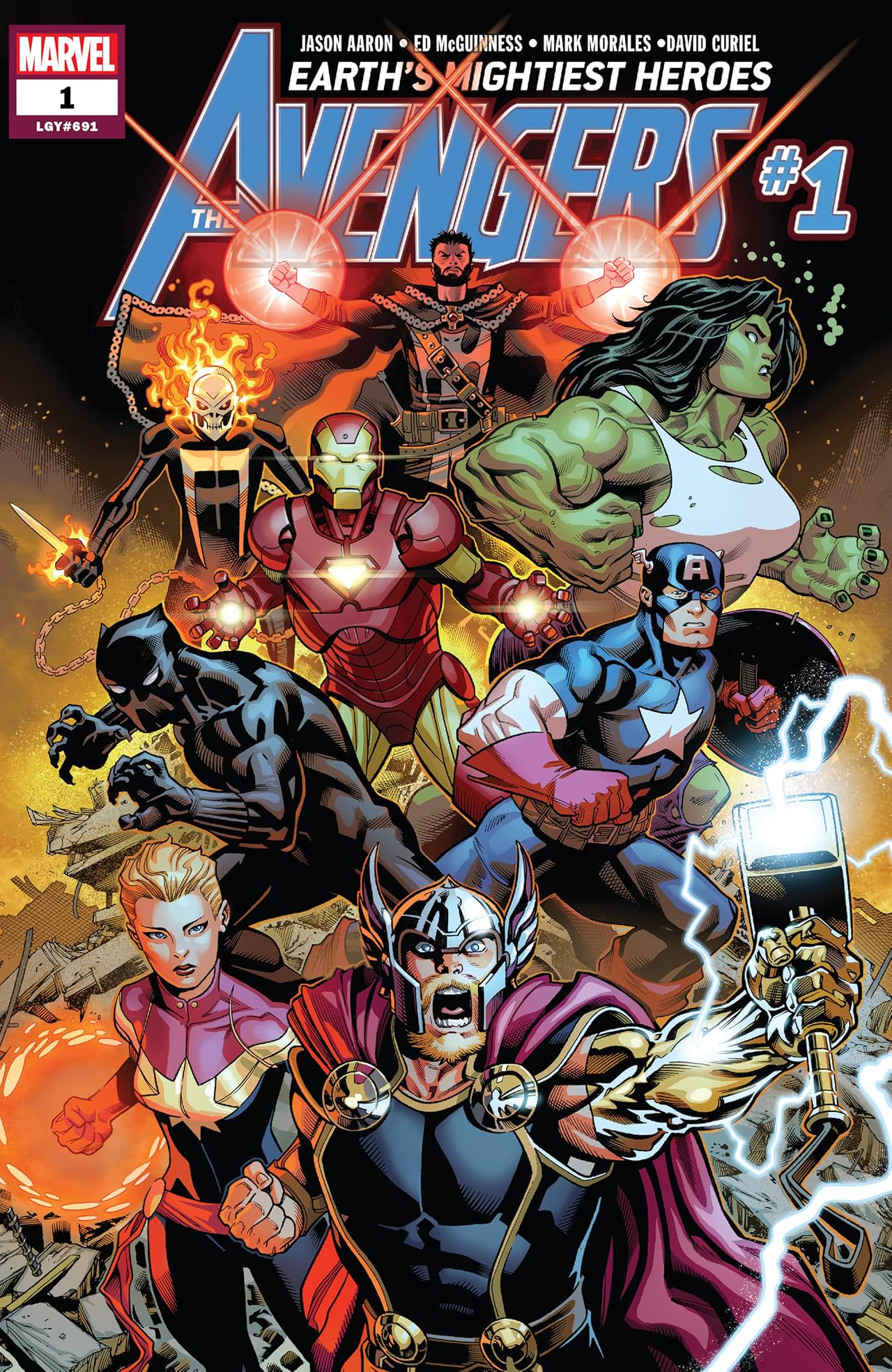
The following is my review of Avengers #1, which was posted on PopMatters.com.


Superhero comics often go through cycles upheavals. There's an accepted status quo that acts as a baseline, of sorts. Then, every once in a while there will be some upheavals that try to shake up the system and introduce new reforms. Some of those reforms stick. Some fail spectacularly. Most just fade into the background. Eventually, though, that familiar status quo returns to maintain the core appeal of a series.

For the Avengers, the traditions established by Thor, Captain America, and Iron Man act as the pillars of Marvel's top-tier heroes. The membership of the team may fluctuate every other week with Wolverine showing up one day while Squirrel Girl shows up another, but the core identity of the Avengers emerges from these three heroes. Every now and then, there's an effort to shake things up by bringing in new characters. No matter who shows up, though, be it a time traveler, a teen prodigy, or a Skrull agent, the Avengers are still built around these three iconic heroes.

In recent years, this core underwent plenty of upheaval with Thor becoming unworthy of Mjolnir, Captain America becoming a Hydra agent, and Tony Stark languishing in a coma. Some of those plots are still controversial and not necessarily for the right reasons. Whatever the controversy, though, it's only ever a matter of time before the Steve Rogers, Tony Stark, and Thor Odinson regain their roles as the Avengers' trinity of heroes.

Jason Aaron, who was behind some of the upheavals, and Ed McGuiness are now tasked with bringing that core back together and moving them forward in Avengers #1. At a time when the Avengers: Infinity War is topping the box office, the stakes are higher than usual for a new Avengers series. There are still lingering scars from the events of Secret Empire and Civil War II. There are also some extenuating circumstances that bring the Avengers together once more.

Despite these strained particulars, though, the stage for is set for the classic core of Avengers to return and Aaron makes good use of it. The events that kept Steve, Tony, and Thor apart aren't ignored. They even acknowledge the sentiment that the world around them is changing, both in terms of world-destroying threats and with respect to the growing diversity among the superhero community. However, even in musing over such changes, this classic trio finds a way to reaffirm that there's still a place for them.

It certainly helps when new threats emerge in the form of dead Celestials falling out of the sky. It's a threat that's not quite as random at it initially seems. This sudden catalyst for such a classic reunion has a basis in the events from Marvel Legacy #1, which introduced the Avengers of 1,000,000 BC. It's a concept that, even within that single issue, hasn't had much impact on anything in the present time to date. Those connections begin to emerge as the Avengers, new and old, begin to assemble.

While it's a refreshing scene, especially to those still recovering from the end of "Avengers: Infinity War," the spectacle is somewhat scattered. Captain America, Iron Man, and Thor are the driving force of the story, but there's also a supporting cast that's caught up in the same plot. That cast includes Black Panther, Dr. Strange, Captain Marvel, She-Hulk, and Ghost Rider. It's a potent mix of heavy hitters and a few emerging stars, but there aren't many opportunities for then to contribute.

They're still in a position to assemble, as Avengers do. Their part in the story, though, is somewhat disconnected from the personal drama going on among Iron Man, Captain America, and Thor. They don't do much to influence the uncertainties that Tony expresses about the future of the Avengers. Those uncertainties are almost as important as the threat of Celestials falling out of the sky, if only because it keeps the story from becoming another generic excuse to get the Avengers to unite.

Avengers #1 doesn't present itself as a simple reunion. Aaron dedicates just as much time discussing the place of the Avengers' old guard in an era where they're shortcomings and vulnerabilities catch up to them more and more. To some extent, their legacy works against them. New threats learn from old threats, adapting and evolving their attacks. They're now at the point where they can make Thor unworthy, turn Captain America into an agent of Hydra, and render Tony Stark comatose.

None of this is lost on the team. At one point, Tony even expresses doubt that he, Steve, and Thor should be the ones to re-assemble the Avengers. That doubt reflects the sentiment that old heroes need to step aside in order for new ones to emerge. It's a sentiment that has fueled a lot of the controversies surrounding these characters, going all the way back to the events of Original Sin.

While the events of Avengers #1 acknowledge that sentiment, it does little to actually address it. Some of that is due to the unavoidable distraction that comes with Celestials showing up out of nowhere, but it still leaves some questions unanswered. The assorted side-plots that put other Avengers in a position to assemble later on do little to help find those answers. One minute, Tony is pondering some important questions that have real implications for the future of the Avengers. The next, he just jumps back into his old role with his fellow Avengers to confront a new threat.

That threat is still intriguing in its own right, thanks to the tie-in with the 1,000,000 BC story line. It also helps that McGuinness' artwork makes it the kind of cosmic spectacle that warrants having these classic heroes take on their iconic poses once more. There are layers to the story and Aaron does plenty to establish the potential for this latest round of upheaval. It even says something about the extent of recent upheavals when it's just refreshing to see classic heroes reunite and feel relatively confident that it's not due to Skrull agents.

Overall, Avengers #1 does plenty to get the Avengers back on track, but doesn't do much to address why they got off track in the first place. There are important conversations to go along with the major events, both in the present and in the distant past. Most of those discussions remain incomplete, but there's still plenty of opportunities to have those discussions, preferably when there aren't dead Celestials lying in in the middle of major cities.

Final Score: 6 out of 10

Friday, October 20, 2017

Sexy Side-Project "The Red Queen Chronicles: The Divine" is LIVE!


If there’s one thing I’ve learned since I started writing sexy side-projects, it’s that fans want their favorite characters to hook up with all sorts of characters. It doesn’t matter that it’s ridiculously non-canon. It doesn’t matter that it would never happen in the books either. Fans just love seeing certain characters get sexier than they’re allowed to be.

Since I started my “New Red Queen” series, I’ve gotten all sorts of suggestions for sexy hook-ups. Given that Mary Jane Watson, with all her amazing sex appeal, is at the center of the story, I expected to get plenty lurid requests for her. However, I didn’t expect to get so many for another fiery redhead, namely Jean Grey.

Perhaps I shouldn’t be too surprised, given all the uncut scenes I’ve done with her in my X-men Supreme series. After the events of “The Red Queen Chronicles: The Phoenix,” though, I’ve opened the proverbial floodgates. I’ve effectively unshackled Jean Grey-Summers from the traditional confines that has kept her fully clothed for too damn long. Apparently, there are a lot of Jean Grey fans who have been waiting for this sort of thing. Surprised or not, I’m going to run with it.

That’s why I’m proud to announce another sexy side-project of the most uncanny kind. It involves Jean Grey hooking up with someone she rarely encounters in the comics and being unapologetically sexy about it. She married Cyclops and flirted with Wolverine, but now that she’s the Black Queen of the Hellfire Club, she’s going to set her sights higher. By that, I mean she’s looking for some truly divine sexiness from someone who just happens to have a big movie coming out.

Yes, I’m referring to the God of Thunder himself, Thor. He and Jean Grey have rarely shared a scene together in the comics, but that doesn’t matter in the world of the Red Queen Chronicles. Through this ambitious, but straightforward one-shot, these two characters you didn’t know you wanted to see hook up are going to get frisky. If this doesn’t get you excited for both the “Thor: Ragnarok” movie or “X-men: Dark Phoenix,” I don’t know what will.


As always, I encourage everyone to provide feedback and leave comments. I can’t promise I’ll pursue every sexy suggestion, whether it involves Jean Grey, Mary Jane Watson, or Squirrel Girl. I’m always open to new ideas, though, especially the sexy kind.

Thursday, October 19, 2017

A Most Worthy Milestone: The Mighty Thor #700

The following is my review of The Mighty Thor #700, which was posted on PopMatters.com.


Whenever a comic reaches a major milestone, it seems obligated to do something big, flashy, and groundbreaking. More often than not, that can be more obstacle than opportunity. Obligation or not, these kinds of upheavals in a story cannot and should not be forced. That doesn't stop some from trying, but that also ensures the results will be mixed. That's exactly what makes The Mighty Thor #700 one of the most intriguing milestone issues of the past decade.

There's no need to force anything here. Jason Aaron has all the necessary pieces in place. What began several years ago in the final issue of Original Sin is set to culminate in The Mighty Thor #700. The concept of worthiness is now far beyond tired arguments of whether the Hulk, Superman, or Squirrel Girl can lift Mjolnir. It isn't just some mystical McGuffin meant to frustrate Thor, Odin, and all of Asgard, although it can come off as such.

Aaron often walks a fine line with Thor, one side being controversy and the other being contrivances. Jane Foster being Thor and wielding Mjolnir blurs that line to an extent that still bothers a certain segment of fans. However, even those fans can't deny the dramatic overtones that The Mighty Thor has conjured since Original Sin. It isn't just about a god struggling with unworthiness. It's about a dying mortal woman wielding the power of a god, knowing she's got little time left.

That time is exceedingly limited and The Mighty Thor #700 adds even more urgency for Jane Foster to make every swing of Mjolnir count. She's not the only one either. For a 50-page milestone issue, Aaron goes for broke by getting every corner of Thor's world involved and does so with an all-star cast of artists that includes the likes of Russell Dauterman, Walter Simonson, Oliver Copiel, and many more. That includes the past, present, and potential future of Asgard, Midgard, and everything in between. It's ambitious, but a worthy ambition befitting of any magic hammer.

There's a glut of material that touches on nearly every major player in Thor's world, from another major clash with Malekith to destructive fight with She-Hulk to a brief interlude with Frog Thor. All cards, including a few that haven't been played in a while, are on the table. They're all part of the same gamble to link every part of Thor's world into a singular conflict. That gamble doesn't necessarily hit the jackpot, but it does pay out in a lot of ways.

Despite all the many elements that find their way into The Mighty Thor #700, there are a few major connections to tie them together, some more so than others. Aaron digs deeper into the mythological foundations of Norse Mythology, literally to some extent, by setting the stage in Nornkeep. It gets even more literal as actual threads of fate start weaving various Thor-centered stories across the realms and across time.

These broad, diverse stories give a chance for every artist employed in this milestone issue to maximize their talent. Some utilize different themes, touching on the future of Thor and what lays in store for all those whose lives revolve around magic hammers. Others unfold in the present, which build on threads from previous issues leading up to The Mighty Thor #700. Some are colorful asides that don't add much to the overall plot, but belabor all things Thor in a way that feels necessary in an oversized issue.


This is where some of the ambition ends up overplaying the plot. Even though the connection of each plot has ties to the events in Nornkeep, those connections aren't always clear or concise. Some are so loose that it's hard to make sense of the role they play in the larger narrative. In addition, the scale of that narrative covers so many times, places, and hammer-centered battles that some end up feeling rushed. Even Jane Foster's battle against She-Hulk doesn't get the kind of elaborate smashing that most battles involving Hulk and Thor require.

Even with connections that are weak and rushed, at times, the direction of the story never gets derailed. Even after Frog Thor provides a little comic relief, the destination of each plot becomes clear. The conflict that begins in Nornkeep is set to spread through every realm, involving the likes of Maliketh, Loki, War Thor, and any number of divine forces that have been hit by Mjolnir one time too many. In that sense, the ambition serves to make The Mighty Thor #700 feel as epic as it needs to.

The worth of any milestone issue is measured in its ability to encompass the past, present, and future of a story. Given the size and scope of the story Aaron tells, The Mighty Thor #700 checks all the necessary boxes. There's a general sense, as well as a major teaser at one point, that the future of Thor is poised for upheaval. Jane Foster's battle with Hulks, gods, monsters, and cancer is about to culminate. Odinson is about to confront his agonizing unworthiness. Frog Thor is going to wade through some puddles. Everyone in Thor's world is poised to have their moment.

Ultimately, that's the most important aspect of any milestone issue. It should act like a catalyst and not an endpoint. It doesn't have to be a full-blown movie trailer, complete with heavy voice-overs and messy editing. It just has to make the journey thus far feel meaningful while making the journey ahead that much more appealing.

It may not have the loud explosions, coupled with heavy metal music, but The Mighty Thor #700 is plenty appealing in all the right ways. Worthiness may still be a hopelessly esoteric concept that fans will be arguing over on message boards for another 700 issues, but this one proves its worth, as only a Thor comic can.

Final Score: 8 out of 10

Thursday, September 28, 2017

Past, Present, and Perspective: Marvel Legacy #1

The following is my review of Marvel Legacy #1, which was posted on PopMatters.com.


Building a legacy is a long, tedious process that usually involves twice as many mistakes than it does successes. In some cases, a half-century of world-building is hardly enough to forge the kind of legacy that stands the test of time, changing writers, and retcons. For Marvel and the extensive world that continues to unfold after over 50 years of continuity, it's safe to say that its legacy has proven its worth. The world that Stan Lee and Jack Kirby created decades ago is worth an entire workshop of Mjolnirs.

The legacy of the Marvel universe is often in flux with the times. There are all sorts of eras that vacillate from grim and dark to upbeat and optimistic. Events like Onslaught, Age of Apocalypse, and Civil War define and redefine what the world of Marvel stands for. Sometimes it takes years to appreciate way in which these events shaped Marvel's legacy. That will likely be the case with Marvel's latest legacy-shaping event, Secret Empire.

Being an event so controversial, coming at a time when all things related to fascism inspire Hulk-level outrage, the current legacy of Marvel is in a tenuous position. It's at one of those forks where it can either go down a dark, dire path or re-invent itself in a new, more positive light. These are uncertain times for Marvel and Marvel Legacy #1 is in a position to shape a new path, provide a sense of certainty, and showcase the strengths of top-level writing and artistic talent.

Jason Aaron, one of Marvel's top writers, and an all-star team of artists that include Esad Ribic, Russell Dauterman, Stuart Immonen, Ed McGuinness, and many more, have a chance to use Marvel Legacy #1 as a gateway towards the future of the Marvel universe. With so much talent to work with, the scope and scale of the story can be nothing short of awe-inspiring. While that bar may be impossibly high, Aaron and his all-star cast of artists come very close to matching and exciting it.

The structure of Marvel Legacy #1 is both fitting and overdue in that it revisits elements from Secret Wars that have been absent for years, namely those of the Richard family. In a sense, their presence acts as a reminder regarding what the greater Marvel universe is missing. To date, Marvel operates in a world where the Fantastic Four are no more, Thor is unworthy, the X-men's leadership is dead or time-displaced, and Steve Rogers is a secret Hydra agent. To say that legacy is on shaky ground is like saying the Hulk is moody.

Aaron doesn't try to fix all that in the span of a single issue. However, the story in Marvel Legacy #1 does establish links to the past, present, and future. It doesn't just provide hope that the missing elements of Marvel's legacy will return. It provides a potential mechanism. It doesn't just offer promises. It offers solutions that don't involve time machines, retcons, or deals with Mephisto.

The links to the past offer the most intriguing and complete part of the plot in that it establishes a period in the history of the Marvel universe that has major implications for the present. It takes familiar faces and forces like the Phoenix Force, the Iron Fist, and the spirit of the Black Panther and personifies them in a battle against a Celestial. That added personality gives greater weight to the events that unfold in the present.


Those events are a little less cohesive, though. Marvel Legacy #1 is understandably ambitious, attempting to jump around into multiple areas and explore a wide variety of elements throughout the greater Marvel universe. It touches on the Avengers, the X-men, the Guardians of the Galaxy, and the remaining members of the Fantastic Four. It even tries to deal with the lingering aftermath of Secret Empire, from Steve Rogers' efforts to rebuild his credibility to the disillusion of SHIELD. There are so many elements to explore that the narrative gets downright erratic at times.


There's only so much Marvel Legacy #1 can address, but it manages to avoid Deadpool-level eccentricity. While the transitions from setting to setting aren't all that seamless, they never feel totally random or out-of-place. If anything, they feel like a succession of teaser trailers that offer glimpses into the near and distant future of the Marvel universe. Some are more subtle than others. Others, namely the ones involving Norman Osborn and Loki, offer a more overt hint. Certain characters, despite being actual gods, just aren't capable of such subtlety.

Beyond just the teaser elements, though, Marvel Legacy #1 adds some significant upheavals to the mix, namely by revealing the return of a certain grumpy Canadian that helped make Hugh Jackman a star. His appearance comes off as sudden, but it also comes with purpose. It feels like part of a larger story that's just beginning to unfold. In many respects, that's the core theme of the entire story. It doesn't just lay the foundation. It provides some very specific, very compelling building materials.

That's not to say every element is equally compelling. Some are underdeveloped and overlooked. Some aren't effectively linked to the larger narrative, but they still have a place in the greater legacy of Marvel so their presence never feels too random. That, in many respects, is the most revealing accomplishment of Marvel Legacy #1. It crafts a story in which everything feels connected on some level. While some connections are stronger than others, it still conveys the sense that Marvel has a vision and that vision is worth exploring.

While the Marvel universe seems to get redefined at least once a month, it's rare for a story to feel as large in scope as it's trying to be. Marvel Legacy #1 succeeds in conveying that feeling. From those disillusioned by Marvel's recent direction and enamored by its past, it offers something to latch onto. The fact it does all that without a time machine, clones, or magic spells makes it all the more astounding.

Final Score: 8 out of 10

Thursday, August 31, 2017

Rising, Falling, and Rebuilding: Secret Empire #10

The following is my review of Secret Empire #10, which was posted on PopMatters.com.


The dramatic rise and spectacular fall of an empire is one of those rare narratives that can be just as dramatic in real life as it is in fiction. From the Ancient Rome to Star Wars, the story behind an empire has an undeniable impact on the human psyche, as well as the annuls of history. Every empire is unique in how it rises, grows, prospers, and falls. Sometimes it plays out over the course of centuries. Sometimes it happens over the course of a few decades. Marvel, with its ever-changing landscape, tries to squeeze that story into ten comic books.

Given the scope of empires, as a concept, that's pretty daunting for anyone not equipped with Reed Richards' mind or Tony Stark's gadgets. Nick Spencer and Steve McNieven may not have such resources, but they've made every moment count in Secret Empire. It's a story that taps into real world fears about powerful individuals seizing power and imposing tyranny under the guise of order. It evokes all sorts of passions, reservations, and arguments on message boards. That alone is a testament to the scope and scale that empires carry, as a story.

Secret Empire is not just about Hydra taking over the world. It's not just about Captain America betraying the Avengers either, although that is the emotional gut punch that makes it so controversial. These elements feed into that larger narrative of an empire coming to power, taking advantage of a vulnerable moment in time and trying to shape the course of history. The ascension of Hydra and Captain America into this position is established. Now, the downfall is underway.

For nine issues, the story sets up various plot-lines that lead to numerous skirmishes. It's not an exhibition game anymore. Both sides are carrying themselves like a couple prize fighters entering the last round. They each bear the scars of all the blows they've taken. They make clear that there will be no judges decision. One of them is going to get knocked out. It's just a matter of who can land the finishing blow. In Secret Empire #10, that blow finally lands with an impact that has both huge reverberations and major implications.

The rise of Hydra and the Hydra-affiliated Steve Rogers centers around reality-warping power capable of making good into evil, right into wrong, and making Deadpool less annoying. Any story that builds itself around that kind of power risks going too far and needing more reality-warping power to fix. It goes beyond resorting to another Deus Ex Machina, especially when that same device is used to set everything up in the first place.

Spencer sets up from the beginning of Secret Empire that a certain amount of warping will be necessary to resolve the story. There's just no way an empire as large as Hydra's can rise, fall, and leave a meaningful impact within ten issues of a series. The biggest risk any story takes in attempting to tell a story within these constraints is rendering reality a messy ball of mud that gets molded and remolded on a whim.

For the most part, the story strikes an appropriate balance between confronting the reality-warping forces behind the story and using them to defeat Hydra. Those involved in delivering that final blow even throw in some Loki-level cunning. It isn't just a matter of all the heroes gathering in one place and collectively beating up an over-powered villain. The Hydra-affiliated Steve Rogers is not Onslaught, Thanos, or some cosmic space god. He's someone with which every hero in the Marvel universe has an emotional connection.

It's that connection that makes the very concept of Steve Rogers becoming a fascist feel so untenable to begin with. That's like making Frank Castle the Kingin or Emma Frost a nun. It's so utterly antithetical to the core of the character that it just feels wrong for everyone involved. In a sense, both the characters in the story and those who know Captain America as the ultimate enemy of fascism are on the same page, in terms of emotional overtones. Nobody reading or participating in the story can accept a reality where Steve Rogers is, and always has been, a fascist.

By the end of Secret Empire #10, that untenable feeling is still there, to some extent. While the story does end up having to warp and re-warp reality to some extent, it stops short of completely undoing everything the Cosmic Cube changed. Certain characters stay dead. Certain places remain destroyed. Steve Rogers isn't the ultimate fascist anymore. A good chunk of the story, along with the best aspects of McNieven's art, is spent giving Rogers a chance to literally attack the fascist monster that Hydra created. While it's as satisfying as it often is when a fascist gets defeated, some of those feelings still linger.

Even though Secret Empire #10 crafts as concise a conclusion it can, given the cosmic forces involved, it still carries a distressing sentiment that may plague Captain America fans the same way the Clone Saga plagues Spider-Man fans. Regardless of the details, it's impossible to get around that Steve Rogers became a fascist. It doesn't matter that cosmic forces were involved. The very concept that such a story is even possible and a character must move forward with that kind of burden just evokes too many conflicting feelings.

The overall structure of the story still works with respect to showing the rise and fall of Hydra's empire. Secret Empire #10 even helps streamline some of the confusing, disjointed elements that are scattered throughout the previous nine issues. However, the manner in which it ends, the feelings surrounding it, and the prospect of moving forward from such a reality-shattering event are still mixed. It doesn't help that too much is narrated and too little is said in the end. It also doesn't help that some of the side-plots in the story don't connect as strongly to others and don't add to the overall impact.

These details, however, don't take too much away from the bigger picture surrounding Secret Empire. Spencer still succeeds at striking the necessary balance that's so hard to achieve when crafting a story that requires a complete deconstruction and subsequent reconstruction of the space-time continuum. That, in and of itself, is an accomplishment.

That accomplishment, however, will be forever lost in the stigma that Secret Empire will inevitably carry. While it might not be on the same level as the original Clone Saga, it will still be the story in which Marvel makes Captain America a fascist. It doesn't matter if someone makes a deal with Mephisto to ensure everyone in the Marvel universe forgets about it entirely. The fact it's still a story that got told in the first place, striking all the wrong emotional chords in the process, will plague it for the foreseeable future. If every fallen empire seeks to leave its mark, then Hydra definitely leaves theirs, albeit not for the reasons they probably intended.

Final Score: 7 out of 10

Thursday, August 24, 2017

Hammering Hard With Worthy Themes: Generations Unworthy Thor & The Mighty Thor #1

The following is my review of Generations: Unworthy Thor and The Mighty Thor #1, which was posted on PopMatters.com.


The concept of who is truly worthy is Marvel's ultimate philosophical McGuffin. It's one of those ideas that can be endlessly debated, argued, twisted, and misconstrued in any number of ways. It's also a major driving force for Thor in nearly every era. From Walter Simonson to Jason Aaron, his struggle to be worthy, stay worthy, and understand what makes him worthy is part of what makes Thor's story compelling.

In terms of major turning points in that story, few are as pivotal as the events that played out in Original Sin. In that story, Thor becomes unworthy with just three words whispered by Nick Fury. It doesn't just upend Thor's idea of worthiness and the story around it. It opens the door for a new Thor with a new understanding of what it means to be worthy.

This is where Jane Foster's story enters the picture and that story is built on a very different foundation. She is not a god, a demigod, or anyone who would ever be mistaken as one. She is a moral woman who also happens to be suffering from one of the most debilitating diseases any mortal can endure. Her ascension to the title of Thor is one of the most significant shifts in Thor's story in decades. There are times when it breathes new life into the world of Thor. There are other times when it triggers incessant whining about identity politics. The fact that Jason Aaron manages to balance that narrative in any capacity is nothing short of astounding.

Now, through Generations: Unworthy Thor and The Mighty Thor #1, Aaron has a chance to build bridges between that vast philosophical gulf between one era of worthiness and another. It may not end the constant whining about female heroes taking on the mantle of male heroes, but it does flesh out the core elements of the Thor mythos that are as relevant today as they are in the ancient times before angry arguments on internet message boards.

Unlike some of the previous narratives in Marvel Generations, there are clearer connections between the events in Generations: Unworthy Thor and The Mighty Thor #1 and the conclusion of Secret Empire. Those connections are few and somewhat vague, but their presence helps create an important context between the past and present. Jane Foster isn't so much the catalyst as she is the unexpected guest, who helps bring clarity to the hopelessly unclear concept of worthiness.

While her role in the story cannot change the path of Odinson, it can provide guidance. Granted, it's a guidance he will undermine with his arrogance on many occasions in the future, but it still offers clarity to the narrative while giving Odinson fewer excuses. In a sense, what happens in the story gives the impression that he was destined to lose Mjolnir at some point, even without any devious whispers of Nick Fury. It's just an inevitable consequence of the arrogance that comes with being Thor and with being a god, in general.

The substance of that story isn't very novel in that it builds on a story that has been explored before in the pages of Uncanny Avengers. Once again, the son of Odin clashes with Apocalypse in an era before the Avengers can assemble and before the X-men can astonish. It's basic and crude, but it provides the necessary setting for the arrogant young Asgardian to learn a lesson or two about divinity and mortality.

The fact he learns it from a mortal woman wielding the hammer he craves provides both personality and entertainment value. It'll also provide more fodder for internet debates, but that doesn't derail the main thrust of the story. It's the setting that's vital here in that it takes place in a time before Odinson first lifted Mjolnir or taken the title of Thor. In this time, he's still the divine equivalent of a teenager who hasn't gotten his driver's license yet, but still wants to take his father's car out for a joyride.

While it annoys Odin to no end, it puts the future Thor in a position to ditch some boring formal gathering of gods to pick a fight on Midgard between Vikings and Apocalypse's Clan Akkaba. Given that formal gathering prohibits mead and mostly involves Odin bellowing orders, it's hard to blame a juvenile Odinson for ditching it.

It's only when he meets a time-displaced Jane Foster that his casual deviance becomes an important learning experience for both of them. The fact that experience also involves an elaborate, violent, lightning-filled battle against Apocalypse that brings out the best in Mahmud Asrar's art is a nice bonus. It just isn't a very memorable experience for any generation of Thor if there isn't some epic battle to fight.


That fight, as entertaining as it is, remains secondary for the most part. The primary struggle still revolves around Odinson's desire to be worthy and Jane Foster's lingering uncertainty about her future. It's a struggle that both characters have a stake in, but one that has limited influence on both characters. While Generations: Unworthy Thor and The Mighty Thor #1 makes the necessary effort to explore those classic themes of worthiness that is so critical to Thor's mythos, the extent to which it impacts the characters involved is somewhat minor.

This is an issue that shows up in previous issues of Marvel Generations, but a limited impact doesn't mean there can't be heavy drama. The potential for that drama is there in Generations: Unworthy Thor and The Mighty Thor #1, but not much of it is realized. Jane Foster and the future Thor do get a moment to interact outside of a major battle, but little comes of it. Both still gain critical insight, though. Both are in a better position to make decisions about the course of their immortal and mortal lives alike. It's not dramatic, but it does make the overall story feel complete.

That story even includes a few bonus parts that make Generations: Unworthy Thor and The Mighty Thor #1 a prelude to other critical events in the past and future. It offers intrigue beyond the basic lessons in worthiness, which is something that previous issues of Marvel Generations has not done. It adds value to a story that can only offer so much before it undermines the hopelessly convoluted, ever-evolving timeline that is the Marvel universe. That value may not make anyone inherently worthy of lifting Mjolnir, but it will put them on the right track.

Final Score: 7 out of 10

Monday, November 7, 2016

Worth Within Unworthiness: The Unworthy Thor #1

The following is my review of The Unworthy Thor #1, which was posted on PopMatters.com.


Discussions over who is worthy and what constitutes worthiness in the first place is one of those topics that has consumed generations of Avengers fans. Go to any Avengers message board or comic book convention and chances are, there will be some people arguing what it means to be worthy, why Hulk can't lift Thor's hammer, and how someone could get around this rule.

This discussion even found its way into Avengers: Age of Ultron in a very tongue-in-cheek sort of way. It's clear that even Joss Whedon gets caught up in these discussions. He just has the resources and financial backing to turn it into a billion-dollar cinematic spectacle. Jason Aaron doesn't have those kinds of resources, but he did add a twist to the discussion when he made Thor Odinson unworthy to wield Mjolnir after the events of Original Sin.

That twist led to Jane Foster taking up the mantle of Thor. Her story is still one that is evolving in a way that continues the discussion over worthiness down a new path. However, Thor Odinson remains on a very different path and that's the path that The Unworthy Thor #1 explores. It has the feel of a story that's been brewing behind the scenes, but is only now ready to be served. It still feels late, overdue, and a little frustrating.

Despite this, it never feels stale. At a time when Jane Foster is flexing her worthiness like Namor at a beach, that's a remarkable accomplishment. Since becoming unworthy in Original Sin, Odinson carries himself less like a champion of Asgard and more like a whiny teenager who had his cell phone taken away. Aaron makes it a point to abandon that sentiment early, giving us an Odinson that is much more motivated and much less mopey.

The Unworthy Thor #1 puts Odinson right in the middle of brutal battle against the kinds of monsters he used to tear through on a boring Sunday afternoon. It doesn't just hit the ground running in terms of action, giving Oliver Copiel ample opportunity to create appropriately brutal visuals. It establishes that this former God of Thunder is learning the hard way what it means to be unworthy. He can't rely on his hammer or any enchanted weapon to carry him through a battle. He has to take a gut punches and blows to the jaw before he can think about the celebratory mead.


It's not just that he's unworthy of wielding Mjolnir. He's a weaker, more jaded Odinson who doesn't have the same power or ability he once did. He's already lost one of his arms. This means he has to fight that much harder to avoid losing more limbs. It helps bring out a different side of his character, one devoid of the nobility, poise, and bravado that once defined him. He actually resorts to biting his enemies now. That's as unworthy as it gets in battle.

Odinson definitely wields more drive and ambition. He's still not the same Thor that Chris Hemsworth did so much to bring to life in the movies, but we do see traces of that proud warrior throughout the narrative. That narrative isn't just restricted to brutal fighting with occasional biting either. Jason Aaron shifts the sequence of events around to add further context and this context actually goes a long way towards giving weight to the brutality.

Since Jane Foster picked up Mjolnir, the events of Original Sin and Secret Wars have been afterthoughts at best. There's just too much of an imperative to show why Jane Foster is so worthy of wielding the title of Thor. That's entirely understandable. It still leaves Odinson with little to work with.

By revisiting the site where he became unworthy, Aaron sets up an appropriate reunion between him and the new Watcher, who calls himself the Unseen. We still know him as Nick Fury, namely the one David Hasselhoff failed to turn into a viable movie franchise, but that only makes this connection all the more fitting. By having him be the one that gives Odinson a chance at being worthy again, it feels like an overdue continuation of the aftermath of Original Sin. Again, it's a story that feels late and overdue, but it never comes off as stale.


This sentiment helps make The Unworthy Thor #1 feel relevant in that it gives Odinson some badly-needed development that he hasn't gotten since he lost his hammer. It also makes this narrative feel somewhat disconnected and not just because Jane Foster is literally stealing his thunder. It feels like this story took too long to set up. Events like Original Sin and Secret Wars have been over for a while now. Reconnecting with those events at this point feel outdated.

Even if the timing is off, the narrative is still compelling. Jason Aaron still gives us a side of Odinson that is genuine and sincere. This is a character who lost a lot more than his favorite weapon. He lost a title and an identity. Now, he finally has the motivation and opportunity to follow a new path. This path doesn't require those same discussions of worthiness that make for such great fodder in the Avengers: Age of Ultron movie. It's uncharted territory for Odinson, but he's forging ahead and it's hard not to root for him.

Overall, The Unworthy Thor #1 creates a narrative that has the right impact. It gives us a former God of Thunder who has to fight harder and cope with being weaker than he's ever been before. It brings out some of his less noble traits, but he still carries himself like a warrior. He gets a chance to become more worthy and he jumps at that chance, if only to ensure he doesn't have to bite his enemies anymore.

Final Score: 8 out of 10

Thursday, August 11, 2016

A Fan Among Heroes: All-New, All-Different Avengers Annual #1

The following is my review of All-New, All Different Avengers Annual #1, which was posted on PopMatters.com.


The success of Deadpool proves there's a fertile market for a story that dares to be overly meta. It's not just about breaking the fourth wall or acknowledging the erratic sentiments of comic book message boards. The appeal of a meta-narrative acts as a mirror of sorts, reflecting the passions of fans, be they the healthy kinds and the not-so-healthy kinds.

Most fans agree that passions like Deadpool aren't exactly healthy. More often than not, they earn the same R-rating as his movie. That doesn't mean that a more PG-13 version of these passions is impossible. In fact, there's another character who embodies the best of these passions and doesn't need to make dirty jokes about it. That character, of course, is Kamala Khan.

There's a long list of reasons why Kamala Khan is such a lovable, endearing character. Chief among them is the fact that she's a fan. Before she becomes Ms. Marvel, she's just another passionate fangirl who loves superheroes and writes fan fiction . She is very much the embodiment of the passions of countless fans. That makes the setup in All-New, All-Different Avengers Annual #1 especially engaging because it offers insight into the fan fiction that reflects Kamala's passions for superheroes. That insight makes for a cartoonish yet uniquely entertaining narrative that inspires the fanboys and fangirls alike.

Some parts of that setup are built upon Ms. Marvel's current narrative. She's an Avenger now and rapidly ascending the ever-shifting hierarchy of the Marvel universe. She even manages to do it without time travel, clones, or someone dying. That alone is a testament to her strengths. Despite this, she is still a teenager and she is still woefully inexperienced. This means she constantly clashes with her teammates, especially her younger cohorts in Spider-Man and Nova.

This inexperience and immaturity, the foundation on which most teenage superheroes grow, makes her reaction to fan fiction stories about Ms. Marvel all the more entertaining. She can't be expected to just ignore the insanity that often manifests in fan fiction. She's a young hero who still isn't accustomed seeing her name associated with embarrassing, easily accessible media. After the events of  All-New, All-Different Avengers Annual #1, she'll likely need advice from Peter Parker.

The story is organized through several colorful, laughably cheesy stories written by multiple writers, including Mark Waid and G. Willow Wilson. They each act as a commentary of sorts on the colorful proclivities of fan fiction, such as tendencies to create bizarre romantic entanglements and making unpopular political statements. These stories never take themselves too seriously and aren't going to be confused with canon in this or any other universe. That's what gives them their charm.

It's because of that unique charm that these stories tend to evoke strong reactions. As some of these stories unfold, Kamala's reactions are almost as relevant as the story themselves. Take one story involving Ms. Marvel attaining the rank of Captain Marvel. At first, it plays out like a story that Kamala Khan would love. Then, an overtly politically incorrect twist at the end completely reverses her reaction. It's the kind of reversal that no competent editor will allow in a comic, but one that manifests all too easily in fan fiction.

Then, there's the story about She-Hulk and a love triangle. It's not a love triangle that would make it into an X-men movie, but it involves She-Hulk being woefully out-of-character in professing her love to a giant monster. It's as strange and entertaining as it sounds. It's also not-so-subtle commentary on the way love triangles play out, both in canon and in fan fiction. It doesn't take much to make them laughably absurd.

Despite this absurdity, it's the strange love story that involves Ms. Marvel, Miles Morales, and a world where everyone is an anthropomorphic animal that bothers Kamala the most. What makes this part of the story stand out is that, as quirky and cartoonish as it is, neither she nor Miles are completely out-of-character. It's another not-so-subtle comment about fan fiction. As crazy as it can be, it is possible for certain truisms to manifest within these absurdities.


These truisms play right into the meta themes of this story. In the end, Kamala Khan's sentiments are similar to those of fans. A few intriguing reveals at the end shows that she's not alone. It creates a larger message of sorts, one that implies that superheroes are aware of the quirky fandoms they inspire. Sometimes those quirks reveal genuine insight for these characters. It doesn't have to involve the bizarre quirks of fan fiction, but they do help get the point across.

For the most part, however, the quirky little stories in All-New, All-Different Avengers Annual #1 don't factor too heavily into Kamla Khan's reaction. Some are just pure entertainment value of the most absurd kind. At a time when Marvel is exploring the dire, depressing issues manifesting in Civil War II, this offers a nice reprieve, even if it doesn't tell a wholly cohesive story.

The lack of cohesion keeps the narrative from gaining any depth. In a story that explores the absurdities of fan fiction, there's only so much depth that's possible, but not much is realized outside a couple stories. Some of those stories may be quirky. Some are more forgettable than others. There's still undeniable entertainment value to be had. There's also an important message to convey.


The internet can and will annoy superheroes every bit as much as the villains they face. With All-New, All-Different Avengers Annual #1, Kamala Khan learns this the hard way. It's just one of many steps she'll have to take in her quest to become a better hero.

Final Score: 7 out of 10

Saturday, April 16, 2016

Mindbending Avenging: All-New, All-Different Avengers #8

The following is my review of All-New, All Different Avengers #8, which was posted on PopMatters.com.


There are some issues in modern superhero comics that just don't have a real-world parallel. Issues like regulating superpowers, safeguarding weapons of mass destruction, and managing the use of killer robots have some degree of contemporary relevance. In fact, the management of killer robots is almost certain to become an election issue if DARPA, the Pentagon, and Amazon have their way. The same cannot be said for mind-wiping.

Despite the CIA's best efforts, there is no real-world equivalent to completely wiping the memory of an otherwise healthy adult mind and reshaping it accordingly. That's what makes the concept behind the Avengers: Standoff event such an intriguing thought experiment. In a world where telepaths like Emma Frost can make people forget their own names, why wouldn't the use of psychic manipulation be an issue? Given its potential uses and abuses, it would probably have its own lobbyists.

All-New, All-Different Avengers #8 highlights the potential of psychic manipulation in a way that is both disturbingly pragmatic and naturally terrifying. SHIELD, in its infinite wisdom and gross lack of oversight, attempts to use psychic manipulation to turn unrepentant criminals into productive members of society. On paper, it sounds like a win-win. It removes dangerous individuals from society in a manner that still allows them to pay taxes and contribute. It's basically a Republican's fantasy and the private prison industry's worst nightmare.

Despite sounding so good on paper, the Avengers learn fist-hand why this sort of thing would have the ACLU up in arms. Thanks to Maria Hill and a sentient version of the Cosmic Cube named Kobik, they've been subjected to the same psychic manipulation usually resolved for the Baron Zemos of the Marvel Universe. The fact that Kobik takes the form of a young girl adds an extra twist that feels like it came right out of The Shining, minus the Stephen King style of horror.

For the Avengers and the Unity Squad, the way Avengers: Standoff unfolds still has all the traits of a horror movie. A brief flash forward at the less-than-favorable outcome of this conflict with Kobik suggests that elements of a slasher movie get mixed in as well. However, these traits become secondary in All-New, All-Different Avengers #8. The story deals less with the mind-bending implications of Pleasant Hill and more with escaping its grasp. It's not quite as exciting as it sounds and in a story that has Deadpool in it, that's quite an accomplishment.

Previous issues of the story deal with breaking the psychic manipulation on the Avengers and the Unity Squad. It's hard to contemplate how someone who hasn't seen The Matrix multiple times might react to such manipulation. Having the power of Thor, the computing capacity of Vision, and the mental instability of Deadpool adds plenty of potential complications that might reveal something about these characters. It might even reveal that they're not that as mentally stable as Deadpool would have them believe.


All-New, All-Different Avengers #8 fails to address this though. It effectively paints itself into a corner, making it unable to add the kind of mind-bending layers to the story. It's less a philosophical thought experiment and more a prison break. The complexities that helped make Avengers: Standoff so intriguing give way to the kind of generic action that the Avengers face every other Tuesday.

That's not to say there aren't some compelling aspects of this struggle to escape Pleasant Hill. As is often the case, Deadpool finds a way to creatively confront the source of the chaos. Being a walking testament to chaos, violence, and tacos, he's uniquely qualified to confront Kobik. It's hard to imagine him being competent enough to confront a little girl who happens to embody a reality-warping power, but it gets a lot easier to imagine, considering it's not even the sixth weirdest thing Deadpool has confronted in his colorful history.

This doesn't necessarily mean Deadpool is a good influence on children, but it does mean he helps end the last parts of the Kobik's reality-warping, mind-bending illusion. It comes off as a bit overly simplistic, but Deadpool helps add a little entertainment value, as only he can. It completes the final part of the escape for the Avengers and the Unity Squad. Entertainment value aside, it still comes off as generic.

If there are any deeper impacts to being mentally manipulated, then they're cast aside in favor of more battles against super-powered monsters, as if the Avengers don't face enough of those. Mark Waid and Adam Kubert still find ways to add entertainment value where they can, but aside from Deadpool's contributions, it falls flat.

There's still a lot of potential in the concept behind Avengers: Standoff and All-New, All-Different Avengers #8 offers the best opportunity to the story to explore that concept. While that opportunity isn't completely wasted in terms of the overall story, it still wastes or ignores much of that opportunity.


The characters are mentally manipulated to a point where they believe that they've lived entirely different lives. Then, when the deception is exposed, they basically snap back to their old selves with no noticeable effects. While the minds of superheroes are supposed to be resilient, there's only so much protection a magic hammer or a spider sense can offer. It gives the impression that the human mind is stronger and more rational than daytime talk shows would have us believe.

Most Avengers stories involve them fighting super-powered bad guys at some point. The challenge is getting them to this point in a creative, novel manner. Avengers: Standoff tries to takes a creative path in meeting this challenge, but reverts back to familiar territory too quickly. There are any number of stories that involve the Avengers escaping the grasp of powerful, mind-bending, reality-warping threats. This is just the latest and far from the greatest.

Final Score: 5 out of 10

Saturday, January 30, 2016

Living in a (Fleeting) Moment: All-New, All-Different Avengers #4

The following is my review of All-New, All-Different Avengers #4, which was posted on PopMatters.com.


There's a reason why the YOLO (You Only Live Once) meme became annoying quicker than a failed American Idol audition. As a concept, it's not inherently wrong. Despite what some world religions might claim, we only know for certain that we have one life to live. In the Marvel Universe, however, the concept becomes a bit more flawed and a lot more complicated.

It's not just because death in comics is a revolving door with a rusted lock. Because of retcons, reboots, and clones the concept of living in the moment might as well come with an asterisk. That still doesn't stop some characters from embracing the concept in a completely non-hipster type way. It's the primary lesson conveyed on All-New, All-Different Avengers #4. And it's conveyed in a way that even the cynical and the jaded can appreciate.

Mark Waid was tasked with assembling a new team of Avengers in the post-Secret Wars world. It sounds like a simple task, but when billion-dollar movie franchises are built on these teams, the stakes are a bit higher than placating fickle fanboys. Waid still rose to the occasion, creating a team of Avengers that includes familiar faces, rising stars, and a solid mix of diversity. While Glen Beck hasn't complained about it yet, it's a team that reflects a fitting and appropriate sentiment for 2016.

The first three issues of the series was a standard coming together story. It wasn't nearly as epic as a certain movie staring Chris Evans and Robert Downey Jr., but it didn't feel as overplayed as a certain movie starting Andrew Garfield. All-New, All-Different Avengers #4 offers the first real insight into how this new team of Avengers functions and it does so in a way that never feels like a bad reality show or a 60s era sitcom.

There's just a real insight into this new team that feels genuine and balanced. It's basically the complete antithesis of the team dynamics we see in Lethal Weapon movies. There are very different personalities with characters like Nova, Ms. Marvel, and Vision. However, those personalities find a way to mesh in a manner that never feels forced. They don't need a drill sergeant or football coach to whip them into shape. They're not the Cleveland Browns. They're the Avengers.

When they get a chance to demonstrate their competence as Avengers, they pass the test. They don't necessarily pass with flying colors, but when the enemy involved is Cyclone, the test is graded on a curve. He's no Red Skull. Even Hugo Weaving couldn't make Cyclone an intimidating threat. However, he does give this new team of Avengers a chance to shine. While the scope of their efforts are as generic as a traffic stop on the Jersey Turnpike, the battle against Cyclone reflects the new normal for this era of Avengers.

It's not just the diversity that makes this new team of Avengers feel appropriate. It comes back to those sensibilities that we, the society of 2016, have developed in recent years. It's no longer enough for the Avengers to show up, fight monsters, punch the Red Skull in the face, and tell kids to eat their vegetables. As the backlash against movies like Man of Steel have shown, modern audiences care about civilian casualties. Indeed, in an era when the failures of our heroes are more scrutinized than ever, society is much less forgiving of missteps and oversights.

The Avengers in this conflict go out of their way to protect the civilians caught in Cyclone's attack. It takes up a good chunk of the fight. While Cyclone eventually gets knocked out in the same tradition as the Red Skull, the emphasis on protecting civilians adds an important dynamic to what would otherwise be the superhero equivalent of a typical Tuesday.

Beyond the new dynamics of a diverse, civilian-focused Avengers, there is another moment that adds weight to an otherwise typical clash in the new Prime Marvel universe. It comes in the form of a kiss between the new Captain America, Sam Wilson, and the new Thor, Jane Foster. In this case, the cover isn't an elaborate form of trolling in the tradition of Action Comics #600 or Astonishing X-men #14. This kiss does happen, but it's not the kind of kiss that will appeal to the Twilight crowd.


This moment between Sam Wilson and Jane Foster is another keen reflection on 2016 sensibilities. It comes after both characters get reminded that they look nothing like Chris Evans or Chris Hemsworth. There are fans, even within the comic itself, that whine about Captain America and Thor not being the "classic" versions. It's the whining internet trolls of comic book message boards taking form and substance. However, Sam and Jane deal with it in the best way possible and it doesn't involve whining to a moderator.

The two characters kiss. They do so after Sam laments about living up to the high bar set by Steve Rogers. Jane, whose true identity is still a mystery to everyone on the team, understands that these are unreasonable standards set by unreasonable people who make unreasonable comments on the internet. The kiss is just a good way of reinforcing her point and shutting him up.

At the same time, however, it isn't conveyed as a kiss that will create Marvel's next big power couple. This is not their response to DC's efforts with Superman and Wonder Woman. At the very most, this is just an awkward kiss at the end of a junior prom. In the context of the story, this is probably for the best.

Over the past decade or so, Marvel has treated romance and iconic couples with the same tact and care as a Jerry Springer rerun. It's gotten to a point where there are no iconic romances left in Marvel's vast mythos. Some have been killed off, retconned out of existence, or denigrated beyond repair. Marvel has treated their most iconic romances with the same care a two-year-old treats bowl of pasta. They only know how to make it into a mess and neither Sam Wilson nor Jane Foster deserve such treatment.

This kiss and the dynamics built around it give All-New, All-Different Avengers #4 just the right impact. There's a sense of hope, albeit fleeting, that this team can function in 2016 in all its unique sensibilities. Mark Waid has taken a diverse cast with iconic names and made it feel genuine. Glen Beck may still protest at some point, but that would only confirm that this new team of Avengers is doing something right.

Final Score: 9 out of 10

Thursday, January 21, 2016

The Catalyst of a Genesis: Secret Wars #9

The following is my review of Secret Wars #9, which was posted on PopMatters.com.


In physics, every major reaction requires a catalyst. Some require a light tap. Some require a metric ton of TNT. When it comes to re-shaping their entire comic universe, Marvel likes to ramp it up to a cosmic scale and then ramp it up a little more for good measure. Secret Wars certainly succeeded in establishing itself on this scale. But that was the easy part. Like making a cake with a nuclear bomb, the narrative got messy at times and subsequent delays didn't help.

However, the various elements that emerged on this massive scale are finally set to converge in Secret Wars #9 and the final product promises to be as succulent as all the cakes ever baked by Willy Wonka. Every issue and the tie-ins that spun out of these issues have been converging, setting the stage for a final battle that even Peter Jackson would find impressive. The main challenge is conveying the impact of such a battle without making it feel like Mythbusters rerun.

Secret Wars has had its flaws, but nobody can accuse Jonathan Hickman of not being thorough in establishing Battleworld and the god-like power of Dr. Doom. Between his attention to detail and the sheer breadth of the conflict, Hickman has channeled his inner Stanley Kubrick in crafting the perfect narrative.

So much of the narrative has been built around the scope of this world that Doom created and just as much effort was put into upsetting that order. It's been brewing in various forms through various plot-threads. Now, it all comes together in Secret Wars #9 to end Battleworld and foster the creation of a new Marvel universe. And the impact of this creation is akin to the aroma of freshly baked cookies on Christmas Eve.

Hickman dots the last of his I's and crosses the last of his T's. The big epic battles that unfolded in the previous issues set the stage for the final showdown between Dr. Doom, Reed Richards, and the few remaining characters who have survived to this point. Nothing is rushed. Nothing feels contrived. It's like pure spring water that hasn't been processed and package by a soft drink company. It's as refreshing as it sounds.

The fighting itself is visceral, but not just because of Esad Ribic's fine artwork. The drama, which has been marinating this story like a premium-quality flank steak, makes every word, every punch, and every off-hand comment by Spider-Man feel meaningful. Despite the delays, the teasers, and the trolling at various points, the impact is there and undeniably potent. It's not on the same level as the impact of seeing The Force Awakened after camping outside a theater for two weeks, but it's in the same time zone.

The primary source of that impact begins and ends with the classic clash between Dr. Doom and Reed Richards. It's one of the most famous conflicts in the history of Marvel and Secret Wars #9 adds another layer to that vast mythos. It effectively accomplishes what Tim Story and Josh Trank failed to do, despite having access to Rupert Murdock's pocketbook.

This clash, however, isn't just between two brilliant minds or two opposing philosophies. This is a conflict built around the core personalities of each character. Both are entirely convinced they're right. One of them just happens to have god-like power. That means this can't be a civil debate. It can't be something that's moderated by Wolf Blitzer and Anderson Cooper. It has to come down to the core of both character.

It starts off lopsided. Reed comes armed only with the truth and his intellect. Dr. Doom has god-like power. That's like one side having a paper clip and the other having a nuclear bomb. But that god-like power ends up becoming a non-factor and not just because Reed subverts it. He doesn't even try to confront that power. He only tries to confront the man.


This is where the dramatic weight, along with Ribic's distinct art style, becomes the fudge icing on top of a plate of brownies. Take away the Doombots, the Fantasticars, the goofy costumes, and masks and you just have two personalities with the same goal. Both Reed Richards and Dr. Doom wanted to save a world that they knew was going to die. In their struggles, they reveal what drove them to do what they did. Neither comes off as inherently wrong, but Doom still comes off as exceedingly petty.

What makes the outcome satisfying is that neither side is humiliated or defeated. There's no scene where Dr. Doom vows horrible revenge on Reed, his family, and the next 10 generations of his descendants. Both actually manage to come out of the conflict better.

In the same mold, a renewed Marvel universe comes out of this conflict. It's not yet clear that it's completely free of incursions, retcons, and clones. But it's a world born from the clash between these two characters. It doesn't just feel like everything just snapped back to the way it was like the end of every sitcom made before 1987. This new Marvel universe feels like a beat up old Cadillac that got a much-needed makeover.

The rebirth of a new Marvel universe makes for a very satisfying conclusion, which has been the exception rather than the norm for man Marvel events. A story on the scope and scale of Secret Wars, complete with agonizing delays and multiple tie-ins, felt like one of those stories that could only ever have a forced, convoluted ending on par with the Seinfeld finale. But Hickman found a way to make it work and Ribic found a way to make it visually stunning.

In terms of accomplishments, this ranks right up there with revitalizing Robert Downy Jr.'s career as one Marvel's greatest. A year from now, nobody is going to remember the delays. Our collective attention spans barely last beyond a season of American Idol. The whole narrative of Secret Wars is now complete, polished, and worthy of its own trophy case.

Not every tie-in was satisfying. Not every character got a chance to shine. But the core narrative that culminated in Secret Wars #9 made it feel as though every character and sub-plot got a chance to contribute. Every moment carried some level of the dramatic weight. In the end, it made Secret Wars feel less like another event comic and more like a catalyst for the next stage of the Marvel mythos. The fact that it made readers feel better about forking over more of their hard-earned money to the Marvel enterprise is just a nice bonus for us and Disney's accountants.

Final Score: 9 out of 10

Wednesday, January 13, 2016

Secret Wars #9: Nuff Said!

We don't like to admit it, but some things are actually worth the agonizing wait. Star Wars fans recently figured that out in the best possible way. The big difference with Secret Wars is that nobody is going to get shot over spoilers and Disney accountants won't be able to build castles of money from the sales. Due to all the bullshit delays that Secret Wars has endured, its ending can only have an impact comparable to prostate exam from a skilled, big-boobed nurse. If done right, it can be pretty awesome. If not, then the shit that comes out isn't going to be pretty. But even though it's several months overdue, I'm committed to reviewing Secret Wars #9 to determine whether the wait was worth it. If you're a Star Wars fan, I might suggest lowering the bar just a little.


Quick question, how do you fight a god-powered Dr. Doom? It sounds like a trick question, like how do you do the amount of blow Keith Richards does on a Saturday and survive. But it does have an answer. You use a fucking Infinity Gauntlet. That’s what Black Panther is packing and finally, it gives Doom a challenge. He can’t snap his neck like Cyclops or burn his ass to a crisp like Dr. Strange. He has to actually get off his ass and do something. I’m sure that’s a novel concept for any god.

Namor gets in on the action as well, throwing in a few punches. But seeing as how he gets his fucking head cut off after this in Squadron Supreme, it’s kind of bittersweet. At least he can die saying he banged Emma Frost and fought a god-powered Dr. Doom. A man who dies with that on his resume can die with some pride. That’s for damn sure.


But you don’t just need an Infinity Gauntlet to fuck with Dr. Doom’s perfect world. You just need to get into the head of the hot blonde he made his wife. Reed finally gets to confront Sue, who still believes Dr. Doom is her husband. She’s now insanely skeptical. To her credit, she doesn’t laugh or bust Reed’s balls with a ratchet. I tried telling a woman that I’m from a world where she wasn’t married to such a douche-bag. I got a kick in the balls and a face full of cheap beer. So no, it’s not an effective pick-up line.

Reed, being the super-genius he is, finds a way to make it work. He doesn’t immediately get Sue to call a heavenly divorce lawyer or anything. He just convinces her that this shit they call Battleworld ain’t right and he can fix that. The fact he says it with a manly fucking beard probably gives Sue enough reason to hear him out. And Reed’s balls are probably thankful.


With his balls intact, he ventures into the fucked up realm where Dr. Doom is keeping Molecule Man, also known as the source of Doom’s godly power. It’s not a pleasant place to be and Ultimate Reed doesn’t help. They come with the intention of ending Doom’s power. Ultimate Reed uses it as an opportunity for the Ultimate Universe to do one last dick move.

How fucked up is it that in a story where Dr. Doom has god-like power, Ultimate Reed is the biggest douche? It’s a testament to both his assholery and the shitty effect the Ultimate Universe has on characters. He thinks he can end his counterpart, take Molecule Man’s power for himself, and spread Ultimate Marvel’s shit to the omniverse. Molecule Man says, “Fuck that!” and turns him into a bunch of meat slices. It’s as satisfying as it sounds. It couldn’t be more satisfying if he turned his piss into vodka.


All this tampering with the source of Doom’s power is sure to get noticed at some point. It’s here where Dr. Doom realizes that as nice as god-like power is, sometimes god-like awareness is more useful. He finds out the hard way that Black Panther was just jerking him around and not in the fun way with the Infinity Gauntlet. He was just distracting him and it fucking worked. That’s right. He fucking outwitted a god-powered Doom. It’s not as impressive as Namor banging Emma Frost, but he’ll live after Secret Wars. He’ll have his chances to catch up.


After getting that cold glare from Sue, which only a hot blonde can deliver, Dr. Doom turns his godly capacity to get pissed off on Reed. And even the lawyers that work for Disney and Fox have to admit it. This is how Secret Wars had to culminate. And Molecule Man, sick of Dr. Doom’s shit, ensures this is an even fight. Dr. Doom can’t use his godly power to end it with the same ease as blocking an internet troll on Twitter. He has to do what most gods avoid doing and put some actual effort into confronting his failures. Somewhere out there, the ghost of Nietzsche is smiling.


This is the battle that everyone since Roger Corman has failed to put into a movie. It’s Reed Richards versus Dr. Doom, the Marvel equivalent of Foreman versus Ali. One is an egotistical dictator who thinks he can fix everything if only he had god like power. One is a super-genius who doesn’t need to be in order to point out how fucked up that idea is.

The clash here is epic, personal, and visceral. There’s no explosions. There’s no cute princess being held in chains. It’s just two men with decades of animosity, fighting in the most meaningful way that doesn’t involve a broken beer bottle. What makes it so satisfying is that in the end, even the god-powered Doom can’t deny it. Reed is still better than him. I don’t care how much godly power Doom has. That shit hurts him, but it makes fans like me squee like a John Oliver in a room full of kittens.


This final clash allows Molecule Man to deliver the final shot in this war, ending both Dr. Doom’s godly reign and Battleworld. He’s still the source of all the power. That means he can end this shit in ways that’ll make Michael Bay jizz his pants. In one big bang, he effectively ends Battleworld. It’s not like when Ultimate Marvel ended and it was more of a “good riddance, that shit was overdue” type feeling. This is more of a “whoa fuck, this deserve another beer!” type feeling. And for a series that has been subject to so many shitty delays, that’s saying something.


So Battleworld ends. That’s it, right? Marvel’s universe is over. They’re shutting down the comics and focusing only on movies, video games, and TV shows that rip off X-men, right? Unless you just came out of a 30-year coma, you have no excuse for being surprised when Black Panther wakes up in a new Marvel Universe. He had a fucking Infinity Gauntlet. Of course he survived.

When he wakes up, he arrives back in his home of Wakanda. The time period is unclear, but there’s no god-powered Dr. Doom in sight so something must have gone right. There’s no mud pit where Storm and Emma Frost are wrestling naked either, but nobody said it was perfect. He arrives just in time to see a vision for a new future for his people. For a guy who went toe-to-toe with Dr. Doom and survived, he’s earned it. I’m sure he still would’ve preferred that mud wrestling match between Storm and Emma, but what are you going to do?


Jump ahead another 8 months. Somewhere along the line, the entire mutant race got fucked over worse than anyone who invested in a Syrian time share scam. But also, some of the less shitty elements from Ultimate Marvel made it into this new universe. That includes, and is almost exclusive to, Miles Morales. He and Peter Parker can now rub elbows in a way that still pisses off racists on the internet, but just not as much. And since you never want to piss off racists too much, I’m going to call that a win.


But what the fuck exactly happened to create this new universe? Did Molecule Man always have the ability to just blow up Battleworld whenever he got bored with Dr. Doom’s shit? Could it really be that contrived? Given Marvel’s history, I certainly wouldn’t be shocked.

But praise Odin’s beard and Emma Frost’s tits! That’s not the case this time. We do get a pretty concise explanation for what happened, courtesy of Valeria Richards. Instead of using this power to make Dr. Doom a god-powered asshole, he channels it through Reed Richards to create entirely new universes from that power. He even is nice enough to heal Molecule Man in the process, something Dr. Doom never would’ve done unless it made Reed’s balls shrivel. They didn’t just fix the universe. They created new ones in the process. It’s like planting one seed and getting enough weed for 20 joints. It’s a beautiful thing.


It makes for a moment that’s actually happy and satisfying for the Richards family. Thanks to Josh Trank and a vendetta by Disney against anything they can’t exploit the fuck out of in their movies, the Fantastic Four haven’t had many. They’re a family again. They’re not dead. And unlike mutants, they haven’t been killed off, diseased, or sterilized. But they do have a new purpose now. Instead of just rubbing elbows with the Avengers and occasionally shitting all over the X-men, they’re just going to be a family and explore these new universes. Given all the ways they could’ve been screwed over by Secret Wars, this is the best thing they could’ve hoped for that didn’t involve puppies that shit chocolate.


But what about Dr. Doom? Did he get the divine screw-job he so rightly deserved? Nobody would shed a tear for his unholy ass if that happened. But those who picked up Invincible Iron Man already know this is not the case. In one last act that might have been an indirect middle finger from Reed, he heals Dr. Doom’s disfigured face. And he now wakes up in Latveria, looking far less menacing and much more fuckable. So in the end, everybody got a happy ending.

Except mutants. It still sucks to be a mutant, an X-man, or anything Bryan Singer and Brett Ratner have ever touched.


So...is it awesome?

Let me put it this way. That big-boobed nurse who gave that prostate exam I mentioned also had a nice ass. In another way, a simple fuck yes is appropriate. Star Wars fans might still scoff, but anyone who has endured the craptastic endings of Fear Itself and Avengers vs. X-men will take note. The delays, the tie-ins, and bullshit teasers that made the delays even worse became an afterthought in the end. And when you forget about that crap without the aid of a case of Jack Daniels, then that's how you know that Hickman and Ribic accomplished something here.

It's a classic clash, Dr. Doom and Reed Richards. At no point did it feel like Josh Trank and Tim Story were blowing each other behind the scenes. It's a culmination of a cosmic shit storm that might not have made all the shitty tie-ins better, but it made the end result pretty damn satisfying. The Marvel universe has been reborn and it doesn't feel like someone's grave got pissed on. Sure, the Ultimate universe died, but let's face it. That was a mercy killing at best. This new world may suck donkey balls for mutants, but the catalyst that created it in Secret Wars #9 is pretty damn awesome for all those involved.

Final Score: 10 out of 10

Wednesday, December 9, 2015

Secret Wars #8: Nuff Said!

There aren't a lot of situations where I'm okay with delays. Whether it's my flight to Las Vegas or a traffic jam on the freeway or my latte at a coffee shop, I just have a low threshold for getting pissed. That said, I will tolerate delays to some extent in comics if the end result is sufficiently awesome. There just comes a point where that extent becomes so frustrating that I lose my capacity to give enough fucks.

Secret Wars #8 was supposed to come out three months ago. Fuck, it was supposed to be the final issue. Instead, someone at Marvel must have gotten some really shitty weed because their schedule has been more fucked than a Bangkok crack whore. But it's still a story that has been building and escalating in all the right ways. And damn it, I'm going to swallow my frustration, along with what's left of my Thanksgiving leftovers, to review this book for you lovely people.


You don’t need to know too much about the setup. There’s a big fucking battle raging. It’s Secret WARS, remember? There’s Spider-Man, Hulk, Sinister, Thors…pretty much everyone who can make a big fucking war and make it awesome. The last issue established the epic scale. If at this point you don’t appreciate it, you should probably lay off the Xanax.

That’s not to say there isn’t a larger strategy here. While the big ass war is unfolding outside Castle Doom, the two Reed Richards are trying to sneak in with help from Starlord. That goes about a s well as you would think. The fact they only got hit by a Hulk means they got off easy.


Speaking of Hulks, remember that big fucking Hellicarrier that arrived at the battle at the end of the previous issue? The one that, for a brief moment, looked like it was going to make Doom break a divine sweat? Well, it doesn’t matter if you forgot or were too stoned to care because Doom has something better than a Hellicarrier with Hulks. He has a giant fucking Thing to take them down. And no, that’s not a dick joke. But it ought to be.

The explosions, the destruction, and the fighting really don’t need much detail here. It’s like a big pair of tits. No words are needed to convey the awesome. And the arrival of a reanimated Galactus? I’ll let that speak for itself too.


It’s an epic battle on an epic scale that should give everyone an epic erection and/or pussy boner. But there are still a few finer details that ensure this battle will do more than just inconvenience Doom. The Richards duo and Starlord might have been hit by a Hulk, but when has that ever stopped them from landing? Like a North Korean airliner, they still get to their destination and crash in Castle Doom. Now they can fuck with Dr. Doom in a more subtle way. They can’t punch him in the balls, but they can give him a nasty rectal itch.


But who really wants to see two versions of Reed Richards get a rage boner for Dr. Doom? This is a Secret WAR god damn it! Let’s see some more war! A giant Thing and Galactus might make things too lopsided though. That’s why Thanos decides to finally join the fun, complete with the Annihilation Horde. This finally gets Dr. Doom to do something other than watch his world turn against him. It’s finally annoyed him to the point where he’s willing to get off his divine ass and act. Like having to take a piss during a football game, it’s annoying, but necessary.


It gets slightly less annoying for Doom when his pet Galactus makes the battle just a bit more uneven. It’s a little rushed, but not for the same reason a zord battle in a Power Rangers episode is rushed. When Thing finds out that it’s Franklin Richards whose piloting his Galactus zord, he’s no longer quite so eager to wreck Doom’s shit. In fact, he’s so un-eager that he lets Franklin finish him off.

It’s a powerful moment and there have been more than one in this series. Despite the annoying delays, this one still has an impact. Thing would rather die than take down someone he loves. That could be a dick joke as well, but it wouldn’t be a very funny one.


You know what is funny though? Starlord fighting the Black Swan. Why is it funny? Well, it’s not because Starlord has a lousy record in battles against sexy female villain types. It’s because he knows he’s outmatched. Hell, even his dick knows it. But he still carries himself with the kind of swag that makes him worthy of being played by Chris Pratt. Sure, he lets her kick his ass for a bit, but he’s got a plan and it doesn’t involve more dick jokes.


The non-sober crowd might not have noticed, but Starlord has been chewing on a tooth pick since this issue began. Since he’s neither a hillbilly nor a NASCAR fan, he has to have a reason for it. Well, that reason happens to have a name and he likes to remind people of that name. No, it’s not Kid Rock. It’s fucking Groot. You can just hear Vin Disel’s voice and how it soaks every pair of panties in a five-mile radius. On top of that, he grows to a level where he can do the kind of remodeling on Castle Doom that we don’t see outside of a Mythbusters special. It’s a very satisfying moment and I’d be shocked if this didn’t make Black Swan horny on some levels.


So Starlord is taking care of things on his end. He might even get laid if he’s really lucky. Reed Richards (at least one of them) might be able to say the same because while Castle Doom is crumbling like the Cleveland Browns’ season, Valeria manages to lead Sue to him. Now keep in mind, she’s still brainwashed into thinking she’s Dr. Doom’s queen and Battleworld is the only world that matters. Now, she’s face-to-face with Reed again. Not only that, he’s rocking an epic beard. I’d be shocked if even this version of Sue can keep her panties on for more than 15 minutes.

Sadly, it’s not the emotional reunion it could’ve been. It’s more of a teaser. And given how every issue of this series has been more delayed than a Guns N’ Roses album, it’s pretty frustrating. But it’s not completely shrugged off or thrown away off-panel. It’s not like this is an X-men comic.


There are some things that just can’t and shouldn’t be done off-panel. A clash between Thanos and Dr. Doom is one of them. Like a nude oil wrestling match between Jennifer Lawrence and Megan Fox, it cannot and should not be glossed over. Thanos has already annoyed the fuck out of Doom by breaking down the walls that separate Battleworld. And since he’s more merciful than most gods, Doom actually offers him a chance at redemption. If he just places faith in him, he’ll make him a new baron. Sounds like a pretty sweet deal, right?

Well, Doom is not a Scientologist and Thanos is not Tom Cruise. So naturally, Thanos tells Doom to go fuck himself. That’s some pretty serious blasphemy and Dr. Doom deals with it the same way Saudi Arabia deals with it. He fucking offs Thanos with just as much ease as he offed a Cyclops-powered Phoenix. It’s every bit as badass as it sounds.


So again, the balance is now tipped in Doom’s favor. He’s the one with the god-like power. There’s only so much edge anyone can have over him. He’s now in a position to deal with this war the same way Bill Belichick deals with annoying journalists. He’s taken out Thanos and a giant Thing. With his kind of god-like power, what more can anyone throw at him that would be more than a mild cough?

Well, there’s always zombies. Never forget about zombies. Battleworld had a whole domain of them and as it just so happens, a portal opens that lets a whole fuckton of them come charging through. And if the Walking Dead has shown us anything, it’s that zombies make any fucked up situation more frustrating. A god-powered Doom isn’t immune to that.


But a portal of zombies alone isn’t enough to make a god-powered Dr. Doom worry. It’ll still annoy him, but not to the point where it’s anything more than extensive target practice. But that’s not all that comes through the portal. In addition to zombies, Namor and Black Panther show up and they’ve got something better than a trillion zombies. They’ve got a fucking Infinity Gauntlet. The list of things that’ll make a god-powered Dr. Doom shit himself is exceedingly short, but this has to be at the top, right along with an army of giant Hulks on meth.


So...is it awesome?

To this, I say a partial fuck yes! Any comic that has a giant monster Groot fight Galactus while Dr. Doom wastes Thanos like a fresh line of blow is awesome by default on some levels. Even shitty delays can't keep a moment like that from being pretty damn satisfying. But after the previous issue set up the kind of epic final battle that Peter Jackson probably jerks off to, this battle didn't exactly follow through. It didn't strike out, but it didn't hit a home run either. There's still plenty to enjoy. Like half a joint, it won't get you high, but it will put a smile on your face. Plus, the final issue still offers the possibility of a full-joint when it comes out...whenever the fuck that might be.

Final Score: 8 out of 10