Showing posts with label Nick Spencer. Show all posts

Thursday, August 31, 2017

Rising, Falling, and Rebuilding: Secret Empire #10

The following is my review of Secret Empire #10, which was posted on PopMatters.com.


The dramatic rise and spectacular fall of an empire is one of those rare narratives that can be just as dramatic in real life as it is in fiction. From the Ancient Rome to Star Wars, the story behind an empire has an undeniable impact on the human psyche, as well as the annuls of history. Every empire is unique in how it rises, grows, prospers, and falls. Sometimes it plays out over the course of centuries. Sometimes it happens over the course of a few decades. Marvel, with its ever-changing landscape, tries to squeeze that story into ten comic books.

Given the scope of empires, as a concept, that's pretty daunting for anyone not equipped with Reed Richards' mind or Tony Stark's gadgets. Nick Spencer and Steve McNieven may not have such resources, but they've made every moment count in Secret Empire. It's a story that taps into real world fears about powerful individuals seizing power and imposing tyranny under the guise of order. It evokes all sorts of passions, reservations, and arguments on message boards. That alone is a testament to the scope and scale that empires carry, as a story.

Secret Empire is not just about Hydra taking over the world. It's not just about Captain America betraying the Avengers either, although that is the emotional gut punch that makes it so controversial. These elements feed into that larger narrative of an empire coming to power, taking advantage of a vulnerable moment in time and trying to shape the course of history. The ascension of Hydra and Captain America into this position is established. Now, the downfall is underway.

For nine issues, the story sets up various plot-lines that lead to numerous skirmishes. It's not an exhibition game anymore. Both sides are carrying themselves like a couple prize fighters entering the last round. They each bear the scars of all the blows they've taken. They make clear that there will be no judges decision. One of them is going to get knocked out. It's just a matter of who can land the finishing blow. In Secret Empire #10, that blow finally lands with an impact that has both huge reverberations and major implications.

The rise of Hydra and the Hydra-affiliated Steve Rogers centers around reality-warping power capable of making good into evil, right into wrong, and making Deadpool less annoying. Any story that builds itself around that kind of power risks going too far and needing more reality-warping power to fix. It goes beyond resorting to another Deus Ex Machina, especially when that same device is used to set everything up in the first place.

Spencer sets up from the beginning of Secret Empire that a certain amount of warping will be necessary to resolve the story. There's just no way an empire as large as Hydra's can rise, fall, and leave a meaningful impact within ten issues of a series. The biggest risk any story takes in attempting to tell a story within these constraints is rendering reality a messy ball of mud that gets molded and remolded on a whim.

For the most part, the story strikes an appropriate balance between confronting the reality-warping forces behind the story and using them to defeat Hydra. Those involved in delivering that final blow even throw in some Loki-level cunning. It isn't just a matter of all the heroes gathering in one place and collectively beating up an over-powered villain. The Hydra-affiliated Steve Rogers is not Onslaught, Thanos, or some cosmic space god. He's someone with which every hero in the Marvel universe has an emotional connection.

It's that connection that makes the very concept of Steve Rogers becoming a fascist feel so untenable to begin with. That's like making Frank Castle the Kingin or Emma Frost a nun. It's so utterly antithetical to the core of the character that it just feels wrong for everyone involved. In a sense, both the characters in the story and those who know Captain America as the ultimate enemy of fascism are on the same page, in terms of emotional overtones. Nobody reading or participating in the story can accept a reality where Steve Rogers is, and always has been, a fascist.

By the end of Secret Empire #10, that untenable feeling is still there, to some extent. While the story does end up having to warp and re-warp reality to some extent, it stops short of completely undoing everything the Cosmic Cube changed. Certain characters stay dead. Certain places remain destroyed. Steve Rogers isn't the ultimate fascist anymore. A good chunk of the story, along with the best aspects of McNieven's art, is spent giving Rogers a chance to literally attack the fascist monster that Hydra created. While it's as satisfying as it often is when a fascist gets defeated, some of those feelings still linger.

Even though Secret Empire #10 crafts as concise a conclusion it can, given the cosmic forces involved, it still carries a distressing sentiment that may plague Captain America fans the same way the Clone Saga plagues Spider-Man fans. Regardless of the details, it's impossible to get around that Steve Rogers became a fascist. It doesn't matter that cosmic forces were involved. The very concept that such a story is even possible and a character must move forward with that kind of burden just evokes too many conflicting feelings.

The overall structure of the story still works with respect to showing the rise and fall of Hydra's empire. Secret Empire #10 even helps streamline some of the confusing, disjointed elements that are scattered throughout the previous nine issues. However, the manner in which it ends, the feelings surrounding it, and the prospect of moving forward from such a reality-shattering event are still mixed. It doesn't help that too much is narrated and too little is said in the end. It also doesn't help that some of the side-plots in the story don't connect as strongly to others and don't add to the overall impact.

These details, however, don't take too much away from the bigger picture surrounding Secret Empire. Spencer still succeeds at striking the necessary balance that's so hard to achieve when crafting a story that requires a complete deconstruction and subsequent reconstruction of the space-time continuum. That, in and of itself, is an accomplishment.

That accomplishment, however, will be forever lost in the stigma that Secret Empire will inevitably carry. While it might not be on the same level as the original Clone Saga, it will still be the story in which Marvel makes Captain America a fascist. It doesn't matter if someone makes a deal with Mephisto to ensure everyone in the Marvel universe forgets about it entirely. The fact it's still a story that got told in the first place, striking all the wrong emotional chords in the process, will plague it for the foreseeable future. If every fallen empire seeks to leave its mark, then Hydra definitely leaves theirs, albeit not for the reasons they probably intended.

Final Score: 7 out of 10

Thursday, July 27, 2017

Plots, Premonitions, and Pitfalls for an Empire: Secret Empire #7

The following is my review of Secret Empire #7, which was posted on PopMatters.com.


Every evil empire, from Star Wars to all the organizations in a James Bond movie, goes through a cycle of self-destruction. It's part of a tried and true narrative wherein an authoritarian regime tries so hard to secure absolute control that they strain themselves and their resources. It doesn't help that these regimes tend to make a lot of enemies, many of which have little to lose and an abundance of targets. For a Hydra-affiliated Captain America, he's achieved a greater level of success than the Red Skull ever could, but he also made himself a huge target in the process.

Throughout the course of Secret Empire, as well as the events that led up to it, Nick Spencer puts Captain America in a high-risk, high-reward position. He is the unambiguous leader and visionary for Hydra, but he's also the perfect target for his enemies and former friends. His role in Secret Empire is akin to the design flaw in the Death Star. It's not very big and it's surrounded by all sorts of machinery, but the flaw is still there. The Avengers, the X-men, and everyone who doesn't enjoy living under Hydra's boot has a clear target and an easy rallying cry. No matter how powerful an empire is, this kind of vulnerability will create cracks.

With each issue of Secret Empire, Spencer reveals and widens certain cracks. Like the plot that put Captain America at the head of Hydra, the vulnerabilities of Hydra's empire are emerging subtly and steadily. The Avengers understand what they have to do to take Hydra down. Cap understands as well, but also has to contend with growing mistrust and distension among Hydra's ranks. Like any evil empire, unity and organization is a luxury and not a given.

There are all sorts of conflicting plots surrounding Hydra, Captain America, and the Avengers. A few have a foundation going back to the events of Civil War II. Some of those plots are finally starting to converge as the event nears its conclusion. Secret Empire #7 acts as both a turning point and a clear sign that the cracks in Hydra's world are about to turn into gaping wounds. As far as evil empires go, Spencer makes sure that Hydra is right on schedule.


From the very beginning of Secret Empire, and even a little bit before that, Captain America goes out of his way to make sure he's in a position of strength while his former allies are not. He arguably pulls off the greatest tactic in the history of the Marvel universe, dividing every major hero and using all the trust they ever put into Captain America against them. Nobody not armed with the Cosmic Cube, a time machine, or a cozy relationship with Marvel's editorial staff can hope to match that kind of subversion.

At the same time, however, Captain America's elaborate efforts have an unavoidable side-effect that even the Cosmic Cube can't avoid. It both humbles and enrages the heroes he worked so hard to defeat. From Captain Marvel to Black Widow to Squirrel Girl, every hero opposing Hydra's regime is battered and wounded, both physically and mentally. They're all in an impossible situation where they're fighting more than just Hydra. They're fighting someone who exposed their greatest vulnerabilities and exploited their trust.

It is, by every measure, a major low point for all those not on board with Hydra. Spencer uses this dire situation to give certain characters a moment of self-reflection. For many, it's overdue. For some, it's unavoidable. It's this self-reflection that helps make Secret Empire the kind of conflict that feels both epic and personal. It also hits hard in terms of drama, making the grim situation feel that much more intimate.

Of all the characters who feel the gravity of the situation in Secret Empire #7, it's Captain Marvel and Miles Morales who get hit hardest. Arguably, Captain Marvel's solemn admissions of failure and humility are overdue. For a character who has a movie coming out in two years and always seems too ambitious for her own good, it's a powerful moment that feels reflective of how many heroes feel after Hydra's triumph. It may not make it into a movie, but it's the kind of insight that can only be shown when a character is at their lowest.

For Miles Morales, the stakes are a bit more pressing. Since Civil War II, he lives with the burden of being destined to kill Captain America, according to a vision of the future. Granted, that vision occurs before Captain America is exposed as a Hydra agent, but it still haunts him. He and Black Widow have a chance to change how that vision plays out. It culminates in one of the most dramatic, and bloody, moments in Secret Empire to date. Vision or no vision, it's a moment meant to strike an emotional chord and it succeeds, albeit in part.


It's that same moment that also exposes some of the flaws in Secret Empire #7. While it succeeds in tying the events of Secret Empire with the events of Civil War II, the path the narrative follows is uneven and chaotic at times. While it never feels rushed, it does feel messy in the sense that there's so much going on between each moment and it's hard to follow the journey for certain characters. That ensures some of those dramatic moments feel hollow.

It's not that the moment has no impact at all. It just comes off as too easy. Given all the drama the entire Marvel universe endures in avoiding the visions in Civil War II, the choices that characters like Miles make and the impacts of those choices don't strike enough of those emotional chords. It creates connections, but not much else. In the end, it feels more like a teenager who just doesn't want to be told what to do rather than someone making the right decision.

Even with the chaotic plot structure, Secret Empire #7 makes clear that Hydra's hold is weakening. Even Steve Rogers is starting to crack under the pressure. Like so many other evil empires before them, he and Hydra are starting to realize that managing a chaotic world full of angry superheroes who don't enjoy being tricked is not easy. At some point, the chaos overwhelms even the mightiest armies. Hydra may be as powerful as any evil organization, but even they can't micromanage beyond a certain extent.

While certain moments struggle to create an impact, the overall story of Secret Empire remains on track. Like a slow-building firestorm, it's finally getting noticeably hot and the artwork of Leinil Francis Yu ensures it's a spectacle to behold. With only a few issues left, Hydra is facing many headaches and for an army that claims to have so many heads, that's saying something.

Final Score: 7 out of 10

Friday, May 5, 2017

No More Secrets With Much Greater Intrigue: Secret Empire #1

The following is my review of Secret Empire #1, which was posted on PopMatters.com.


There's a lot that can be said about Marvel's various crossover events, retcons, and relaunches over the past decade. It's now trendy for fans to roll their collective eyes at yet another major event that promises to shake the foundations of the Marvel universe, as if that doesn't happen every other week. To some extent, Marvel does rely heavily, if not excessively, on crossover events, either to raise the profile of certain characters or establish a new status quo. The success of these efforts vary wildly, from the blockbuster success of the original Civil War to endlessly forgettable Clone Saga.

Within this environment of cynicism and aversion to crossover events, Nick Spencer and Steve McNiven's Secret Empire is up against unreasonably unfair odds. It's a story that has been building for a while, having begun after the events of Avengers: Standoff. However, it's a story that Captain America fans, and Marvel fans in general, are already prepared to despise.

That predetermined sentiment has some basis in the growing aversion to crossover events, but that hate got a gamma-powered boost with the shocking reveal/retcon that Captain America is a secret Hydra agent. That revelation is on par with Thanos revealing he's Tony Stark's biological father. It's both shocking and infuriating with some eagerly awaiting answers while others complain that their childhood is ruined.

In both cases, Spencer and McNiven have an uphill battle with Secret Empire. They can't do anything about those who are already determined to hate anything that doesn't involve Nazi punching, but they can still make the most of Secret Empire's potential and the potential is there. Secret Empire #1 finally unleashes the full extent of Hydra's subversion efforts. While it's sure to trigger those who Hulk out at the idea of Captain America being a secret Hydra agent, there is a wealth of content and substance.

Those who can look past the lack of Nazi punching will uncover a world that offers much more than the stand heroes versus fascist narrative. Spencer dares to add a bit more balance to the conflict and when one side of that equation are regularly equated with Nazis, that's both bold and risky. It's also necessary within the context of Secret Empire. It's not enough to just have Hydra raise their flag over the White House, declare themselves rulers of the world, and spend every other moment twirling their collective mustaches in triumph. It's necessary to explore the kind of world they now rule and why some buy into it.


Spencer doesn't water it down either. The new world revealed in Secret Empire is a fascist, authoritarian world where children are taught the glory of Hydra and government-sponsored bullies arrest people for daring to scoff at such glory. The first part of the story doesn't even involve any heroes. It just shows how a few school-age children live their lives in a world now dominated by Hydra. Those lives, as well as the order they now regularly hail, provide an important context that gives greater weight to the conflict.

Hydra may be fascist and anything fascist tends to elicit Hulk-like outrage by most, but the order they offer is tempting to some extent. Throughout Secret Empire #1, Spencer shows some of the benefits of that order. There's a strong, well-equipped army armed with ridiculous Hydra weapons to enforce the peace. There's a robust, orderly economy that is rich in jobs and opportunity. Those who buy into it gain a level of security and certainty that doesn't require mind control to appreciate.

That's an important component of the narrative because it adds a certain level of complexity to the conflict. It's not just a matter of underdog heroes taking on the big Hydra bullies who spend their days bathing in the tears of sick orphans. Secret Empire #1 dares to offer two sides of that conflict. Usually, when one of those sides is an outright fascist, there isn't much to debate that doesn't involve lung-bursting outrage. By ignoring that unavoidable outrage, Spencer and McNiven set up a uniquely daunting challenge for those who oppose Hydra's new world order.

The circumstances are pretty dire, as they tend to be for those on the other side of a fascist conflict. Those who play by the rules in a fascist state don't lose their freedom, their lives, or even their internet connection. For those resisting this style of patriotic tyranny, it's a test of will and resolve. Unlike previous conflicts, there's no rousing speech by Captain America to inspire the heroes. For once, the rousing speeches are working against them.

Cap being on the fascist side of the conflict in Secret Empire completely flips the script. This time, the iconic leader and pillar of virtue is working for Hydra. His style is not like that of the Red Skull or Baron Zemo. He still carries himself as a patriot, seeking to preserve the values he believes are right. It doesn't just add yet another daunting element for the Avengers or any other hero seeking to oppose Hydra. It gives the overall conflict a dramatic impact that can only happen through Captain America.


In the same way that generations of Captain America fans who played with toy shields as kids refuse to believe his betrayal, the heroes now fighting Hydra share in that disbelief. They look for any possible excuse, clinging to the belief that the Captain America they know and love is still there. Spencer makes it clear, though, that there's no mind control, evil clone, or Skrull agent at work here. The Captain America now leading the "Hail Hydra!" cheers is the same Captain America they've always known. It's gut-wrenching on a level that no amount of Nazi punching can alleviate.

The fact that the context and structure of Secret Empire is so dramatically gut-wrenching is what gives the story such strength. The details and organization of that story are somewhat loose in certain areas, but the impact is still there. Those still determined to hate Secret Empire and everything that set it up will probably not change their opinion. Anyone who still despises the idea of Captain America being a fascist will still be sick their stomach seeing him salute Hydra's flag.

Spencer and McNiven take a huge risk in Secret Empire #1, daring to make a conflict that involves fascists feel balanced. While that balance is still somewhat fragile, it still works. It still creates a story that feels compelling and dramatic. It won't make anyone pro-fascist, but it will offer plenty of intrigue.

Final Score: 8 out of 10

Tuesday, September 27, 2011

X-POSITION: Nick Spencer - My Answered (Sort Of)

Bear with me people. I'm a little drunk and a little depressed right now. On top of that, the subject of this post is Ultimate so you know I'll be going on my share of angry rants. Recently, I did a full review of Ultimate X-men #1 because self-mutilation just wasn't cutting it. That book was so bad I was prepared to dive head first into a vat of mercury to sufficiently damage my brain to the point where I stopped giving a fuck. But of course if that shit actually worked, every fan of the Cleveland Browns would have done that years ago.

Despite my apparent lack of regard for my own health and my fetish for brain damage, I was determined to give Ultimate X-men a chance. I have not forgotten that this was once my favorite comic book for nearly a decade. I still have boxes of Ultimate X-men comics that are gathering dust because I'm too disgusted to look at them. I want to like the new books. I really do. It would do my liver so many favors. But try as I might, the series still sucks several donkey balls and a moose cock. I respect Nick Spencer and all the work he does. I think he's a great writer and I would have loved to see him on Ultimate before the anal raping that was Ultimatum, but what's done is done. As such, I decided to send him some questions for his first X-POSITION for Ultimate X-men. Despite my angry ravings on this blog, he was kind enough to answer.


CBR: X-POSITION - Nick Spencer

Now I know most answers for any X-POSITION are vague. Writers can't spill all the details or I assume Marvel sends hit-men to rough them up when they're taking a shit. But at least they give some sort of rhyme to the reason. Well the answers I got this time had about as much rhythm as Mike the Situation's rap album. Here's what was said:

The arms of MarvelMaster616 seem to be kind of tired from some old baggage he's carrying around. Is there anything you can tell him to lighten his load?

1) I was once a big Ultimate X-Men fan, but then I (and others) were turned off by "Ultimatum." It seems many have attached a "stigma" to this event and its relation to the Ultimate X-Men. Does this present a challenge for you? Do you feel the need to address this?

Personally, a great deal of the appeal in doing the book came from the status quo upheavals that took place during "Ultimatum." To me, if this were just another book with all the familiar X-trappings and the same cast we see in the Marvel Universe, I really wouldn't understand the point of it. Why would we need an "Ultimate Comics X-Men" book if it didn't stand out considerably from what was already on the shelves?

To me, "Ultimatum" opened the door for much bigger stories than what came before. I get that might upset some people if they liked what came before and they wanted more of that, or if they felt angry about the deaths of some of their favorite characters. But for me, change is exciting. Upheaval is exciting. It opens doors to new stories. Whether or not you like those new stories is entirely up to you, I guess, but I think there's something to be said for taking chances here. I think it's making the most of a line like 'Ultimate Comics.'

Okay, first off I have to call bullshit on the notion that Ultimatum was an upheaval. It fucking slaughtered half the X-men for crying out loud! That's not an upheaval. That's a comic book equivalent of a snuff film. And why the fuck is it necessary to kill characters in order to make the series stand out? Who says he had to use the same characters and themes of 616 anyways? He can do that WITHOUT FUCKING KILLING OFF HALF THE FUCKING CAST! Ultimatum didn't open any doors. It closed them by killing the characters and the stories they had left to tell. Killing characters doesn't open up new stories. It destroys them because characters ARE stories. Especially in comics. Why else would Disney pay BILLIONS to buy the rights to these characters? Why would the Kirby family be suing Marvel to get those rights back? This isn't change. This is regression. To call this change is like calling a mass murder change. It's not the kind that people care for. Especially if they actually gave half a damn about the first 100 issues that came before this shit. The sad part is I agree with Spencer in that upheaval is exciting, but you don't need to fucking kill characters to get that excitement! That's like chopping off your arm for an adrenaline rush. It's fucking stupid.

2) Many characters that died in "Ultimatum" were killed off-panel with no apparent cause. Some characters like Dazzler, Toad, and Psylocke never had a chance to develop their stories further. I know you've stated that you'll never bring back any characters, but don't you think that's kind of limiting?

Not [in] my view. To me, "dead means dead" is such a powerful selling point for this universe. It ups the stakes and makes those deaths mean something. Right now, when a character dies in most superhero books, let's be honest, the fans set a timer and start counting down to the eventual resurrection. You can't do that here, and to me, that's a big part of what makes these books special. I worry a lot about the impermanence of death in comics and how it robs us of the ability to do tragedies -- and thankfully, that's not a problem in this line.

As far as a character dying before their arc is resolved, well, that's exactly how death works. None of us know when it's gonna hit, and not everyone gets to go out in a blaze of glory or just after they've reached closure on all the important things in our lives. Sometimes it happens quickly, and sometimes it happens when we least expect it. 

Sorry, but that's also bullshit. Dead means dead doesn't add value to any character's death. It's not a selling point either. Honestly, does Spencer really believe that a book with the title "Hey! We killed Wolverine in this book! Come check it out!" will actually appeal to people? It may get their attention the same way a train wreck that kills 140 people would, but it wouldn't hold it. Most people are repulsed enough to look away after a few moments. And those resurrection stories he pans? Well, some of them are very powerful. Case and point, Blackest Night. That was the biggest comic event by DC in nearly a decade. It was a huge resurrection story and guess what? It sold like a motherfucker. So he's wrong. The fact that Ultimate can't and won't do that doesn't make it appealing. It limits the book in ways akin to cutting off it's legs, chopping off it's arms, an asking it to play charades. And the part about just shrugging off characters that were killed before their stories were told was very callous and insulting of Spencer. I hope he does realize that some people do actually like characters such as Psylocke and Dazzler. And just shrugging their deaths off is the comic creator equivalent of being a dick. I get that he's not bringing them back, but the least he could have done is be more respectful.

3) Between the hunting of mutants, all the hatred incurred by Magneto, and the revelation about mutants being man-made, doesn't that render mutants permanently "screwed" (for lack of a better word)? Where's the hope for progression?

I'm not sure what you mean here by "progression." In my experience, stories where everything just keeps getting better for the protagonists tend to be pretty boring. "Amazing Spider-Man" is probably the most successful ongoing superhero comic ever made, and really, if you lay it out by what's happened, it's really just one horrible thing after another happening to Peter Parker with very few things actually working out well for him. In the real world, the poor guy would probably be locked up in a mental hospital somewhere by now. But what we love about his story is the way he picks himself up and keeps trying to do the right thing, even in the face of what seem like insurmountable odds.

That's exactly what I think we're doing here, too, if we get it right. The question is, what will our heroes do, what can they do, in a world that's decided they are the enemy? The only way you can feel great triumph as a reader is if the stage was set with great adversity, after all. And while the relationship between man and mutant might be irreparably broken, that doesn't mean there are no opportunities for personal victories in the midst of that, either.

This one was my fault. Progression was not the right word. I shouldn't have used it. By progression I don't mean that shit gets better. By progression I mean that stories have a logical flow to them. The current X-books have that. Messiah Complex led to Messiah War which led to Second Coming which led to Schism. There's a flow to it. Ultimate had none. It was just kill everybody and pick up the pieces. I know that stories about everything getting better are boring. That's why my latest issue of X-men Supreme royally fucked up the X-men's world, but at least I did it without killing any major characters. And I'm a fucking drunk. If I'm able to do that, then there's no excuse for anyone working at Marvel. He really didn't address my concern. I get that the characters will overcome adversity, but what's the point really? There seems to be none. Personal victories are just that. Personal. They don't have any impact on the bigger picture. X-men has always been about a bigger picture story and Ultimate is essentially fucking that up while ripping off Days of Futures Past in the process.


And it wasn't just his answers to my questions that I found upsetting. For another questions, he said this: "I resolved, when I took the assignment, not to start fixing things up or diluting all the world-changing events that had come before. If anything, I decided to push things further to the brink..." That essentially contradicted his answer to my third question. It's completely asinine. You go into a book with the intention of fucking it up even more? This series is a corpse that's already been butt-fucked to the point where even the maggots devouring the flesh have given up. Sooner or later, your dick will start hitting dirt. Marvel is supposed to be the House of Ideas. How is wanting to fuck up a series that has already been fucked up for two years a good idea? How does that fit into the mold of "Anything can happen (expect resurrections)." It can't. I'm sorry, but it just fucking can't.


Again, I like Nick Spencer. His work on Morning Glories speaks for itself. I wish him well with this and every book he writes. But he's wrong here. I'm sorry, but that's the only way I can put it without resorting to more necrophiliac jokes. One month from now, Marvel will be relaunching Uncanny X-men and Wolverine and the X-men. These books will actually have the characters that Ultimate threw away. When the sales figures come out for those books, I hope everyone else on the Ultimate staff will realize that killing characters is a shitty gimmick that hurts the books long term. Now if anyone out there has a pill or a drug that helps me stop giving so many fucks about this shitty series, email me and we'll talk. But for now, this series is really fucked and Nick Spencer does not seem inclined to unfuck it. Nuff said.

Sunday, September 25, 2011

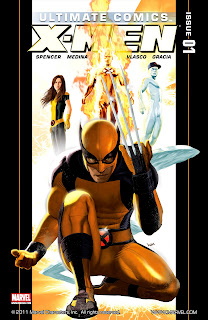
Ultimate X-men #1 - The Ultimate Letdown


I consider myself an equal opportunity drunk. By that I mean if I get fucked up on one exotic substance, I make it a point to get fucked up on another just to ensure the karma of the universe remains intact. Sure, it makes me sick to my stomach. I think I puked up half my small intestines after reading Ultimate Spider-Man #1. And I can objectively say that the reddish brown entrails on the gas station toilet had more creative merit than that piece of shit. Ultimate comics have sucked so bad that it's made me wish that kid who kicked my ass in school spiked my milk with rat poison rather than laxatives. That would be far less painful than this shit. But in the spirit of fucking myself up on a balanced level, I've decided to review Ultimate X-men #1. After reading Ultimate X #4 I now go into uncontrolled convulsions every time I read the worlds Ultimate and X-men in one sentence. It's hard to believe that this used to be my favorite book for the better part of a decade. Since then it's crashed harder than Tiger Woods's image.

Ultimate X-men is like a corpse that's already been butt-fucked by necrophiliacs, lit on fire, pissed out by incontinent monkeys, and then shit on again by a pack of constipated elephants. Jesus Christ, Mohammed, Moses, and Xenu couldn't fix this shit with all the magic from every holy book ever written. That's what happens when you have an event like Ultimatum that essentially butchers good characters in a way so tasteless that Marvel might as well have paid a bum four bucks to stab their fans with a rusty knife. Now the only fans who seem to enjoy Ultimate X-men are the fans that never gave a shit about X-men in the first place or hate the major characters that make up the X-men. But by that definition, they aren't really X-men fans! So what the fuck is the point of this book?

Apparently, Marvel is treating Ultimate like that sandbox every kid takes a shit in. It was once fun, but nobody wants to go near it anymore. It's like that slut in your senior year of high school that everybody fucks and will do anything you want. Those sluts usually disappear without a trace for a reason. But not Ultimate X-men. Marvel insists on telling an X-men story where Cyclops, Wolverine, Professor Xavier, Magneto, Gambit, and Angel are dead. Well if that's the story they want to tell, then why the fuck call it X-men? But I digress.

Ultimate X-men is basically a world where all X-men are screwed. Magneto inflicted mass genocide. Now all mutants are basically criminals by association. They're to be shot on sight or thrown into prison camps. It's not an issue of them being victims. Magneto fucked them all over and there's no going back from it. They might as well be Nazis trying to win the Jewish vote in Florida. There's just no coming back from genocide. You're either screwed over or slightly less screwed over. The new writer, Nick Spencer, has a proven track record with titles like Morning Glories (a book you should totally read if you haven't already). However, he seems to have drawn the short straw and has to tell stories in this shitty series about how shitty the lives of mutants are. I actually feel sorry for the guy because he might as well be trying to market used toilet paper. But enough shitting over this already wrecked stage. What exactly does this shell of an X-book have to offer? Well that's why I'm here, people! I review this shit so you don't have to.

Ultimate X-men #1 starts off with Karen Grant. She's another brilliant fuck-up from the X-books. She was once Jean Grey, an outgoing and passionate character that was one of Ultimate's most lovable characters. Then after Ultimatum she changed her appearance, took on the role of Karen Grant, and become this emo porcelain doll with the personality depth of someone who had a botched frontal lobotomy. She even refers to Jean Grey in the past tense. She doesn't even consider herself Jean Grey anymore. And maybe that's for the better because she has the people skills of a crack head. It shows when she visits this woman who just found out her daughter is a mutant. She has red hair and telekinesis. Really? In a book where and I quote "Anything can happen" this is what they come up with? I'm sorry, but Generation Hope beat this book to the punch by over a fucking year. Since when did "anything" mean shit that was done less than a year ago?


So they're talking and Jean goes over how fucked all mutants are. They're basically under the thumb of the government and the only reason she's not in a prison camp is because Nick Fury says so. She didn't even say she could help. She says she's just visiting out of "concern." As if somehow that's enough to do much good. She has nothing to offer this woman. No hope for her daughter other than a life that sucks. So when there's a bang off panel and the girl's father comes down carrying a shotgun saying he just killed his daughter, there's really no impact. It's not all that shocking or all that hard hitting. It's meant to be an emotional scene, but since this is an Ultimate book it's just par for the course. So a man kills his daughter when she finds out she's a mutant. In Ultimate, that's like finding out that Lindsey Lohan got arrested again. Boring!


Then the book gets political because seriously, what's more exciting than politics in comic books? Isn't that why fans read books and not because of the characters that the title on the cover promises? Or maybe I'm just crazy. Anyways, Valerie Cooper basically holds a press conference telling the world what readers found out in Ultimate Origins (nearly four years ago). Mutants aren't a big step in evolution. They're just a failed science experiment. This as opposed to being the product of alien space gods like the Celestials in 616. That's like going from fucking Pamela Anderson to fucking Betty White.


Watching this news conference are the rag-tag team of non-X-men that were assembled in Ultimate X. They include Jimmy (Wolverine replacement), Derek Morgan (a Batman/Daredevil/Angel ripoff), and Liz Allen (whiny bitch that's just annoying). They're understandably frustrated by the royal screw-job that mutants are getting. But again, they got no choice and no hope. They're basically just hanging around Karen because she's on Nick Fury's good side and he's keeping them out of jail. This leaves Jimmy the Wolverine rip-off to basically copy his old man completely and strike out on his own. He wants to see this place where mutants were first made. For a moment it sounds like Wolverine isn't even dead. Ultimate X sucked ass, but at least Jimmy made an effort not to be too much like his old man. Seriously, if Marvel wants an X-men series where Wolverine is dead, why replace him with a kid that acts just like him?


So the news report continues because politics are just so exciting. Valerie Cooper continues answering questions, basically taking excuses right from the press in 1942 when everyone was justifying the internment of the Japanese. The difference here is that mutants are being prodded like cattle as a scene with Colossus so nicely illustrates. There are some places that claim to be nice such as the one Storm is at, but those are just for photo-ops. I'm not sure if the historical parallels are supposed to apply here, but they do to a point. The only difference is that if a guy like Magneto inflicts mass genocide then something as shitty as internment camps actually seems reasonable. That's how fucked up politics are in Ultimate. Michelle Bachmann would be right at home.


But it isn't just prison camps that are screwing mutants over. Some are still on the loose. Some still need to be hunted. How do they do that? Well here's a pop quiz for all you X-men fans out there. What other reality has mutants being hunted and thrown into prison camps? If you answered Days of Futures Past, you get a gold star and bonus points for being able to look up a story that is over 30 years old. Now Nick Spencer claimed that he's simply taking some inspiration from Days of Futures Past. He's not just ripping it off. I want to believe him. I really do. But when Rogue, who has been on the run since Ultimate X, is confronted by a Nimrod sentinel that might as well have been copied and pasted from the old Days of Futures Past storyline then I have to cry foul.

This is a huge problem for me among many. Ultimate has been pitched as this place where these new, novel stories can be told that can't be told in 616. But mutants being hunted and thrown into prison camps is not new. Days of Futures Past is an old story. It's one thing to take some elements from it. I know pretty much everything is a rip-off these days, but it's a matter of degree. When you throw the Nimrod sentinel into the mix and it looks almost exactly like it's 30-year-old counterpart then that's ten degrees too much. It's such an egregious level that Al Gore could make a documentary out of it.


So the White House press event went about as well as it does in real life. That is to say it triggered riots all over the country. So at least Ultimate still gets some things right. It falls on Nick Fury to do something about it. Yet he's the guy putting together a mutant team with a Karen Grant and Wolverine's kid. So how is he credible again? He's prepared to call in the National Guard, which in comics is like admitting your a pussy. That's when Quicksilver shows up. You know, the guy who basically manipulated Magneto into conducting mass genocide by making him believe his children were dead? He comes along and no one shoots on him the spot because only the readers know that. Now I know dramatic irony is supposed to heighten the moment here, but all it really does is make Fury and the President look like morons because they actually take him seriously. Pietro doesn't actually reveal what he has in mind. No, that's because this is a setup issue. That means shit isn't going to happen until the next issue. It's not a cliff-hanger. It's basically a hostage situation.


So most of this comic has essentially showed you how fucked mutants are and how fucked they're going to be with Quicksilver working out his daddy issues. Now we revisit some of the other X-men that weren't horribly butchered. Kitty Pryde, Bobby Drake, and Johnny Storm have all basically given up on the whole hero gig. It's hard to be a hero when everyone wants to kill you. So they just live the life of hobos, sleeping in old Morlock caverns. Yet they're aware of the crap that's going on and aren't inclined to thrust themselves into that shit storm. And who can blame them? This is one instance were being a hero is not just stupid. It's pretty much pointless.


But then Bobby points out on his nifty product placement ipad (I'm sure Marvel gets a shit ton of free itunes cards for this) that Rogue is involved in one of those riots. Well that seals it. When an old girlfriend is about to get lynched, that warrants coming out of the sewer and actually kicking some ass. It would be so heroic if at the end Kitty doesn't narrate it as saying this is how she became the world's most wanted terrorist. There's trying to twist the plot and then there's just trying too hard. So now they're going to become terrorists? Yet this book is called Ultimate X-men, isn't it? Four years ago I would have been confused and intrigued. Now I'm just bored. It's the end of the issue and all the elaborate setup, but I have no desire to see the action. I think it's safe to assume that the setup failed for me. Watching heroes become terrorists and mutants become increasingly screwed may make for a decent arc, but not a whole fucking comic series.


I know I come off as harsh, but in reality I'm saddened by how terrible this series has become. I can't find anything appealing about this book at all. A book where anything can happen except the return of the characters that most X-men fans actually give a shit about isn't a very good premise for a book. Not only is this book basically a setup issue, all it really sets up is that mutants are fucked. The only stories you can really look forward to is how fucked are they. The only way they can not be fucked is if the story becomes extremely contrived and just starts ignoring all the shit that led up to it. So in order for the stories to be good, it has to use bad storytelling. In a universe with working physics, that's just not possible. Nick Spencer is basically in a catch 22. There's really nothing he can do here other than roll with the punches and there's nothing to work with. Not in the slightest. Now like Brian Bendis, I like Nick Spencer. He's a great writer and if I met him and real life, I would buy him a beer and a hooker. But the circumstances of this book are beyond salvaging and he doesn't do anything to make it better. That's really the least I can say about this book.

I want to be excited for an Ultimate book again. I really do. But this series has just turned into a What If story that won't fucking end. What if Marvel was actually stupid enough to kill Peter Parker? What if Marvel was actually deluded enough to kill most of the X-men, try to replace some of the characters, and make a series out of it? What if Marvel made a series about the Avengers just being a bunch of assholes who only occasionally acted heroic? Part of the appeal of What If stories are that they're finite. They're not dragged out or used to destroy the potential of a series that actually was once a top tier series. But Ultimate X-men #1 epitomizes all that is wrong with Ultimate comics. It's boring. It's bland. The characterization sucks. The premise sucks. There's no sense of progression. No build-up or promise. No hope whatsoever. Now if this story happened without Ultimatum, then it may have some merit. But Ultimatum did such a thorough job of desensitizing the series from any shock or intrigue that there's nothing this book can do that will leave the readers' jaw on the floor. When a series has resorted to cannibalism, decapitation, and replacement characters shrouded in race gimmicks that's it. Game over. There's nothing left to surprise anyone.

At the very infinitesimal least, Nick Spencer makes sure his talent is apparent in the way the characters talk and interact. However, all the talent in the world couldn't make this shit ball shine. I hope Spencer gets a shot at another X-men book, but this just has nothing going for it. I can't find any reason to recommend it to anybody, even if they were just going to use it as toilet paper. No ass deserves the crap that's within these pages. If Ultimate were a dog, it would have been shot and buried by now. That's really the only thing that will make this series meaningful again. If Marvel decided to kill it like it should have after Ultimatum. Ultimate X-men #1 only gets a 0.5 out of 5. I didn't want to give the 0 I gave Ultimate X #4 because that book also had shitty art to go along. That book will make you spew diarrhea through your tear ducts. This one will just make you sick to your stomach and depress you that this is how low Ultimate has sunk. Nuff said.