Showing posts with label Amazons. Show all posts

Friday, May 11, 2018

Dark Connections and Darker Divinity: Wonder Woman #46

The following is my review of Wonder Woman #46, which was posted on PopMatters.com.


When it comes to the ancient mythologies, the major themes often reflect distinctly human traits. Gods, demigods, and everything in between tend to highlight extremes and embellishments of these traits. The modern superhero genre frequently utilizes the same approach, forging heroes that embody powerful traits that reflect the best and worst of humanity. In that context, Wonder Woman reflects the best of mortals and gods alike.

Unlike the traits embodied in Superman or Batman, Wonder Woman's story is closely tied to that of the Olympian gods that she and her fellow Amazons worship. Much of her power, persona, and heritage stem from the stories of these gods that go back to ancient times. Sometimes, they empower Wonder Woman and drive her forward. Other times, they present her with adversaries and conflicts. In recent times, her struggles under James Robinson utilize a little of both.

There are a great many upheavals going on in Wonder Woman's life, both as high-profile hero in the DC Universe and on the personal front. After being reunited with her long lost twin brother, Jason, she goes through a bit of an adjustment period, having lived much of her life under the assumptions her mother, the gods, and her Amazon sisters instilled. More and more of those assumptions are now coming into question. The events of Dark Nights: Metal and her recent dealings with Grail have Wonder Woman at another crossroads that may result in more than just shocking family revelations.

While secrets and lies are a frequent catalyst in mythology, ancient and contemporary alike, Wonder Woman #46 lays the groundwork with conflict more relevant to Wonder Woman's recent personal struggles. Between discovering her long-lost brother and watching Barbara Minerva transform into Cheetah again, she's already familiar with divine melodrama, albeit on a smaller scale. James Robinson keeps the scale small at first, but it steadily escalates.

It starts with Cheetah's escape. It's sudden, violent, and brings her face-to-face with Veronica Cale, the woman most responsible for Barbara Minerva becoming Cheetah again. On the surface, it presents itself as simple revenge scheme in the mold of John Wick. That's how Wonder Woman approaches it when she enters the picture, but it gets distinctly less simple from there. That tends to happen whenever gods, new and old alike, get involved.

Parallel to Cheetah's story, Diana's twin brother, Jason, follows his own plot that reunites him with his adopted father, Glaucus. Like Cheetah's blood-soaked revenge story, his starts out simple. Rescuing his adopted father from people intent on studying the biology of immortals doesn't break much new ground. As with Diana, though, that changes once some divine details emerge.

Unlike Diana, though, Jason's story is still new and has a few lingering plot holes. Robinson doesn't overlook them, but doesn't give a full answer either. Jason's emergence within Wonder Woman is already heavily influenced by the Olympian gods. His connection with them is a bit less certain compared to his sister, if only because he's shown a tendency to be far less responsible. The hints dropped by Glaucus also indicate that they've influenced Jason more than he thinks.

This provides an ominous backdrop once the impact of Dark Nights: Metal catches up to the story. It's somewhat abrupt, hitting Diana both literally and figuratively as she tries to deal with Cheetah. Most stories involving gods and god-like beings tend to evoke powerful passions throughout the mortal masses, especially among those expected to provide worship. Anything that disrupts that worship is an attack on their very soul.

The passions, in this case, have little to do with piety. True to ancient mythologies that highlight the importance of the gods, their absence or lack of influence leaves the world of dangerous and prone to chaos. This is where Dark Nights: Metal starts spreading its influence and Wonder Woman is on the front line. Being a demigoddess, herself, it's fitting that she finds herself drawn into the chaos. An agent of that chaos even ends up being a familiar face who bears a familiar red cape and symbol on her chest, which further raises the stakes.

Wonder Woman #46 takes its time to set up a new plot involving the Old Gods, the emerging Dark Gods, and how it all effects Wonder Woman, someone's whose story involves battling divine chaos every other week. The connections between Diana's recent clashes and Dark Nights: Metal are subtle, but relevant. However, they're too subtle to generate much impact, aside from the last couple of pages. While the story is full of bloody battles and divinely-fueled chaos, it still moves too slowly to really test Wonder Woman in a meaningful way.

It still makes the necessary connections and establishes a foundation for a divine conflict that will bring new, but familiar contributors to her struggle. Whether they'll help or hinder her efforts remain to be seen. One of ancient mythology's most common themes, aside from gods impregnating mortal women, involves how determined gods are at maintaining their godly status. Those who worship them can be just as determined and if Wonder Woman #46 is any indication, she'll may end up fighting both.

Final Score: 6 out of 10

Thursday, February 15, 2018

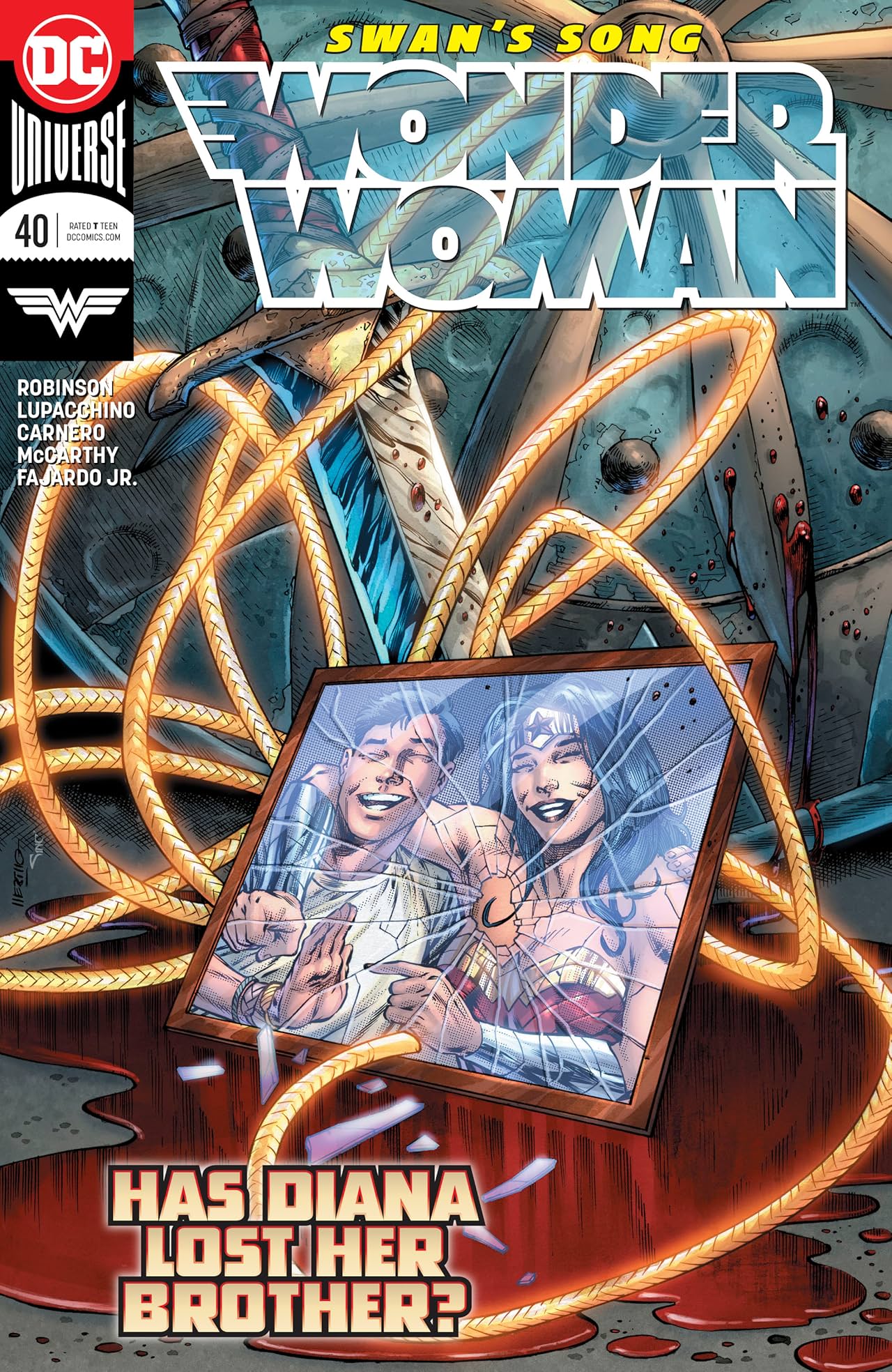
Petty Villains Makes For Shallow Conflict: Wonder Woman #40

The following is my review of Wonder Woman #40, which was posted on PopMatters.com.


There are certain villains who don't need much push to fall into that never-ending cycle of evil, resentment, and constantly seeking new henchmen. Characters like Thanos, Lex Luthor, or Darkseid rarely a lot of motivation to walk that path. They're kind of expected to because they fill a particular role. They're the kind of villains whose existence makes the struggle of the heroes necessary. They provide obstacles that often have to be fought with fists rather than words.

Then, there are the villains who need a much harder push to walk that path. These are the Walter Whites of villains, characters who tried to live an honorable life, but chose a different path when circumstances worked against them. As such, the dynamics driving these characters tend to be more complex. Sometimes, they can be downright erratic because it's not always clear whether such a character qualifies as a villain. When those dynamics are working, though, these kinds of characters can be uniquely compelling.

Most of Wonder Woman's villains don't fall into the category of a Walter White. Historically, her villains involve gods, demigods, mythical monsters, and alien tyrants. The dynamics with those kinds of characters tend to be pretty basic. That's what makes Silver Swan a breath of fresh air in James Robinson's ongoing run in Wonder Woman. She's no demigod or mythical monster, but her conflict with Wonder Woman is uniquely dramatic in that it's so personal.

The story that begins in Wonder Woman #38 takes someone who never showed an inclination towards evil and guides them down that path. Wonder Woman #40 marks the culmination of that journey. It puts Wonder Woman in a difficult position, one in which every punch and every attack she unleashes against Silver Swan is like a jab to the heart. It's one of those battles that's destined to feel like a loss, even when she wins. That kind of inner struggle and tends to bring out the best in Diana.

There are key instances in the story where Wonder Woman demonstrates that unique strength. The path that leads to her showdown with Silver Swan is pretty direct. There aren't many diversions or mysteries to solve. There's no need for Batman's detective skills or a favor from Olympus either. The path to that dramatic clash is pretty straightforward, so much so that there isn't much room for tension. Given Silver Swan's willingness to attack a hospitals and slit throats, particularly the one of the long-lost brother that Diana just reunited with, there isn't much need for it.

Much of the clash and the story around it is fairly basic. Silver Swan's motivations don't include some grand, deranged vision that involves tearing the universe asunder while using the pained cries of her enemies as background music. She just hates Wonder Woman because she feels betrayed by her. Before she becomes Silver Swan, she believes she's Wonder Woman's friend. She draws strength from that as she deals with her own personal issues. Then, when she really needs that friendship, it's not there and that pushes her over the edge.

In terms of the catalyst that turns someone from a friend to an enemy, it's pretty shallow. Silver Swan is no Lex Luthor or Joker. She's no Mole Man either. She never comes off as psychotic or broken. If anything, she comes off as petty, as though she's somehow entitled to Wonder Woman's support during her time of need. She sees her as the emotional equivalent of an Uber driver, someone she can call on to feel strong and loved again. She doesn't seem to realize that Wonder Woman, as a full-fledged member of the Justice League who has to battle alien tyrants and demigods every other week, has a lot on her plate.

This is what makes Silver Swan seem downright petty, even by villain standards. It also makes it hard to see her side things when the battle between her and Wonder Woman finally erupts. Quality villains, even the exceedingly unlikable kind like Lex Luthor and Darkseid, have some sort of grievance to bring to the table that makes their hatred of heroes seem legitimate. Silver Swan primary grievance is that Wonder Woman didn't inconvenience herself enough for her. That makes her difficult to sympathize with, let alone root for.

She still manages to come off as a highly-driven villain that hurts Wonder Woman on an emotional level. That part of the story still carries plenty of dramatic weight and that gives Wonder Woman #40 a sense of depth. However, the impact of that depth is somewhat undermined by how rushed the final battle ends up being. There isn't much time to build the tension. There's still plenty of heartfelt strain, but it ends before anyone needs to catch their breath.

That's somewhat necessary, though, because a good chunk of the story is spent on how Diana's long-lost brother, Jason, is adapting to being part of Wonder Woman's life. That's a compelling story in its own right and while it does make for some colorful moments in previous issues, it's more of a distraction in Wonder Woman #40. Despite being a demigod like Wonder Woman, Jason does more to hinder rather than help his sister's efforts against Silver Swan.

The family drama and the personal drama just don't effectively mix. Given how dramatic and convoluted things can get whenever demigods are involved, that comes off as a missed opportunity. The aftermath of the battle itself also leaves a lot of issues unresolved. While Robinson does plant the seeds of new mysteries and further complications with Jason, it doesn't make for much impact because it contributes so little to the battle against Silver Swan.

On paper, the story surrounding Silver Swan and Wonder Woman's newfound family connections has all the necessary components for a big, dramatic story full of heart, tragedy, and jokes about Zeus' various infidelities. It's an opportunity to create a new villain for Wonder Woman that tests her in ways that make iconic heroes even greater. Just being able to do that without creepy clown makeup is an accomplishment in modern comics.

Unfortunately, the story that culminates in Wonder Woman #40 doesn't make use of those components. The characters and situations are there, but connections and motivations aren't. Silver Swan isn't going to be placed in the same tier as Lex Luthor, the Joker, or even Cheetah anytime soon. Robinson does leave her story open for more development, she has a long way to go before she becomes the kind of villain that deserves Wonder Woman's tears and fists.

Final Score: 5 out of 10

Thursday, June 29, 2017

From Rebirth To Resolve: Wonder Woman #25

The following is my review of Wonder Woman #25, which was posted on PopMatters.com.


By every measure, Wonder Woman is having a great year. For the first time in her history, it's not unreasonable to say that hers is the brightest star in the DC trinity. Superman and Batman can have their epic battles and bitter disputes, but only Wonder Woman can say she raised her profile while maintaining the heart that makes her so endearing. She's conquered both the box office and the critics on Rotten Tomatoes, something that Batman and Superman's epic clash cannot claim.

Wonder Woman's star is burning so brightly at the moment that it's easy to forget that part of that flame has been regularly stoked by Greg Rucka and Liam Sharp in her comics. After the events of DC Rebirth, Wonder Woman goes through a sobering process of sorts. The world she thought she knew is shrouded with lies that she didn't know were plaguing her. The life she thought she had lived has gaping holes in it that she cannot ignore. For a woman used to extracting truth with her lasso and her charm, that's an unfamiliar feelings.

Like many other DC Rebirth titles, the narrative in Wonder Woman is crafted in a way that builds and escalates. At times, it tends to drag. On top of that, Rucka and Sharp explore some of the gaps that emerged while the DC universe underwent its messy rebirthing process. They end up having to retell, reshape, and update Wonder Woman's story, often while trying to tell a parallel story in the present. It's easy to lose track of the story, but it can make for a uniquely satisfying payoff.

Wonder Woman #25 marks the end of Rucka's run on the series. It also marks the epilogue of sorts of all the various plots within Wonder Woman's rebirth-induced history. It's no easy feat, revamping and retelling Wonder Woman's entire history in just 25 issues while a major Hollywood movie is making headlines in the background. Rucka rises to the challenge, providing a capstone of sorts to a journey that balances the hardened warrior, the loving spirit, and the feminine ideal that she embodies.

It's an important balancing act for Wonder Woman. Throughout her history, multiple writers approach her from various angles. For some, she's only that hardened warrior. For others, she's only that loving spirit and feminine ideal. As iconic a character she is, the stories about her tend to segment her character. All too often, only parts of her personality are explored. Rucka dares to use every one of them in Wonder Woman #25 and in many ways, it completes her rebirth process.

The story itself is built around the aftermath of a lengthy arc that jumps between time periods, exploring Wonder Woman's initial arrival into man's world and her latest clash with a couple menacing gods. Along the way, she faces an identity crisis that makes a rebirth all too necessary. She faces a painful, soul-crushing revelation. For someone who's used to getting the truth out of everyone with ease, that's an accomplishment, even for gods.

Entire chunks of Wonder Woman's life are called into question. Her faith in the gods, her heritage, and herself become subject to major doubt. At the same time, she's still trying to help her friends and still be a full-time member of the Justice League. It's stressful, to say the least. It sends the message that if someone like Wonder Woman can crack under the strain at times, then what hope does anyone have?

That hope doesn't stay lost for long, though. Early on, Rucka shows that Wonder Woman can still be Wonder Woman in the midst of so much upheaval. She can arrive on the scene with the Justice League, fight giant monsters, and hardly break a sweat in taking it down. The hardened warrior aspect of her character is rightly preserved. However, that's not the sole focus of the story or Wonder Woman's journey over the course of the past 25 issues. It's never more than a secondary focus because Wonder Woman embodies more than just a fighting spirit.

Much more of Wonder Woman #25 focuses on her heart, which is heavy and wounded. She spent a great deal of her recent journey trying to save Dr. Barbara Minerva from the clutches of Cheetah, but circumstances beyond her control make that impossible. That's pretty heart-wrenching because when something is impossible for Wonder Woman, who regularly deals with gods, monsters, and Batman, that makes clear that some things are just beyond anyone's control.

She still makes an effort to help her former friend. She also makes a desperate plea for help from the last person who would want to help her. Even with all her love and heart, it isn't enough. It shows in the way she fights. Even her fellow friends on the Justice League sense it. When she finally gets around to confronting it, she has to essentially accept what she can't control. The truth may hurt, but that doesn't make it any less important. There are people who go their entire lives avoiding that. Wonder Woman confronts it, even when she's angry and wounded. Given her immortal heritage, that's quite an accomplishment.


Rucka goes heavy on the symbolism, giving Wonder Woman a love/hate relationship with her magic lasso at a time when the truth can hurt even an immortal warrior woman. Sharp's colorful artwork keeps the tone of the story from getting too bleak or dire. In the end, her willingness to take back her lasso and accept the harsh truth for what it is highlights the end of a journey that Wonder Woman needed to take. It's a journey that strengthens every part of her character, as well as those around her.

As fitting an end as Wonder Woman #25 is to that journey, it does gloss over a few issues and rushes a few others. There's never a clear resolution with Cheetah and Wonder Woman's acceptance of the truth feels somewhat rushed. The fact she only needs a pep talk before taking back her lasso feels somewhat unremarkable, if not contrived. There are a lot of arguments she could've and probably should've had with the gods that deceived her. However, those conversations are essentially shrugged off in favor of some sexy time with Steve Trevor. On some levels, though, that's a fair trade-off.

Overall, Rucka's run on Wonder Woman is a remarkable accomplishment. At a time when Gal Gadot, Chris Pine, and Patty Jenkins are elevating Wonder Woman's star to new heights, her DC: Rebirth journey finds a way to make that star burn a little brighter. Wonder Woman is tough, compassionate, loving, loyal, and beautiful on every level. It's not something that most people need to be reminded of, but some reminders are still worth having.

Final Score: 8 out of 10

Sunday, April 10, 2016

Unholy Grail: Justice League: Darkseid War Special #1

The following is my review of Justice League: Darkseid War Special #1, which was posted on PopMatters.com.


When historians look back on this era of comics, they will likely refer to this era as the silver age of female superheroes. The only thing that might keep it from being a golden age would be the fact that Ant Man got a solo movie before Wonder Woman. Shortcomings aside, it's undeniable that female superheroes have risen to prominence during this era.

Carol Danvers became Captain Marvel. Kamala Khan became Ms. Marvel. Harley Quinn became more than an obsessive Joker fangirl. There are still unresolved issues, such as Power Girl's costume and Starfire's sexuality, but there has definitely been progress in the realm of female superheroes. However, the same cannot be said for female villains.

Female villains create a unique set of challenges that cannot be easily resolved with clones, time travel, and skin-tight costumes. All too often, female villains are reduced to typical femme fatales or glorified Bond girls. It's not enough for a female villain to just be a menacing presence with an hourglass figure. To stand out in an era where it's way too easy to undermine female characters, it takes a novel approach.

This is the approach Geoff Johns has set up with Grail, who has been the main catalyst to the events of Darkseid Wars. He has tried to make the fact that she's a woman secondary to the overall story. It's ambitious in that it's one of those feats that isn't usually accomplished outside of a Joss Whedon movie. For it to work, Grail can't just be a female version of Darkseid. Having an hourglass figure and a desire to exterminate all life in the universe just isn't enough. She's has to be different kind of villain with a different set of motivations.

Justice League: Darkseid War Special #1 attempts to shed light on those motivations. What it offers helps move the plot of Darkseid Wars forward, but it does little to make Grail more than Darkseid's evil daughter. She still comes off as the rotten apple of her daddy's eye, in some cases quite literally when omega beams enter the picture, and her story does little to make that more interesting. If anything, it overly simplifies her persona in a way that might as well be ripped from a Superfriends rerun.

That story doesn't try to make excuses for Grail. It doesn't try to make much of a story of it either. Grail is an evil, devious woman who treats inflicting death with the same glee as a child eating a chocolate cake. There was no real progression to this evil. She basically just follows Lady Gaga's message to the letter in that she was born this way. There's never really a sense that she could be anything else.

That's not to say the overall story is bland. If Justice League: Darkseid War Special #1 has an intriguing character, then it's not Grail. It's her mother, Myrina Black. She's the only character whose motivations feel compelling. She's a mother trying to protect her daughter, but she's also a mother fighting a losing battle. Any mother who has dealt with a rebellious teenage girl can empathize. With Grail, though, this battle is taken to an unreasonable extreme.


There's nothing in this story that would make anyone sympathize with Grail. Geoff Johns doesn't try to make her a tragic villain in the tradition of Two-Face, Sinestro, or Joel Shumacher. He only ever reinforces the notion that Grail is just inherently evil and everything she does is intended to make children and puppies cry. To her credit, Myrina Black still tries to love her daughter as any mother would. However, despite what nearly every song by the Beatles may claim, love is simply not enough.

Even if love isn't enough, the greatest strength of the story is that it's told from Myrina Black's perspective. Geoff Johns includes plenty of rich dialog and inner musings that offer insight into Myrina's personality. She's very much an Amazon. She has more warrior spirit in her pinkie than most people not named Bruce Wayne have in their entire bodies. She sets herself apart from Wonder Woman in that her mission as a mother converges with her mission as a warrior. In the end, however, it's a mission that was doomed to fail.

If Myrina Black's perspective is a strength in this story, then Grail's progression is its greatest weakness. There's no real sense that she ever even tried to become more than Darkseid's daughter. There's never a sense that anything Myrina Black did would've had any impact on Grail or how the events of Darkseid Wars played out. Justice League: Darkseid War Special #1 basically amounts to Myrina Black's failed efforts to help her daughter and Grail's utter lack of effort in heeding her mother's help.

It's basically a perfect storm for failed parenting. There's never a sense that a little extra therapy, a little more honesty, and a few more self-help books would've changed the situation. Grail still walked the same path as her father and she did it with a smile. While that might make her the kind of female villain who can take down the Justice League without breaking a sweat, it doesn't make her the kind of character that would be any more compelling than an evil Supergirl.


Grail is still a menacing character with a great deal of potential. Justice League: Darkseid War Special #1 is able to realize some of this potential, but for the most part it just moves the Darkseid War arc forward. It nicely ties in with the events in other books, incorporating ongoing plots involving Jessica Cruz and Steve Trevor into the mix. However, if the purpose of the story was to make Grail a more compelling character, then it came up short.

It didn't fall flat on its face, but it didn't break new ground either. Grail is evil. Grail is her father's daughter. Her mother never stood a chance at helping her. It's a depressing message, but most stories that begin on Apokolips usually are.

Final Score: 5 out of 10

Tuesday, August 25, 2015

Meddling Progress: Wonder Woman #43

The following is my review of Wonder Woman #43, which was posted on PopMatters.com.


If there’s one thing that the success of HGTV has taught us, it’s that society has a weakness for reclamation projects. In the same way certain women can’t help but fall for the bad boys in hope of saving them, there’s a kind of broken character that draws us in. Like Pamela Anderson at a hair band reunion tour, we can’t help but embrace these characters. As it stands, Donna Troy is the comic book equivalent of a burned out 80s rock star that just got out of rehab.

Her introduction to the post-Flashpoint era might as well have come with a bad handicap and adamantium shackles. She entered the world as a pawn, which is somehow worse than being another illegitimate offspring of Zeus. Her first act was the textbook definition of a war crime. Even the ancient Mongols would’ve raised an eyebrow at slaughtering an entire population of men that happened to be brothers of the Amazons. While she wasn’t completely control of her faculties at the time, she still has to live with that burden the same way Hallie Berry has to live with her role in the Catwoman movie.

The aftermath of this atrocity has served as the foundation of a new era for Wonder Woman. She’s now the acting God of War, Queen of the Amazons, and an active member of the Justice League. Even Hillary Clinton would call her an overachiever at this point. But while she’s trying to shoulder the burden of all these responsibilities, she still hasn’t come up with a way to deal with Donna Troy. It’s a story that has been set up and teased. Now, in Wonder Woman #43, that story finally starts to unfold.

It’s a story that follows many of the same themes that Wonder Woman has been exploring since the New 52 reboot. It has mischievous gods whose idea of entertainment is tormenting mortals and frustrating Wonder Woman. It has colorful characters with god-like powers who are essentially parodies of classic mythology, but not in the Weird Al tradition. And Wonder Woman is expected to manage this chaos while fighting the injustices of a patriarchal world. The demands on her couldn’t be more unreasonable without asking her to coach the Oakland Raiders.


Yet for all her power and responsibilities, Wonder Woman is largely powerless to help Donna Troy in this story. While Wonder Woman spends most of her time just looking for her, Donna’s story is an ongoing tragedy. However, that’s still an upgrade over being the catalyst for an outright war crime. What makes that tragedy compelling is that she understands the scope and scale of her crimes. She doesn’t try to hide from it. She doesn’t try to justify it. She actually tries to deal with it, which is more than most war criminals ever try to do. And none of these criminals can claim they were being controlled by black magic, except for maybe Kim Jong Ill.

It’s here where we’re also reminded that in addition to being guilty of an atrocity, Donna Troy is still a child. She’s basically an infant in a teenage girl’s body. She has no life experiences, let alone emotional maturity. A teenage mind is barely equipped to cope with calculus exams. This girl has to cope with being guilty of a war crime. It might be the first time a teenage girl’s melodramatic lamentation is completely warranted.

And being so emotionally immature, Donna’s first inclination is to seek an immature solution. She tries to end her life. Being an Amazon, she can’t exactly use Kurt Cobain’s approach. So she seeks out the mythological Sisters of Fate. However, they claim they can’t give her what she wants and not because suicidal teenagers have a tendency to not think things through. Despite being god-like beings, they can’t end her life because her fate isn’t set.

In some respects, it’s an appropriate metaphor for any teenager not guilty of war crimes. They may think that their life will always be defined by one bad day at high school, one day at work, or one bad relationship. That’s not how life works. The universe’s attention span isn’t as big as we make it out to be, especially for those whose experiences are so limited. And for Donna, her experiences couldn’t possibly be more limited without having been born in the lower decks of the Titanic.

Her frustration and self-hatred is the greatest strength of this story. It helps make her character endearing, notwithstanding the war crimes she’s still quite guilty of. The problem is her story is somewhat truncated. Another critical part of this story involves Wonder Woman searching for Donna. This leads to a few ambiguous twists involving someone attacking the Sisters of Fate and a surprise attack by Aegeus. It’s presented as a mystery, but ambiguity makes it come off as bland movie trailer.

Beyond the conflict, Wonder Woman doesn’t give the impression she has a plan for Donna. She doesn’t even indicate she can help her in any way other than bringing her back to Olympus, a place where gods torment mortals whenever they get bored. She still talks about helping Donna forgive herself and accept the weight of her crimes. That’s all well and good from a Dr. Phil perspective, but it’s insufficient for a character whose only life experiences involve being a pawn to war atrocities.

There is still some intrigue to this mystery, but its lacking in substance. It makes the overall narrative in Wonder Woman #43 uneven. It’s worth following to see the story of Donna Troy evolve beyond the grim circumstances of her creation. Beyond that, it’s mostly a generic conflict among gods with too much power, too much free time, and no Netflix.

There is still hope for Donna Troy as a character. Her journey is one that has the potential to be something unique and intriguing. She just has to find out how to circumvent self-hatred and meddling gods. If she can do that, she can be an inspiration for melodramatic teenagers everywhere. And in this day and age, there can never be too many of those.

Final Score: 6 out of 10

Monday, July 20, 2015

Equals in an Unequal Struggle: Superman/Wonder Woman #19

The following is my review of Superman/Wonder Woman #19, which was posted on PopMatters.com.


When things are good, every relationship feels like the opening theme to a 90s sitcom. It’s all smiles, laughter, and terrible music from the Hootie and Blowfish type bands. Even Tina and Ike Turner probably had their good days. It’s only when things get bad that we find out which couples are the Waldens and which couple are the Bundies.

Since DC decided to do the most obvious romantic pairing since Mulder and Scully in the X-Files, the Superman/Wonder Woman relationship has evolved in an astoundingly mature way. There was no beating around the bush, Ross and Rachel style. There was no drawn out melodrama that every reality show ever has tried to capture. Superman and Wonder Woman just came together, embraced the opportunity, and actually made the effort to create a functioning relationship.

In fact, they’ve put more effort into their relationship than every couple that ever got together in 90210. They’ve gotten to a point where they truly carried themselves as equals, making complementing their strengths and confronting their weaknesses. They’re not defined by their romance, but they are better because of it.

Now, Superman and Wonder Woman’s relationship is being tested in a way that even the worst romantic comedy has never attempted. Superman’s identity has been exposed. His powers have been severely curtailed. On top of that, someone is intent on destroying the ruins of Clark Kent’s life and spitting on the ashes. If ever he needed the support of his girlfriend, it’s now. If ever there was a hardship for a relationship, this is right up there with a weekend at the in-laws.

Superman/Wonder Woman #19 puts Wonder Woman at ground zero of the ongoing effort to make her lover miserable. She doesn’t have to be part of this fight, but she chooses to be part of it because she cares about her lover just that much. In doing so, we get a story with an engaging, dramatic narrative that never feels overly dramatic. There’s no part of this situation that’s ideal for either Superman or Wonder Woman, but that’s exactly what makes the drama meaningful.

They’ve already had a decidedly bad day since showing up in Smallville. They arrived to investigate the disappearance of its people, which includes Superman’s old flame, Lana Lang. That day gets even worse when they encounter the Suicide Squad. At this point, a tornado and a string of outdated Wizard of Oz jokes would have been less frustrating. It leads to a fairly basic clash that nobody is going to mistake for a war with Darkseid, but it still creates some meaningful moments.

In any other circumstances, this is the kind of fight that Superman and Wonder Woman could brush aside in the same way Bill Gates brushes aside a check from Applebees. But with Superman’s powers being limited, the battle takes on a much more urgent tone. He can’t just cough in a way that’ll blow Black Manta, Harley Quinn, and Deadshot into the next County. He has to get his hands dirty and take a few bullets. It forces Superman to be less upstanding than usual, carrying himself like a hung over Rocky Balboa at times. But it doesn’t stop him from being Superman.


This also doesn’t stop Wonder Woman from being the warrior and lover she’s always been. She’s used to protecting those weaker than her, but she’s probably not used to Superman being among them. Even so, the battle never becomes like an inverted version of Super Mario. She doesn’t have to be his hero. She just has to keep being his lover. She fights by his side, not in his place. It may not make for a good Nintendo game, but it does reveal a mature and evolving relationship.

Beyond their relationship, there’s also a compelling story unfolding behind the scenes. During the battle against the Suicide Squad, we find out that they’re not responsible for the disappearances of the people in Smallville. That means even the Amanda Wallers in the government are clueless as well. It further deepens the mystery. It’s not as simple as Lex Luthor attempting to troll Superman in the worst possible way. There are other forces at work here.

We get some hints as to who might behind this, but not nearly enough. We can only confirm at this point that whoever is behind this, they’re not done tormenting Superman. And for some reason, they think it’s a good idea to mess with a very irritated Superman, who also happens to be Wonder Woman’s boyfriend. Ignoring the death wish behind this plot, it raises a few intriguing questions that warrant further exploration.

It’s also at this point where another important aspect of Superman and Wonder Woman’s relationship is exposed. While Wonder Woman doesn’t have to save Superman in the Princess Peach tradition, she still has to treat him when he gets wounded. She also makes it clear that his vulnerability worries her, as it probably should for any caring lover. It makes for a tender moment, but it never becomes too much like a Greys Anatomy sub-plot. Superman doesn’t let it.

Instead, he makes it clear that he doesn’t want Wonder Woman to change how she goes about being Wonder Woman. He does the exact opposite of what the majority of love stories in Disney movies do, telling his lover to not change who she is or how she lives her life. It may be jarring to those used to seeing women upend their lives for a handsome man or men doing the same for a beautiful woman, but that’s what helps set Superman and Wonder Woman apart. It is truly a relationship of equals.

That mutual trust and shared struggle is what makes Superman/Wonder Woman #19 feel like another important step in the development of this relationship. They’ve shared major battles together. They’ve shared the frustrations of being on the same team as Batman together. Now, they’re sharing each other’s personal struggles and even when one of them is weak, it still feels like a relationship among equals. That sort of thing is difficult to find in an era of radical feminism, men’s rights activists, and Kardashian marriages. But that’s exactly what makes it so meaningful.

Final Score: 8 out of 10

Thursday, July 16, 2015

Scanned Thoughts: Superman/Wonder Woman #19


What is true love? My grandfather said true love is being able to throw up in a toilet while your lover holds your hair and sings to you. My ex-girlfriends would disagree, but I'm convinced that some of them don't know the difference between true love and having an neutered dog. This is a debate that has baffled philosophers, emperors, and shitty movies for ages. I sure as hell can't debate this kind of shit when I'm overly sober, but I can at least accept one argument. We know love when we see it.

And right now, anyone who doesn't have a raging hard-on for Lois Lane has to say that the Superman/Wonder Woman relationship is the kind of love that would make a guy like me quit drinking. They're a relationship of equals. Their not defined by their love for each other. They're made stronger and happier because of it. They actually go out of their way to work on their relationship to make it better. Hell, I couldn't get my last girlfriend to order a fucking pizza for me. Superman and Wonder Woman have shown what it takes to make love work.

Now, they're showing what happens when a special breed of asshole goes out of their way to make someone's life miserable. Superman's identity has been exposed. And since it's not enough that he can't live the life he worked so hard to maintain, someone has to go out of his way to desecrate his old home in Smallville. Outside Game of Thrones, there aren't many people who can claim to be that cruel. Someone wants to torment Clark Kent and Diana Prince is ready to stand by her man. That's what makes the setup for Superman/Wonder Woman #19 so intriguing. It also reminds me that true love and navigating shit storms aren't a mutually exclusive process.

I'm not sure what category shit storm that fighting the Suicide Squad in a graveyard falls under, but I imagine it's the kind that would get most people to board up their houses and stock up on duct tape. Superman and Wonder Woman have been investigating a distress call from Superman's old gal pal, Lana Lang. That distress call has revealed that someone has gone to great lengths to troll Superman in the worst possible way. Even the 4chan crowd would be impressed. Now, the Suicide Squad shows up to make Superman even more miserable. I'm not sure this counts as rubbing kryptonite laced salt in the wound, but it damn well ought to.


Under traditional circumstances, a fight between the Suicide Squad and the collective muscle of Superman and Wonder Woman wouldn't be fair. Hell, it's a fight that would be over the moment Superman and Wonder Woman got bored, tired, or horny. But Superman is not at full strength. He's vulnerable, both physically and emotionally. That makes the fight a bit more fair, but he still has Wonder Woman on his side so it's still more lopsided than a drinking contest between a Mormon and a Kennedy.

Fair or not, it still makes for a much more visceral battle. It's not as epic as a clash with Darkseid or Zod would be, but it's still pretty satisfying. Wonder Woman takes on the heavy hitters like Reverse Flash. Superman takes on the dipshits who still think shooting him will solve their problems. Even in his weakened form, he's got to be rolling his eyes. But these aren't typical Bond villain henchmen. They're the Suicide Squad. They have some personality in addition to their personality disorders. So there's plenty of entertainment value, as is often the case whenever Harley Quinn gets involved.


Entertaining aside, there's still one burning question that semi-sober minds are probably asking. Why the fuck would the Suicide Squad attack Superman in the first place? Who honestly thought it was a good idea to attack Wonder Woman's man? I don't know what kind of drugs would make someone think that shit, but even I wouldn't try them.

Wonder Woman makes sure she gets that point across, even to demented minds like Harley Quinn. But this question becomes somewhat moot while Superman is battling Black Manta. During their struggle, he reveals something intriguing. As sane as it sounds, the Suicide Squad's mission didn't involve fucking with Superman and Wonder Woman. They arrived in Smallville because others have noted some crazy shit going on. That means they didn't kick up this shit storm. They just got sent into it.

This adds another layer to the mystery and one that adds a new dimension to Superman's ongoing identity issue. Before his identity got exposed, most people probably couldn't find Smallville on a map, let alone think anything more remarkable than a pie-eating contest would occur. Now that everyone knows it's Clark Kent's hometown, it's attracting all the wrong kinds of attention and that includes the Suicide Squad. It's another testament to just how fucked Superman is in a world where he has no secret identity anymore.


Intrigue or not, the Suicide Squad isn't passing up an opportunity to rough up Superman when he's vulnerable. They might have had a chance to succeed if Wonder Woman hadn't been with him. But she is so they're more fucked than a Greek bank's credit rating. That's not to say Superman still doesn't show some grit. While Wonder Woman protects him from Deadshot's onslaught, he goes out of his way to really fuck up Black Manta. He doesn't try to be nice and friendly about it either. He's still Superman, but he's a Superman in a foul mood. He won't murder Black Manta, but he will make him wish he was dead and sometimes that's just as heroic.

The battle finally ends and as satisfying as it might be to rough up the Suicide Squad, they still need answers. And as it just so happens, Superman left Black Manta conscious. I'm sure he still wishes he were dead, but that just means it sucks even more to be him. He reiterates that the Suicide Squad had nothing to do with the disappearances. They're investigating it too and since this happens to be the hometown of Superman, sending a team of deranged villains just felt right. It still leaves Superman pretty pissed off, but it helps deepen the mystery.


For some, however, they couldn't give three tenths of a fuck about mystery. They have a chance to kick Superman when he's down and fuck, they're going to take it. That's exactly what Deadshot does, who they also left conscious. Superman and Wonder Woman probably regret being so merciful, especially Superman because he ends up getting a full-fledged bullet massage. It doesn't kill him, but just as he did with Black Manta, it makes him wish he were dead.

It's not the worst blow Superman has ever taken by a long shot. It's still probably more of an annoyance on par with a mild rectal itch. But it's a moment that once again reinforces just how vulnerable Superman is right now. He's still strong enough to take a bullet, but now they don't just bounce off him. Now they actually fucking hurt. I imagine it's a lot harder to stand for truth, justice, and the American way when you're sore as fuck, but that's why he's Superman.


And Wonder Woman is still his lover so Deadshot just ensured he'll need to be dry humping morphine for the next three weeks. She does a reverse Princess Peach and limits Superman's soreness as best she could. She also makes damn sure that Deadshot will be way more sore for the foreseeable future. It's yet another mark of genuine love. One person fucks with their lover, that person gets fucked up as a result. It's simple, genuine, romantic, and even a little violent, but in the best possible way. It's not the kind of shit that'll ever show up in a romantic comedy and that's exactly what makes it so satisfying.


What makes it even more satisfying is how Wonder Woman rushes to his aid. But she doesn't try to prop him up and baby him. She's his girlfriend, not his mother. He's sore and wounded, but at least he had someone to take it out on and Wonder Woman was there to share in the fun. I'm pretty sure this counts as a date by their twisted standards. Wonder Woman even finds a way to add some extra sentiment, giving him the old Kent family mailbox as something he can hold onto. It's not the most romantic gift she could've given him. I'm pretty sure crotchless panties would've revitalized him just as much. But it gets the point across. It's the kind of non-creepy romantic gesture that even Twilight haters can enjoy.

Beyond the romance, we get a few more hints as to who's fucking with Superman's life and thinks it's a good idea. While Wonder Woman flies him away, someone else is spying on him. He's not Lex Luthor. In fact, he looks kind of like the principal of my old high school, which means he must have choked a live puppy at some point in his day. He's also intrigued at Superman's vulnerability and probably wants to exploit the fuck out of it. And he makes it clear that he's not done fucking with him. Either he really hates Superman or getting beat up by Wonder Woman is the only thing that'll give him a boner anymore.


Wonder Woman takes Superman back to the bunker under his old house, which is probably the only part of his life as Clark Kent that wasn't hit with a TNT enema. While there, Wonder Woman plays the part of the sexy nurse girlfriend, but in a completely non-porno way. It makes for a wonderfully sweet moment that should still give some people the same boners that sexy nurse porn will. Superman is badly bruised and in a lot of pain. Wonder Woman is there to treat him. It's a beautiful moment. It's intimate without being overly sexy. For once, my heart and my penis are in agreement.

Beyond the sentiment of the moment, Superman says something important that some women only wish their lover's would say. He tells Wonder Woman that they can't go into a battle where she has to worry about protecting him all the time. Even though he's vulnerable, she has to trust him to carry his own weight. Now that might not apply in a battle against Darkseid or a coked up Lex Luthor, but they be an inverted version of Super Mario brothers. They still have to trust each other, even when one of them isn't at full strength.

What makes this moment so special is that it shows how Superman isn't going to let his girlfriend fight his battles for him. Some men might be okay with that. Some might even prefer it. But Superman still has to be Superman. It still worries Wonder Woman because like any genuine lover, she doesn't want to lose him. And some women will wrap their lovers in bubble wrap and duct tape in a very unsexy way to protect them. But she's not willing to be that obsessive. She's Wonder Woman, not some character Jennifer Anniston plays in shitty movies.


Once they make these reservations known, Superman focuses back on the conflict at hand. He's still Superman. He's still determined to save innocent people, especially those from his hometown. To do that, he'll have to do some kind of crazy shit that only Superman can get away with doing. And he has to do it without Wonder Woman. It feeds directly off the conversation they just had. He needs her to trust him to do what he needs to do and she has to believe him when he says she doesn't want to be in this part of the shit storm. It's a test that even mature relationships will fuck up every now and then. With these two, the margin for fucking up is extremely small. It's a powerful moment that conveys its power while fully clothed. That alone helps make it meaningful.


So why exactly would Superman not want Wonder Woman to tag along through this wing of the shit storm? Well, there's actually a very believable explanation for that and one most women, minus those who get reality shows on A&E, would understand. It involves Superman breaking into the White House and having a chat with the President himself. So yeah, this is shit that only Superman could do and not be the target for drone strikes for the next eight years. And bringing Wonder Woman along for this would only make it more awkward. Two of the world's most powerful heroes breaking into the White House doesn't send a very good message. One vulnerable hero who just got attacked by a government-sponsored task force is more palatable. At worst, it'll trigger a few committee hearings and some bitching from John McCain.


In reading the Superman/Wonder Woman comics, I've come to see it as the antithesis to romantic comedies and softcore porn on Cinemax. This series isn't about some quirky way a couple of attractive, model-worthy people hook up and start humping. This is about two people actually building a meaningful relationship. The fact that they're two of the most iconic heroes in the history of comics is actually secondary. Think about that for a moment. The heroics that make Superman and Wonder Woman the icons they've been since the days of FDR is superseded by a relationship. And yet, it's still awesome.

This is the kind of relationship that won't get Twilight fans horny, but it will get anyone who values honest, realistic romance excited. And yes, there are people who do appreciate that shit. They won't admit it and they'll deny it until the day they die, but it's a common theme that binds anyone who has ever been in love in any capacity. So unless you're an emo goth who never stops listening to Linken Park songs, this comic will resonate.

The battle against the Suicide Squad was nicely detailed, even if it didn't do anything overly epic. But more than anything else, it deepened the mystery and put Superman on a more dangerous path. We still don't know who has been making him miserable, but we know Wonder Woman is giving him something to fight for. And she can do it while keeping her top on. That, my friends, is true love right there. I give Superman/Wonder Woman #19 an 8 out of 10. It'll put a smile on your face, but it won't make your hearts explode. Those looking for something more intense should just stick to crack. Nuff said!

Monday, June 8, 2015

Hollow Redemption: Wonder Woman Annual #1

The following is my review of Wonder Woman Annual #1, which was posted on PopMatters.com.


Having the moral high ground is a lot like having Monopoly money. It's value is mostly symbolic and rarely, if ever, pragmatic in a meaningful way. For many years, the Amazons could claim without question that they had the moral high ground. They were warriors that embodied the highest values. They fought in the name of love, compassion, and justice. They're the kinds of values that only tyrants and internet trolls could oppose. Even if those values were symbolic, it made them more noble.

That nobility helped mask the fine print of the Amazons' principles for many years. That fine print contains clauses like the provisions in an Apple user agreement that specifies how all the love and compassion is not applicable to men. They'll love and cherish one another as sisters. They'll fight the good fight against aliens, gods, and Lex Luthor. But when it comes to the male population as a whole, they come off as more petty than young Madonna.

That caveat was easy to overlook in some respects because the history of the Amazons was tied to the atrocities they suffered in the past. What gave them the moral high ground in the first place was their ability to rise above these atrocities as a society. Then, the New 52 brought about some inglorious details that highlighted other parts of that fine print.

They already lost a big part of the moral high ground when it was revealed how they slaughtered men after seducing them to produce more Amazons. They did manage to keep a sliver of it when they chose not to go full-on Spartan with discarding male babies. But with the creation of Donna Troy, the Amazons let it get even more inglorious. And if there's any moral high ground left to retain, it has to be salvaged in Wonder Woman Annual #1. In the end, however, they only managed to salvage a portion.

The culmination of the conflict between Wonder Woman and Donna Troy had been hyped up like a title fight over the course of multiple issues. And Wonder Woman had to go into this fight somewhat handicapped because she had been dealing with another conflict that unfolded from the fallout of her battle with the First Born. Both of these conflicts were pretty disconnected, so much so that Wonder Woman is essentially a victim of circumstance. And no matter how powerful a man or woman might be, circumstance will find a way to screw them over.


Wonder Woman really couldn't do anything about Donna Troy because she was caught up in something else. It comes off as underhanded in some respects, her having to be distracted for this conflict within the Amazons to manifest. It's like Wonder Woman is being punished for trying to do too much. However, the conflict involving the fallout from the First Born actually establishes something important for the struggle against Donna Troy. Even if she is trying to do too much, Wonder Woman's heart is always in the right place. Not many people since the death of Mr. Rogers can say that.

By resolving the conflict with the trapped aliens who had been awakened by the First Born's defeat, Wonder Woman made an important statement. First, she showed the value of not resorting to the Dick Cheney approach to dealing with problems, finding a peaceful resolution first. Second, she maintained her claim on the moral high ground. That made her battle against Donna Troy more meaningful because it makes clear that she's the only remaining Amazon who can claim the moral high ground. And unlike Mr. Rogers, she's willing to fight to maintain that claim.

When the battle against Wonder Woman and Donna Troy finally unfolds, all the right emotions are in place. The artistic detail provided by David Finch highlights all the visceral details of this title fight between two Amazon heavyweights. And unlike the Mayweather/Pacquiao fight, it's much more satisfying. It's also much cheaper than an overpriced pay-per-view package. But even if it is more satisfying, the aftermath is somewhat mixed.

At the very least, nobody can complain they got ripped off. However, the impact of Wonder Woman's fellow Amazons feels a bit too muted. Under Donna Troy, they committed an atrocity that's as much a war crime in the 21st century as it was in the 1st century. They just stormed a village full of innocent, unarmed men and slaughtered them without mercy or provocation. On top of that, these men were their brothers and they had fought beside them in the battle against the First Born. It's the kind of family treachery that would disgust even Game of Thrones fans.

However, Donna Troy's defeat doesn't really deal with this crime in a satisfying way. Sure, Donna is deposed and the Amazons involved are punished, but the lack of impact on the Amazons as a whole is troubling. They really don't seem to mourn the loss of their Amazon brothers. They react the same way most people react when they find out that they overpaid for a Prius. Wonder Woman is the only one who sheds a tear. Sure, one of her sisters is nice enough to kill the old woman who pulled the strings from behind the scenes. But the rest don't even apologize for doing absolutely squat when they had a chance.


The Amazons haven't just lost the moral high ground. They crumpled it up, threw it on the ground, and spit on it. Now only Wonder Woman still has this symbolic claim. The problem is it really doesn't seem to matter much to her sisters. She can do the right thing all she wants. She can be the paragon of Amazon values until the end of time. Her sisters aren't going to apologize for the glaring inconsistencies in their philosophy. Like debating creationists on a message board, Wonder Woman is dooming herself to frustration by trying to inspire her sisters to be better.

This incomplete resolution makes Wonder Woman Annual #1 feel disheartening in too many ways. The Amazons still come off as thugs more than warriors. Other than Wonder Woman herself, the emotions in this story might as well have come from Kristen Stewart. The Amazons are in need of redemption. But by all accounts, they're a long ways from getting it and their efforts in achieving it are haphazard at best. And for the tribe that birthed Wonder Woman, they deserve better.

Final Score: 6 out of 10