Showing posts with label James Robinson. Show all posts

Friday, May 11, 2018

Dark Connections and Darker Divinity: Wonder Woman #46

The following is my review of Wonder Woman #46, which was posted on PopMatters.com.


When it comes to the ancient mythologies, the major themes often reflect distinctly human traits. Gods, demigods, and everything in between tend to highlight extremes and embellishments of these traits. The modern superhero genre frequently utilizes the same approach, forging heroes that embody powerful traits that reflect the best and worst of humanity. In that context, Wonder Woman reflects the best of mortals and gods alike.

Unlike the traits embodied in Superman or Batman, Wonder Woman's story is closely tied to that of the Olympian gods that she and her fellow Amazons worship. Much of her power, persona, and heritage stem from the stories of these gods that go back to ancient times. Sometimes, they empower Wonder Woman and drive her forward. Other times, they present her with adversaries and conflicts. In recent times, her struggles under James Robinson utilize a little of both.

There are a great many upheavals going on in Wonder Woman's life, both as high-profile hero in the DC Universe and on the personal front. After being reunited with her long lost twin brother, Jason, she goes through a bit of an adjustment period, having lived much of her life under the assumptions her mother, the gods, and her Amazon sisters instilled. More and more of those assumptions are now coming into question. The events of Dark Nights: Metal and her recent dealings with Grail have Wonder Woman at another crossroads that may result in more than just shocking family revelations.

While secrets and lies are a frequent catalyst in mythology, ancient and contemporary alike, Wonder Woman #46 lays the groundwork with conflict more relevant to Wonder Woman's recent personal struggles. Between discovering her long-lost brother and watching Barbara Minerva transform into Cheetah again, she's already familiar with divine melodrama, albeit on a smaller scale. James Robinson keeps the scale small at first, but it steadily escalates.

It starts with Cheetah's escape. It's sudden, violent, and brings her face-to-face with Veronica Cale, the woman most responsible for Barbara Minerva becoming Cheetah again. On the surface, it presents itself as simple revenge scheme in the mold of John Wick. That's how Wonder Woman approaches it when she enters the picture, but it gets distinctly less simple from there. That tends to happen whenever gods, new and old alike, get involved.

Parallel to Cheetah's story, Diana's twin brother, Jason, follows his own plot that reunites him with his adopted father, Glaucus. Like Cheetah's blood-soaked revenge story, his starts out simple. Rescuing his adopted father from people intent on studying the biology of immortals doesn't break much new ground. As with Diana, though, that changes once some divine details emerge.

Unlike Diana, though, Jason's story is still new and has a few lingering plot holes. Robinson doesn't overlook them, but doesn't give a full answer either. Jason's emergence within Wonder Woman is already heavily influenced by the Olympian gods. His connection with them is a bit less certain compared to his sister, if only because he's shown a tendency to be far less responsible. The hints dropped by Glaucus also indicate that they've influenced Jason more than he thinks.

This provides an ominous backdrop once the impact of Dark Nights: Metal catches up to the story. It's somewhat abrupt, hitting Diana both literally and figuratively as she tries to deal with Cheetah. Most stories involving gods and god-like beings tend to evoke powerful passions throughout the mortal masses, especially among those expected to provide worship. Anything that disrupts that worship is an attack on their very soul.

The passions, in this case, have little to do with piety. True to ancient mythologies that highlight the importance of the gods, their absence or lack of influence leaves the world of dangerous and prone to chaos. This is where Dark Nights: Metal starts spreading its influence and Wonder Woman is on the front line. Being a demigoddess, herself, it's fitting that she finds herself drawn into the chaos. An agent of that chaos even ends up being a familiar face who bears a familiar red cape and symbol on her chest, which further raises the stakes.

Wonder Woman #46 takes its time to set up a new plot involving the Old Gods, the emerging Dark Gods, and how it all effects Wonder Woman, someone's whose story involves battling divine chaos every other week. The connections between Diana's recent clashes and Dark Nights: Metal are subtle, but relevant. However, they're too subtle to generate much impact, aside from the last couple of pages. While the story is full of bloody battles and divinely-fueled chaos, it still moves too slowly to really test Wonder Woman in a meaningful way.

It still makes the necessary connections and establishes a foundation for a divine conflict that will bring new, but familiar contributors to her struggle. Whether they'll help or hinder her efforts remain to be seen. One of ancient mythology's most common themes, aside from gods impregnating mortal women, involves how determined gods are at maintaining their godly status. Those who worship them can be just as determined and if Wonder Woman #46 is any indication, she'll may end up fighting both.

Final Score: 6 out of 10

Thursday, February 15, 2018

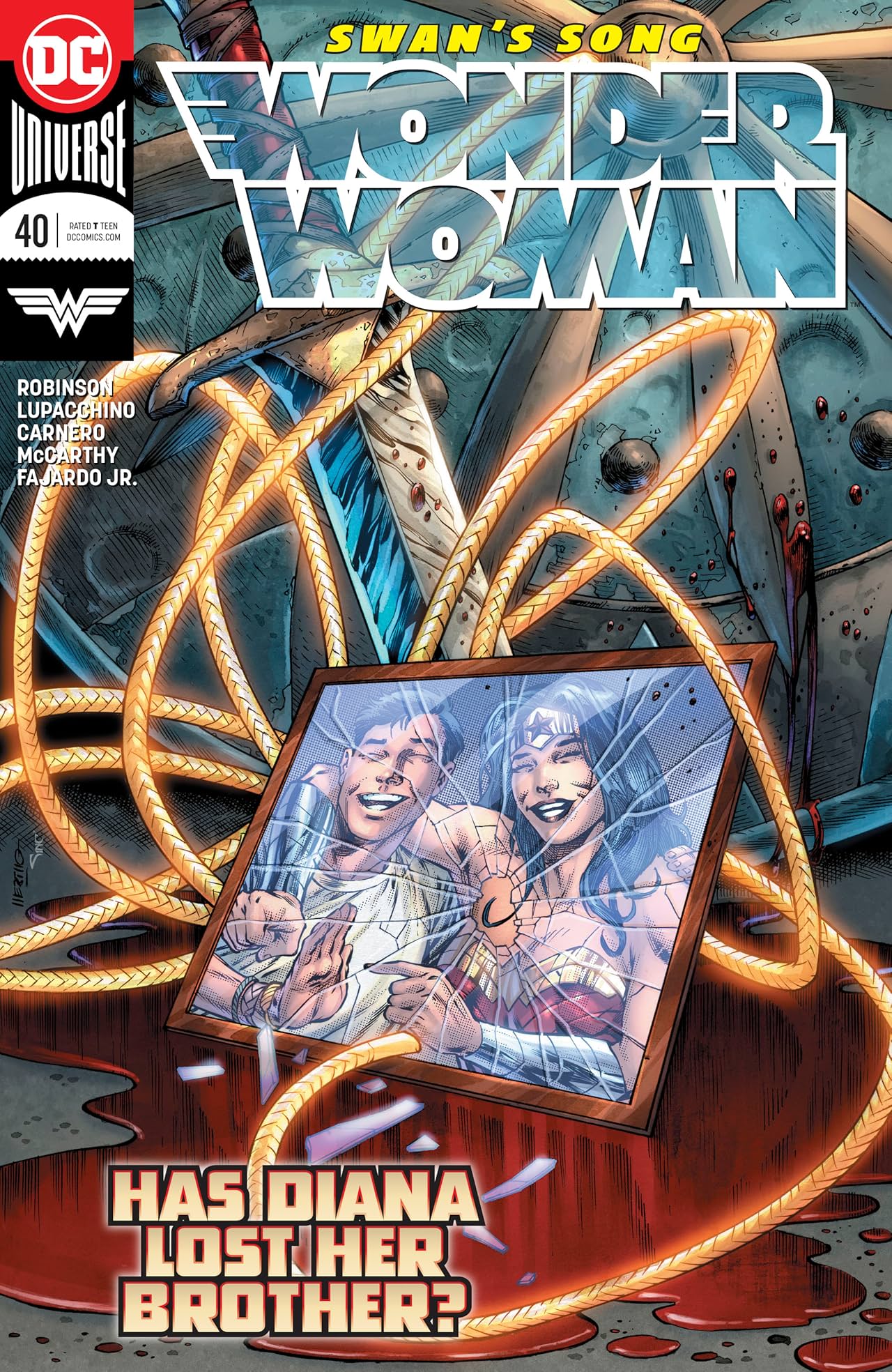
Petty Villains Makes For Shallow Conflict: Wonder Woman #40

The following is my review of Wonder Woman #40, which was posted on PopMatters.com.


There are certain villains who don't need much push to fall into that never-ending cycle of evil, resentment, and constantly seeking new henchmen. Characters like Thanos, Lex Luthor, or Darkseid rarely a lot of motivation to walk that path. They're kind of expected to because they fill a particular role. They're the kind of villains whose existence makes the struggle of the heroes necessary. They provide obstacles that often have to be fought with fists rather than words.

Then, there are the villains who need a much harder push to walk that path. These are the Walter Whites of villains, characters who tried to live an honorable life, but chose a different path when circumstances worked against them. As such, the dynamics driving these characters tend to be more complex. Sometimes, they can be downright erratic because it's not always clear whether such a character qualifies as a villain. When those dynamics are working, though, these kinds of characters can be uniquely compelling.

Most of Wonder Woman's villains don't fall into the category of a Walter White. Historically, her villains involve gods, demigods, mythical monsters, and alien tyrants. The dynamics with those kinds of characters tend to be pretty basic. That's what makes Silver Swan a breath of fresh air in James Robinson's ongoing run in Wonder Woman. She's no demigod or mythical monster, but her conflict with Wonder Woman is uniquely dramatic in that it's so personal.

The story that begins in Wonder Woman #38 takes someone who never showed an inclination towards evil and guides them down that path. Wonder Woman #40 marks the culmination of that journey. It puts Wonder Woman in a difficult position, one in which every punch and every attack she unleashes against Silver Swan is like a jab to the heart. It's one of those battles that's destined to feel like a loss, even when she wins. That kind of inner struggle and tends to bring out the best in Diana.

There are key instances in the story where Wonder Woman demonstrates that unique strength. The path that leads to her showdown with Silver Swan is pretty direct. There aren't many diversions or mysteries to solve. There's no need for Batman's detective skills or a favor from Olympus either. The path to that dramatic clash is pretty straightforward, so much so that there isn't much room for tension. Given Silver Swan's willingness to attack a hospitals and slit throats, particularly the one of the long-lost brother that Diana just reunited with, there isn't much need for it.

Much of the clash and the story around it is fairly basic. Silver Swan's motivations don't include some grand, deranged vision that involves tearing the universe asunder while using the pained cries of her enemies as background music. She just hates Wonder Woman because she feels betrayed by her. Before she becomes Silver Swan, she believes she's Wonder Woman's friend. She draws strength from that as she deals with her own personal issues. Then, when she really needs that friendship, it's not there and that pushes her over the edge.

In terms of the catalyst that turns someone from a friend to an enemy, it's pretty shallow. Silver Swan is no Lex Luthor or Joker. She's no Mole Man either. She never comes off as psychotic or broken. If anything, she comes off as petty, as though she's somehow entitled to Wonder Woman's support during her time of need. She sees her as the emotional equivalent of an Uber driver, someone she can call on to feel strong and loved again. She doesn't seem to realize that Wonder Woman, as a full-fledged member of the Justice League who has to battle alien tyrants and demigods every other week, has a lot on her plate.

This is what makes Silver Swan seem downright petty, even by villain standards. It also makes it hard to see her side things when the battle between her and Wonder Woman finally erupts. Quality villains, even the exceedingly unlikable kind like Lex Luthor and Darkseid, have some sort of grievance to bring to the table that makes their hatred of heroes seem legitimate. Silver Swan primary grievance is that Wonder Woman didn't inconvenience herself enough for her. That makes her difficult to sympathize with, let alone root for.

She still manages to come off as a highly-driven villain that hurts Wonder Woman on an emotional level. That part of the story still carries plenty of dramatic weight and that gives Wonder Woman #40 a sense of depth. However, the impact of that depth is somewhat undermined by how rushed the final battle ends up being. There isn't much time to build the tension. There's still plenty of heartfelt strain, but it ends before anyone needs to catch their breath.

That's somewhat necessary, though, because a good chunk of the story is spent on how Diana's long-lost brother, Jason, is adapting to being part of Wonder Woman's life. That's a compelling story in its own right and while it does make for some colorful moments in previous issues, it's more of a distraction in Wonder Woman #40. Despite being a demigod like Wonder Woman, Jason does more to hinder rather than help his sister's efforts against Silver Swan.

The family drama and the personal drama just don't effectively mix. Given how dramatic and convoluted things can get whenever demigods are involved, that comes off as a missed opportunity. The aftermath of the battle itself also leaves a lot of issues unresolved. While Robinson does plant the seeds of new mysteries and further complications with Jason, it doesn't make for much impact because it contributes so little to the battle against Silver Swan.

On paper, the story surrounding Silver Swan and Wonder Woman's newfound family connections has all the necessary components for a big, dramatic story full of heart, tragedy, and jokes about Zeus' various infidelities. It's an opportunity to create a new villain for Wonder Woman that tests her in ways that make iconic heroes even greater. Just being able to do that without creepy clown makeup is an accomplishment in modern comics.

Unfortunately, the story that culminates in Wonder Woman #40 doesn't make use of those components. The characters and situations are there, but connections and motivations aren't. Silver Swan isn't going to be placed in the same tier as Lex Luthor, the Joker, or even Cheetah anytime soon. Robinson does leave her story open for more development, she has a long way to go before she becomes the kind of villain that deserves Wonder Woman's tears and fists.

Final Score: 5 out of 10

Friday, October 27, 2017

Evil Wonders: Wonder Woman #33

The following is my review of Wonder Woman #33, which was posted on PopMatters.com.


No matter how dysfunctional a family is, there's usually some kind of sentiment binding it together. That sentiment isn't always healthy. Many sitcoms, good and bad alike, are built on that kind of dysfunction. Add gods, demigods, and superheroes to the mix and that dysfunction takes on a level that even the trashiest prime-time sitcom can't match. Wonder Woman's family may not have that kind of dysfunction, but whenever gods and demigods enter the mix, it usually means she'll eventually start punching something.

Wonder Woman's family already has its share of complications, thanks largely to an origins story that is still muddled between clay figurines and Zeus not being able to keep it in his pants again. The events of Darkseid Wars adds another complication in the form of Grail, who is basically the anti-Wonder Woman. As the daughter of Darkseid and a self-professed daddy's girl, she exists to spit on everything Wonder Woman stands for while looking more menacing than any illegitimate offspring that Zeus could ever sire.

Grail is one of those characters who has the potential to be a true nemesis to Wonder Woman. Superman has Lex Luthor. Batman has the Joker. Wonder Woman really doesn't have anyone on that level who isn't a renegade god or demigod. Grail, after taking down the entire Justice League in Darkseid Wars, can challenge Wonder Woman on every conceivable level. Wonder Woman #33 finally puts Grail in that position and James Robinson makes the most of it.

Darkseid War introduced Grail, but offers little insight into who she is and what motivates her. She never comes off as an overly complex character. There's no effort to craft some elaborate story about how she ends up on the path of evil. Her father is Darkseid. Evil is literally in her blood and she doesn't even try to avoid that. She embraces it. Like Lex Luthor and the Joker, she is not in conflict with who she is. She's evil and she's fine with that. That kind of self-awareness may be basic, but it's oddly refreshing in an era where too many villains try to come off as tragic figures.

That simple, streamlined persona helps move the story along. Wonder Woman #33 isn't just about establishing Grail as someone who can battle Wonder Woman without relying entirely on played out themes from Greco-Roman mythology. It's about tying her story into Wonder Woman's world, specifically the ongoing conflict with her long lost brother. Again, Wonder Woman's divine brands of family dysfunction are complicated, but that makes Grail's simplicity all the more appropriate.

Like Wonder Woman, much of Grail's story revolves around her family. She isn't just driven by her dark heritage. She actively works to protect and preserve it. The recent events surrounding Dark Knights: Metal puts Darkseid in a strange, but vulnerable position. After his defeat, he reverts to the form of an infant and it's up to Grail to play the role of mother to her father. It sounds weird, but when Greco-Roman traditions involve multiple instances of incest, infidelity, and unholy unions, it barely raises an eyebrow.


Grail still embraces this role. She never shows any hesitation or reservations about helping Darkseid return to form. She's just like him, wanting nothing more than to spread death and destruction to everything she touches. Even when aiding her father means murdering various demigods, mostly the many illegitimate children of Zeus, she does so without a second thought. She never sees it as evil or inconvenient, for that matter. She's just an evil daughter helping her evil father.

This makes for plenty of brief, but brutal moments that reinforce the extent of Grail's persona. She is evil to the core and that doesn't bother her in the slightest. While this goes a long way towards establishing her as a menacing villain for Wonder Woman, it doesn't make for too compelling a plot. Wonder Woman #33 offers a great many insights into Grail, at least with respect to her role in the ongoing story surrounding Wonder Woman's brother. Beyond that, though, there aren't many complexities or revelations.

The simplicity of Grail's character may help move the story along, but it offers little else, in terms of intrigue. She has a problem, namely her father's nascent state. She has to solve that problem by killing the many demigods that Zeus sired when he kept thinking with the wrong head. She goes about solving that problem with the kind of gratuitous violence that would make any evil father proud. There's not much more to the story beyond that.

There are some characters whose evil nature needs to be belabored every now and then. Grail established during Darkseid Wars that she is not one of them. Anyone who has Darkseid for a father doesn't need that kind of effort. While giving her a defined role in Wonder Woman's ongoing narrative is important, Grail doesn't get much depth beyond that. For her to truly become the Lex Luthor or Joker for Wonder Woman, she needs more than just a desire to help her father.

Wonder Woman #33 still succeeds in exploring Grail, demonstrating just how menacing a threat she can be to anyone she faces, demigod or not. Robinson skillfully guides her into a collision course with Wonder Woman while the artwork of Emanuela Lupacchino provides the necessary brutal imagery to that journey. More than anything else, that journey ensures that any pending clash between Grail and Wonder Woman will carry a lot of dramatic weight.

The family dynamics for both Wonder Woman and Grail, as dysfunctional and divine they may be, create a unique appeal that feels right at home in the bizzare, yet lecherous world of Greco-Roman mythology. Wonder Woman still embodies the higher values that mythos, but Grail is set to embody the worse. The fact she can do all of this without being the bitter offspring of Zeus makes that feat all the more remarkable.

Final Score: 6 out of 10

Thursday, June 1, 2017

Timely Traditions: Cable #1

The following is my review of Cable #1, which was posted on PopMatters.com.


When it comes to time travel, there aren't many superheroes these days that can do it without making fans roll their eyes. As a concept, time travel is overdone, burned out, and utterly devoid of shock value. The days of "Back To The Future" and the lovable eccentricities of Doc Brown are long gone. Stories that involve time travel are about as inane as a stories that involve Superman telling kids to eat their vegetables.

However, there is still one character who can build their story around time travel and make it work. It's not Doc Brown either. It's Cable. He's part Terminator, part Marty McFly, and part Rocky Balboa. He's also friends with Deadpool and willingly works with him on a regular basis. That alone is a testament to his grit and determination.

With a major role in the next Deadpool movie, as well as the star power of Josh Brolin, the time traveling mutant has a lot going for him. With Cable #1, another title in Marvel's ongoing RessurXion effort, James Robinson and Carlos Pacheco try to put Cable on the same wave that Deadpool rode to a wave of popularity. He may never inspire as many Funko figures or cos-play costumes, but he still has so many factors going for him.

The story in Cable #1 takes the core of his character and runs with it. There's no elaborate exposition. There's no major build-up to the plot. It just puts Cable in the middle of a time travel plot and lets him do his thing. Anyone who knows anything about Cable won't be too surprised. They won't be disappointed either. There's time travel, there's big guns, and there's large-scale violence both on and off-panel. By every measure, this is a typical Tuesday for Cable.


In terms of getting back to the core of a particular character, Cable #1 checks the necessary boxes. It doesn't check every box, but it checks the ones that are most important to the core of Cable's character. Robinson doesn't try to reinvent Cable or twist his story in some elaborate way. He sticks to the basics of time travel and big guns, which are the meat and potatoes of every great Cable story.

In terms of the contents of that story, it itself doesn't try to be too iconic. It has Cable doing some time-hopping to find someone who has been sharing futuristic weapons with people and time periods that haven't even mastered indoor plumbing. Anyone who deals with Marvel's twisted timeline is right to be concerned about that sort of thing. Given the absence of the Fantastic Four and the ineptitude of those such as Hank McCoy, Cable is the only one qualified to handle this issue. The substance is there. It's only the portion size that's lacking.

The core concept is there in Cable #1. There's someone screwing with the timeline by giving high-tech guns and swords to cowboys and samurai. That makes for plenty of gun-fights and gratuitous violence, as only Cable can inspire, but there's little context to the story. There's no real clue as to who Cable is after. The only detail revealed is that they think giving people who still see bathing as a luxury is a good idea. Beyond that, there's little else to go on.

That doesn't make Cable's battles any less entertaining. Compared to the plots of a typical Terminator movie, Cable #1 is refreshingly straightforward. There's just too little drama and too little setup to intrigue those who aren't already fans of Cable's time-hopping narratives. Robinson doesn't try to push the envelope and that's understandable. At a time when many other X-men characters are returning to their roots in wake of Inhumans vs. X-men, his efforts in Cable #1 fit the larger narrative. It just doesn't try to push it any further.

For those who don't know much about Cable or his convoluted backstory, complete with clones and techno-organic viruses, they won't see anything too overwhelming. They won't see anything too shocking either. They'll just see a character that specializes in traveling through time, shooting big guns, and getting into big fights. That alone has plenty of entertainment value. However, in a world that still has Deadpool and multiple Wolverine knock-offs, that only goes so far.

There aren't many details of the story in Cable #1 that are clear from the beginning or even the end, for that matter. That's not to say the story is messy or convoluted, though. It is the beginning of a larger story. The ending teases a much larger conflict at hand, one that will require more time travel and more big guns.

That has plenty of appeal to long-time Cable fans, but new readers won't find anything that they can't find in other comics that deal with big guns and gratuitous violence. Given the number of characters that rely on big guns and gratuitous violence, Cable #1 doesn't do much to set itself apart. However, there is still something to be said about a story that can involve cowboys and samurais in the same story.


In the end, the greatest success of Cable #1 is how sticks to the basics and doesn't complicate the narrative. In any story that involves time travel, that in and of itself is an accomplishment. Robinson maintains the core of Cable's character and Pacheco's art ensures that it's visually appealing. The story has the necessary foundation on which to build upon Cable's story. There's nothing in that story that precludes a narrative that becomes an iconic moment in his history. It's a long way towards achieving that level of quality, but it's on the right path.

With a promising future in Deadpool 2, courtesy of Josh Brolin, Cable is one of those characters whose profile is on the rise. Cable #1 puts him at the front of the batting order and shows off the potential of what he can bring to the table. With big guns, a bad attitude, and a blatant disregard for time paradoxes, he has all the tools he needs to be a major player for the X-men. At a time when Hugh Jackman has retired and Deadpool is the new adamantium standard, the timing couldn't be better.

Final Score: 6 out of 10

Friday, December 11, 2015

Redemptions and New Roles: Scarlet Witch #1

The following is my review of Scarlet Witch #1, which was posted on PopMatters.com.


Given enough time, every comic book character ends up needing some form of redemption. It's not all that different from politics. Give the talking heads on TV and radio enough slow news days and they'll find a scandal to exploit. Wanda Maximoff needs no help when it comes to scandals. And while most comic book fans can't agree on the color of the sky, they can probably agree that the Scarlet Witch is in need of some redemption.

But James Robinson is tasked with doing more than a redemption story for Wanda in Scarlet Witch #1. As part of Marvel's post-Secret Wars 8-month skip, Wanda is set to establish a new role for herself. She can't keep being the genocidal, mentally unstable, ex-mutant retcon whose powers act as a never-ending mulligan to Marvel's continuity issues.

At one point, Wanda Maximoff was a respectable member of the Avengers. It seems so long ago, requiring a trip back to an era when the Backstreet Boys were still relevant. Then, the events of Decimation made her entire character revolve around cleaning up the messes that she herself makes. Like the first Hangover movie, her story had its moments. But like the Hangover sequels, it got old fast and the rectons of her origin story didn't help.

Now, more than ever, the Scarlet Witch needs to move forward as a character. The story James Robinson tells in Scarlet Witch #1 makes a solid and long overdue case that Wanda Maximoff has more to offer the Marvel universe besides being a walking retcon device. In fact, this story gives her a new role that she's uniquely qualified to handle. And it's a role that feels pretty vital in a world where demons, goblins, and deals with Mephisto are uncomfortably common.

Whether she fell into it or just embraced it during the 8-month gap, the Scarlet Witch is now the top cop for witchcraft in the Marvel Universe. She's like the Roger Goodell of the mystic arts, minus the obscene salary and having to deal with the Jerry Jones of the world. It's a component of the Marvel Universe that has been poorly explored, despite having a Sorcerer Supreme and a Dr. Doom running around. Robinson makes it a point to establish witchcraft as something unique and his attention to detail would make any Dungeons and Dragons enthusiast proud.

This world of witchcraft is explored in the form of a CSI-style mystery, minus the drug cartels and car bombs. Wanda, with help from the ghost of Agatha Hawkins, explores a series of murders that may or may not have a basis in witchcraft. And it's not long before the importance of the Scarlet Witch's new role becomes apparent quickly. The NYPD has a hard time justifying parking tickets. What hope do they have of responsibly investigating murders caused by witchcraft?

The Scarlet Witch demonstrates both the need for her services and her competence in delivering. She effectively coordinates with the authorities, which is no small feat in a city that has a history of trying to arrest Spider-Man. She also gives the detective involved a crash course in the history of witchcraft. It's not enough to rip off the Wizard of Oz and most Disney movies made before 1980. She has to provide a context for the forces involved and it's a vital context for the story as a whole.

James Robinson puts a great deal of effort into highlighting the unique challenges that come with witchcraft. He makes it a point to ensure that the Scarlet Witch isn't just a female version of Dr. Strange. That story is best left to perverse fan art.

The story Robinson tells in Scarlet Witch #1 establishes a very different set of forces and a very different set of challenges that Wanda must confront. None of them involve Magneto, Dr. Doom, or sexy male androids either. It makes for a wholly new and deeply refreshing narrative for a character who needed it.

There's no team this time for the Scarlet Witch. There's no personality clashes, romantic tensions, or family drama either. While it might be jarring for those used to seeing Wanda butt heads with Hawkeye every other day, it still works because it puts her in a unique role that she and she alone is qualified to handle. Adding someone like Hawkeye to the mix would add comic relief at best and bad Lethal Weapon style jokes at worst.

As adept as the Scarlet Witch is in her new role, the story of her first day on the job in this role isn't going to get anyone's heart racing. This is a story that's heavy on exposition. That's not necessarily a bad thing. Exposition is needed to establish this new role for Wanda and to assure readers that it doesn't involve her having another mental breakdown. However, it does leave little room for action or even that much of a struggle.

Granted, there's only so much struggle that's possible for someone who spits in the face of physics and warps reality like a piece of tin foil. This makes the Scarlet Witch's clash with the mystical creature she uncovers feel somewhat muted. But it's her first day on the job. In the same way a rookie cop can't be expected to take down Pablo Escobar, she can't be expected to sucker punch Mephisto.

While Scarlet Witch #1 is heavy on the details, it succeeds in giving Wanda Maximoff's character exactly what she needs. It's jarring at times, but in a good way. An entire generation of Marvel fans has come to see the Scarlet Witch as a ticking time bomb whose actions usually require a retcon down the line or several. Now, she's here to show that generation that she's not just some walking Deus Ex Machina who looks good in a red dress.

Wanda Maximoff now has something to contribute to the Marvel Universe. She has a unique set of skills to take on a unique set of challenges. In a world that's populated with clones, robots, and aliens, she can forge her own path and not go crazy in the process. Anyone who has ever had to work retail during the holidays can respect that.

Final Score: 7 out of 10

Wednesday, June 23, 2010

Superman #700 - Giant Sized Awesome


Thanks to likes of Blackest Night and Brightest Day my love for DC Comics has been rekindled and my wallet hates me for adding that much more to my weekly comic budget. We're not currently on speaking terms, but I'm not letting that stop me from getting awesome comics like Superman #700. I know I normally don't review Superman comics, but this is a Giant Sized anniversary issue and I just couldn't resist. These kinds of books are like a winning season for the Detroit Lions, rare in it's frequency yet beautiful in it's own right.

The book itself is divided into three self-contained stories. All of them are awesome in their own right, making it a three for one deal that offers more bang for the buck. Your wallet and bank account may just like you a little bit more, although my wallet still hates me. The first story centers around Clark and Lois. Now it may seem strange that the most iconic relationship in the history of comics has been lacking lately, but between Blackest Night and War of the Supermen these two haven't really gotten a lot of screen time. They're long overdue and they get their chance when Lois gets into trouble (as she's so prone to do) with Parasite.


What happens next is classic without being cliched. Superman shows up and saves Lois. I know, some are rolling their eyes because that's what Superman has been doing for nearly a century. My response to them (other than "what the fuck is your problem?") would be this is who these characters are. This age old story of Superman saving Lois is ingrained in their persona and it helps drive their relationship in a unique way that makes it the most iconic in comic history. Add to that, Superman still looks pretty badass when he beats the shit out of guys like Parasite.


After a classic super ass-kicking, Clark and Lois get more personal and this is where the real meat of the story resides. Clark fills Lois in about what happened on New Krypton (read War of the Superman if you're scratching your head) and they have a brief discussion. It's not as cliched as one would expect. These two, like any serious couple who doesn't want to end up in divorce court, don't gloss over these facts and confront them. I know that may seem counter-intuitive to readers raised on the merits of make-up sex, but in the real world and with characters like these confronting these issues is what makes a relationship actually work. Yet to satisfy these twisted notions, Clark and Lois do have an intimate moment.


After some super cuddling, the couple go out for a stroll. And by stroll I mean flying through the sky at speeds that would make most people shit themselves. This is Superman we're talking about. Everything he does is done with super dedication and that includes Lois, who by now should be plenty used to flying over the city as no mere mortal woman ever has. Here they share another moment that is very reflective of their relationship. Lois wants Superman to promise that he'll never leave her again. Now most men when their woman tells them this are obligated to say one thing: "Yes dear. I will never leave you again." Anything less will result in couch banishment for a full year and no sex for possibly longer.

But this is Superman we're dealing with. He's a guy whose righteous to a fault. He can't make a promise he can't keep, even to the woman he loves. He doesn't even flinch. He tells her he can't make that promise. This is why Lois is so right for him. She doesn't just understand. This is a part about him she loves. Many women may find it annoying for a man to be this blunt and morally ridged. But for Lois, for whatever odd tastes she may have, it's the equivalent of a pussy boner. And his response is just what she expected and wanted. If after this you're still cynical about Clark and Lois being the best couple in comic history, then you're just being difficult.


The next story shifts gears a bit, telling a story using the Worlds Finest. For those of you who aren't up to speed with comic lingo, that means Batman/Superman. Only this story isn't a typical Batman/Superman team up. In this story, Robin gets to do the teaming while Bruce Wayne and Batman take a back seat. What happens is Bruce has the standard Wayne Enterprise business he can't miss and Gotham has to go without Batman for the night. Robin is expected to stay home and finish his Geometry homework. But as with any rebellious teenager, he has other plans.


He ventures out on his motorcycle to stop a smuggling ring. There's no Batman to watch his back. He's just a kid in a costume looking to bust some heads. In the context of this story it's pretty predictable what happens next. He's overwhelmed, cornered, and captured by the well-armed smugglers. It seems at this point Robin can't hold his own and the bad guys don't take any chances, knowing Batman won't go down so easily.


But Batman is the least of their worries. As it just so happens, Superman is in town and he lends Robin a hand. He saves him from a concrete slipper and a date with the bottom of the river and makes quick work of the smugglers. Well-armed they may be, but Lex Luthor they are not. They don't stand a chance. Superman takes them out and Commissioner Gordon takes care of the rest.


Now if the story ended here, that would be fairly decent if not sub-par. But there are a few more twists that bring the awesome factor up to par. Not only does Superman fly Robin back home before Bruce can find out, he actually does his geometry homework for him! Seriously, when have you ever heard of a superhero being that cool? That's the kind of hero you don't just admire. That's the kind of hero you'd rather pray to besides some greedy, overly dramatic non-homework-doing super-being in tights. Only Superman can pull it off and it makes for a fun and entertaining end to a story that could have been too bland to mention.


The next story is a bit lighter on the action and much heavier on the drama. It covers Superman being interviewed about what happened with New Krypton by the media. The questions are pretty standard and unlike 99.9999 percent of all politicians and public figures, Superman answers honestly and without hesitation. He even says those three words that no politician is even supposed to think "I don't know." It all seems standard when out of nowhere this woman comes up and slaps him right across the face. No, she's not a super-villain looking to cause trouble. She's a regular woman whose pissed at Big Blue.


Now why is she pissed? It's not because Superman wronged her or lied to her. It's not even because of what happened to New Krypton. She was mad because she just lost her husband to a brain tumor. It seems odd that she would lash out at Superman of all people. He's a guy who fights super-powered monsters, not brain tumors. But that wasn't the point. The point she made was that he wasn't there. He wasn't where he was supposed to be, with the people he was supposed to look after. Some may argue circumstances, but it doesn't make her wrong and Superman knows this.


Superman then flies off, which is sort of his way of saying "no more questions" only in his case the media doesn't give him shit for it. He's clearly affected by what that woman said. He talks to Batman and the Flash about it. He talks about perspective and how they relate to the people they're trying to protect. For a guy who by many measures isn't human, that's an important perspective to have. The events of New Krypton made him forget about that and it's only now he's fully realizing that.


It makes for a fitting and emotional ending to the three stories. It also ties together the after-effects of events like War of the Supermen. It's always easy to gloss over these more personal moments in a story where there aren't giant robots looking to crush everything in their path. It perfectly compliments the first two stories and brings home much of what makes a Superman comic super. It may seem melodramatic to some, but in terms of storytelling it adds to a sense of completion.

In terms of a Giant Sized anniversary issue, Superman #700 can be considered a standard by which all others like it are measured. It's one of those issues where the writers seem to put extra effort. Some might find themselves wishing "why the hell can't they do this with every issue?!" Well that's not how these stories work. They are best told in a certain way and under the right circumstances. Those circumstances just happen to be rare and that's what makes it special. Nobody would give a fuck about Christmas if it happened more than once a year. It's the rarity that makes it special and this comic embodies all of those traits and then some.

Any Superman, DC, or general comic fan would be wise to add this to their collection and frame it for future generations so they know what real awesome entails. This issue gets a 5 out of 5 and every mark of perfection a comic can possibly earn. If DC keeps making comics like this, I'll be needing a much bigger pull list for each Wednesday. Now if you'll excuse me, my wallet and I are going to have another fight. But for awesome like this, it's worth it!