Showing posts with label Hulk. Show all posts

Thursday, May 3, 2018

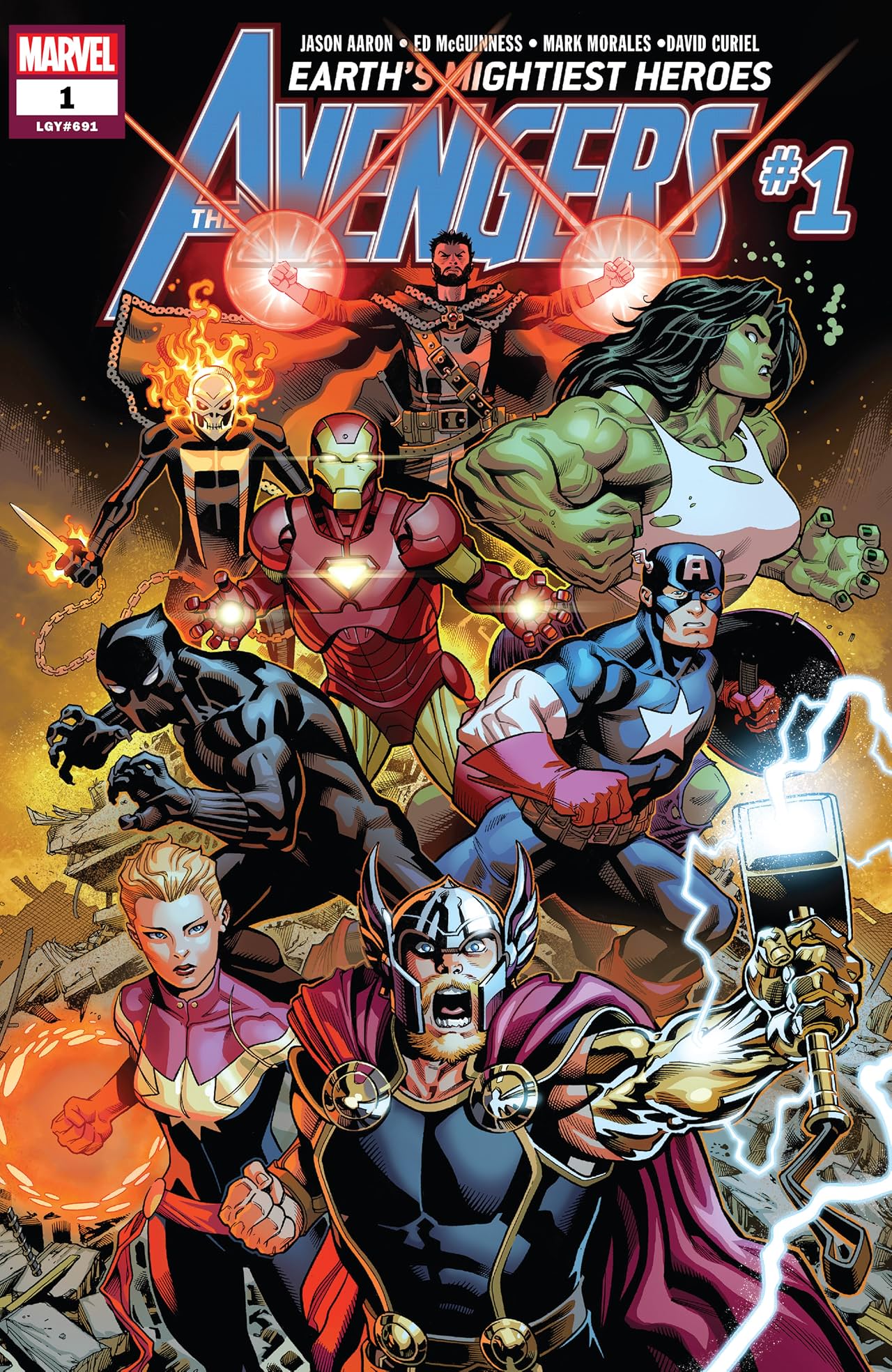
Defending Old School Avenging: Avengers #1

The following is my review of Avengers #1, which was posted on PopMatters.com.


Superhero comics often go through cycles upheavals. There's an accepted status quo that acts as a baseline, of sorts. Then, every once in a while there will be some upheavals that try to shake up the system and introduce new reforms. Some of those reforms stick. Some fail spectacularly. Most just fade into the background. Eventually, though, that familiar status quo returns to maintain the core appeal of a series.

For the Avengers, the traditions established by Thor, Captain America, and Iron Man act as the pillars of Marvel's top-tier heroes. The membership of the team may fluctuate every other week with Wolverine showing up one day while Squirrel Girl shows up another, but the core identity of the Avengers emerges from these three heroes. Every now and then, there's an effort to shake things up by bringing in new characters. No matter who shows up, though, be it a time traveler, a teen prodigy, or a Skrull agent, the Avengers are still built around these three iconic heroes.

In recent years, this core underwent plenty of upheaval with Thor becoming unworthy of Mjolnir, Captain America becoming a Hydra agent, and Tony Stark languishing in a coma. Some of those plots are still controversial and not necessarily for the right reasons. Whatever the controversy, though, it's only ever a matter of time before the Steve Rogers, Tony Stark, and Thor Odinson regain their roles as the Avengers' trinity of heroes.

Jason Aaron, who was behind some of the upheavals, and Ed McGuiness are now tasked with bringing that core back together and moving them forward in Avengers #1. At a time when the Avengers: Infinity War is topping the box office, the stakes are higher than usual for a new Avengers series. There are still lingering scars from the events of Secret Empire and Civil War II. There are also some extenuating circumstances that bring the Avengers together once more.

Despite these strained particulars, though, the stage for is set for the classic core of Avengers to return and Aaron makes good use of it. The events that kept Steve, Tony, and Thor apart aren't ignored. They even acknowledge the sentiment that the world around them is changing, both in terms of world-destroying threats and with respect to the growing diversity among the superhero community. However, even in musing over such changes, this classic trio finds a way to reaffirm that there's still a place for them.

It certainly helps when new threats emerge in the form of dead Celestials falling out of the sky. It's a threat that's not quite as random at it initially seems. This sudden catalyst for such a classic reunion has a basis in the events from Marvel Legacy #1, which introduced the Avengers of 1,000,000 BC. It's a concept that, even within that single issue, hasn't had much impact on anything in the present time to date. Those connections begin to emerge as the Avengers, new and old, begin to assemble.

While it's a refreshing scene, especially to those still recovering from the end of "Avengers: Infinity War," the spectacle is somewhat scattered. Captain America, Iron Man, and Thor are the driving force of the story, but there's also a supporting cast that's caught up in the same plot. That cast includes Black Panther, Dr. Strange, Captain Marvel, She-Hulk, and Ghost Rider. It's a potent mix of heavy hitters and a few emerging stars, but there aren't many opportunities for then to contribute.

They're still in a position to assemble, as Avengers do. Their part in the story, though, is somewhat disconnected from the personal drama going on among Iron Man, Captain America, and Thor. They don't do much to influence the uncertainties that Tony expresses about the future of the Avengers. Those uncertainties are almost as important as the threat of Celestials falling out of the sky, if only because it keeps the story from becoming another generic excuse to get the Avengers to unite.

Avengers #1 doesn't present itself as a simple reunion. Aaron dedicates just as much time discussing the place of the Avengers' old guard in an era where they're shortcomings and vulnerabilities catch up to them more and more. To some extent, their legacy works against them. New threats learn from old threats, adapting and evolving their attacks. They're now at the point where they can make Thor unworthy, turn Captain America into an agent of Hydra, and render Tony Stark comatose.

None of this is lost on the team. At one point, Tony even expresses doubt that he, Steve, and Thor should be the ones to re-assemble the Avengers. That doubt reflects the sentiment that old heroes need to step aside in order for new ones to emerge. It's a sentiment that has fueled a lot of the controversies surrounding these characters, going all the way back to the events of Original Sin.

While the events of Avengers #1 acknowledge that sentiment, it does little to actually address it. Some of that is due to the unavoidable distraction that comes with Celestials showing up out of nowhere, but it still leaves some questions unanswered. The assorted side-plots that put other Avengers in a position to assemble later on do little to help find those answers. One minute, Tony is pondering some important questions that have real implications for the future of the Avengers. The next, he just jumps back into his old role with his fellow Avengers to confront a new threat.

That threat is still intriguing in its own right, thanks to the tie-in with the 1,000,000 BC story line. It also helps that McGuinness' artwork makes it the kind of cosmic spectacle that warrants having these classic heroes take on their iconic poses once more. There are layers to the story and Aaron does plenty to establish the potential for this latest round of upheaval. It even says something about the extent of recent upheavals when it's just refreshing to see classic heroes reunite and feel relatively confident that it's not due to Skrull agents.

Overall, Avengers #1 does plenty to get the Avengers back on track, but doesn't do much to address why they got off track in the first place. There are important conversations to go along with the major events, both in the present and in the distant past. Most of those discussions remain incomplete, but there's still plenty of opportunities to have those discussions, preferably when there aren't dead Celestials lying in in the middle of major cities.

Final Score: 6 out of 10

Thursday, January 18, 2018

Strength In Numbers With Youthful Idealism: Champions #16

The following is my review of Champions #16, which was posted on PopMatters.com.


Any gambler not named Remy Lebeau knows there's a time to fold, a time to double down, and a time to re-evaluate one's bluffing skills. So long as they're not down to their last penny, it's usually wise to know when the odds just aren't favorable anymore. Young superheroes, especially those still in their teenage years, face greater odds than most. At the same time, however, they have the benefit of not being too jaded to throw away their ideals the same way Peter Parker claims to give up being Spider-Man every now and then.

Youth may inspire the kind of wide-eyed optimism that makes most jaded adults roll their eyes. However, that's exactly what makes teams like Champions so endearing. They live in a world where adult superhero teams have waged a civil war on one another twice. They regularly see established heroes like Captain America fall prey to sinister influences like Hydra while villains like Magneto somehow manage to operate with some semblance of credibility. These are some pretty mixed messages, especially for impressionable youth.

Mark Waid and Hamberto Ramos don't shield the members of the Champions from those messages. In fact, confronting those heroic inconsistencies of the modern Marvel universe is a major theme of Champions, as well as a major appeal. This cast of younger, less jaded heroes want to cling to those superhero ideals that seemed to go out of style since the Frank Miller era. The world around them isn't making that easy. If anything, that world keeps upping its bets and skewing the odds.  

Champions #16 has these idealistic young heroes respond by having them go on a recruitment run. Considering the events of previous issues, which included crossovers and clashes with the far less idealistic adult Avengers, it comes off as strange, if not too soon. From the perspective of young, teenage heroes who cling ardently to their idealism, though, it makes perfect sense. Tragedy and drama may hit adults and teenagers equally hard, but teenagers will often find more creative ways of dealing with it. Those ways aren't always healthy or rational, but that's exactly what makes them endearing.

The tragedy and drama in this case has to do with the recent upheavals surrounding Viv Vision. Even by advanced android standards, she's in a strange position. After the Champions and Avengers' recent clash with the High Evolutionary, there are now two versions of her, one human and one android. It's an identity crisis that's unprecedented, even in a world full of clones and shape-shifting aliens. Neither version is able to make sense of the situation. Viv's teammates don't fare much better.

There's now a sense in Champions that the team is more vulnerable than it was when it began. It's not just because one of their members is a time traveler who could trigger a paradox with one bad decision. The events surrounding Viv painfully demonstrate that there are times when the team becomes fractured. There are moments when personal dramas hinder the team's ability to function. It's a problem adults face too, but adults are more inclined to stick with what works and preserve the past. Teenagers, not having much of a past to begin with, look to the future.


That's the underlying theme of the narrative that Waid crafts in Champions #16 and Ramos' colorful visuals make it feel optimistic, despite the dramatic circumstances. Despite the seriousness of these circumstances, Waid preserves the light-hearted, upbeat tone that gives Champions much of its appeal. Throughout the story, the fact that these are still teenagers never becomes lost. They see what happens to their friend. They don't make light of it, but they still move forward.

That part of the story works to the extent that it lays the foundation for more interactions between the Champions and other young heroes. While Viv heals, their recruiting run leads them to cross paths with the likes of Moon Girl, Red Locust, Iron Heart, and Patriot. Some of these characters have crossed paths with the Champions before. Like the Champions, though, they respond to the message because they too lack the jaded mentality that plagues older heroes.

It's a golden opportunity for young heroes to come together and remind older heroes that there's still room for the kind of wide-eyed idealism that most superheroes lose in their first year. Unfortunately, little of that opportunity is realized in Champions #16. The recruitment run does get off to a good start, but there's not much depth beyond just interacting with other young heroes. Some, like those with Moon Girl, fit the spirit and character of the story. Others, like the moments with Iron Heart, don't really contribute much.

That lack of depth is partially due to the unfolding side-plot surrounding Viv. In many respects, this plot carries with it much heavier drama. Viv's identity crisis and sense of self are in flux. There's a lot of internal conflict that plays out in between interactions with her android self and Vision. Some of it still echoes with the kind of teenage melodrama that is so distinct of Champions. Most of it, though, comes off as detached narration.

The intent is clear throughout the story, both with Viv Vision and the Champions' recruitment drive. It's the execution that leaves much to be desired. Both elements of the story have the right dynamics, but both end up feeling incomplete. It gives the impression that the story needed to be at least twice as longer for the necessary elements to play out. It makes Champions #16 feel somewhat truncated, even if the potential is still there.

The idealism and appeal of Champions never wanes, even in light of major upheavals, both personal and circumstantial. That remains one of the greatest strengths of the series. It's realizing the potential of the various plots and sub-plots that keep it from having the kind of impact that teenagers and adults alike can appreciate. Even if both are destined to end up jaded, the appeal of the idealism espoused by young heroes remains as strong as ever.

Final Score: 5 out of 10

Thursday, August 31, 2017

Rising, Falling, and Rebuilding: Secret Empire #10

The following is my review of Secret Empire #10, which was posted on PopMatters.com.


The dramatic rise and spectacular fall of an empire is one of those rare narratives that can be just as dramatic in real life as it is in fiction. From the Ancient Rome to Star Wars, the story behind an empire has an undeniable impact on the human psyche, as well as the annuls of history. Every empire is unique in how it rises, grows, prospers, and falls. Sometimes it plays out over the course of centuries. Sometimes it happens over the course of a few decades. Marvel, with its ever-changing landscape, tries to squeeze that story into ten comic books.

Given the scope of empires, as a concept, that's pretty daunting for anyone not equipped with Reed Richards' mind or Tony Stark's gadgets. Nick Spencer and Steve McNieven may not have such resources, but they've made every moment count in Secret Empire. It's a story that taps into real world fears about powerful individuals seizing power and imposing tyranny under the guise of order. It evokes all sorts of passions, reservations, and arguments on message boards. That alone is a testament to the scope and scale that empires carry, as a story.

Secret Empire is not just about Hydra taking over the world. It's not just about Captain America betraying the Avengers either, although that is the emotional gut punch that makes it so controversial. These elements feed into that larger narrative of an empire coming to power, taking advantage of a vulnerable moment in time and trying to shape the course of history. The ascension of Hydra and Captain America into this position is established. Now, the downfall is underway.

For nine issues, the story sets up various plot-lines that lead to numerous skirmishes. It's not an exhibition game anymore. Both sides are carrying themselves like a couple prize fighters entering the last round. They each bear the scars of all the blows they've taken. They make clear that there will be no judges decision. One of them is going to get knocked out. It's just a matter of who can land the finishing blow. In Secret Empire #10, that blow finally lands with an impact that has both huge reverberations and major implications.

The rise of Hydra and the Hydra-affiliated Steve Rogers centers around reality-warping power capable of making good into evil, right into wrong, and making Deadpool less annoying. Any story that builds itself around that kind of power risks going too far and needing more reality-warping power to fix. It goes beyond resorting to another Deus Ex Machina, especially when that same device is used to set everything up in the first place.

Spencer sets up from the beginning of Secret Empire that a certain amount of warping will be necessary to resolve the story. There's just no way an empire as large as Hydra's can rise, fall, and leave a meaningful impact within ten issues of a series. The biggest risk any story takes in attempting to tell a story within these constraints is rendering reality a messy ball of mud that gets molded and remolded on a whim.

For the most part, the story strikes an appropriate balance between confronting the reality-warping forces behind the story and using them to defeat Hydra. Those involved in delivering that final blow even throw in some Loki-level cunning. It isn't just a matter of all the heroes gathering in one place and collectively beating up an over-powered villain. The Hydra-affiliated Steve Rogers is not Onslaught, Thanos, or some cosmic space god. He's someone with which every hero in the Marvel universe has an emotional connection.

It's that connection that makes the very concept of Steve Rogers becoming a fascist feel so untenable to begin with. That's like making Frank Castle the Kingin or Emma Frost a nun. It's so utterly antithetical to the core of the character that it just feels wrong for everyone involved. In a sense, both the characters in the story and those who know Captain America as the ultimate enemy of fascism are on the same page, in terms of emotional overtones. Nobody reading or participating in the story can accept a reality where Steve Rogers is, and always has been, a fascist.

By the end of Secret Empire #10, that untenable feeling is still there, to some extent. While the story does end up having to warp and re-warp reality to some extent, it stops short of completely undoing everything the Cosmic Cube changed. Certain characters stay dead. Certain places remain destroyed. Steve Rogers isn't the ultimate fascist anymore. A good chunk of the story, along with the best aspects of McNieven's art, is spent giving Rogers a chance to literally attack the fascist monster that Hydra created. While it's as satisfying as it often is when a fascist gets defeated, some of those feelings still linger.

Even though Secret Empire #10 crafts as concise a conclusion it can, given the cosmic forces involved, it still carries a distressing sentiment that may plague Captain America fans the same way the Clone Saga plagues Spider-Man fans. Regardless of the details, it's impossible to get around that Steve Rogers became a fascist. It doesn't matter that cosmic forces were involved. The very concept that such a story is even possible and a character must move forward with that kind of burden just evokes too many conflicting feelings.

The overall structure of the story still works with respect to showing the rise and fall of Hydra's empire. Secret Empire #10 even helps streamline some of the confusing, disjointed elements that are scattered throughout the previous nine issues. However, the manner in which it ends, the feelings surrounding it, and the prospect of moving forward from such a reality-shattering event are still mixed. It doesn't help that too much is narrated and too little is said in the end. It also doesn't help that some of the side-plots in the story don't connect as strongly to others and don't add to the overall impact.

These details, however, don't take too much away from the bigger picture surrounding Secret Empire. Spencer still succeeds at striking the necessary balance that's so hard to achieve when crafting a story that requires a complete deconstruction and subsequent reconstruction of the space-time continuum. That, in and of itself, is an accomplishment.

That accomplishment, however, will be forever lost in the stigma that Secret Empire will inevitably carry. While it might not be on the same level as the original Clone Saga, it will still be the story in which Marvel makes Captain America a fascist. It doesn't matter if someone makes a deal with Mephisto to ensure everyone in the Marvel universe forgets about it entirely. The fact it's still a story that got told in the first place, striking all the wrong emotional chords in the process, will plague it for the foreseeable future. If every fallen empire seeks to leave its mark, then Hydra definitely leaves theirs, albeit not for the reasons they probably intended.

Final Score: 7 out of 10

Thursday, August 3, 2017

Anger Across The Ages: Generations: Banner Hulk & Totally Awesome Hulk #1

The following is my review of Generations: Banner Hulk and Totally Awesome Hulk #1, which was posted on PopMatters.com.


There are few constants in the ever-evolving, constantly-retconning narrative that is the Marvel universe. Costumes may change. Marriages may be undone by deals with Mephisto. Characters may turn out to be from an alternate universe, a Skrull agent, or evil clones of characters that died years ago. The fact that anyone can accept that kind of convoluted continuity with a straight face is a miracle, in and of itself. That makes the constants that remain all the more important and few are as memorable or iconic as the Hulk's anger.

His enemies may not like it when he's angry, but the Hulk's destructive rage makes for some of the best entertainment that the Marvel universe can offer. That anger, as blinding as it can be sometimes, takes many forms over the course of the Hulk's illustrious life. The rage that begins under Stan Lee's legendary pen is not the same as the one that continues under Greg Pak. That's what makes the concept of mixing the past and present so intriguing. That's the premise behind the Marvel Generations series. That's how the rage of one Hulk meets the rage of another in Generations: Banner Hulk and Totally Awesome Hulk #1.

In terms of context, the differences between Bruce Banner and Amadeus Cho are considerable. While both carry the burden of the Hulk, the weight of that burden is different for both characters. The death of Bruce Banner in Civil War II and the emergence of Amadeus Cho in Totally Awesome Hulk puts both characters on a different path. Pak, with the skilled art of Matteo Buffagni, brings those paths together in a story of shared anger.

The premise of the story is somewhat unclear. The mechanism by which Cho ends up in the past, confronting the Hulk during one of his earliest clashes with General Ross, is not overtly explained. Cho is in the present one moment. Then, he's in the past. That's the extent of the explanation.

That's not to say it's wholly contrived. In a world routinely driven by reality-bending hardware like the Cosmic Cube, the Infinity Gauntlet, and editorial mandates, it's not that much of a stretch that Cho would find himself unexpectedly in the past. That sounds like the sort of thing that happens to anyone who hangs out with Cable too much.

The lack of a premise does little to undermine the gamma-powered action, though. Pak doesn't waste any time giving Hulks from two different eras to start smashing something. He understands that if there are going to be two hulks in a story, then there needs to be twice the smashing. Generations: Banner Hulk and Totally Awesome Hulk #1 does plenty to fill that quota. Buffagni also does plenty to give it the distinct visual elements that make a Hulk story stand out. There are open spaces, raging monsters, and hard-nosed old men trying to solve problems by blowing them up.

In terms of checking the boxes for a classic Hulk story, Generations: Banner Hulk and Totally Awesome Hulk #1 covers most of the basics. However, the boxes it doesn't check are arguably the most important and that represents the most significant flaw in a story that otherwise has ample entertainment value. It's not enough to just have two Hulks smashing things. That's all well and good, but smashing without any greater meaning or drama behind it is just empty smashing. Even with the Hulk, that kind of smashing only goes so far.

 
It's when Cho and Bruce Banner aren't bulky green behemoths where the story really stalls. There's some initial confusion, as is to be expected whenever someone not named Dr. Doom warps time and space. Then, they start interacting, but not much comes of it. They try to avoid General Ross. They attempt to conceal themselves in populated areas. They even talk about their respective struggles to control the Hulk and the rage that drives him.

However, not much really comes from those conversations. Cho and Banner don't tell each other anything that they don't already know about themselves or the Hulk. There's not much dramatic impact in anything they do. Cho barely references the Hulk's future death in Civil War II, nor does he show much emotion when interacting with Banner. Given their history and their various connections throughout the Hulk's mythos, it feels downright muted.

There's still an underlying theme. There's still a sense of connection between Amadeus Cho's version of the Hulk and Bruce Banner's version. Concepts of anger, burdens, and dealing with inner monsters are all there. There's just no melodrama behind it. It may as well be an unnecessary reminder. Anyone who reads a Hulk comic from any era will get that same message, albeit with different varieties of smashing.

There's nothing about the narrative in Generations: Banner Hulk and Totally Awesome Hulk #1 that's out of place in terms of characterization, plot, or style. Both Banner and Cho get a chance to be their own Hulk. Pak, whose Hulk pedigree is beyond dispute, handles both characters as well as he has in previous efforts. Buffagni's artwork helps supplement those efforts. That's what makes the utter lack of impact so glaring and for a character who specializes in smashing, that's saying a lot.

Mixing elements from the past and present creates opportunities to explore classic themes while expanding on the dramatic weight that has built up to such a massive extent over the years. Generations: Banner Hulk and Totally Awesome Hulk #1 feels like one of those opportunities that was only partially realized. It does enough to smash all the right things. It just doesn't add enough merit behind the smashing.

Final Score: 5 out of 10

Friday, June 23, 2017

A Familiar and Weaponized Narrative: Weapons of Mutant Destruction #1

The following is my review of Weapons of Mutant Destruction #1, which was posted on PopMatters.com.


There are some ideas that are just so wrought with failure that the mere act of entertaining them again is akin to giving Deadpool an unlimited supply of napalm. It's one thing to revamp and reconsider a failed idea. Sometimes, ideas are just too ahead of their time or not properly managed. Others, however, are akin to fixing a cracked windshield with a sledgehammer.

When it comes to ideas that fail in the most spectacularly destructive ways possible, the Weapon X program and the gamma experiments that made the Incredible Hulk are basically co-champions. These are experiments with simple, albeit devious goals. One seeks to create the ultimate living weapon. The other seeks to create an unstoppable monster that can be controlled and directed like a bomb that never stops going off.

They are weapons that anyone, be they the Avengers or Hydra, wouldn't mind having in their arsenal. When it comes to developing them, however, there sheer breadth of the failures are so staggering that even the most deranged James Bond villain wouldn't dare attempt them again. Even with the combined efforts of the Scarlet Witch and every good luck charm that ever existed, the odds just aren't in anyone's favor.

That's why the premise for Weapons of Mutant Destruction is akin to waiting for a demolition derby where every car is armed with a machine gun and a rocket launcher. Weapon X and all things gamma related have done enough damage to the Marvel universe to buy Hulkbuster armor for every man, woman, and child. Greg Pak and Mahmud Asrar believe there's still plenty of entertainment value in that level of destruction. Weapons of Mutant Destruction #1 shows that even if that value is there, making it compelling is a challenge that even heavy doses of gamma can't help.


The foundation of the story is built on ongoing stories unfolding in two of Pak's other books, Weapon X and Totally Awesome Hulk. From a structural standpoint, the transition is seamless. A narrative that begins in Weapon X #1 starts to culminate in Weapons of Mutant Destruction #1. The key, with respect to the actual substance of the story, is that the culmination only starts. It just doesn't go very far. It's akin to a drag racer that makes a lot of noise, but stalls just as the race commences.

That's not to say the ingredients are there. Pak makes it a point to give the conflict in Weapons of Mutant Destruction #1 larger implications that go beyond his own books. Mutant-killing living weapons, as overdone as they may be, still pose an existential threat to the rest of the X-men. The use of gamma power poses a similar threat to anyone still affiliated with the Hulk. Every character involved has a purpose and a clear motivation in the story. Nobody ever gets involved in a living weapons program for fun. Even Deadpool isn't that deranged.

As the story unfolds, though, there's a sense that it's trying to avoid the familiar tropes associated with conflicts built around living weapons. There's a lot of exposition, not all of which is necessary. There are some mystery elements, which are organic extensions of the events unfolding in Weapon X. However, the very fact they involve living weapons somewhat limits the mystery.

The obscenely poor and exceedingly violent track record of living weapons programs in Marvel Comics doesn't hint at any major twist. In an era where Skrull agents and Hydra agents are overused, twists like that are limited in terms of impact. There's never a sense that Weapons of Mutant Destruction is going to break new ground. It has mutant-killing cyborgs and gamma-powered monsters. For both the X-men and the Hulk, these kinds of stories are aren't exactly as rare as adamantium.

Even though the story has many familiar elements, Pak does manage to mix in some unique details along the way. Teaming Amadeus Cho up with the likes of Old Man Logan, Sabretooth, and Lady Deathstrike adds some much-needed novelty to the story. Unlike Bruce Banner, Cho is less experienced with smashing mutant-killing machines. At the very least, though, Pak gives him plenty of incentive to learn quickly and not hesitate.


At one point, Cho is a little disturbed at the brutality of living weapons programs. Considering how Lady Deathstrike and Old Man Logan barely bat an eye, that's pretty revealing in terms of how common these stories are and how inexperienced Cho still is as the Hulk. From his perspective, fighting mutant killing machines isn't something he does every other Monday like the X-men. His role creates some new dynamics that help make the story feel fresh to a limited extent.

That extent still isn't enough to make Weapons of Mutant Destruction more than the latest in a long line of living weapons programs that need to be smashed and/or stabbed with adamantium claws. The story's reliance on exposition, as well as its slow pace, isn't going to make anyone hulk out. With the way the events plays out, the story acts more as a teaser rather than a culmination. That kind of structure works when a story is breaking new ground. It doesn't work quite as well when it's relying on the kind of living weapons tropes that have played out any number of ways since the disco era.

The concept of Weapons of Mutant Destruction is still sound. The story is, by no means, bereft of value. By most measures, Pak's handling of the story is competent and concise. The characters are spot on and the plot never gets too convoluted. Asrar's artwork complements these efforts as well, creating the kinds of dark, sinister undertones that are to be expected with any story involving living weapons or anyone who has ever had to deal with Lady Deathstrike and Sabretooth.

There's something to be said about a story that's so familiar that nothing short of clowns and Cosmic Cubes can make it feel novel. The concept of living weapons in the Marvel Universe is still one that will make anyone who has ever had to clean up blood stains roll their eyes. It can still make for a fun story though. Like a cold beer for Wolverine, it's a familiar and comforting experience. There will always be a place for stories like that in Marvel.

Final Score: 5 out of 10

Thursday, March 2, 2017

Aspirations For Inspiration: Champions #6

The following is my review of Champions #6, which was posted on PopMatters.com.


Seeking to inspire others to do good is one of the most fundamental acts of heroism that any superhero can do. Superman inspires by embodying an ideal for humanity to aspire towards. Captain America inspires by embodying the patriotic spirit that emboldens and strengthens an entire nation. Deadpool inspires by embodying the power of tacos and machine guns. These are among the most basic traits of a hero and after Civil War II, the entire Marvel universe needs a refresher course.

That's what Mark Waid and Hamberto Ramos are doing with Champions, getting back to basic and showing the rest of Marvel's superhero community that there are better ways to do good and they don't require superhero civil wars. Ms. Marvel, Nova, Spider-Man, Cyclops, Hulk, and Viv Vision are all uniquely qualified to teach this lesson in that they're young, idealistic, and haven't been revealed as Skrulls or Hydra agents yet. Beyond being diverse, coming from many different backgrounds and even different time periods, they are essentially a disaffected generation that sees what's happening with established heroes and think there's room for improvement.

It's a common spirit that pervades inexperienced youth. They see the flaws of the older generation and think they can do better, but the cast of Champions accomplish much more than any hippie protest or online petition. They embody a spirit often gets muted by politics, bureaucracy, or one too many retcons. This eclectic cast of young heroes aren't quite that jaded just yet, if only because they haven't dealt with SHIELD or Maria Hill enough.

The first several issues of Champions show this diverse cast coming together and establishing a standard for how they conduct themselves as heroes. That standard proves quite effective, leading to some meaningful victories and a kiss involving the Hulk. However, as often happens with many efforts involving ambitious youth, they encounter a few challenges and Champions #6 establishes the scope of those challenges, complete with relevant social commentary.

Now it's debatable how important these undertones are to the underlying themes of the series. There are any number of rants, tirades, and bemoaning that can be levied against a series that unambiguously reflects a particular political affiliation. Any comic that risks being vocal about any relevant issue risks agitating a world that would turn Superman into a Nazi if he says the wrong thing in the wrong context. That's the power of hashtags, phony outrage, and too much free time.

Regardless of how anyone may feel about social commentary in a comic book, Champions #6 shows that a certain level of social appeal can go a long way. Waid and Ramos make it a point to show how the Champions have influenced the world as a whole. They demonstrate how the Champions have created an entire social movement for all the right reasons with all the right impacts.


The Champions aren't just saving the day from monsters, human traffickers, and internet trolls. They're inspiring others to get up, embrace the Champion's principles, and do something. Given how much it takes to drag people away from their cell phones and jobs, that's quite an accomplishment.

Given how detached other superhero teams have become from the people at large, such an impact carries a great deal of weight for the greater Marvel universe. If a bunch of teenagers, one of which is a robot and another of which is a time traveler, can have this kind of positive impact, then those with helicarriers and space stations have no excuse.

Beyond that impact, though, the story in Champions #6 is just as much about the unintended backlash to this new superhero team as it is their success. The team is still coming together and Waid gives them a chance to show that they're still teenagers in addition to being heroes. Having them train through a game of paintball makes for a fun, light-hearted tone that even those who whine about the book's social commentary can appreciate.

From the perspective of the larger narrative, this kind of team activity doesn't raise the stakes or heighten the drama. However, it does flesh out the various personalities on the team and shows how they interact. Despite the diversity, they function as well as any group of teenagers armed with superpowers and paintball guns. They're not necessarily a dysfunctional family, but they're not the Fantastic Four either.

Those more light-hearted elements get balanced out when Waid explores the first major backlash that the Champions inspire. Such a backlash is always bound to happen and most teenagers have to learn the hard way that no good deed goes unpunished in the real world. In this case, the punishment hardly fits the deed because the Champions have no way of knowing how those with greater authority than a bunch of teenagers opt to react to their impact.

This is where the Freelancers come in. They are, in essence, the counter-punch to the movement that Champions have inspired. Much of Champions #6 involves introducing this team and establishing how they're going to undermine everything the Champions have accomplished. Like the Champions, they're a bunch of jaded teenagers with superpowers. Unlike the Champions, however, they care less about social commentary and more about their bank statement.

Waid reveals this in a somewhat elaborate manner. At first, the Freelancers give the impression that they're just a bit less ethical than the Champions. By the end, though, they make clear that they'll gladly rub elbows with big oil companies, Hydra agents, and tobacco lobbyists to improve their living standards. They care less about being a hero and more about making the most money with the least amount of effort and/or ethical constraints.


In the context of the major themes surrounding Champions, the Freelancers are the perfect adversaries. Waid makes this abundantly clear in Champions #6. However, this clarity doesn't come with any larger plot developments. A paintball game of super-powered teenagers is fun, but does little to expand their story. The only ones who get any real progression are the Freelancers and while their mission is fairly clear, their respective personalities are under-developed and overly forgettable.

Champions #6 still accomplishes and important feat for the greater narrative. It establishes what the Champions are up against and how their new movement of less civil wars and more heroics is creating an impact. Waid and Ramos to mix that impact with the fun of a paintball game. While the entertainment value of paintball is beyond dispute, the larger implications of the Champions' story remains underdeveloped and unresolved.

Final Score: 6 out of 10

Tuesday, August 23, 2016

Requiem For The Green Goliath: Civil War II: The Fallen #1

The following is my review of Civil War II: The Fallen #1, which was posted on PopMatters.com.


What makes a defining moment so defining has little to do with the immediate impact it has on a story. That impact may be intense and memorable by every objective measure, but it's often just a prelude to the much larger conflicts that it inspires. Whether it's Doomsday killing Superman, the Joker crippling Barbara Gordon, or Tony Stark taking his first shot of tequila, these moments only become defining when that larger conflict takes shape.

Without question, the death of Bruce Banner is the defining moment for Civil War II. The impact of this moment creates the catalyst for the real meat of the story. After this moment, the lines are drawn, the divisions are set, and the hearts of Marvel's greatest heroes are pulled in opposite directions. It's the last straw for Tony Stark. It's that painful moment of clarity that only admitted alcoholics can appreciate.

There's no question that the death of the Hulk lit the match that ignited the powder keg that is Civil War II. However, in the midst of this raging inferno, it's easy to overlook the personal impact of the Hulk's death. Bruce Banner dies surrounded by friends and former teammates who knew him as more than just the oversized brute with anger-management issues.

That sentiment is understandably sidelined by the larger conflict in Civil War II, but Greg Pak and Mark Bagley attempt to explore that sentiment in Civil War II: The Fallen #1. That sentiment proves vital to delivering the dramatic impact of the Bruce Banner's death. It takes a step back from the legal, philosophical, and ethical debate surrounding proactive punishment and focuses solely on the emotions surrounding those closest to Hulk and Bruce Banner. There's nothing that'll overwhelm a message board here. There's just raw, genuine drama surrounding the death of a beloved friend.

There are no monster battles. There are no alien invasions. There are no homages to Bill Bixby walking solemnly down a highway. Civil War II: The Fallen #1 deals solely with the reactions among Bruce Banner's friends and family. Those reactions are not divorced from the larger context of Civil War II, but they are secondary. The primary focused here is the mixed legacy the Hulk leaves behind.


The bitter part of that mixture plays out at Bruce Banner's funeral. Whereas Bruce's friends and fellow heroes are on hand to honor his memory, there are plenty of protesters as well who still condemn the Hulk in death. This is an important context to include because it highlights the unique dimensions of the Hulk. It's a big part of what makes him unique among heroes. Plenty of heroes have green skin and big muscles. Few deal with the kinds of complications that the Hulk deals with, even when he isn't angry.

It's easy to forget that the Hulk's rampages can be pretty destructive. Given the enemies he deals with, his battles incur more collateral damage than most. In a world that includes shape-shifting aliens, uncontrollable mutant powers, and helicarrier that crash every other week, that's saying something. Unlike those destructive elements though, the Hulk is a singular face on which people can focus their blame. As any minority, real or fictional, can attest, it doesn't take much blame to inspire outrage.

Despite this outrage, Bruce Banner spends his life trying to make the Hulk a force for good. Those are the efforts that his friends and family honor. Throughout Civil War II: The Fallen #1, the darker parts of his legacy aren't ignored. Instead, they are seen in context, which isn't easy to do with a rampaging monster. It's a testament to Banner's efforts and it nicely highlights the sentiment of every character involved.

However, the funeral of Bruce Banner isn't what gives Civil War II: The Fallen #1 the bulk of its dramatic weight. It's the living will that Bruce shares with his friends and family after death that evoke the most emotion. It doesn't just involve his assets, his work, or his acknowledgement that his anger management skills had room for improvement. It involves creating a legacy that appropriately embodies the impact of the Hulk. Naturally, it has to do with anger.

It all comes back to anger and how to deal with it. For most people, including Hulk's own friends and family, dealing with anger doesn't result in the same consequences or collateral damage as him. As a result, he has to work harder than most. That means he has to master anger management techniques that cannot be found in self-help books or overpriced seminars. His efforts to share this mastery, as imperfect it may be, acts as his greatest legacy as the Hulk.

It's fitting in so many ways. How many problems in the real world and comic book world could be solved if people just managed their anger better? How many battles would that avoid? How many buildings would go un-smashed? It's the best legacy that Bruce Banner could've left. However, it resonates with some more than others.


As fitting and heartfelt as Bruce Banner's final testament may be, there are those who need more than better anger management skills. Amadeus Cho, who Pak is developing in Totally Awesome Hulk, does not take time to grieve like so many of Hulk's friends. For him, the sentiment in Civil War II: The Fallen #1 is hollow at best. He sees what happened to Bruce Banner as an injustice and that just makes him too angry.

Cho's reaction, as well as the reaction of others like General Ross, are somewhat muted at times. There are some inconsistencies in the narrative and with certain characterizations, but the underlying sentiment is spot on. The tone in Civil War II: The Fallen #1 is solemn, but appropriate. Pak and Bagley craft a fitting, heartfelt sendoff to the Green Goliath. For once, anger takes a back seat to a Hulk story and it works, creating far less collateral damage in the process.

Final Score: 8 out of 10

Thursday, May 21, 2015

Scanned Thoughts: Secret Wars Battleworld #1


I imagine that when the world ends, I’ll either be in a bar or sitting naked in my bathtub with a bottle of whiskey in both hands. I don’t think that everyone in the Marvel universe thought that far ahead after the events of Secret Wars. They tried and failed to stop the final incursion between their world and the rotting corpse that is Ultimate Marvel. But the end of the world doesn’t mean the end of the story. The Disney overlords who aren’t content swimming in a pool of Age of Ultron money will never allow that.

With the entire Marvel universe in ruin, only Battleworld remains. This creates the kind of fucked up setting that is usually only found in a Stanley Kubrick movie. It’s like Marvel took a drunk off the streets, pumped him with tequila and meth, and had him chop up random bits of various Marvel universes into a singular clusterfuck of a world. Seeing as how I blacked out for two days and woke up in a ditch in New Orleans last weekend, I have my suspicions. But in this singular clusterfuck, there are characters from multiple worlds coming together to explore this new world. Secret Wars Battleworld #1 offers a taste of what we can expect in this singular clusterfuck of a world. Since the tequila and meth are now out of my system, I’m ready to give a fair assessment.

It goes without saying that there are a lot of fucked up versions of characters that were fucked up to begin with. I won’t say Frank Castle is the most fucked up in the Marvel Universe, not by a long shot. But he’s still a man who needs more therapy than an army of Dr. Phils. But in one nook of Battleworld, there’s a version of him whose body and soul got hijacked by Dr. Strange. In his defense, he was battling an army of vampires and not the ones that sparkle either. It still sucks for Castle, which is probably why he decided to give the finger to Dr. Droom’s rules about staying within your own damn fucked up AU. There’s not a whole lot of background info given on him or his world, but it’s just enough to make this story function without the aid of LSD.


Whatever his story or the reasons for being stuck with Dr. Strange, Frank Castle is still a guy who tends not to give a shit about draconian laws, even if they’re passed down by a unholy uber-powerful Dr. Doom. As a result, he gets a visit from a team of familiar faces representing Dr. Doom’s version of mall cops. This includes the Hulk, Wolverine, Spider-Man, and Ghost Rider. With a team like this, Paul Blart might have actually been a watchable movie. They basically tell him that he’s been crossing borders and in Dr. Doom’s world, that’s like punching the President in the dick.


This sorcerer Punisher doesn’t have a spell that allows him to punch Dr. Doom in the dick, but he does have spells that make for a pretty awesome fight. He can still conjure guns. He can still channel his inner Rambo. But having the Sorcerer Supreme at his disposal certainly has its advantages. He’s able to de-Hulk Bruce Banner and freeze Ghost Rider. I’m sure he’s disappointed that he couldn’t do this with a big ass gun, but I think he’s learned from Tony Stark that big ass guns can cause more problems than they solve. That or Tony Stark is just a lousy shot.

It’s still nice fight that shows how the Punisher makes use of his powers as the Sorcerer Supreme. It’s still not all that epic. It feels rushed and underdeveloped. But it gets the job done. A version of the Punisher armed with the powers of the Sorcerer Supreme shouldn’t be a fair fight. Like giving Jason Vorhees a machine gun, there’s only so much would-be camp counselors can do.


But like Jason Vorhees, one victim is always going to come back to bite him. This time it’s Wolverine. After what it took to kill him in 616, the power of the Sorcerer Supreme isn’t quite as efficient in taking him out. That makes the battle between Wolverine and the Punisher a bit more engaging, but not by much. It’s not because the Punisher doesn’t have the power either. He really doesn’t try to win. Even when Dr. Strange offers to help him, he doesn’t really give a shit. So when Wolverine comes in for an attack, he opts to just use a spell that blows himself up.

If it sounds crude and unnecessary, don’t quit drinking. It is, but for a reason. It’s not a good reason, but it’s still better than any reason my landlord gives for jacking up the rent. The Punisher doesn’t care much for living under Dr. Doom’s absolute laws. He didn’t even care much for living under America’s laws. Since he can’t shoot a god-powered Doom between the eyes, he’ll settle for going down fighting. It’s still pretty crude in that it effectively ends his story in a suicide-by-cop type deal. That’s really not Frank Castle’s style, even if he is dealing with Dr. Strange’s shit. It makes for a flashy finale, but it has no real impact. It’s just one of the many benefits of Battleworld. It’s basically as flexible as fan fiction, minus all the horrible grammar.


Having blown himself up, the Sorcerer Supreme Punisher is no more. It’s probably for the best. Punisher armed with that much power would’ve created a world where quality blow was impossible to get. Wolverine even pointed out that Castle had a death wish. It further limits the impact of the fight, but in a place like Battleworld I guess that’s to be expected. With so many version of other characters running around, I’m sure some get tired of that shit real fast.

But Frank Castle’s death did have one notable effect. It freed Dr. Strange’s soul from Castle, which meant he was in need of a new host. And since Wolverine just happened to be at ground zero, he decides to hitch a ride. This way, he gets more booze and sexier women. I guess if anyone wins here, it’s Dr. Strange. He still has to tag along while Wolverine is acting as Dr. Doom’s pit-bull, but it could be worse. He could be bound to Howard the Duck’s body.


That’s the end of the first mini-story in this issue. The second involves something a little less emo, but only to the extent that someone like MODOK can go goth. Yes, this walking Mardi Gras float gets to have some fun in Battleworld too and he’s not nearly as pessimistic as Frank Castle.

In a lab in one of Battleworld’s warzones, which I’m guessing is somewhere outside a version of Detroit, MODOK has created a machine that can transport multiple versions of himself from across Battleworld. Like Frank Castle, he’s basically spitting in the face of a god-powered Dr. Doom. He would probably be better off trying to sue Apple, but it’s not like MODOK has ever fully thought his plans through. He’s designed for killing, not being proactive. He leaves that sort of shit for villains who don’t make people laugh or think someone gave them bad acid.


Careful thought aside, MODOK’s machine works. He’s able to summon an army of twisted AU MODOKs that look more like cos-players than equals. There’s one that looks like Spider-Man. There’s one that looks like Hulk. There’s even one that looks like a really fat version of Mr. Chow from the Hangover, although I imagine his dick is the same size. It’s a fucked up assortment of MODOKs, but that’s exactly what makes it work. Unlike the Punisher, it’s not meant to be serious. How can anyone take a giant floating head seriously to begin with? Unless their Power Rangers, this might as well be one of Deadpool’s dreams that don’t involve tacos.


MODOK tries to rally his fellow MODOKs into joining him in the fight against Dr. Doom. And by joining him, he basically means they should all follow him so he can basically take Dr. Doom’s place. Let’s face it, MODOK is about as subtle as George W. Bush on crystal meth and has as much charisma as Ben Stein on valium. His other selves aren’t all that inspired. Hell, they would’ve been more inspired by watching an old Mighty Ducks movie. They start bickering and arguing, as only clones and AU characters can. It’s like a sitcom, minus the cocaine in between takes.

It only gets too fucked up, even for MODOK, when he confronts a version of himself that looks like a baby. And it’s not the cute kind of baby that makes a new viral video every other day or so. This is a crazy, homicidal baby version of MODOK. It’s not nearly as adorable as it sounds. This seems to be the final straw for MODOKs duplicates. Any plan that involves a crazy baby is just too fucked up, even for MODOK. Like Spider-Man and clones, MODOK and other versions of himself just don’t work.


It leads to a massive MODOK vs. MODOK vs. MODOK brawl. It’s every bit as fucked up and entertaining as it sounds. Like giving a bunch of drunk monkies an unlimited supply of spray cheese, it’s just a chaotic and crazy scene. Like the fight with the Punisher and Wolverine earlier, it’s not a fight that’s going to have a lot of impact. This sort of shit isn’t exactly going to undermine Dr. Doom’s god-like power. But it’s still entertaining and funny. Where else are we going to see MODOK kick is own ass for once? And the guy doesn’t even have an ass in the first place. That just makes this all the more appropriate.


Eventually, MODOK and his army cause enough of a racket for Dr. Doom to take notice. That or Dr. Doom had to stop laughing his ass off long enough to send the Thor Corps to investigate. He must have been laughing pretty hard because by the time they show up, all the MODOKs are dead or defeated. The entire facility is in ruins as well. There’s only one MODOK left and he’s more than eager to surrender. He’s capable of taking on the Hulk. He’s even willing to take on the Avengers. But after a battle against versions of himself that include a giant baby, he’s done.


This issue doesn’t really move the overall plot of Secret Wars forward, but it doesn’t attempt to and it doesn’t have to in order to be awesome. The scope and scale of Secret Wars is way too fucking big for one series. Even tie-ins can only accomplish so much. Battleworld has so many domains and so many characters that trying to fit them all into one narrative would be like trying to perform brain surgery while having an orgy at the Playboy Mansion. This story gave us two short yet entertaining stories. They’re not going to do anything other than amuse Dr. Doom, but they do offer some nice insight into the workings of Battleworld.

And like any other domain that doesn’t take place in a 1950s sitcom, there are some fucked up neighborhoods. Areas that have Frank Castle as the sorcerer supreme and MODOK recruiting multiple versions of himself are like the streets in a city where all the strip clubs are based. They don’t make the same contributions as others, but they still play a role. In the same way no society can function without a place for men to get a good lap dance, Battleworld can’t function without perspective. These perspectives are easy to overlook, especially for those who don’t read their comics sober. But it’s a nice bonus level of sorts. I give Secret Wars Battleworld #1 a 6 out of 10. If nothing else, this issue taught me that if mankind ever masters multidimensional travel, then I’m better off not knowing how fucked up my alternate selves are. Nuff said!

Thursday, March 5, 2015

Marvel's Avengers: Age of Ultron - Trailer 3

At this point, I don't think I need to say jack shit about Avengers 2: Age of Ultron. It comes out on May 1st and that day is taking way too fucking long to get here. But Marvel released another trailer today. It revealed more juicy bits that should make fans everywhere squee. And I'm pretty sure Disney's accountants will be squeeing the most when all is said and done. Now sequels can be hit or miss. For every Dark Knight there are more Matrix Reloadeds. But that's not going to stop this movie from being the bigger than my dick at the Playboy Mansion. Enjoy!


Am I just really fucking high or was that the Soul Gem in Vision's head at the end? I'm just going to say I'm high and see for myself when the movie comes out. Nuff said!

Monday, February 25, 2013

Marvel's New #1 Teaser - What Could It Be?!

I'll accuse Marvel of a lot of crazy shit, but I'll never accuse their marketing and PR people as being lazy. It seems we can't go more than a few weeks without them teasing something that will tear the Marvel universe several new assholes. I've done posts on teasers before and usually they're just vague enough to get you scratching your head. But every now and then they do one that is so perplexing that if it were an anime it would induce lethal seizures. This is one of them and it is only summed up as a big ass #1.

Marvel Promises "HUGE Story" With "Marvel" #1 Teaser


So what the hell could it be? First off, let's state clearly what it is and that's another excuse for Marvel to slap a new #1 on a comic book. I've already pointed this out many times before and fans continue to roll their eyes for some reason whenever it's vindicated multiple times. Books with #1 on them sell and until they stop selling, Marvel and DC will continue to churn out books with this magical number that allows them to get more money without having to do any additional work. Speaking on behalf of stoners everywhere, I can say without hestiation that there is inherent worth to such tactics. The folks at Marvel need stripper and booze money too.

But beyond what we know, what the fuck could this #1 entail? It listed a wide range of Marvel characters, some major and some minor and some pissant little redhead that should be dead by now. Is this a new series or some new event spinning right out of Age of Ultron? It's hard to tell, but fuck if I'm not intrigued. I'm sure that's exactly how Marvel planned it. A big ass #1 is all it takes for us brainless consumers to get interested. I want to be ashamed, but I'm too intrigued to give a shit. Nuff said!

Thursday, August 11, 2011

Fear Itself #5 - Big Brawls of Awesome


There's an old saying about big comic events. The bigger they are the easier they are to bash. Okay, it's not old. I just pulled it out of my ass while high. That doesn't mean it's wrong though. Whenever Marvel, DC, or anybody who pays a metric fuck-ton of money to marketing firms to hype up a product, it raises expectations so high that the flaws stand out like Snooki in an abstinence convention. You have to have balls of vibranium to hype up an event like Fear Itself, putting that big target on your ass and daring the haters to kick it. Marvel spared no expense in saying this will be the greatest story you can read without the aid of LSD. And for the most part, it's delivered.

I don't hide from it. I was one of Matt Fraction's crazy drunken critics while he was writing Uncanny X-men. I bashed everything from his characterization to those goofy glasses he wears at comic conventions, but I'm willing to take all that and shove it up my own ass for what he's done with Fear Itself. It's the kind of event I haven't seen from Marvel in years. It's big, it's explosive, it's dramatic, it's heartfelt, and above all it's fucking awesome. It has gods fighting superheroes, family secrets fucking up lives, giant Nazi killer robots, and Tony Stark getting shit faced. It basically has all the trademarks of a great Marvel event. It hasn't been perfect. At times, it has been a little mindless and low on depth. However, the sheer scale and impact of the story has more than compensated.

The previous issue of Fear Itself dealt with the death of Bucky Barnes. It was a powerful moment, one that led Steve Rogers to dawn his old Captain America outfit and fight in the name of his fallen friend. It also had Thor returning to the battle after Odin had been a divine sized dick and threw him back to Earth while he cowered from the Serpent, who was terrorizing massive amounts of shit from every bowel on the planet with his army of hammer-wielding minions. And as I previously stated, it had Tony jump off the sobriety wagon and hit the bottle again. That's three big name Avengers stepping up, allowing their superhero balls descend, and take on the Serpent in a battle that was as epic as it was flashy. There was a lot of style and a little bit of substance. I gave that book a high score because of how it came together. Now all that style continues with Fear Itself #5. I've already swallowed many a shit from what I said about Matt Fraction. I'm ready to swallow more and I had a light lunch! So here we go!

Fear Itself #5 skips needless banter and soap-opera bullshit and gets right down to business. By that I mean Thor is going hammer to hammer with Hulk and Thing, two old buddies of his who were air mailed a couple of the Serpents Asgardian hammers and like dip-shits they picked them up. Now they're not just mindless minions of the Serpent. Their mindless minions with god-like power capable of liquifying bones with their pinkie toe. And Thor has to take them both on. Needless to say, Thor gets hammered in ways you can only get in New Orleans during Mardi Gras.


While Thor is getting the kind of hammer treatment that only MC Hammer's bankruptcy lawyers could possibly comprehend, Captain America (keep in mind this is Steve Rogers and not Bucky) is facing off against Sin. The bitch killed his best friend so he's got plenty of incentive to fuck her up. Never mind the fact that she started this shit and is responsible for the Serpent in the first place. Just for killing Bucky, Captain America has plenty or reason to take her on. He skips the speech about how she killed him. He just lets her boast like Charlie Sheen at the bank and goes right after her. It's raw, it's basic, it's a little dumbed down, but it's still awesome.


But not all action need be mindless hammer bashing and revenge killings. Tony Stark got his ass kicked a different way. He picked up a bottle of booze again and went graveling to Odin, who is still hiding away and letting Earth get fucked worse than Bankok tranny on meth. In the last issue, Tony called him out in a very memorable moment that showed Iron Man at his most vulnerable. Odin heeds his call and it's here where Fraction shows some interesting characterization.

Keep in mind that this is a god and a man of science. One uses magic. The other uses machines. The contrast here is striking and it shows in how they carry themselves. Odin scoffs at the need for tools because he has magic. Iron Man scoffs at magic because he has tools. He doesn't ask Odin for help. He doesn't even ask him for a secret weapon. He just asks to use his workshop. That's it. He'll build the shit himself. That's like a guy saying "Fuck your fancy blow-up doll! Give me some silicone, a cow heart, and a car battery and  I'll build one myself!" It's one of the most powerful moments to date for Fear Itself and it sets the stage for a big moment for Tony Stark, hopefully one where he keeps his pants on.


Whereas Tony uses his words to get a message across, Thor still uses a more direct approach. And by direct, I mean he uses a big ass hammer. I can say from experience that a hammer goes a long ways towards winning a debate with someone. For a while, Thing and Hulk get the better of him. But Thor shows that he's more than capable of wounding his friends when he summons his hammer and it goes right through Thing. I'll repeat that. The hammer goes right through Thing like a fucking blast of buckshot to the chest. I don't care how much holy mojo the Serpent shoots into your ass. That kind of shit is hard to heal from. Not content with taking down Thing, Thor goes on the offensive against Hulk. There's no "HULK SMASH" or "HULK STRONGEST THERE IS" bullshit. Thor just lets his hammer shut him up and it's quite a sight to behold.


The battle against Sin and Captain America is also quite a spectacle, but it's somewhat tapered by the fact that Sin just won't shut the hell up. She keeps boasting about how she killed Bucky and how Cap killed her father. Granted, her father was a complete asshole AND a Nazi, but that’s besides the point. Remarkably, Captain America doesn’t seem to bring up how pissed he is that Bucky is dead. In fact, he doesn’t say much either. I don’t know if that’s because Sin keeps talking over him or if he’s getting his ass kicked that much. But this is where a slight problem begins with the book. After having such great dialog with Tony and Odin, he really falls flat here. Maybe it’s because he’s written Iron Man before, but he has to know that Cap actually talks when he’s kicking ass or getting his ass kicked.


It ends up making little difference because while Sin is talking Cap’s ear off, the Serpent shows up. And he’s not a grizzled old man that looks like Christopher Walken without the makeup. He’s actually quite dashing in a way that says nothing about my sexuality. That’s the result of all that yummy fear fueling his power. I can already some phony doctor trying to patent this idea and pay a supermodel in cocaine to sell it on an infomercial. Unlike their money back guarantees, this shit actually works. The Serpent lands next to Sin, proclaims himself to having the biggest most godly balls in the world. He’s basically like Donald Trump, but with slightly more humility and much better hair.


No matter how big his godly balls may be, the rest of the Avengers (at least their second stringers) show up to help Captain America. Unlike the Bush Doctrine, they don’t expect the red, white, and blue to do all the heavy lifting and be an asshole about it. So they all move in to attack the Serpent in what promises to be another epic clash. However, it’s over rather quickly. Not because it’s poorly done or anything. It’s because…well, the Serpent is THAT fucking powerful. He calls Earth’s mightiest heroes children. So with the godly equivalent of giving them the middle finger, he unleashes the kind of power that Kim Jong Ill probably masturbates to every night.

Now this show of force is pretty fucking awesome. However, there is a problem. It doesn’t kill anybody. Now how is that a problem? Well if he’s really that powerful, why the fuck wouldn’t he just wipe out all the heroes like a competent powerful asshole? Stalin didn’t have any powers and he did a damn good job wiping out pricks that annoyed him. It’s an age old flaw that so many comic villains make, but in this case it just seems way too fucked up. Not only that, the Serpent disappears afterwards. He doesn’t even stick around to wave his dick in their face. Again, it’s an old gimmick, but one that really comes off as cheap in an event that has done such a great job of balancing such elements.

Now the issue could have gone downhill from here, but Fraction does make up for it somewhat. While the Serpent is treating the Avengers the same way Colonel Sanders treats chickens, Thor is still battling Hulk. Remember, Thor was getting his ass kicked when this issue began. Well now he’s showing that being cast out by his own father has a way of pissing him off. He doesn’t take him down subtly either. When the time comes to deliver the finishing blow, he reminds readers that he’s the motherfucking god of Thunder and the Serpent could suck it! That last part is implied by the way.


As for the heroes who just got pwned by the Serpent, they wake up from the ashes with remarkably minor injuries. Considering the explosion earlier looked like something from the Akira movie, that's grounds for calling bullshit. What they say is even more shitty. They just walk around, talking about how powerful the Serpent is and how screwed they are. There's really not much drama here. There's no heart in their words. It's quite a change from earlier when Fraction demonstrated that he could write drama into a moment with Odin and Tony Stark. So this is quite a shift and it ends the comic on a bit of a bland note. Nobody's dying. Nobody's seriously wounded. They're just standing around, musing at how fucked they are. Not a good way to end the book, but at least the beginning and middle were decent. It's like a slightly better version of the Matrix trilogy that wasn't fucked up by Keanu.


It's a pretty bleak assessment. Marvel's mightiest heroes came together in their usual Rocky IV moment only to get bitch-slapped by the Serpent's inner Ivan Drago. This issue was heavy on epic battles. Hell, that took up most of the issue. You had Thor vs. Hulk vs. Thing. You had Captain America vs. Sin. You had the Serpent vs. damn near everybody. In the end, the Serpent proved he's the pimp and everyone else are the hos. The Avengers have thrown everything they could possible throw at him and they were brushed off like Tiger Woods's clean cut image. It's a spectacle, plain and simple. It fits the whole plain and simple model that this series has demonstrated since the beginning. That's still a major part of the appeal, but this time that fragile balance between awesome and mindless is somewhat upset.

The problem is the dialog. For the most part, it was decent. Odin's conversation with Iron Man was Matt Fraction at his best. His dialog towards the end was the kind of shit you pay a drunk hobo to say in exchange for a shot of whiskey. It got pretty bland. The Serpent just showed he's got the kind of power that would make Galactus piss his cosmic underwear and the best he gets is Captain America saying "We're going to lose"? The impact is completely glossed over. The sheer weight of the Serpent's power is understated if not in the artwork then certainly within the characters. There are no memorable lines at the end. Nothing ominous is said to soak the panties for the next issue. Everything from the beginning and most of the middle was wonderfully crafted. It was the end that just fell flat and it's a disappointing shift in the momentum of this event.

While the end was pretty weak, it wasn't weak enough to bring down the whole event. I'm not saying it was so poorly done that it warrants dropping the event. If you give up on Fear Itself just because of one weak ending, then you're just being an asshole. But the lack of impact and the underwhelming sentiment of the issue makes me somewhat less excited for the next issue. I'm not foaming at the mouth, punching myself in the kidney's in anticipation for the next issue like I was early on (speaking of which, anybody in the market for a slightly worn out kidney?). I'm still excited to see where Fear Itself goes. But for this issue, I can't be as enthusiastic as I once was. So for Fear Itself #5, I give it a 3.5 out of 5. It's still above average on most levels, but the end is disappointing. It's like a good meal followed by a bad shit. One overly compensates for the other. Nuff said!