Showing posts with label Cullen Bunn. Show all posts

Thursday, September 13, 2018

Time (Inevitably) Runs Out: X-men Blue #35

The following is my review of X-men Blue #35, which was posted on PopMatters.com.


Certain time-displaced, alternate universe, or cloned characters never wear out their welcome. Time paradoxes aside, someone like Cable is here to stay. Josh Brolin's role in Deadpool 2 and Dafne Keen's role in Logan effectively cements that. Those are rare exceptions, though. For the most part, characters derived from others or a byproduct time travel have an expiration date. It's arguable when that date was for the original five X-men who first came to the future in All-New X-men, but most agree that date has long since passed.

Pretty much every circumstance that kept the time-displaced X-men in the future is moot at this point. Jean Grey is no longer dead. Cyclops never causes a mutant genocide. Iceman doesn't stay in the closet. Angel never loses his wings. At one point, there are legitimate barriers keeping them in the future, which play out in X-men: Battle of the Atom. However, most of those barriers crumble throughout Cullen Bunn's run on X-men Blue. They're now at a point where they not only have the ability to go back. They accept that they must go back.


While the logistics of that story play out in Extermination, there's room for reflections and reconciliations. X-men Blue #35 doesn't act as a prelude to Extermination as much as it does an epilogue to the journey that Brian Michael Bendis began in All-New X-men. These characters, despite the many myriad of complications incurred by time travel, are in a very different place than they were when they first arrived. Some improve their situations. Some see it become much worse. In any case, they're all painfully aware of the headaches generated by time travel.

No matter their status, these iconic characters are no longer the wide-eyed idealists that they were when Charles Xavier began training them. They've seen a future where ideals get tainted at every turn and spirits get broken almost as often. In doing so, these characters diverge considerably from the path they were on before. The structure of X-men Blue #35 is built around each member of the time-displaced X-men confronting their future selves, but affirming that they're not the same person.

The problem is they can't be the person they've become anymore. Beast makes clear that in order to avoid any further pitfalls relating to time travel, he and his fellow time-displaced X-men have to forget everything they've experienced during their time in the future. Going back with the knowledge they have, from who wins in every superhero civil war to who plays in every Super Bowl, has serious implications for the overall continuity of the Marvel universe. Given the many convolutions of that continuity, as it stands, the timeline just can't handle that.

This makes for a strange, but intriguing tension between the characters. In each conversation they have with their future selves, they try to affirm they're their own person. However, they also acknowledge that they can't separate themselves from who they're destined to become. If they do, they break reality and after the events of Secret Wars, the timeline just can't handle that.


Each member of the time-displaced X-men deals with their own existential crisis, of sorts. Jean comes off as having a full-blown identity crisis, lamenting at how she feels false in the presence of her older self. To some extent, she's right. She and her teammates aren't the "true" version of the original five X-men at this point in the timeline. They're anomalies that have to disappear completely in order to keep reality intact. To them, though, going back to their own time doesn't mean resolving a long-standing time travel plot. It means erasing themselves from existence.

It's actually Bobby who seems to understand this more than the others. For him, going back in time means going back to being closeted and that bothers him. It's one of those ideas that would bother anyone identifying as LGBT, having to go back to that isolated place and live a lie. Even though his older self is in a much better place in terms of accepting his identity, it doesn't make the underlying notion less distressing.

That's the overall sentiment of each time-displaced character in X-men Blue #35. They agonize over the idea that everything they've done in the present will only serve those in the present. They still have to go back and endure all the hardships, heartaches, and losses. Despite accepting that they must return to their own time, they establish that their preference is to stay. Existing is just inherently more appealing to oblivion.

While it's easy to sympathize with those feelings, Bunn belabors the consequences of following those feelings. Parallel to the interactions between the time-displaced X-men and their counterparts, there are brief flash-forwards that depict the future that unfolds if they don't go back. This side-story doesn't just link X-men Blue #35 with the events of Extermination. It reveals the extent of the existential crisis the X-men face.


Even if going back to their own time is overdue, there are still a lot of problems that these characters want to resolve. Angel is still going to lose his mind and become a horseman of Apocalypse. Cyclops is still going to end up dead and vilified for all the wrong reasons. Beast is still going to end up a blue, furry ape man who plays fast and loose with time machines. Despite the many harsh realizations they've endured, they still retain that youthful idealism that defines the original five X-men.

If that's the primary goal in X-men Blue #35, it definitely succeeds. In terms of furthering the various other plots that have been unfolding since X-men Blue began, it doesn't fail, but it comes up short. There's a lot of lamentation and frustration, but not much else. This being the penultimate issue of the series, there isn't time to tie up every loose end. However, that's the appeal/irony of time travel stories. If everything were resolved, then time travel wouldn't be necessary in the first place.

Final Score: 7 out of 10

Saturday, June 16, 2018

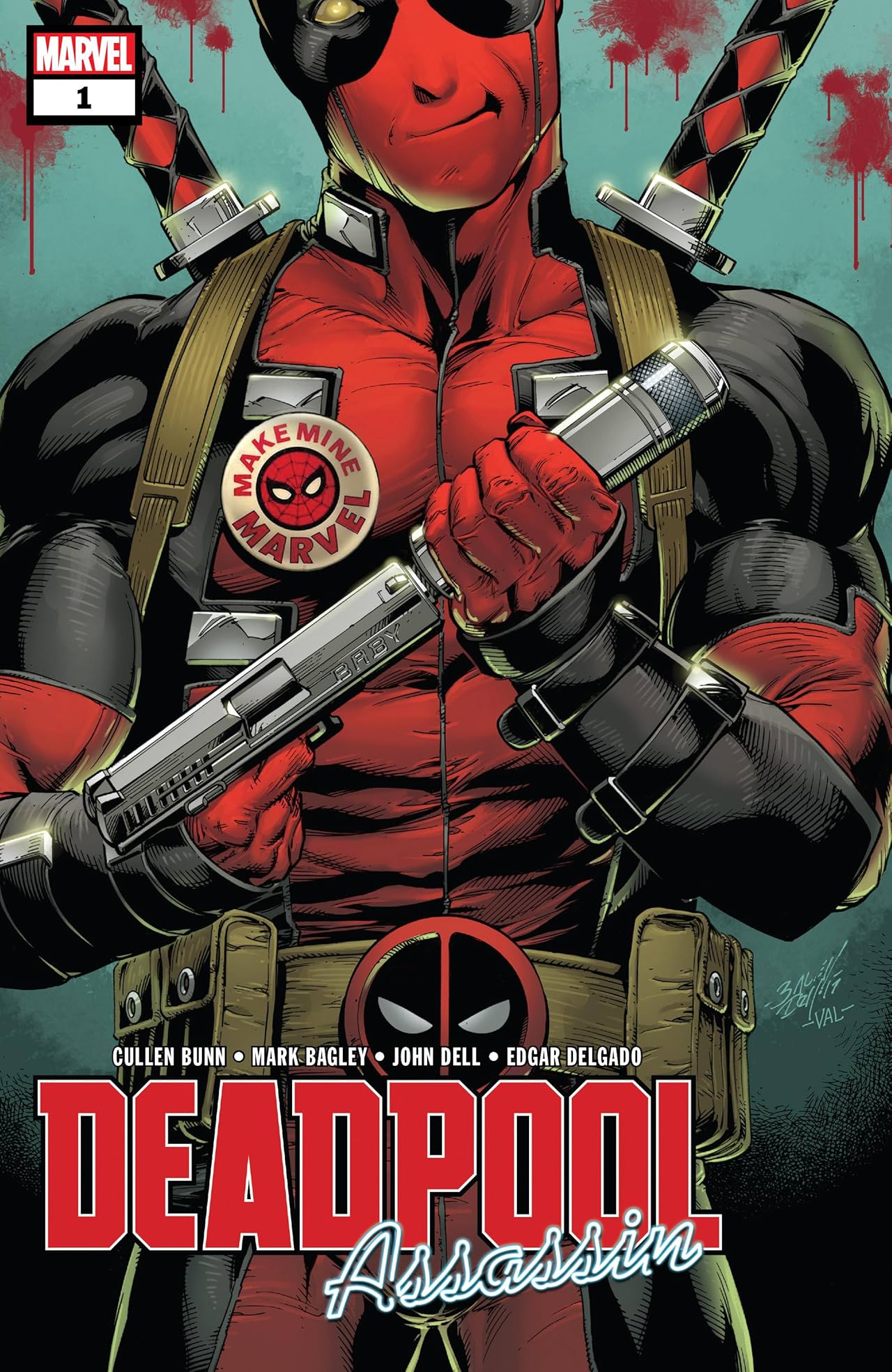
The Maturation of (Regenerating) Degenerates: Deadpool Assassin #1

The following is my review of Deadpool: Assassin #1, which was posted on PopMatters.com.


When it comes to gratuitous violence and genuine heart, Deadpool is in a class all his own. In fact, it's not unreasonable to say that Deadpool, as both a character and a concept, goes out of his way to stand out and isn't afraid to be obnoxious about it. Regardless of whether his name and design was derived from Deathstroke, he's someone who does more than most to stand out in a sea of Wolverine, Superman, and Batman rip-offs.

Thanks to two successful movies and the inherent likability of Ryan Reynolds, Deadpool's star has never burned brighter. It's safe to say that in his efforts to stand out, he has succeeded. His mask, his tumor-laden face, and his propensity to break the fourth wall are now every bit as iconic as Wolverine's claws or Captain America's shield. He has nothing left to prove. He's earned the right to brag and gorge on all the chimichangas he wants.

As much as he's achieved, Deadpool always finds ways to stay busy and entertain. Most of those ways still involve the kind of destruction and vulgarity that would get most characters fined by the FCC, but he never does it out of pure malice. He's not Sabretooth, Norman Osborn, or Dexter Morgan. He's crazier than a sack of ferrets, but he still maintains a code of conduct that sets him apart from less scrupulous mercenaries. Those who undermine that code are likely to be on the wrong end of Deadpool's guns, katanas, and toilet humor.

That's both the setup and the appeal of Deadpool: Assassin #1. Cullen Bunn and Mark Bagley put Deadpool in a position to further set himself apart by showing that there is merit to having a code of conduct as a mercenary. That process involves a hefty bit of bloodshed and mayhem, but anything other than that just wouldn't be true to Deadpool's increasingly powerful brand and he does plenty to maintain it in this story.

Bunn and Bagley don't try to reinvent the regenerating degenerate. They just put him in a situation where he can do what he does best, which means being in close proximity to far less ethical mercenaries and evil ninjas. For Deadpool, that's like mixing chocolate and peanut butter, but with several extra sides of carnage and bloodshed. It's every bit as potent as it tries to be.


These crude, but colorful basics give Deadpool: Assassin #1 plenty of entertainment value. However, there are some other side-plots thrown into the mix that keep it from being a generic story about a Deadpool-centric shooting spree. One involves Deadpool's old friend Weasel, whose life has taken a far more domestic turn. He still works with Deadpool and still provides him with plenty of opportunities to shoot things, but he's got other priorities. In revealing those, Deadpool himself reveals something striking and potentially profound.

Being so unhinged and eccentric, Deadpool never comes off as one of those guys who plans for a simpler future that doesn't involve as many explosions. Between his skills as a mercenary and his fourth-wall breaking awareness, he rarely shows interest in settling down, retiring, or taking up a hobby that doesn't require heavy firearms.

He operates on a moment-by-moment basis, going from one job and/or wisecrack to the next. While he may occasionally mix things up by joining the X-men or marrying a succubus, Deadpool still acts primarily on an impulse. Even with the limited ethical standards by which he operates, he's not known for his foresight any more than he's known for his choice of underwear. Wherever there's violence to be had, he tends to gravitate towards it. With an unstable mind and a body covered in tumors, that's kind of how he has to be.

That's what makes his admission that he's getting bored with mercenary work so striking. He still makes clear that he loves killing unscrupulous mercs and ninjas, but that's not enough for him anymore. He claims he's only doing a few more jobs before he moves onto something else. It's not clear how serious he is. It's like Peter Parker saying he doesn't want to be Spider-Man anymore, but that sentiment goes away the second he has an excuse to change his mind. Unlike Peter, though, Deadpool isn't known for responsible decision-making.

That makes the plot surrounding Deadpool's changing priorities seem tentative, at best. Nobody, fictional or otherwise, can buy that he wants to retire to his own tropical island and sip margaritas for as long as his healing factor allows him to live. He gets bored too easily, enjoys dangerous surroundings too much, and makes too many impulsive decisions. While that makes his antics fun to watch, it also makes any effort to settle down less believable.

To some extent, Weasel's situation reflects that. He's no longer a former Hydra agent who just happens to be friends with an unhinged mercenary. He's got a stable job, a wife, and an overall easier life that involves less killer ninjas and more credit card bills. It's less hectic, which Deadpool claims to want, but Weasel never gives the impression that it's very fulfilling.

If anything, he sends the message that settling down can make a man feel domesticated. This doesn't impact Deadpool's intentions or his ninja-fighting skills, but it does throw shade on the idea that seeking a less damaging occupation comes at a cost. It also establishes that if Deadpool really does attempt to hang up his katanas and guns, he'll end up changing his mind faster than Peter Parker ever did.

Long-term intentions aside, still provides plenty of value in terms of giving Deadpool fans what they want. Bagley's artwork makes it colorful while Bunn's dialog makes it witty. It checks all the necessary boxes for a fun, engaging Deadpool story. It tries to do more and while it lays a foundation, it doesn't offer much in terms of clues. He's still doing mercenary work, as only he can, but what does someone like Deadpool do when he wants to move onto a new endeavor?

That question goes unanswered in Deadpool: Assassin #1. More than anything, it puts Deadpool in a position to mix things up again. It probably won't result in him getting a job as a tax attorney or a janitor, but if it leads him to novel forms of violence, then it can only help the potty-mouthed merc in his never-ending struggle to overshadow Deathstroke.

Final Score: 7 out of 10

Thursday, April 5, 2018

Poison and Perils Within Symbiotic Plots: Venomized #1

The following is my review of Venomized #1, which was posted on PopMatters.com.


Alien life has an uncanny ability to fascinate because it is, by definition, alien. Humans have amazing imaginations, but no matter how creative or elaborate it gets, it's still limited by the amount of gray matter within the human brain. Alien creatures like the symbiotes, whose function is both radically different and somewhat disturbing in the context of the non-comic book world, push those perceptions even further.

As a character, Venom checks all the right boxes for a menacing creature operating with an alien mindset. It's not just some monstrous glob with a biological imperative to hate Spider-Man. A part of that hatred comes directly from its alien persona. It's part of a race whose survival depends on more than just finding a host. It must also improve that host, something that puts it far beyond any tapeworm or tick.

Venom, and symbiotes in general, take on the best and worst of a host, turning the volume on their most defining traits up to the max and beyond. For someone like Eddie Brock, it takes almost any story to extremes. Whether it's trying to kill Spider-Man or a cosmic journey with time-displaced X-men, every element takes on an a more intense context. Whereas hating Spider-Man is a fairly common narrative that has played out any number of ways since the Reagan Administration, Cullen Bunn crafts a different story with Venom in Venomized.

Spinning right out of the events of X-men Blue, another series Bunn writes, Venomized builds directly on top of those events that brought Venom into conflict with the Poisons. That story establishes that, like all forms of life, there's competition for resources, as well as diseases. For symbiotes, Poisons are both. Bunn establishes that these creatures are to symbiotes what mosquitoes and malaria are to humans.

In Venomized #1, the Poisons grow even bolder. Whereas Poison X in X-men Blue focused primarily on the time-displaced X-men, this story expands that conflict to the wider Marvel universe. The X-men, the Avengers, SHIELD, Spider-Man, and even the villains who fight them get involved. The symbiotes don't discriminate. When it comes to hosts, they're more egalitarian than most humans can hope to be.

Much of the story revolves around corrupted symbiotes attacking and infecting other heroes. It makes for plenty of colorful sequences involving major characters like Thor, Hercules, Storm, and Iron Heart getting infected. It's not the kind of epic struggle that often plays out with Spider-Man every time he encounters a symbiote, nor does it try to be. Turning heroes into hosts is just part of a larger agenda that unfolds quickly and chaotically.

It's an agenda that's more ambitious than anything Venom has attempted before. With and without a host, be it Peter Parker or Eddie Brock, Venom is a highly individualistic character. Sometimes it's downright greedy, which is part of what leads it to clashing with Spider-Man so often. It makes for an unusual dichotomy, having that sense of individualism while still needing a host to survive. That's part of what gives Venom his character. It's also part of how it influences its hosts.

By contrast, the Poisons work to subvert the individualism in symbiotes like Venom. They're not content with simply improving a host, which is as far as any symbiote will go. They'll completely consume it and use the body of that host to empower a larger collective. It's like communism mixed with parasitism mixed with cannibalism. Even by symbiote standards, it's pretty gruesome.

The elements of a larger symbiote war are in place. However, Venom and the time-displaced X-men are behind the curve for most of the story in Venomized #1. They don't arrive on the scene until after the Poisons have landed and started attacking the heroes. Even when they do arrive, they aren't able to do much to slow the Poisons down. Their already several steps ahead of them. While this does add more urgency to the story, it also hinders it in some ways.

Things don't just happen quickly. There's a lot that apparently happens off-panel. Even if the agenda of the Poisons is fairly clear, the details are somewhat lost in the spectacle. That's to be expected, to some extent, for a story that covers so much ground with so many characters. However, those lack of details creates the impression that there's so much more going on behind the scenes and too little of it unfolds in the actual narrative.

While this helps create many symbiote-fueled battles throughout Venomized #1, there isn't much in terms of drama. Compared to the Poisons X arc that played out in X-men Blue, there aren't a whole lot of emotions to explore beyond Thor and Hercules drunkenly stumbling out of a bar. Even when Spider-Man gets involved, a character whose history with symbiotes is full of drama, the drama falls fairly flat.

The potential for drama is still there and hints of it even emerge towards the end once Carnage enters the picture. It's still somewhat limited in terms of impact. The story has plenty of structure to build around, going back to the Edge of the Venomverse. It's only lacking the dramatic weight that gives greater purpose to all the symbiote-fueled fighting.

Even without that weight though, Venomized #1 still has plenty to offer. It's very much in keeping with the spirit of symbiotes and extremes. It puts heroes and villains alike in a position where they have to take part in a war that spans the both the multiverse and Venom's own personal ego. In terms of scope, it's hard to get more extreme than that.

Final Score: 6 out of 10

Thursday, January 25, 2018

Transcending Time-Tested Tropes: X-men Blue #20

The following is my review of X-men Blue #20, which was posted on PopMatters.com.


Time travel stories are kind of like those needlessly loud stereo systems that some people put in their cars. From a purely functional standpoint, there's not much to gain by having the ability to project music at volumes that make most peoples' ears bleed. However, the functionality of such a system is hardly reflective of its value. There are other, less tangible reasons why someone would want those systems in their cars. More than anything else, such elaborate systems create equally elaborate spectacles.

Time travel plots are similar in that they rarely function as a means to simplify or clarify a story. Most of the time, they create additional complications that only get more complicated when time paradoxes enter the picture. Such stories may not be simple, but they can work even in light of those paradoxes, as multiple Back to the Future movies have proven. The X-men also have a better track record than most when it comes to compelling time travel stories, going all the way back to Days of Future Past from the Chris Claremont era. Cullen Bunn and R.B. Silva are making a concerted effort to channel Claremont's skills with Cross Time Capers in X-men Blue.

In some respects, this is a story that had to happen sooner or later. Going all the way back to the early days of All-New X-men, when the original five X-men first ventured into the future, those inescapable complications that come with time travel continue plaguing the young X-men. They can't avoid the fact that their presence in the future and their absence in the past is bound to have serious ramifications. Some of those ramifications play out over the course of their story, particularly in events like X-men: Battle of the Atom.

With Cross Time Capers, though, Bunn puts the time-displaced X-men in a position to confront the consequences of their time-traveling shenanigans. It may have taken longer for them to feel those consequences, but they finally get a sense of perspective throughout the arc. It's only in the concluding conflicts in X-men Blue #20 that they gain a better understanding of how they're affecting the space-time continuum.

If there's any lesson the original five X-men should learn from this, it's that when there's a gaping hole in the timeline, someone or something will come along to exploit it. Biff Tannen did it in Back to the Future. The future Brotherhood of Mutants, led by Charles Xavier Jr. and his omega-level daddy issues, do the same. While they're not quite as ambitious as Biff Tannen, they are every bit as devious. What they do to exploit the time-displaced X-men's absence is neither subtle nor minor. It leaves an impact, one that goes beyond the usual lessons learned by messing with time travel.

Bunn closely follows the traditions of Chris Claremont in that respect in that the sci-fi elements associated with time travel are secondary to the dramatic elements. The story is less about the original five X-men traveling through time to fix the past than it is about them confronting the consequences of their actions. Their continued presence in the future has consequences and these are the kinds of consequences that literally fight back.


It's that element of drama that helps subvert the usual complications and confusion often associated with time travel. Classic stories like Days of Future Past show that this is an effective way to give time travel stories a genuine impact without making every other conversation an existential crisis on time paradoxes. Those conversations still happen in X-men Blue #20, but the assorted techno-babble is kept to a minimum.

Instead, Bunn relies on converging the various elements seeded throughout the journey that unfolds in Cross Time Capers, throwing a many of them as possible in the final battle. It's a battle that Silva effectively turns into a colorful, vibrant spectacle that feels epic in both size and scope. While it unfolds quickly, it hits on all the necessary dramatic elements, from confronting Xavier Jr. to the original five X-men reuniting with their mentor. Each moment carries weight and without incurring more time paradoxes.

That's not to say the time travel elements don't also carry weight in this story. Given the circumstances and context of the original five X-men's time displacement, those aspects of the conflict are unavoidable. The story clearly establishes that their decisions in the future have an impact on the past. It also provides some ominous, albeit not too surprising, foreboding about the decisions they'll have to make at some point.

Like Battle of the Atom before it, Cross Time Capers makes clear that what the original five X-men are doing still has an impact on the overall timeline. The choices they make, the battles they fight, and the impact they have on the past and future all matter. It also puts the team in an awkward position because to some extent, they already know what they'll end up having to do. It's like reading an unwanted spoiler in that they can't unread it.

This is where X-men #20 stumbles a bit into the inevitable complications of time travel stories. Even with the drama, there are some details that don't get fleshed. There are moments that have the potential to become very emotional and impactful, but some of that potential is lost for the sake of keeping the story going. Certain elements from the early parts of the story don't really play a role in the final battle, but they aren't rendered meaningless by the final conclusion.

In terms of the most critical elements, X-men Blue #20 handles those very well. There's reason and purpose behind every decision. The motivations and emotions of each character is clear. The events of previous issues influence the outcome of the final battle. Even with the complications of time travel and the erratic pacing of that final battle, the end result is a concise, cohesive story that satisfies as much as any time travel story can without getting too caught up in paradoxes.

That's not just an accomplishment that honors the standards set by Chris Claremont. It's a testament to the unique challenges of time travel stories. They have so many moving parts and so many potential complications that may or may not result in someone like Biff Tannen messing up the timeline. Being able to tell that story and not lose track of all the frustrating time travel tropes that derail so many stories is quite a feat. While Cross Time Capers may not be in the same league as Back to the Future, it certainly makes the case that those stories are still worth telling.

Final Score: 8 out of 10

Thursday, November 30, 2017

Doubling (And Tripling) Down On Time Travel: X-men Blue #16

The following is my review of X-men Blue #16, which was posted on PopMatters.com.


There's a certain point in a narrative where a certain subplot either needs to be abandoned or shoved back into the spotlight. It's like that point in a poker game where pushing all the chips to the center of the table is the only sound tactic left. It's a major risk and one that potentially undermines the entire foundation of a story, but the payoff is significant. For the time-displaced X-men in X-men Blue, the time is right for that kind of gamble.

There's no getting around it. Since arriving from the past in the pages of All-New X-men, the mission of the original five X-men seems to change every other week. One week, they're trying to stop Cyclops from ushering in a full-blown mutant genocide. The next, they're joining Cyclops to become mutant revolutionaries. The week after that, they're working with Magneto, the same guy who tried to kill them on their first mission. While it's not uncommon for teenagers to have erratic priorities, time travel seems to exacerbate the situation for the time-displaced X-men.

Beyond these varying missions and allegiances, though, there remains one common, unresolved thread. These time-displaced X-men are, for reasons not yet explained, cannot go back to the future. The events of X-men: Battle of the Atom establish that there is something keeping these time traveling teenagers stuck in the future. The nature of that mechanism is vague and rarely hinted it. For the most part, it's like Spider-Man's marriage in that it's overtly ignored for the most part.

In X-men Blue #16, Cullen Bunn and Thony Silas finally revisit this issue in a way that requires them to push those proverbial chips to the center of the table. It all happens quickly and under the backdrop of some typical teenage melodrama that always seems to find its way into the pages of X-men Blue. The mixture and transitions aren't always seamless, but few things involving teenage melodrama are.

That melodrama is only a small part of a much more serious conflict that has roots that extent back to X-men: Battle of the Atom and beyond. Anyone who has seen Back To The Future more than once understands the erratic and chaotic nature of time travel. Mess with the timeline too much and eventually, it'll get impatient. Whatever patience kept the original five X-men intact in the future seems to have run out, albeit quite suddenly.


There's little build-up or foundation to the sudden fracturing of time. It just starts happening, forcing the time-displaced X-men to react on the spot. Part of that reaction involves them engaging in more time travel. On the surface, that seems like fighting fire with napalm. In this rare instance, though, it makes sense and it addresses an important issue that has remained vague since X-men: Battle of the Atom.

Even those who haven't seen Back To The Future understand on some levels that time travel, especially one that involves changing the past, tends to incur an unpredictable impact on the present. For the most part, the impact of the original five X-men being in the future hasn't been that significant. The final few issues of Dennis Hopeless' run on All-New X-men even imply that their presence may not affect the timeline at all, which undermines the entire premise of a time travel story to begin with.

Like the events of X-men: Battle of the Atom, the temporal details remain vague. However, X-men Blue #16 ditches much of those subtleties and makes one thing very clear. The original five X-men's presence is indeed having an impact on the timeline. They aren't just a bunch of clones or alternate versions of themselves from a dystopian future, of which the Marvel universe already has plenty. They are from the same timeline and what they do does effect the present. That reaction may have been delayed, but it's happening.

It's an important facet that Bunn and Silas belabor, which helps establish the premise and the stakes of the Cross Time Capers arc that begins in X-men Blue #16. It's an overdue dose of clarity for an issue that many recent stories involving the time-displaced X-men go out of their way to ignore. It's both refreshing and profound in that sense that it gives the story genuine stakes, but still doesn't forget that those involved are teenagers. That means that no matter how serious the story may be, there's going to be some entertaining awkwardness along the way.

There is some of that in X-men Blue #16, but not nearly enough. Much of the melodrama involves ongoing emotional entanglements between Cyclops and Jean Grey. While those kinds of entanglements are a major part of X-men drama, regardless of timeline, they seem somewhat forced. It's as though these two always have to have the same kind of drama thrown in, as though that's the only drama they know. Being teenagers, that's less believable than anyone shooting lasers from their eyes.

Even if the melodrama is forced and the pace is quick, the sheer intensity of X-men Blue #16 make it a solid beginning to what promises to be a chaotic arc involving time travel. Given how X-men Blue is coming off an event that involved Mojo, that's saying something. Bunn's concise storytelling and Silas' colorful lay a solid foundation that has the potential to incur more significant implications than anything the time-displaced X-men have experienced to date. Like Marty McFly though, they will likely have to learn about those implications the hard way.

Final Score 6 out of 10

Thursday, August 10, 2017

Rising Ashes From Two Eras: Generations: Phoenix & Jean Grey #1

The following is my review of Generations: Phoenix and Jean Grey #1, which was posted on PopMatters.com.


It's usually a sign when a certain character becomes best known for dying, not staying dead, and having large chunks of their history retconned and rewritten. It's rarely a good sign, but a select few can manage more balanced results. Jean Grey functions better than most with that kind of legacy. She dies, comes back to life, dies again, gets cloned, travels through time, and somehow finds a way to deal with a cosmic force. That may very well be another sign, but one that speaks to the strength of her character.

In a sense, Jean Grey is one of those characters who's always torn between two opposing forces. Sometimes it involves her being on the wrong end of a love triangle. Other times, it involves wanting to forge her own path while still confronting the many conflicts in her history. She knows she ends up dead, an icon to some and a walking resurrection joke to others. Since her arrival from the past in All-New X-men, Jean's story seems to fluctuate from one conflicting force to another.

One day, she's trying everything she can to avoid the same obstacles that doomed her adult self. The next, she's determined to face them. Given that she's a teenager and teenagers are known to have erratic methods in dealing with problems, this is understandable. It also makes Jean Grey's story somewhat chaotic. There's not a clear understanding of what she hopes to accomplish, so long as she's stuck in the future with the rest of the time-displaced X-men. Unlike her teammates, though, she can't reach out to her older self for guidance.

Now, thanks to space-time machinations for Marvel Generations, a teenage Jean Grey finally gets the chance to interact with her older self and learn from the icon herself. What plays out in Marvel Generations: Phoenix and Jean Grey #1 is not an illusion. It's not some twisted memory either. This is the real Jean Grey of X-men lore who goes onto devour a star, cheat death, get clones, and inspire any number of fights between Cyclops and Wolverine. It's as big a moment as a teenage girl can ever face outside her prom night.


Cullen Bunn and RB Silva don't just rip a teenage Jean Grey out of the present and stick her into some contrived point in the ever-changing, constantly-reconnected timeline of the X-men. Bunn shows that he's done his homework by putting the young Jean Grey in a specific moment within the original Phoenix Saga between that ran between Uncanny X-men #101 and Uncanny X-men #138. It's the kind of attention to detail that Chris Claremont himself would be proud of.

In a sense, it's the most optimal moment Jean and her older self could've chosen for their respective stories. Within the context of the original Phoenix Saga, it's that brief period where Jean had control over the Phoenix Force. She isn't corrupted, twisted, or devouring entire star systems just to see what it feels like. She's still very human in her perspective, but vulnerable to the corruption that comes with the god-like power of the Phoenix Force.

It's a narrow window for her teenage self to explore, but one that's vital within the context of her own story. It provides a clear and effective link between the conflict unfolding in Jean's solo series and the events unfolding in Marvel Generations. Once again, Jean faces the prospect of dealing with the Phoenix Force again.

She knows as well as anyone who tries to follow convoluted timelines and never-ending death/rebirth plots that it's bound to cause cosmic headaches for everyone. In order to deal with it, she needs to learn about it. She'll find no better source than this particular version of herself at this particular point in her history. Even a cosmic version of Wikipedia can't provide information that comprehensive.

As a result, Marvel Generations: Phoenix and Jean Grey #1 takes on a very personal undertone. Bunn dedicates significant parts of the narrative to exploring the inner conflict within the teenage Jean Grey. She recognizes from the beginning that this is an important opportunity, one that she can't afford to pass up. She needs to learn everything she can about the Phoenix Force. On top of that, she has spoilers to the tragedy that lies just ahead for her adult counterpart.


Despite all the implications this meeting has for both characters, Bunn resists the urge to turn teenage Jean Grey into Marty McFly from Back to the Future in that she doesn't mindlessly mess with the timeline. She actually establishes a personal connection with her older self. She doesn't attempt to deceive her or impede her. She presents herself as a friend and ally. It may seem redundant since they're the same person, but it serves an important purpose.

By becoming an ally, teen Jean gets a chance to learn about her older self outside the tragedy, heartache, and retcons that exist only in the memories of her fellow X-men. She sees that, like her, the older Jean Grey is also struggling to make sense of this cosmic power. However, her older self clearly has a different perspective of that power, which she eagerly demonstrates in ways that maximizes the visual appeal of Silva's art.

It leads to a cosmic clash between the Phoenix and Galactus. It's the kind of clash that's inherently epic on paper, but easy to mess up in a story. Bunn achieves a fitting balance of sorts, giving Jean and her adult counterpart a chance to shine and learn from each other. In doing so, it sets up a unique moment between two characters from different periods in a vast mythos. That moment carries with it a dramatic impact that maximizes the opportunity that Marvel Generations creates.

It's a moment that Marty McFly botched in Back to the Future. For Jean Grey, it's a moment of clarity that takes place at the best possible time. That's not just an outside observation either. The Watcher himself shows up to let her know just how important her decision is in the grand scheme of the never-ending chaos that is the Marvel universe. She has a chance to make the easy decision that will most definitely incur all sorts of complications and consequences. She ends up making a different choice. The fact she makes that choice as a teenager, whose natural inclinations gravitate towards easy solutions bereft of consequence, speaks to the strength of her character.

Marvel Generations: Phoenix and Jean Grey #1 is in a position to literally rewrite the history of one of the X-men's most iconic stories. It's also in a position to add even greater complications to a story that has had more than its share since the 1980s. Bunn doesn't draw the ire of Chris Claremont, nor does he completely nullify the potential of the moment. The Jean Grey from the past and the Jean Grey from the present both get something out of their encounter. It's not the same as a retcon or a time paradox, but it has a genuine impact and that impact feels relevant to both characters.

There's still a sense that teenage Jean didn't do as much as she could've. It could be argued that she didn't do as much as she should've either. However, what she ends up doing is probably the most responsible decision she could've made in that situation. For a teenager constantly looking for ways to avoid the destiny that fate has laid out for her, it speaks volumes to the strength of her character. Even if the circumstances of Marvel Generations are unclear and the overall impact is uncertain, Jean Grey shows why, no matter which era she's in, she's still the heart of the X-men.

Final Score: 9 out of 10

Thursday, May 25, 2017

Clawing For Relevancy: X-men Blue #4

The following is my review of X-men Blue #4, which was posted on PopMatters.com.


Contrary to popular belief, it is possible for certain comic book characters to be too awesome. It's rarely the fault of the characters themselves. The problem is that when one writer finds a winning formula, a hundred others work tirelessly to recreate it, which leads to some predictably spectacular failures. With all due respect to characters like Hyperion and Sentry, the sheer volume of characters that try to match Superman's winning formula proves that even great success can breed greater problems.

When it comes to the X-men, Wolverine is the spitting, swearing poster boy of this issue. In terms of the overall X-men mythos, he is the standard by which all others are measured. He's an amazing character with a convoluted, but compelling past. He has personality, charisma, and mass appeal that's easy to stick on a T-shirt or lunch box. Few characters can hope to match that standard. Some characters, such as X-23, come surprisingly close. Others, however, fail miserably and become afterthoughts at best.

Up until Secret Wars, Jimmy Hudson was a case study in such failure. In the now-defunct Ultimate Marvel, he attempts to replace Wolverine and falls woefully short at every turn. He does nothing to distinguish himself. He brings nothing new or compelling to the story. He's basically just a teenage Wolverine, minus the skills, the mysterious past, the personality, and the overall appeal. At a time when there are so many other characters, such as X-23 and Old Man Logan, who do a much better job following that formula, Jimmy Hudson enters X-men Blue with some significant headwinds.

In some respects, he's entering a favorable situation. Like him, the original five X-men are exiled from their own timeline. They're also teenagers with lofty legacies to live up to. However, the baggage of being a failed replacement character from a failed series is not easy to escape. Cullen Bunn and Julian Lopez try to make the case in X-men Blue #4 that Jimmy can overcome that baggage. The verdict, however, is incomplete. The jury is still out, but the evidence is not on Jimmy's side.


The structure of the story, itself, as concise and well-crafted. The original five X-men respond to news of a distressed mutant. That's what the X-men of all generations do, time displaced or otherwise. Bunn establishes in the first three issues that this is the core mission of the team. It's simple, familiar, and functional. It works in the sense that it brings out the best in the original five X-men. It continues to work in X-men Blue #4. However, when Jimmy Hudson enters the picture, this core mission clashes with his heaviest baggage.

If Jimmy didn't have claws, wasn't related to Logan, and hadn't been part of a defunct world that stopped being relevant years ago, then his appearance would have some intrigue. Instead, he enters the world of X-men Blue in a way that's so familiar, so predictable, and so devoid of drama that it's hard to get excited about his arrival. Nothing he does sets him apart as a new and intriguing character. If anything, everything he does will just make Wolverine fans miss Logan.

It's one of Jimmy Hudson's biggest problems, both as a character and as plot for X-men Blue #4. It's a problem that has lingered since his first appearance in Ultimate X. The fact that Jimmy Hudson is Logan's son isn't the issue. The problem is he does nothing to really set himself apart.

In every comic since his first appearance, he doesn't carry himself as Jimmy. He carries himself as teenage Logan. It would be far more intriguing if someone had just cast a magic spell and reverted Logan back to a teenager. Given the abundance of overpowered sorcerers and time machines in the Marvel universe, that really isn't much of a stretch.

That all-too familiar tradition continues in X-men Blue #4. All the familiar Logan tropes are there. Jimmy is alone in a hostile wilderness, stuck in a blood rage, and can't remember where he came from. These are all core themes of at least a dozen other Wolverine stories since 1975. There's nothing distinct or memorable here. Jimmy once again conducts himself as a teenage Logan and nothing more. Unlike the original five X-men, though, he can't use time displacement as an excuse.

It might be understandable for Jimmy to struggle to escape his Logan's shadow in the sense that he sets the bar pretty high. Wolverine is one of the most popular comic book characters of all time. He's the one who helped make Hugh Jackman famous. Expecting Jimmy to even come close to that bar seems unreasonable. However, that excuse fails too because there is a precedent, which further undermines Jimmy's case.

Other characters inspired or derived from Wolverine have succeeded. Both X-23 and Daken have established themselves as solid, compelling characters who can hold their own without being too similar to Logan. X-23 does such a good job of this that she went onto become one of the best parts of the last Wolverine movie. Jimmy Hudson, though, gives no impression that he deserves a role next to Hugh Jackman.


Unlike Daken and X-23, Jimmy does nothing to stand out whether he's in a fight or standing on a street corner. His only distinguishing feature is his blond hair. If Molina were to use the wrong color, then few would be able to discern Jimmy from an overly youthful Logan. Given all the other distinguishing traits of Daken and X-23, which include tattoos and different claw configurations, Jimmy feels less like a derivation and more of a rip-off.

At the very least, his presence doesn't derail the story in X-men Blue #4. Bunn never makes him the primary focal point and that keeps the narrative on-track and consistent with the themes of the series. Jimmy's presence even manages to incur a distinct twist to the story that couldn't be done with X-23 or Daken. He acts primarily as a catalyst for the original five X-men's next challenge. He succeeds in this, but fails be distinct or compelling at any point in the process.

He's still that character who failed miserably to fill the void left by Logan's death in Ultimate Marvel. Now, he's in a world where two other characters can claim some measure of success, one of which made Dafne Keen famous. Jimmy is a long way from that kind of success. That baggage is still as heavy as ever. He's still that character few mourned when Ultimate perished at the end of Secret Wars. Escaping that baggage isn't easy and with X-men Blue #4, he's off to a poor start.

Final Score: 6 out of 10

Sunday, April 16, 2017

An Original Cast With Renewed Energy: X-men Blue #1

The following is my review of X-men Blue #1, which was posted on PopMatters.com.


Some concepts work well in any era, no matter the context. Those concepts are few and far between, but their universal appeal is what helps make them iconic. When it comes to the original five X-men, as created by Stan Lee and Jack Kirby over 50 years ago, they check all the right boxes with respect to those concepts.

They're young, idealistic, vulnerable, determined, anxious, eager, and even a little arrogant at times. They believe in following a dream. They also haven't experienced the harshest realities of the real world, which tend to crush dreams like Juggernaut in a china shop. Since arriving in a future where they find out their future selves are dead, disfigured, or had lost their minds, they fight desperately to cling to those dreams. Despite the knowledge that those dreams shattered under the weight of cosmic forces, psychic manipulation, and evil clones, they still fight for that dream. It says a lot about both their youthful spirit, as well as their youthful arrogance.

They may not need that arrogance quite as much these days. After the events of Inhumans vs. X-men, the dream the original five X-men fight for isn't quite as shattered as before. Mutants are no longer being gassed to death by a giant green cloud and the Scarlet Witch hasn't had a mental breakdown lately. That means mutants have a future again and, despite being the product of an out-of-control time travel plot, they seek to forge part of that future in X-men Blue.

Cullen Bunn and Jorge Molina bring the original five X-men back together in X-men Blue #1, attempting to capture as much of those classic concepts as possible while fitting them into a new status quo. That includes everything from teenagers complaining about random things and fighting the Juggernaut. By all those lofty standards of the Kirby/Lee tradition, it still checks the right boxes boxes.


From the outset, the story is fairly basic. The Original Five X-men go up against an old enemy in Black Tom, but from their time-displaced perspective, he's a fresh face with a sinister mustache. There's not much to Black Tom's plot. He's just holding a lot of rich people hostage, twirling his sinister mustache, and generally doing all the things Lex Luthor used to do before he got into politics.

There may not be much complexity to that plot at first, but it still leads to some entertaining theatrics that allow the time-displaced X-men to stop lamenting about their future selves and just be heroes. Given that they're still teenagers, there is some lamenting, but Bunn makes sure it's doesn't devolve into the kind of teen angst that often plagued the characters after Secret Wars. That makes the effect of X-men Blue #1 all the more profound because it shifts the tone back to a sense of youthful idealism. After surviving a poison gas cloud, it's a shift that needed to happen.

As the story unfolds, new complexities emerge. The narrative doesn't just rely on a group of teenage mutants flying in and saving the day. The battle also illustrates some new dynamics within the team. Most notably, Jean Grey is now the leader. It may not be akin to making Doop the leader, but the change is notable in the way the X-men conduct themselves.

It's different in that Cyclops doesn't go barking out orders while everyone else jokes about how uptight he is. Jean Grey's style of leadership is different in that she'll spearhead the charge, but trusts her teammates to handle themselves, even against someone like Juggernaut. This style isn't without its faults though. They quickly get overwhelmed and end up having to wing it in order to save the day, so much that they end up having to cheat with magic.

This is where X-men Blue #1 ties itself into the larger narrative that has been unfolding with the time-displaced X-men since they arrived in the future back in All-New X-men. Bunn doesn't ignore the nuances have emerged with certain characters. In this case, Beast's newfound appreciation of magic proves pivotal, both in terms of resolving a conflict and establishing new levels of tension. It makes for different tactics, but it also leads to arguments and uncertainties about how the team operates. In a team made up of entirely of teenagers, that's always fertile ground for conflict.


It also establishes that while X-men Blue is relying on more traditional X-men dynamics, the team is still very much a work-in-progress. Jean Grey is still learning how to lead. Beast is still learning how to manage his new mystical abilities. All the while, Cyclops has to resist the urge to start barking out orders again. As a team, they're not a finished product. They're still rookies who have the potential to be all stars, but are a long way from that level.

That sense of growth is one of the greatest strengths in X-men Blue #1. Even though it uses a team line-up that was introduced during the Kennedy Administration, it still comes off as novel. It's very much a product of an evolving narrative, one that has taken many twists and come dangerously close to being derailed. Magic and tactics aside, Bunn seems to have the original five X-men back on track and Molina's artwork makes them look good while they do it.

That track even has some interesting turns towards the end. While the story starts off as fairly basic, it gains greater intrigue towards the end. There are hints and teases about the Original Five X-men's larger goals and how they intend to go about it. Coming on the heels of a classic clash that brings new energy to a team that underwent so much upheaval, X-men Blue #1 creates a new foundation for an old cast of characters. For characters are teenagers, time-displaced, and dabbling in magic, that's quite an accomplishment.

Final Score: 8 out of 10

Tuesday, January 24, 2017

Marvelous Monstruous Mayhem: Monsters Unleashed #1

The following is my review of Monsters Unleashed #1, which was posted on PopMatters.com.


It says something about the current state of superhero comics when the idea of superheroes not fighting each other seems like a novel concept. It may seem like such a long time ago, but there was once a time when superheroes primarily fought villains, criminals, and monstrous manifestations ripped right out of old Roger Corman movies.

It's getting harder and harder to remember those times. These days, it seems every major superhero team, in both Marvel and DC, can't go a year without fighting one another. Cullen Bunn and Steve McNiven clearly remember those simpler times and if Monsters Unleashed #1 is any indication, they remember them fondly. The challenge for them is to remind readers that there's still a place for stories that don't involve superheroes fighting each other.

It's one of those concepts that shouldn't be such a challenge, but between Civil War II and Batman vs. Superman: Dawn of Justice, it may as well be a chess match with Dr. Doom. Bunn and McNiven are getting back to basics, having Marvel's premier heroes take a break from clashing with each other to confront a new threat. The end result is an over-the-top, action-packed thrill ride that pits iconic heroes against giant monsters. It's as basic a formula it can possibly be without Deadpool making a poop joke, but it works.

The story doesn't try to be overly complex or nuanced. Monsters start falling from the sky in cities all over the world. Marvel's various superhero teams, including the Avengers, the X-men, the Inhumans, the Champions, and the Guardians of the Galaxy, all get to step up and fight some monsters. There's no elaborate exposition. There is some mystery, but Bunn never lets it get in the way of the spectacle of heroes fighting monsters.


He seems to understand the audience. He knows there's too much entertainment value in giant monsters. It should be as obvious as a temper tantrum by the Hulk, but it still feels refreshing in that it provides a simple, entertaining story that allows heroes to just be heroes. Nobody has to worry about characters acting strangely, timelines being tampered with, or reputations being ruined. It's just heroes fighting monsters. No fan need agonize over their favorite characters and in at a time where Captain America can be a Hydra agent, that counts for something.

That's not to say that the narrative in Monsters Unleashed #1 is overly simple. It does have some refinements that make it more engaging than a typical Power Rangers rerun, although not by much. While Bunn does make it a point to emphasize the battles between heroes and monsters, he does squeeze in some mystery behind the wanton destruction.

The details of that mystery, which involves a kid who enjoys drawing monsters more than fighting them, are somewhat ambiguous. It involves Elsa Bloodstone and another dime-a-dozen doomsday prophecies, of which there are plenty in the Marvel universe. It's not nearly as engaging as seeing the Hulk punch a giant eye monster, but does add a sense of purpose to the hero vs. monster clash. There is a larger story behind it, even if that story offers as few hints as necessary. At the very least, it ensures that Monsters Unleashed #1 never devolves into a glorified Michael Bay movie.

The main appeal of the story is still its simplicity. McNiven's art further supplements that appeal, providing rich and colorful battles that give a diverse cast of heroes plenty of opportunities to shine. These are the kinds of scenes that will never make it into a Marvel movie, if only because even Disney's pockets aren't bottomless. That helps add to the overall spectacle in Monsters Unleashed #1 and in a story that involves giant monsters, that's saying something.

There's something to be said about the overall context of this story. In real estate, it's all about location. That's the key to making a project work. In comics, the closest equivalent is timing. While some stories are indeed timeless, as those of Superman and Captain America have proven, work best when the time is just right in both the real world and the fanciful world of comics.

Stories like the Phoenix Saga and the first Civil War have an impact because they reflect a certain time and sentiment with the audience. Monsters Unleashed is one of those concepts that could be shrugged off in the extremes of the '90s, the macho grittiness of the '80s, or the psychedelic mindscape of the '60s. However, its presence in 2017, a time when audiences are burned out on superheroes fighting each other, feels both right and overdue.


Comics don't need to blow minds, break hearts, and shatter spirits every other week. They just need to entertain. Bunn and McNiven succeed in delivering just that with Monsters Unleashed #1. They go out of their way to avoid complicating the plot. They also avoid crafting a story that devolves into shameless disaster porn as well. There is story. There is mystery. Some details are lacking, but it still works. No major characters are getting reinvented, retconned, or replaced by clones. In this particular era of comics where everything gets shaken up every other year, that counts for something.

Monsters Unleashed #1 is not a story that's going to get anyone thinking too hard about real-world parallels or blurred lines between good and evil. It's not going to reinvent an entire genre either. This story caters to the kid in everybody who plays with action figures, imagines giant monsters attacking big cities, and comes up with over-the-top battles full of fiery explosions and crumbling buildings. Anyone's inner child, especially those that pestered their parents for action figures every Christmas, will be thrilled with this story.

Final Score: 7 out of 10

Friday, September 23, 2016

Uncanny X-men #13: Nuff Said!

When villains become heroes and heroes become villains, it doesn't always mean the Scarlet Witch got drunk on chaos magic again and inverted everybody. It can also mean that a situation is now so utterly fucked that we can't help but cheer for villains to some extent. For the X-men, who rely heavily on sterilization, time travel, and alternate universes to hold themselves together, I'd say they're fifteen steps past fucked.

That's why I think people are ready to actually root for the Hellfire Club. For once, it won't just be the pro-orgy, pro-corruption, pro-Victorian fashion enthusiasts who will be cheering. The world is basically giving a big middle finger to the mutant race. The Hellfire Club is poised to do the same and get laid in the process. Who wouldn't respect that? They've been operating behind the scenes since Uncanny X-men began under Cullen Bunn. In Uncanny X-men #13, he's finally getting around to digging a little deeper. I'm expecting plenty of orgy and wine to be mixed in. Bet you're not going to get that shit on New Attilan.


Other than orgies and wine, the X-men do show that they can work with the Hellfire Club when corrupt companies and Racist Xenophobic Slave-Owners are involved. Together, they launch an attack on an oil rig run by the Someday Corporation, the overly shady motherfuckers from the first arc of this series that claimed to help mutants by letting them sleep through this latest shit storm. They suspect that a company that puts mutants in comas may have a less noble agenda. That's like saying Mel Gibson may have an anger management problem.

In the least surprising development since Adam Sandler failed to get nominated for an Oscar, the X-men and their orgy-loving allies are attacked on the rig by a team of weaponized mutants. This makes for some heavy action, complete with some nice little insight from Psylocke, who is basically the one getting most pissed off by this team-up. Seeing that she's on a team with Sabretooth, that's saying something.


It's a fun, gritty battle that's perfectly in line with the battles Magneto's team has fought throughout this series. With the Hellfire Club involved, it becomes even more appropriate. However, they all do keep their clothes on during the fight so maybe there's still room for improvement.

It's not just mindless slap-fighting either. There is a strategy involved here. That strategy involves Mystique doing some sneaky shit behind the scene and being sexy as hell while doing it. That's a damn good strategy by default. It involves singling out one weaponized mutant, sedating him, and letting Arcangel carry him off. I don't know the merit of that strategy, but Mystique is involved so I'm giving her the benefit of the doubt. Well, that and my penis won't let me do otherwise.


The battle intensifies. The X-men and their new orgy-loving buddies are surrounded. Shit is going south faster than a constipated horse with food poisoning. Then, one of the weaponized mutants gets a psychic message and they leave. It's ominous and vague as fuck, but that's what happens. They just up and leave.

Is it a somewhat disappointing way to end a gritty, visceral clash between X-men and weaponized mutants? Yes, to some degree it is. However, it doesn't come off as completely meaningless because Mystique still succeeds with her strategy. Either the Someday Corporation is just trolling them or they have a strategy of their own. If it leads to Mystique being sneaky and sexy as hell, then I'm all for it.


Once all the weaponized mutants are gone, they enter the belly of the rig and find the same disturbing shit they've found before with Someday. They have mutants in statis tubes, hoping they'll wake up in a future where mutants aren't sterilized, heroes aren't fighting one another, and every hooker looks like Emma Frost. That's probably hoping for way too fucking much, but I can't say I blame them for wanting to sit this shit out.

Again, there's no big surprises here. These people weaponize mutants. Anyone who thinks they're being entirely honest with their business probably buys diet pills from Dr. Oz. Psylocke finds out there's some mind-fucking going on with these mutants and not the fun kind that the Hellfire Club probably enjoys every other Tuesday. Nobody looks surprised, nor should they be. They just know for certain now that more people need to have their heads bashed in.


They return to the Hellfire Club, which also happens to have a research lab that may or may not also act as a porno set. There's more curious insight from Psylocke, whose attitudes towards the Hellfire Club are skeptical at best. I'm sure she doesn't trust any organization that thinks lingerie is a suitable uniform. Then again, she has been on teams with Emma Frost so maybe she's not one to talk.

She remains less focused on those who enjoy one too many orgies and more on the mind-fucking that the Someday Corporation is pulling. She dips into the mind of the mutant they captured from the rig. She finds out he's from Mongolia and his life as a mutant really sucks donkey balls, which is fairly typical in any world where Racist Xenophobic Slave-Owners get preferential treatment. He jumps at the chance to find sanctuary with Someday for reasons that are entirely understandable. Even so, he had to know on some levels that they were going to screw him over. It's like getting a loan from Tony Soprano. Somebody is going to break some bones at some point.

It leads to a flashy psychic journey into the mind of an ordinary mutant who doesn't want to be an X-man or live in a world where it sucks this much for mutants. It's a rare insight into the mutant population that gets glossed over/screwed over in X-men comics too often. Having Psylocke enter a mind, wielding her classic costume, and uncovering a painful psychic presence is just a nice bonus that moves the story forward.


Mystique may not share Psylocke's psychic gifts, but she's every bit as good at doing her job and looking sexy as hell in the process. She still has her own strategy and it involves doing what she does best, infiltrating a shady organization and finding ways to screw them over in ways they won't enjoy. It's a beautiful thing. It helped make Jennifer Lawrence's career. I always get a little emotional seeing it.

She's not nearly as charming as Jennifer Lawrence this time around. She gets in, she fights a few guards, and snaps a few necks. That's pretty much Mystique on a Monday. Once she's in, she takes the form of one of the mutant weapons and does a little digging. She ends up finding a surgery center that probably isn't just doing cheap boob jobs. Historically, surgery and mutants are like napalm and meth labs. It's bad combination.


It's also usually a bad combination to have a powerful telepath in the mind of a disturbed mutant. It only helps when one of those telepaths is sexy as hell. The sexiness, however, doesn't protect Psylocke from a little psychic trap. While in the mind of the hapless mutant who just wanted to sleep through this shit storm, she finds out the mind-fucking began shortly after they put him into stasis. That's right. Someday didn't even let him dream about a future where Jean Grey is President, Charles Xavier is the Pope, and Wolverine is Secretary of Whiskey. They just go right to mind-fucking him. Even the folks at Halliburton would say that's cold.


It's painful. It's disturbing. It's also flashy as hell, as are most psychic battles. As Psylocke is trying to dig through this unlucky mutant's mind, Mystique is snapping more necks. She doesn't like being left behind of course she's going to overcompensate. It's part of what makes her so skilled and sexy. She tries fighting off the asshats in the surgery room while Psylocke tries to find the source of the mind-fucking. It gets a little chaotic and a little confusing, as do most things that involve mind battles and shape shifters. Again, it helps when the characters involved are sexy as hell so at least there's entertainment value.


In the end, it's Mystique who uncovers the source of the mind-fucking. She's competitive. She's not going to let a purple-haired ninja beat her to the punch. That's what makes her so damn good at her job. However, she may regret being so damn good because the source of the mind-fucking isn't someone whose neck is easily snapped. It's Exodus.

Remember this asshole? He's powerful. He's mean. He looks like he lost one too many fights with a tanning both. He's also a powerful psychic and someone who actively looks for excuses to piss off the X-men. His presence is intriguing in that it exposes some secrets about the Someday Corporation. It also hints that there may be another battle between X-men and Exodus. I guess it beats the hell out of them fighting other heroes for once.


So...is it awesome?

I guess that depends on how intrigued you are on any story that involves Exodus mind-fucking people. Personally, I find that shit pretty damn intriguing. Magneto is no boy scout, but Exodus is right up there with tobacco lobbyists and traffic cops in terms of being an asshole. Cullen Bunn has been weaving all sorts of vague mysteries surrounding the Someday Corporation since Uncanny X-men began. I took 13 issues, but we finally have some answers and I can now say it was worth the wait.

Like a slow-burning candle that fills a room with the scent of peppermint and chocolate, Uncanny X-men #13 took a while to get noticeably awesome. It drags at times and gets a little disorganized. However, it still finds a way to make your asshole clench for all the right reasons. It also gives you a damn good reason to pick up the next issue. For the good of the series and the good of Disney's accountants, that's a win in my book.

Final Score: 7 out of 10

Thursday, September 22, 2016

Infighting With Underdogs: Civil War II: X-men #4

The following is my review of Civil War II: X-men #4, which was posted on PopMatters.com.


A balanced conflict goes a long ways towards crafting a compelling narrative. While it is possible for an arm-wrestling context between the Hulk and Howard the Duck to be entertaining, it's not a struggle that's going to be all that interesting. Civil War II goes to great lengths to create a conflict in which the divisions between characters are genuine, understandable, and intriguing. It's as balanced as any conflict can be and it doesn't even need time travel, magic, or deals with Mephisto.

Creating a balanced conflict in Civil War II: X-men is already a challenge. Before Civil War II even begins, the X-men and the entire mutant race are stuck playing a rigged game while handicapped. They're on the brink of extinction yet again. They're despised, sterilized, and a good chunk of their top characters are either dead, time displaced, or holdovers from an apocalyptic universe. Even by underdog standards, the X-men are depleted in terms of what they can bring to a conflict.

This makes the tone of Civil War II: X-men so distinct compared to other tie-ins. The X-men already lost one war against the Inhumans. Now, they have Ulysses, whose precognition powers may as well be cheat codes. Cullen Bunn goes to great lengths drawing the lines between the X-men, crafting some level of balance between those who want to work with the Inhumans and those who feel they have one too many advantages at this point. Civil War II: X-men #4 maintains that balance for the most part, but doesn't take it far enough.

There's nothing elaborate or subtle about the narrative. This final clash between Magneto's team and Storm's team is effectively streamlined into a single, simple clash. It's light on drama, but solid on details. Andrea Broccardo's art makes this clash visually engaging and well-organized. Mutant battles tend to get chaotic, but since this one doesn't involve time travelers, it's a lot easier to follow.


While the infighting makes up the bulk of the story, it's Magneto who gives the narrative some personal dimensions. More than any other character in this tie-in, he establishes himself as a hardened realist. He now operates on a level that's several steps beyond the debate between his vision and Charles Xavier's dream. He sees the mutant issue as a struggle for survival now and the Inhumans are actively undermining that survival. Giving them an advantage at this point would be tantamount to running up the score.

This emphasis on survival and fighting those who undermine it isn't knew for Magneto. What Civil War II: X-men #4 does is frame it in a new context, one that makes the infighting among the X-men feel somewhat misguided. In this context, Magneto's approach is actually more understandable than Storm's in a backwards sort of way.

Storm wants to work with the Inhumans just like Charles Xavier wanted to work with the human race. However, the conflict with the Inhumans is a bit more specific. A cloud that they unleashed is killing an entire race and they refuse to do anything about it. Working with them has produced little to no tangible results. This makes Storm's efforts to coordinate with them seem misguided. Her heart is in the right place, as it often is, but it disrupts the fragile balance of the conflict that makes the Civil War II narrative work.

This balance is somewhat restored once Magneto gets a chance to interact with Ulysses. This ends up being far more meaningful than any interaction he could have with Storm. The discussion they share is significant in that it forces Magneto to re-evaluate his tactics. However, this meaningful interaction ends up leading to a bland and inconsequential conclusion.


There aren't any meaningful changes that emerge from this clash between Magneto's team and Storm's team. Once Magneto meets Ulysses, the battle just ends. There are no major scars. There are no serious injuries that can't be treated with off-panel magic and bed rest. There aren't even any major consequences to lies, betrayals, and deception. The characters just shrug it off, as though it happens every other week.

What makes this outcome somewhat palatable is the context behind it. Magneto, being a cold and callous pragmatist at heart, sees how this conflict will play out and quite literally. The only way to make sure that he's in a position to protect his people and take on the Inhumans again down the line is to just swallow his pride and leave. It's an inglorious way to end a conflict, but it's perfectly in line with who Magneto is and why he does what he does.

That's not to say there isn't some kind of meaningful impact in Civil War II: X-men #4. It does add more bricks to the foundation on which the X-men and Inhumans will clash down the line. It also supplements some of the ongoing tensions within the teams, such as Magneto and Psylocke. These bits and pieces of progress aren't enough to give the overall story enough weight. It still feels like an overblown round of infighting that doesn't amount to much.

In the ongoing debate between aiding the Inhumans and fighting them, the balance may very well be too fragile to function. Civil War II: X-men #4 only reinforces the inevitability of another clash between these two teams. It also further proves that such a clash may not be a balanced one. At the end of the day, one side still has its movie rights. The other is tied up with another studio. Even with X-men being the ultimate underdogs, it doesn't feel like a fight that'll benefit them in any way.

Final Score: 6 out of 10

Wednesday, September 21, 2016

Civil War II: X-men #4: Nuff Said!

If you're playing Call of Duty and you know there's an asshole on the opposing squad who's cheating, your first inclination is to either do something about it or call the kid's mother a whore. As human beings, we do value fairness to some degree. Unless we all get to cheat, we get pissed and want to see the cheaters punished, shamed, and humiliated. Unfortunately, Marvel is willing to give a past to a group of Racist Xenophobic Slave-Owners.

They now have Ulysses, a precog who can win every fantasy sports league without breaking a sweat. He's already saving the world and getting other heroes killed. Now, some in the X-men are a bit uncomfortable with the Racist Xenophobic Slave-Owners gaining even more of an edge. They've already got their own country. Their fart cloud is sterilizing mutants and exiling them to a fucking demon realm. That shit just isn't fair in the slightest and Magneto is trying to do something about that.

The odds are against him though and some X-men are actually willing to team up with the Racist Xenophobic Slave-Owners. How sad is that? Civil War II: X-men #4 doesn't promise much fairness, but it has Magneto doing what he does best. The fact it's easier to root for him over Storm really says something.


Why is Magneto so easy to root for? Well, Storm and her people are hiding out in a fucking demon realm while the Racist Xenophobic Slave-Owners' big green fart cloud roams the Earth, maiming their fellow mutants. Magneto is confronting the source of that big fucking fart cloud. Which one do you think is being more proactive?

With Rachel Grey's help, he fights his way through New Attilan like a motherfucking boss. Rachel tries to tell him that these people don't hate him like he thinks. However, she also fails to give a damn good reason why they're not doing jack shit about the big fucking fart cloud that's maiming their entire species. Yet they're still considered fucking heroes? If I were Magneto, I'd shit in every one of their sinks just to send a message. Sadly, he doesn't have time for that. He has to get to Ulysses, who naturally expects his arrival. He's a fucking precog. He probably knows how much the Cleveland Browns will lose by this Sunday.


While Magneto is busy taking the fight to the asshole Racist Xenophobic Slave-Owners who are butchering the mutant race, Storm and her team are busy fighting their fellow X-men. Seriously, I'm very uncomfortable rooting against Storm to this degree, but she's making it goddamn hard.

At the very least, she shows she can put up a damn good fight and Andrea Broccardo's art makes it a damn pretty sight. The problem is, she's fighting Arcangel. This guy is a fucking horseman of Apocalypse. He's supposed to bring war and death. A fucking thunderstorm may as well be pillow fight for him, minus the sexy co-eds. So of course he gets in a nasty shot that knocks Storm out of the sky and for once, it doesn't bother me. Again, I'm very uncomfortable with that feeling.


Cut to Old Man Logan beating up Sabretooth and just like that, I'm comfortable again. Throw in fights between Mystique and Psylocke, as well as Gambit and Fantomex, and there's something for everybody to enjoy. Mystique and Psylocke's battle makes my penis happy. Gambit and Fantomex's battle should make the gay crowd happy. So everyone's penis should find a reason to enjoy this on some levels and that's never a bad thing.

It's still X-men fighting X-men though. At a time when they're getting sterilized while Racist Xenophobic Slave-Owners just laugh while jerking off from afar, this feels unproductive to say the least. Then again, it is part of a Civil War event. So if heroes weren't fighting heroes, then that would be flagrant false advertising. We get enough of that from pharmaceutical ads so I'm glad X-men aren't adding to it.


As this battle is going on, making everyone's penises very happy, Magneto finally confronts Ulysses. Keep in mind, this kid isn't a fighter. He's a fucking college kid who just became ground zero for the latest superhero shit storm. So standing in the shadow of fucking Magneto, a guy who will snap your neck with a goddamn smile if he thinks it'll protect the mutant race, is pretty damn terrifying.

Knowing this, Ulysses opts not to fight. I can't tell if he shit his pants, but I imagine he's resisting the urge with every ounce of strength. Instead, he tries to talk Magneto down. He claims he's not a weapon that'll be used against mutants. Then again, he's new to the Racist Xenophobic Slave-Owners so he probably doesn't know how few fucks they give about screwing over entire races. He also drops an ominous hint about how this shit will play out. If he has any cards at all to play, it's that he can see how Magneto's bullshit will screw him over.


Meanwhile, the battle with the rest of the X-men intensifies. Sabretooth and Old Man Logan bloody each other up a bit more. Nightcrawler kicks his mother in the face. Fantomex and Gambit rough each other up. It's standard, but satisfying. This isn't Cyclops and Wolverine fighting over an old pair of Jean Grey's panties. This is a fairly typical X-men vs. X-men clash. It's not Lord of the Rings epic, but it's not Weekend at Bernies cheap either.

It finally steps up a notch when Storm's team brings in some bigger guns. That includes O5 Jean Grey, Magik, and a Sentinel-packing Cerebra. This finally gives Storm's team a chance to ditch Magneto's team so they can catch up with him before he gives the Racist Xenophobic Slave-Owners another reason to sterilize them. Again, I still feel very odd rooting for Magneto at this point.


It seems like they're really going to fuck each other over, trying to stop Magneto from fighting the Racist Xenophobic Slave-Owners. The concept alone just feels wrong, considering how fucked the mutant race already is. It doesn't look like it's going to turn out well for either side. If anything, it'll give the Racist Xenophobic Slave-Owners more reasons to laugh their ass off and jerk off with the blood of innocent mutants.

Then, this concept gets royally fucked when Ulysses shows Magneto one of his painfully accurate visions. In that vision, he sees just how much more he'll fuck over the mutant race by continuing this fight. It involves a dead Jean Grey, a dead Monet, a dead Iceman, and a dead Nightcrawler. It's pretty fucking terrible, but it also has a dead Beast so let's call it a push.

Either way, it gives Magneto enough pause to reconsider. He knows how annoyingly accurate this kid's visions can be. He also knows that any future that involves a dead Jean Grey tends to get fucked up real fast. While he may be a ruthless motherfucker with little love for Racist Xenophobic Slave-Owners, he's a pragmatist at heart.


So he just leaves. That's right. That's how this clash ends. Magneto just shrugs his shoulders, curses under his breath, and fucking leaves. It's as anti-climactic as it sounds. At the same time, however, it makes the most sense. Like I said, he's a pragmatist. He doesn't just go on random mutant crusades because it gives him a boner. He likes his crusades to have a fucking point. He knows this one won't give him that. So he just leaves.

It makes for somewhat of an awkward moment between Rachel, who fought by Magneto's side, and Storm's Extraordinary team. Then again, she's in the presence of her time-displaced teenage mother. Awkward is kind of a moot point for her. She basically just asks as a buffer, keeping the two X-men teams from fucking each other up any further. They need to save their strength for when they get a chance to get back at the Racist Xenophobic Slave-Owners. They'll need it.


Speaking of the Racist Xenophobic Slave-Owners, of which I've already said way too much about, Magneto does manage to get one last message to Queen Medusa, also known as the only redhead in comics I don't jerk off to. They have a brief, but tense conversation where Magneto makes one thing clear. The next time he shows up on their doorstep, he's not going to come hoping to share freshly baked cookies. He's going to come to end their bullshit once and for all. Medusa doesn't seem opposed to this in the slightest. I guess Racist Xenophobic Slave-Owners don't care how many people they piss off at this point. They got fucking movie rights on their side. They have the advantage.


It's still a bit of a whimper to say the least. Pretty much nothing changes as a result of this clash. Magneto goes back to his base. Storm goes back to her. Storm doesn't even give Nightcrawler any shit for joining Magneto. Yet she still gives Cyclops all the shit in the world? How the fuck does that make any sense? Maybe she should've slept with him at some point. That might have made her more understanding. It worked with Emma Frost.

With Magneto, he's done enough shit for one day to convince Rachel that this isn't the crowd she wants to run with. He also earned himself a slap in the face from Psylocke. However, a slap from Psylocke is likely to give most men a boner so I'm not sure Magneto can say he lost too much. At the very least, he gets both teams of X-men geared up for the moment when they'll have to fight the Racist Xenophobic Slave-Owners. Hopefully by then, they'll run out of reasons to blame this shit on Cyclops.


So...is it awesome?

Well, let me sum it up like this. Was it action packed? Fuck yeah. Was it entertaining and enjoyable? Fuck yeah. Was it somewhat anti-climactic at the end? Sadly, that's also a fuck yeah. At the very least, though, it was a fitting kind of anti-climax and outside a slasher flick, that's not usually a good thing. In this case, it works because it makes use of Ulysses' powers in just the right way. It also makes use of Magneto's tendency to not piss into the wind when he knows he can't win. He may be a ruthless motherfucker, but he's not stupid.

That lack of stupidity means that this clash could only end with a whimper and never a bang. That's kind of a drag, but it's not like the whole thing cut to a car insurance commercial or something. Some of the outcomes are forced. The fact that Storm just shrugs off Nightcrawler joining Magneto is pretty fucking ridiculous. If only traffic cops were that forgiving. It may improve my driving record, but it doesn't help this book. In the end, too much shit gets cut off in Civil War II #4 before any real drama emerged. Sure, it gets cut off for a damn good reason, but like neutered dogs, it comes at a price.

Final Score: 6 out of 10